 Mandelbrot
 The Accountant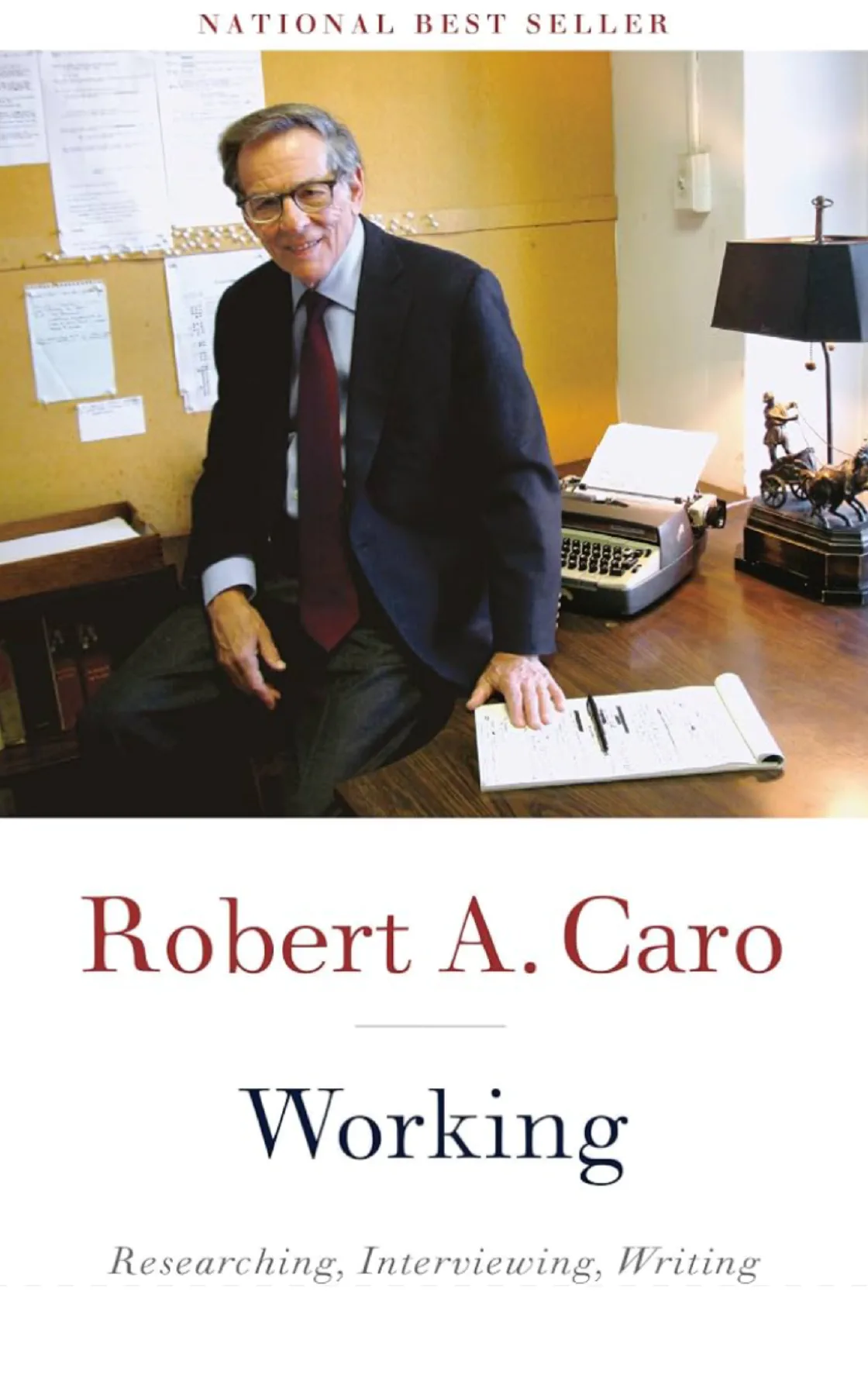
An official met him at the front door at Idlewild and led him to a conference room with a table stacked high with file folders. Caro had never gone through files before. He worked through the memos and minutes all night, and a pattern surfaced. The agency wanted the field turned into a civilian airport because executives of corporations with offices on Long Island wanted to fly their company planes in and out without the drive to Idlewild or LaGuardia. The price of their saved time would be paid, in Caro’s words, by “a poor kid getting an education and a better chance in life.” When he walked out of the building the sun was coming up.
He wrote a memo and drove to the office the next morning “sure every mile of the way that I was about to be fired.” The managing editor, Alan Hathway, held a deep prejudice against graduates of prestigious universities. He had never hired one. The staff had hired Caro, a Princeton man, as a joke while Hathway was on vacation, and for weeks Hathway refused to nod when Caro said hello. Now Hathway read the memo, looked up, and said he didn’t know someone from Princeton could dig like that. From then on, Caro would do investigative work. Caro protested that he knew nothing about investigative reporting. Hathway stared at him for a long time and gave him the instruction that runs under every book Caro has written since.
Turn every page. Never assume anything.
Working is Caro’s short account of how he researched and wrote The Power Broker and the Lyndon Johnson volumes. He wrote it because journalists covering his hopes of finishing the Johnson series like to tell him to “do the math.” He can do that math. He knows the full memoir may never come, so he put some of the anecdotes down now. What he penned down is a manual for anyone whose work depends on getting to the bottom of a file, and what that habit costs.
What Did I Get Out of It
The book is anecdotal and brief. The lessons compound anyway, because every story circles back to the same question Caro has been asking since he was a college sportswriter who kept writing about how the coach coached instead of how the team played: how does a thing really work?
The Evidence Sits Between the Documents
The most useful sentence in the Idlewild story describes what Caro didn’t find.
I kept looking for a piece of paper on which someone came right out and said that, but I didn’t find one; everything I could find on paper talked around that point. But between all the pieces of paper, I found sentences and paragraphs that, taken together, made the point clear.
Nobody writes down the incriminating sentence. Anyone who has tested a control environment knows the pattern. An approval references a conversation. The conversation was never minuted. A journal entry carries the description “per discussion with management.” Each document is clean on its own, and the conclusion only appears when you lay them side by side and read the gaps. Caro describes the feeling of making files “yield up their secrets” as a thrill, and he gives a reason that resonates with anyone who prefers source documents to summaries: raw files are closer to reality, unfiltered by press releases or later books. The further a piece of paper sits from the event, the more hands have smoothed it.
The same instinct governed his interviews with Robert Moses. Moses had first blocked Caro entirely, spreading word that any architect, engineer, or contractor who talked would never get another public contract. Caro drew concentric circles around a dot that represented Moses. He assumed the inner circles, family and close aides, were sealed. He bet the outer circles, people who knew Moses but weren’t in regular contact, would talk. They did, and eventually Moses granted interviews himself. Then the files started contradicting him.
on some points-including some crucial points-there were rather sharp discrepancies between his accounts and the written record, so it was necessary for me to start asking him to reconcile his account with that record
At the seventh interview, on April 27, 1968, Caro raised Otto Kahn and the Northern State Parkway as obliquely as he could. Moses understood from the first mention of Kahn’s name that Caro had seen the letters and telegrams. His eyes hardened. He changed the subject, cut the interview short, and never spoke to Caro again in the five remaining years of work. Caro had hundreds of questions prepared and got to ask one. The reaction told him more than an answer would have. A counterparty at ease with the record doesn’t end the meeting.
Which Pages to Turn
Hathway’s rule broke on contact with the Lyndon Johnson Library. Caro asked to see one of the four floors of archive boxes and walked an aisle between shelves taller than he was. The archivist gave him the numbers: about forty thousand boxes, thirty-two million pages.
I had never forgotten it; it was engraved in my mind. There would be no turning every page here
Every audit runs into the same wall. The population is too large, so you sample. Statistical sampling lets you say something defensible about the whole, but fraud and error don’t distribute themselves evenly across a ledger for the convenience of the tester. Caro admits he still gets a sick feeling remembering how long it took to decide which pages to turn. He never pretends he solved the problem. He and his wife Ina, the only researcher he has ever had, worked the Reading Room from nine to five with few lunch breaks, requesting box after box. The rule adapted without dying. They couldn’t turn every page in the library, so once they picked a file, they turned every page in that file. Choose the population with judgement, then exhaust it. I’ve written before about allocating attention across a living surface, and Caro’s method is the cleanest version of the idea I’ve seen: the selection step is where judgement lives, and the coverage step is where discipline lives.
The payoff came in a file of about 230 pages.
I sat there turning the pages, every page, thinking that I was probably just wasting more days of my life. And then, suddenly, as I lifted yet another innocuous letter to put it aside, the next document was not a letter but a Western Union telegram form, turned brown during the decades since it had been sent
The telegram, dated October 19, 1940, came from George Brown to Lyndon Johnson: YOU WERE SUPPOSED TO HAVE CHECKS BY FRIDAY HOPE THEY ARRIVED IN DUE FORM AND ON TIME. It named six Brown & Root subcontractors who were supposed to have sent them. The document that opened up Johnson’s early money operation sat in the middle of a stack of routine correspondence, and it looked like the letters around it until Caro lifted the one on top. Had he skimmed the file, or sampled every tenth page, he would have missed it. Diligence feels like waste right up to the page where it stops being waste, and you don’t get to know in advance which page that is.
Power Shows on the Powerless
Caro traces his subject back to a single moment. As a young man he was riding in a car with a political boss on election day when he saw neatly dressed Black demonstrators being herded into paddy wagons, nudged along by nightsticks. What struck him was their meekness, as if they expected nothing else. At the next traffic light he opened the door and got out without a word. He never heard from the boss again. He had realized he wanted to be out there with the protesters.
To really show political power, you had to show the effect of power on the powerless, and show it fully enough so the reader could feel it.
Moses had held power for more than four decades, power no one understood and hardly anyone examined. Caro could explain its workings from the files. He decided the explanation was incomplete without the other side of the coin, so he spent weeks in East Tremont, the Bronx neighborhood the Cross-Bronx Expressway had torn apart. He describes glass so thick on the lobby floors it crunched underfoot and walls broken open so addicts could pull out the copper pipes. Young men watched him from street corners. People warned him to be gone before dark. He knocked on doors anyway.
If I persisted in my knocking, I would hear footsteps coming to the door, and then a voice-in my recollection it was always the voice of a little boy-would ask, through the closed door, the same question: “Are you the man from the welfare?”
A highway’s cost appears on a project budget as land acquisition, construction, and financing. The families displaced, and the neighborhood that decayed after them, sit on nobody’s books. Financial statements record transactions from the entity’s side. The costs borne by parties who never signed anything go unrecorded, which is why they so often go unnoticed. Caro went further and tracked down former residents who had lived in East Tremont when it was still a neighborhood, because their losses were part of the ledger too. One woman he met, surrounded by her small children, answered every question the same way: “I’ve got to get my kids out of here.”
Caro never lets the ledger run one direction. He describes standing with Moses in front of his map, thrilled, understanding the mind that could look at a mudflat from Riverside Drive and see a park and a highway. He calls Moses a sculptor who worked in whole cities. The book is more credible because Caro records both entries.
Silence, and “What Did You See?”
When Caro started on Johnson, the people of the Texas Hill Country answered every direct question truthfully and volunteered nothing. If he repeated a well-known anecdote from an earlier biography, the most he’d get was “Well, that’s not quite what happened.” During the presidency, reporters had flown in for a few days, sometimes a week, and gone home to explain the place to America. Locals had a name for them: portable journalists. They assumed Caro was one more. He told Ina they would have to move there. Ina asked why he couldn’t write a biography of Napoleon, then said, as she always does, “Sure.” They lived there most of the next three years. The shallow version of understanding that I wrote about in Beyond the Surface has no better illustration than a population that can spot a visitor who plans to leave.
Residency bought access. Technique did the rest.
silence is the weapon, silence and people’s need to fill it as long as the person isn’t you, the interviewer.
Maigret taps and scrapes his pipe. Smiley polishes his glasses on the end of his tie. Caro writes “SU,” for Shut Up, in his notebook, and admits his notebooks are full of them. In a process walkthrough, the first answer is usually the documented process, the version in the policy manual. The second answer, after a pause the interviewer refuses to fill, is how the work gets done. Most of us rush to fill that pause because silence feels rude. Caro treats the discomfort as the price of the information.
His other tool is a single question, asked until people get angry.
My interviewees sometimes get quite annoyed with me because I keep asking them “What did you see?” “If I was standing beside you at the time, what would I have seen?” I’ve had people get really angry at me. But if you ask it often enough, sometimes you make them see.
Johnson’s driver, Carroll, mentioned that Johnson often talked to himself in the back seat. Caro called back to ask what he said. Carroll didn’t remember. Caro called again, and again, until the driver produced it: Johnson berating himself after a campaign day, “Boy, wasn’t that dumb! You know you just lost that ballot box,” then rehearsing out loud what he would tell that precinct next time. Caro applied the same question to himself. He walked Johnson’s route past the Capitol many times, trying to understand why young Johnson broke into a run every morning, and saw nothing. Then he realized he had never walked it at Johnson’s hour. At 5:30 in the morning, the rising sun strikes the Capitol’s eastern façade full on and lights it like a movie set. A boy from the land of dog-run cabins was running toward everything he wanted. Storyworthy argues that stories work when the listener can see the scene. Caro’s standard is harsher: you can’t make the reader see what you haven’t seen yourself.
Truth Takes Time
Caro’s first estimate for The Power Broker came from an outline and a newspaperman’s instincts. He won a Carnegie Fellowship that paid his salary for a year, quit Newsday, and told Ina he’d finish in nine months and then they’d finally go to France. At the end of the year the book was barely started and they were out of money. Ina sold their house on Long Island. They moved to a Bronx apartment they disliked, and Caro rented a cinderblock room in a basement as an office. When a basketball injury put him in bed for months, Ina drove to the Nassau County Courthouse and called him from the phone booth on the second floor while he directed her, from memory, to the right row of file cabinets. Eventually there was no money left, and Caro describes the worst night, when he didn’t know how to face her.
His reference class had been deadlines measured in weeks. How Big Things Get Done makes the case that projects fail on planning when the planner borrows a reference class that doesn’t fit, and Caro’s nine-month outline is a textbook example. His defense of the overrun is the best passage in the book.
there are Facts, objective facts, discernible and verifiable. And the more facts you accumulate, the closer you come to whatever truth there is. And finding facts-through reading documents or through interviewing and re-interviewing-can’t be rushed; it takes time. Truth takes time.
He is candid that logic is only part of the story. He calls the other part a quality in his nature that he can’t take credit for and can’t take blame for either: the compulsion that, once every question is answered, produces new questions that feel essential to the book’s completeness. Elsewhere he puts the problem in two lines. “If you ask the right questions, there always is. That’s the problem.” I found the admission more useful than any productivity advice. The trait that finds the telegram is the same trait that blows the deadline, and Caro doesn’t pretend you can keep one and discard the other. My piece on truth circled the same tension between verification and speed without resolving it. Caro doesn’t resolve it either. He pays for it.
The rescue came in two parts. His agent, Lynn, told him the money was the easy problem; everybody in New York knew about the book. Her job was to find him an editor for life. Three editors took him to expensive lunches and promised to make him a star. Bob Gottlieb at Knopf said he didn’t go out for lunch, but they could have a sandwich at his desk and talk about the book. Caro picked Gottlieb. The second rescue was a room. By then the final draft ran to 1,050,000 words, later cut to 700,000, and friends had started asking whether he was “still doing that book.” Caro dreaded the question. Then he was admitted to a shared writers’ room, and one of his idols asked how long he’d been working on it.
“Oh,” Jim Flexner said, “that’s not so long. I’ve been working on my Washington for nine years.”
The next day Joe Lash told him Eleanor and Franklin had taken seven. Two sentences from two men who knew the work undid five years of doubt. Peer groups set the baseline against which effort feels reasonable or insane. Among friends whose horizon was a newspaper deadline, five years looked like failure. Among biographers it looked normal. Grit talks about persistence as a trait. Caro’s story suggests persistence also depends on who is standing over your desk when you’re in the middle. And the “do the math” line that opens the book gives the whole section its weight. Four Thousand Weeks asks how you spend a finite life. Caro chose to spend his turning pages, knowing the arithmetic.
A Job With a Quota
Someone once told the young Caro he would never achieve what he wanted if he didn’t “stop thinking with your fingers.” He took the advice. He drafts in longhand on narrow-lined legal pads, three or four drafts, then types triple-spaced so there’s room to rewrite in pencil. Some typed pages end up with no typed words left. As he aged he noticed that pages written late in the afternoon failed the next morning’s reread, so he stopped working late. The routine is a set of controls around a man who distrusts his own sense of effort.
it’s easy to fool yourself that you’re really working hard when you’re not. And I’m naturally lazy. So what I do is-people laugh at me-I put on a jacket and a tie to come to work… I try to do at least three pages a day. Some days you don’t, but without some kind of quota, I think you’re fooling yourself
He counts lines the way newspapers did, ten words to a line, and logs them daily. Coming from the man who spent seven years on one book, the confession of laziness sounds absurd until you notice what he’s guarding against: the feeling of work substituting for output. Research can absorb unlimited hours and produce a sense of progress with nothing on the page. The jacket and the line count convert a vague calling into a measurable job. I wrote about discipline as structure you build so you don’t have to rely on mood. Caro built his structure out of the habits of a 1950s city room.
He applies the same distrust to finished work.
I’ve learned from hard experience that it’s a real mistake to get too confident about what I’ve written. I do so much writing and rewriting. And Knopf knows. I rewrite the galleys completely. I even rewrite in page proofs, which they don’t actually allow you to do, but they’ve been very good to me. I’d rewrite in the finished book if I could….
Anne Lamott argues in Bird by Bird for giving yourself permission to write badly first. Caro’s version is the other end: never granting yourself permission to be done. He keeps the book’s narrative theme, a few paragraphs, posted where he can see it, and tests every new passage against it. Good writing that doesn’t fit the theme gets thrown out or reworked until it fits. A reviewer checking whether each disclosure supports the overall position of the financial statements runs the same test. Accuracy at the line level isn’t enough if the lines don’t add up to a coherent account.
Who Is This For
The book will disappoint anyone expecting a full memoir or a writing system. The anecdotes are loose, and some assume you know The Power Broker and the Johnson volumes. Readers who haven’t read those will still follow, but they’ll feel the weight less.
What the book changed for me was a belief about thoroughness. I had treated it as a virtue you choose and can dial up or down at will. Caro describes a trait closer to a condition, one that produces both the discoveries and the missed deadlines, and he refuses to separate them. The thirty-two million pages gave me the more usable rule. You can’t turn every page. You can choose the file with care, and then turn every page in it.