 Mandelbrot
 The Accountant
[
In Greek mythology, Daedalus crafted two pairs of wings from wax and feathers. Before taking flight with his son Icarus, he gave a crucial warning: fly too low and the sea’s mist will dampen the feathers, fly too high and the sun will melt the wax. The path to safety lay in balance, in understanding and respecting these boundaries.
Icarus, enchanted by the thrill of flight and the allure of soaring ever higher, ignored his father’s wisdom. As he climbed toward the sun, the wax began to melt. His magnificent wings, symbols of both human ingenuity and hubris, disintegrated. The young man who moments ago touched the clouds now plunged into the sea, leaving behind a cautionary tale about the price of ignoring fundamental risks.
Two thousand years later, in the gleaming towers of Zurich, another story of hubris was unfolding. Credit Suisse, a 167-year-old institution that had weathered world wars, the Great Depression, and countless market cycles, was flying too close to its own sun. The bank’s leaders, like Icarus, seemed more enchanted by the heights they could reach than mindful of what kept them airborne.
It’s a story about what happens when an institution puts people in positions of power who don’t truly understand the risks they’re managing. Leaders who, instead of respecting the fundamental boundaries of banking: trust, risk management, and prudent oversight; were more interested in personal glory and short-term gains.
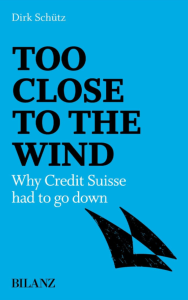
The wings that kept Credit Suisse aloft for over a century and a half weren’t made of wax and feathers, but of trust and reputation. As we’ll see in Dirk Shütz’s “Too Close to the Wind,” when these wings began to melt, the fall was just as spectacular as Icarus’s plunge into the sea. The question isn’t just how one of the world’s most prestigious banks could fall so far, but what warnings were ignored along the way, and what we can learn from its descent.
Credit Suisse — Flash Timeline (2015–2024)
- Mar 10, 2015: Board names Tidjane Thiam CEO (poached from insurer Prudential); later that year unveils an overhaul incl. CHF 6bn capital raise and deep cost cuts.
- Sep 2019 – Feb 7, 2020: Corporate spying scandal erupts; Thiam resigns; Thomas Gottstein succeeds him.
- Mar 2021: Greensill: CS freezes/winds down ~$10bn supply-chain finance funds.
- Mar 25–26, 2021: Archegos collapse → ~$5.5bn loss; post-mortem slams risk culture.
- Mar 14, 2023: 2022 annual report flags “material weaknesses” in financial reporting.
- Mar 16, 2023: SNB offers CHF 50bn liquidity line; confidence still slides.
- Mar 19, 2023: Swiss authorities broker UBS takeover for CHF 3bn with major backstops.
- May 31, 2024: Legal merger of the parent companies completed.
What Did I Get Out of It
The collapse of Credit Suisse isn’t just another story of banking gone wrong. It’s a masterclass in how seemingly rational decisions, made by intelligent people, can slowly erode the foundations of even the most established institutions. Through Shutz’s detailed account, we see how the combination of non-expert leadership, weakened risk management, cultural transformation, and the illusion of control created a perfect storm that brought down a 167-year-old banking giant.
But these lessons extend far beyond banking. They speak to fundamental truths about leadership, risk, organizational culture, and the dangers of prioritizing short-term gains over long-term stability. Whether you’re running a global bank or a small team, the principles that emerge from Credit Suisse’s downfall offer valuable insights into what makes organizations truly resilient – and what makes them vulnerable to catastrophic failure.
Through examining the bank’s final years, several critical lessons emerge that can help us understand not just why institutions fail, but how to build ones that last.
The Danger of Non-Expert Leadership
The most fundamental lesson from Credit Suisse’s collapse is deceptively simple: expertise matters. When Tidjane Thiam was asked if he understood the banking business, his response was telling:
“He had, he said snappishly, looked after banks during his McKinsey years.”
This consultant’s view of banking expertise would prove catastrophic. Credit Suisse had placed its fate in the hands of leaders who didn’t understand its core business. As the book notes:
“It was probably the most elaborate search for a CEO ever conducted by a Swiss banking group. Tidjane Thiam would later refer to Rohner’s statements that the chairman had met him 19 times for recruitment talks, and that he had turned him down twice.”
The irony is stark; despite the extensive search process, they chose a leader without banking experience. This wasn’t an isolated mistake but part of a broader pattern. The board itself was stripped of banking expertise:
“For the first time in history, probably the wildest of all major global banks was led by two non-bankers - and there was meagre banking expertise on the Board of Directors.”
The consequences of this leadership vacuum became apparent in how the bank handled risk and operations. The contrast with previous leadership was striking:
“The members of the Executive Board quickly noticed that their new chief did not come from the banking business. The insurance industry was traditionally local. Due to the different regulatory requirements, each country formed its own market with its own set of rules, even for globally positioned groups, which inevitably fuelled decentralisation.”
This lack of domain expertise manifested in dangerous ways. Under previous CEOs like Dougan:
“For him, as for Grübel, it was a ground rule: the CEO is the first risk manager of the bank. Every fortnight he held a telephone conference with those responsible for the largest risk positions, across the hierarchy levels. In delicate cases, he went through each item individually.”
But under non-expert leadership:
“The bi-weekly meetings at which Dougan combed through all the important trading positions no longer existed under Thiam.”
The result was predictable:
“It was like a cascade: the president was not a banker, the CEO was not a banker, and the head of risk had neither previous training nor experience in risk control. ‘Rohner and Thiam assumed that smart people could do anything, even if they had no experience.’”
This belief: that general management skills could substitute for deep domain expertise, proved to be a fatal conceit. The Financial Times captured it perfectly when quoting a CS manager:
“But that didn’t work for risk and compliance.”
The lesson here isn’t that outsiders can never lead organizations in complex industries. Rather, it’s that leadership without deep domain knowledge requires extraordinary humility and a willingness to rely on experts. Instead, Credit Suisse’s non-expert leaders often dismissed those who understood the business best:
“If you speak out critically, you are fired.”
What makes this lesson particularly relevant today is the growing trend of viewing leadership as a generic skill set that can be applied anywhere. Credit Suisse’s collapse serves as a stark warning about the limits of this perspective. In complex, risk-heavy industries, there’s no substitute for leaders who deeply understand the fundamental mechanics of their business.
Risk Management Is Not Optional
If non-expert leadership was the match, weakened risk management was the kindling that allowed Credit Suisse to burn. The bank’s approach to risk control reveals a fundamental truth: risk management isn’t a cost center to be optimized; it’s the foundation that keeps a financial institution standing.
The book describes three critical lines of defense that should protect a bank:
“The controllers distinguished between three lines of defence: the frontline managers, who had to be the first to competently assess the risks when contacting clients. Then the actual risk managers who supervise the client people. And finally the leadership of these controllers - from the head of risk up to the CEO and the Board of Directors.”
Under Thiam’s leadership, all three lines were systematically weakened:
“The first line - frontline responsibility - had been massively weakened after the incident in New York and Thiam’s attack on the investment bankers. Many experienced bankers had left CS, junior staff moved up - ‘juniorisation’ is what the bankers called it when the lack of experience became threatening.”
The second line of defense fared no better:
“The second line had suffered under Thiam’s brutal pressure to save money. The IT systems, which had been suffering for a long time, were further weakened, which made reporting massively more difficult for the third line up to the bosses in Zurich.”
Perhaps most alarmingly, the bank’s leadership lost sight of their total risk exposure:
“Members of the Executive Board remember that when asked, they received accurately prepared reports on individual clients. But those who probed a little deeper often found only a collection of arbitrarily compiled Excel sheets. There was no comprehensive overview of the exposure.”
The deterioration of risk management wasn’t just about systems; it was about culture. The bank appointed leaders who saw risk management as a career steppingstone rather than a critical function:
“Risk managers were the grey brakemen in the basement, and they made a living out of having to make themselves unpopular in order to prevent transactions that were too dangerous. There was probably no position within a bank that was so unsuitable as a career springboard. But for Warner, the new post was just that: a stage on the way up.”
The consequences were predictable:
“Risk management was thinned out. More than a third of the managing directors in the risk area left the bank, and their responsibilities were distributed largely to internal staff, who had to take on additional tasks as a result. Certain controllers also had to report to the front office. All these measures were poison for a strong, independent risk control.”
This erosion of risk management created a dangerous dynamic where warnings couldn’t reach the top:
“Although there were warning signals within the risk organization, they did not reach the top.”
The lesson here is stark: risk management isn’t a luxury to be trimmed when times are tough. It’s the immune system of a financial institution. When you weaken it to save costs or boost short-term profits, you make the entire organization vulnerable to catastrophic failure.
As the book concludes:
“When the stock market winds were right, business went reasonably well. But below deck, the rot continued to eat away - and now the supporting pillars were crumbling.”
Culture Eats Strategy for Breakfast
The transformation of Credit Suisse’s culture represents perhaps the most insidious aspect of its decline. What began as a tradition of prudent Swiss banking gradually morphed into a culture of short-term thinking and excessive risk-taking. The shift was stark:
“The culture was high risk, high reward, losses are part of the business. For complaints from regulators or lawyers, the rule was: ignore or fight.”
This cultural deterioration wasn’t sudden; it evolved over time, shaped by leadership choices and incentive structures. The book captures this evolution through the story of Allen Wheat:
"‘Greed is good’, the legendary motto of the hero Gordon Gekko in the film Wall Street by director Oliver Stone, was also Wheat’s driving force… Wheat was like Milken: not long-term greedy like his rivals at Goldman Sachs, but short-term greedy. And he transferred this mentality to the bank."
The focus on short-term gains became deeply embedded in the bank’s DNA:
“A very special combination of numbers demonstrate the particular culture of CS more clearly than any other: how much profit did the bank make in aggregate over the last 15 years? After all the losses and fines, the bottom line was just CHF 800 million… And how much did it pay out in bonuses in total during that time? More than CHF 40 billion - 50 times more.”
Under Thiam’s leadership, the culture shifted even further:
“The culture shifted slowly: from a tough but predictable American business culture to a French politicised loyalty culture… We had a king is what Zurich Council of States member Ruedi Noser, a member of the board at the company’s subsidiary CS Asset Management, is supposed to have said about Thiam in 2023, the year of doom.”
This cultural transformation had practical consequences. The bank’s approach to problems became increasingly defensive and opaque:
“The motto in every regulatory procedure or lawsuit: first deny it, then take a hard legal stand - and just get on with it. This attitude was followed through to the end.”
The contrast with healthier banking cultures was striking. As noted about Morgan Stanley’s culture under Kelleher:
“The ‘we’ culture was central to him - ego shooters did not get far under his aegis. ‘Rotten apples always fall from the tree’ was his motto at Morgan Stanley. After the takeover, he was to describe the money-driven ego culture of CS as ‘rotten’. It was as bad as a bank could get in his view.”
The lesson here isn’t just about the dangers of greed or short-term thinking. It’s about how cultural changes, once set in motion, can become self-reinforcing. Credit Suisse transformed from an institution focused on long-term stability into what the book ultimately describes as:
“Credit Suisse was the biggest self-service shop in the banking world. Its end is a tragedy, in particular for the many employees who had devoted their hearts to it.”
This cultural decay proved impossible to reverse, even when later leaders recognized the problem. It’s a reminder that culture isn’t just about what leaders say; it’s about what behaviors they reward, what decisions they make, and most importantly, what they’re willing to tolerate in pursuit of their goals.
The Illusion of Control
Perhaps the most dangerous aspect of Credit Suisse’s decline was the persistent belief that everything was under control, even as the foundations were crumbling. This illusion was maintained through creative accounting, surface-level success metrics, and a deliberate blindness to mounting problems.
The bank’s approach to financial reporting under Thiam perfectly captures this dynamic:
“Thiam had designed the restructuring for three years in the best consultant manner. His finance chief Mathers had adapted the entire reporting to this plan and delivered a special set of figures for each quarter: the bank created its own key figures such as a ’look-through capital ratio’ and presented a wealth of ‘adjusted’ key figures: cost base, pre-tax profit - all adjusted.”
The manipulation of reality was explicit:
“According to the definition in the small print, ‘items that management considers unrepresentative of underlying business performance’ were excluded. In plain language, accounting as a concert of wishes. At the very end of the media releases, there were always the audited figures according to the prescribed accounting standards.”
This illusion of control was so convincing that even external observers were fooled:
“The UK banking publication Euromoney even named him ‘Banker of the Year’ in 2018. The share price had fallen by more than 50% since he took office, but that did not seem to bother the jury of the editorial team.”
The parallels to previous banking disasters were eerily similar:
“In an almost uncanny parallel at UBS, CEO Peter Wuffli was once named ‘Banker of the Year’ before his bank loaded toxic subprime securities onto its balance sheet on a large scale and UBS was thus able to escape exit only with state aid.”
Meanwhile, beneath the surface, the reality was very different:
“The lack of investment is a big burden for the future. The insufficient investment in controls would take its revenge. And the decentralisation was a huge mistake… For that is what made the banking business so special: a global investment bank can glide calmly across the sea from the outside, while rot has long been eating away at the inside of the ship.”
Even in its final months, this illusion persisted. The bank’s leaders continued to believe they could manage their way out of the crisis:
“The principle of hope reigned supreme, fuelled by the permanent optimist Lehmann at individual meetings with Jordan and Maurer: ‘We will succeed.’”
But the reality of modern banking made this illusion particularly dangerous:
“Bank runs have existed since banks existed, and no bank could survive if all its customers withdrew their money at the same time, because the business model consisted of accepting money from customers in the short term and lending it out in the long term… The transfer of money is only a click away on the mobile phone.”
The lesson: the appearance of control can be more dangerous than acknowledged uncertainty. Credit Suisse’s leaders confused the ability to measure and report on risks with the ability to control them. In doing so, they fell victim to what might be called the “control paradox” – the more they tried to demonstrate control through creative accounting and adjusted metrics, the less actual control they had over the bank’s fundamental stability.
Death by a Thousand Cuts
The title of this lesson comes directly from how Credit Suisse’s decline was perceived in its final days:
“The thesis of ‘death by a thousand cuts’ - a form of slow death execution in the Chinese imperial era - was heard most frequently in the bars and meeting rooms around Paradeplatz in the heart of the city. Many deep cuts had indeed been suffered by the venerable Credit Suisse in recent decades.”
This metaphor perfectly captures how great institutions don’t typically fail from a single catastrophic event, but through an accumulation of seemingly manageable problems. The pattern at Credit Suisse was cyclical:
“The bank rode the wave perfectly, even if its end was also foreseeable. It was always like this: the eternal cycle of greed and fear drove the capital-scarce house into a corner at regular intervals. In good times the gambler-bankers profited, in bad times the rich Swiss and their shareholders - had to open their wallets.”
Each crisis seemed survivable on its own, but together they steadily eroded the bank’s foundations. Even attempts to fix problems often created new ones:
“Such a large-scale reduction could be carried out only when markets were going strong. The UBS restructuring was launched in an upswing phase, and UBS was not a restructuring case… Trying to unwind a significantly larger investment bank in falling markets, on the other hand, was almost a mission impossible.”
The bank’s attempts to save itself through cost-cutting actually accelerated its decline:
“The man who wanted to give a healthy bank a fresh growth course when he took office suddenly became, in the best McKinsey manner, the toughest cost-cutter in the banking world. His savings targets had been vague in the beginning, but he now imposed detailed targets. Hardly any investments were made - Thiam sawed the bank to the bone.”
Even when individual problems were addressed, the cumulative damage remained:
“The shortcomings in the infrastructure could not be remedied so quickly. The total exposure, for example, to the Chinese real estate giant Evergrande and to the Russian market, after the start of the Ukraine war, could not be fully represented.”
In the end, what killed Credit Suisse wasn’t any single decision or event – it was the accumulation of compromises, short-term fixes, and unaddressed problems. As the book concludes:
“There had always been bank failures in history. It was a structural problem: no bank could survive if all its customers withdrew their money at the same time… The end of CS was thus also a declaration of bankruptcy of the painstakingly worked-out too-big-to-fail regulation of the Swiss authorities.”
Institutional decline rarely happens all at once. Instead, it’s the result of numerous small decisions, each seemingly rational in isolation, but collectively fatal. The death of Credit Suisse wasn’t just about what its leaders did wrong; it was about what they failed to fix, what they chose to ignore, and what they thought they could postpone dealing with until tomorrow.
Who Is This For
“Too Close to the Wind” is more than just another autopsy of a bank failure. It’s a warning about human nature, organizational decay, and the deceptive nature of institutional decline. As Hemingway once wrote about going bankrupt, it happens “gradually, then suddenly”, and Credit Suisse’s story perfectly illustrates this truth.
While the book’s detailed account of the various players and personalities involved can sometimes feel like navigating a complex web of names and titles, this granularity serves a purpose. It shows how institutional failure isn’t the product of a single villain or mistake, but rather the cumulative result of numerous decisions made by many people over time. Through Shütz’s careful structuring, we watch the tragedy unfold in slow motion, making it impossible to dismiss as just another case of sudden financial collapse.
This book is essential reading for several audiences. For business leaders and managers, it’s a stark reminder that expertise matters and that the fundamentals of risk management can’t be sacrificed for short-term gains. For board members and those in oversight roles, it demonstrates how cultural decay can happen right under their noses if they’re not vigilant. For investors, it shows why looking beyond surface-level metrics and adjusted figures is crucial for understanding true institutional health.
But perhaps most importantly, this book is for anyone interested in understanding how great institutions fail. It’s not just about banking – it’s about the universal principles of organizational decline. The lessons about expertise, risk management, culture, and the illusion of control apply across industries and contexts.
What makes Shütz’s account particularly valuable is its timing. Written with the benefit of hindsight but close enough to events to capture crucial details, it provides both the forest and the trees – the big-picture lessons and the specific decisions that led to them. While some readers might find the parade of Swiss banking personalities occasionally overwhelming, the author’s structured approach helps us see the patterns in the chaos.
In the end, “Too Close to the Wind” is a reminder that institutional failure is rarely about one moment or one decision. It’s about the small compromises we make, the warnings we ignore, and the fundamentals we forget. In an era where many institutions seem too big to fail, Credit Suisse’s story is a timely reminder that size and history offer no protection against the consequences of forgetting these basic truths.