 Mandelbrot
 The Accountant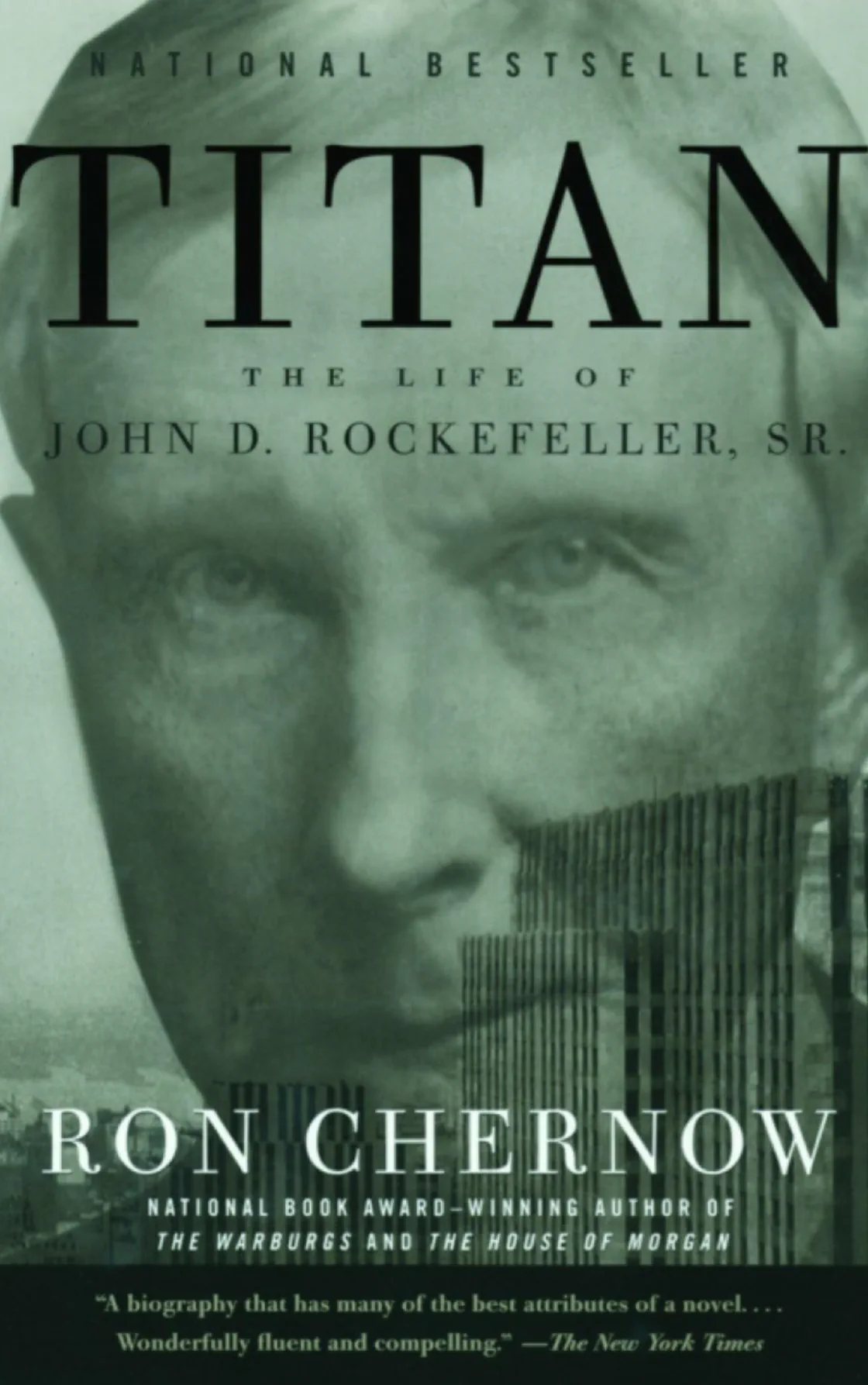
“How many drops of solder do you use on each can?” “Forty,” the man replied. “Have you ever tried thirty-eight?” Rockefeller asked. “No? Would you mind having some sealed with thirty-eight and let me know?”
Thirty-eight leaked. Thirty-nine held. Thirty-nine became the standard at every refinery Standard Oil owned, and it stayed the standard while the export business doubled and then quadrupled. One drop, withdrawn once, multiplied by every can the company shipped for the rest of the century.
John D. Rockefeller already controlled most of the world’s refining capacity. He had nothing left to prove and no competitive pressure forcing him to go to the factory floor. He asked because he had been asking questions since he was sixteen, when he worked as a bookkeeper in a Cleveland commission house and pounced on errors of a few cents.
Ron Chernow spent years with the archives and describes Rockefeller as a sphinx. The records show, in unusual density, how Rockefeller worked: how he priced, how he borrowed, how he hired, how he decided, and how he arranged an industry so that the outcome stopped depending on luck.
The solder shows the whole approach in miniature. Find the smallest recurring unit of cost in a process that will run millions of times, test the edge of it empirically, then hold the new standard.
What Did I Get Out of It
The Ledger Came First
Rockefeller celebrated the anniversary of his first job more faithfully than his own birthday. He called it Job Day. The job was assistant bookkeeper, and the habits it installed were never forgotten.
He pounced on errors of even a few cents and reacted with scornful amazement when the boss next door handed his clerk a lengthy, unexamined plumbing bill and blithely said, “Please pay this bill.”
The plumbing bill is the oldest control failure there is, and it still shows up in walkthroughs. An approval that doesn’t question is masked as a control but in truth its just a signature. The person signing believes they have performed a check; the process records that a check occurred; while nothing was checked. Rockefeller’s contempt for the neighbor wasn’t about the money on the invoice. He understood that a man who pays an unread bill has no idea what anything costs him, and a man who doesn’t know his costs cannot price his product, cannot borrow safely, and cannot tell a good year from a lucky one.
Close application to one kind of business, an avoidance of all positions of honorary character that cost time, keeping everything pertaining to his business in so methodical a manner that he knows every night how he stands with the world.
Every night. Not every quarter, after adjustments. Most organizations I have worked inside cannot claim that, and the gap is rarely a systems problem. The month-end close reconstructs a position rather than reports one, because the underlying records were never maintained at the standard that would allow a nightly answer. Rockefeller built the accounting discipline before he built the refinery, and every later advantage rested on it. When he wanted to break a competitor’s resolve, his most effective weapon was to open his books and let the man see what Standard Oil’s cost per barrel actually was.
Cash Before Conquest
The Standard Oil story is usually told as a story about rebates. But there is something duller that is far more decisive.
It is impossible to comprehend Rockefeller’s breathtaking ascent without realizing that he always moved into battle backed by abundant cash. Whether riding out downturns or coasting on booms, he kept plentiful reserves and won many bidding contests simply because his war chest was deeper.
He raised capital on the eve of the fights, not during them. On the first two days of January 1872, with the Cleveland acquisitions ahead of him, he increased the firm’s capitalization twice. The refiners he then approached were losing money in a glutted market, and he paid many of them roughly a quarter of what their plants had cost to build. Carnegie ran the same play in steel after the 1873 panic, expanding while his rivals were retrenching, and the pattern repeats in every industry where capacity is built on borrowed money. The buyer with reserves doesn’t need to forecast the cycle. He needs only to still be solvent when everyone else is not, which is the whole premise of capital cycle investing.
He also understood who sets prices in a distressed industry, and it isn’t the strong.
oftentimes the most difficult competition comes, not from the strong, the intelligent, the conservative competitor, but from the man who is holding on by the eyelids and is ignorant of his costs, and anyway he’s got to keep running or bust!
The dangerous competitor is the one who doesn’t know he’s selling below cost. He will underprice you until his capital is gone, and he will take your margins with him on the way down. The winner suffers eventually, but the damage lands on everyone in the market first. Rockefeller’s answer was to buy those men out rather than wait for them to die, which was efficient and predatory in equal measure.
He Stopped Competing and Started Designing
In 1869, one year after a railroad coup that had gone entirely his way, refining capacity in America stood at roughly triple what the market could absorb. Everyone was going to lose money.
He saw that his individual success as a refiner was now menaced by industrywide failure and that it therefore demanded a systemic solution. This was a momentous insight, pregnant with consequences. Instead of just tending to his own business, he began to conceive of the industry as a gigantic, interrelated mechanism and thought in terms of strategic alliances and long-term planning.
Up to that point he is an outstanding operator running a plant better than his neighbors. After it, he stops treating the industry as weather and starts treating it as a system with levers. Kerosene was a standardized commodity, so cost of carriage decided everything, and he had already located his first refinery where rail and water both reached it. He then went after the carriage itself, accumulating tank cars the railroads were too nervous to buy, because a shipper who owns the specialized equipment holds the terms. The same variable that reshaped world trade a century later, freight cost on a standardized unit, was the variable he had been agonizing over since 1863.
One of Rockefeller’s strengths in bargaining situations was that he figured out what he wanted and what the other party wanted and then crafted mutually advantageous terms.
The railroads had their own problem: they were tearing each other apart in rate wars and could not police an agreement among themselves. Rockefeller offered to be their referee, allocating oil traffic among the three trunk lines in fixed proportions, and in exchange took rebates on his own shipments plus drawbacks on his competitors’. Both sides gained. The cost was carried entirely by people who were not part of the deal. Reading it, I kept thinking about how often “win-win” is a claim about a negotiation’s participants rather than about its consequences, and how rarely anyone asks who funds the surplus.
Hire Before You Need, Then Leave
Standard Oil had a stated internal doctrine about work, and it sounds at first like an endorsement of idleness.
Has anyone given you the law of these offices? No? It is this: nobody does anything if he can get anybody else to do it. As soon as you can, get some one whom you can rely on, train him in the work, sit down, cock up your heels, and think out some way for the Standard Oil to make some money.
It’s a mandate to make yourself replaceable as fast as possible so you can move up the value of your own time. Rockefeller hired talented people as he found them rather than when he needed them, on the assumption that the empire would keep growing into the capacity. He tested people exhaustively at first, then handed them real authority and stayed out unless something broke badly. He owned less than a third of the company and knew he could not command it, so he built a committee structure he had to persuade, kept outspoken colleagues around, and rarely used the word “I.” Munger’s line about needing someone to put your thoughts in order with is the same instinct Rockefeller satisfied with Flagler, the one partner who would argue with him and share the daydream.
The ability to deal with people is as purchasable a commodity as sugar or coffee, and I pay more for that ability than for any other under the sun.
The man who computed every cost in his universe to several decimal places paid his highest premium for the one quality he could not compute. He had watched an entire industry of technically competent refiners fail at negotiation, at credit, at holding a team together, and he priced the scarce input accordingly. Most compensation structures do the opposite: they pay for the measurable output and treat the ability to work with other people as a personality trait rather than a purchased capability.
Silence, Distance, and the Blind Spot They Build
Chernow’s frustration with his own subject produces the most quietly damning line in the book.
Rockefeller trained himself to reveal as little as possible, even in private letters, which he wrote as if they might someday fall into the hands of a prosecuting attorney.
He warned refiners who joined Standard Oil not to display their new wealth, in case people wondered where it came from. Acquired firms kept their old names and publicly denied any connection to the trust. Corporate strategy was to furnish as little information as possible, to competitors, to legislators, to the press. It worked for decades and then detonated, because an organization whose default is concealment cannot produce a credible defense when it finally needs one. Every disclosure regime built since exists because opacity of that kind, sustained long enough, stops being discretion and becomes evidence.
The structural consequence is worse than the secrecy.
What further blinded Rockefeller to his misdeeds was that by the 1880s he always stood at several removes from any mayhem. He was now a master puppeteer, adroitly manipulating his marionettes, with the strings artfully concealed. As Standard Oil’s leading figure, he was the only person who didn’t have any direct operational responsibility.
Nobody ever handed him a document that said “coerce this man out of the pipeline business.” The pressure was applied by a subsidiary manager acting on an understanding of what the center wanted, and the center retained a clean file. I don’t think he lied to himself with much effort. The system did the lying, which is exactly why proximity to consequence matters more than stated values in any governance design. The senior person who is insulated from every transaction retains plausible ignorance by construction, and plausible ignorance is not a control environment. It’s an alibi that gets built one delegation at a time.
What the Ledger Never Recorded
The public image was of a serene man in perfect command. His own account of those years does not match.
For years on end I never had a solid night’s sleep, worrying about how it was to come out. I tossed about in bed night after night worrying over the outcome. . . . All the fortune that I have made has not served to compensate for the anxiety of that period.
There is a scene from his twenties where his partner George Gardner invites him out on a yacht for an afternoon and Rockefeller turns on him, accusing him of damaging their credit at the banks, and refuses even to look at the boat. Gardner’s tells Rockefeller that he likes money better than anything else in the world, and that he himself would rather have some fun along the way. Rockefeller later learned to hide the anxiety behind a studied calm. But the anxiety did not go anywhere. He built the largest fortune in history and spent the decades of its construction unable to sleep.
He also got lucky in ways his method could not have produced. The antitrust dissolution he fought for years turned him from a very rich man into something near history’s first billionaire, because he held a quarter of the trust and therefore received a quarter of each of the thirty-three pieces, which then repriced upward as the automobile arrived. He made more money retired than employed. Position beats forecast, and his position was so good that even his worst legal defeat paid him.
People tell me I have done much in my life. I know I have worked hard. But the best thing I ever accomplished and the thing that has given me the greatest happiness was to win Cettie Spelman.
By 1922 he had outlived his parents, all four siblings, his wife, his eldest daughter, two grandchildren, and nearly every partner who had built the company with him. Chernow writes that Rockefeller found Cettie where she had died and stared for a long time at the woman who had shared the whole of it. The record he kept every night of his life had no line for that, and the book is honest enough not to pretend the two balance.
Who Is This For
The value here isn’t the fortune, it’s the method: cost discipline installed before scale, reserves held before the fight, capacity bought in the slump, talent hired ahead of need, decisions left to simmer and then executed without hesitation. If you run a process, a function, or a portfolio, the transferable material is dense.
The book doubles as a case study in how a compliance disaster gets assembled by capable people who never once decide to do wrong. The distance between the man and the mayhem was an operating choice before it was a legal defense.
Not for a reader who wants a verdict. Chernow refuses to resolve him, and that is the whole point. The same traits that make Rockefeller admirable in the first three hundred pages are the traits producing the drawbacks and the stealth acquisitions in the next three hundred. The book runs long, and the middle sections on the trust litigation demand patience.
He was ninety when the market broke in 1929, and the line he offered then is the only piece of forecasting in the book that has aged well.
These are days when many are discouraged. In the ninety years of my life, depressions have come and gone. Prosperity has always returned, and will again.
He had watched 1857 wipe out five thousand businesses while people marveled that a booming economy could stall. He had watched 1873 destroy the refiners he then bought for a fraction of cost. By 1929 the pattern was not a belief for him, it was inventory. What the amnesia of markets destroys in most participants, he had simply kept on the books.
I had Rockefeller filed as a monopolist and skipped past the bookkeeper. The bookkeeper is the actual subject, and he asked one question relentlessly: what is the smallest unit of this, and what does it cost. I have signed things I did not examine. Not many, and never anything I thought was material at the time, but the plumbing bill is the plumbing bill regardless of the amount, and Rockefeller’s scorn for the man next door landed on me rather than on him.