 Mandelbrot
 The Accountant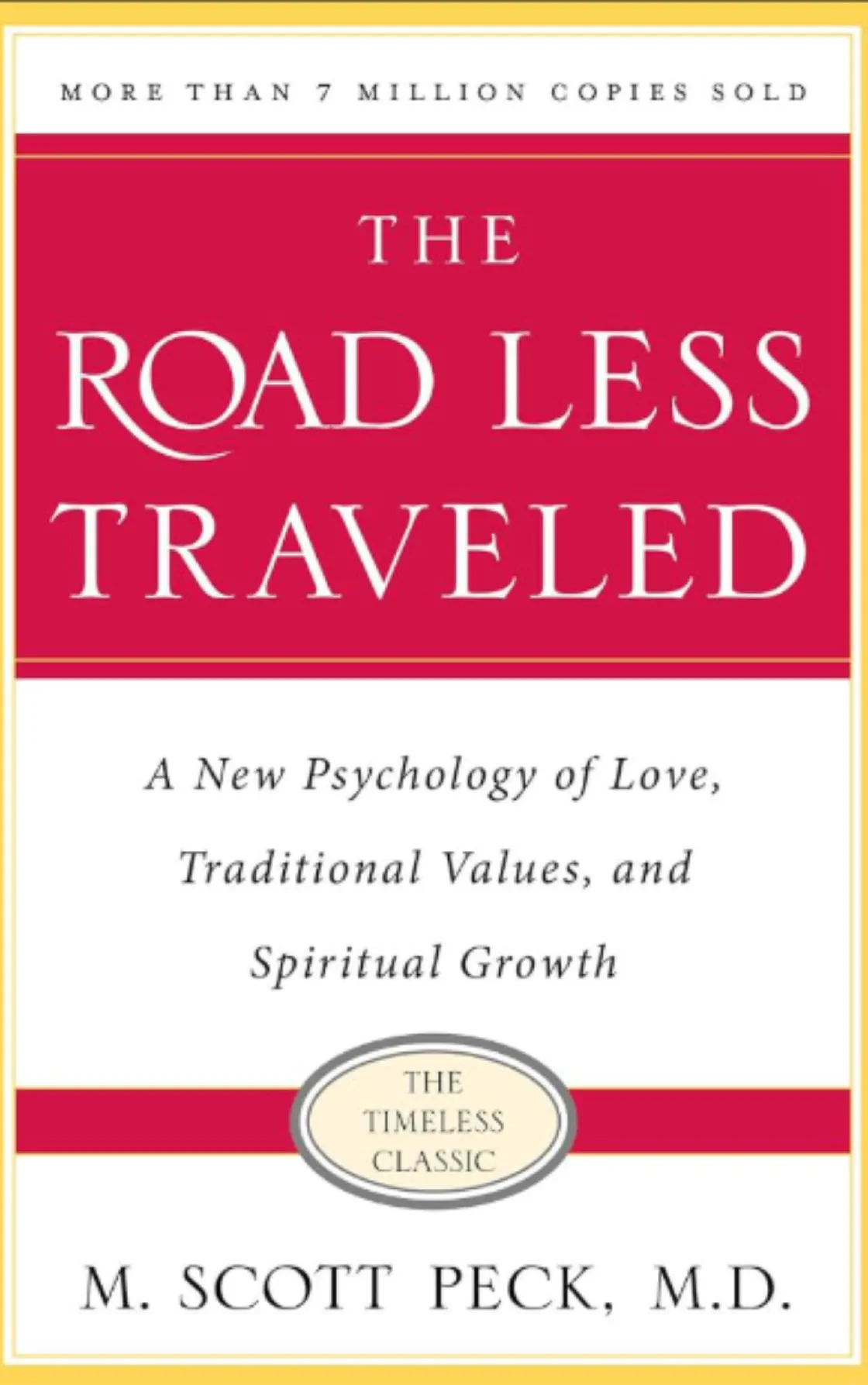
He doesn’t offer that as a joke about handiness, its diagnosis for root cause. The neighbour had converted a few seconds of unwillingness into a permanent statement about his own capacity. Not incapable. Just never present with the problem long enough for it to give way.
Many people simply do not take the time necessary to solve many of life’s intellectual, social or spiritual problems.
The book runs on that observation for three hundred pages. Peck was a practising psychiatrist, and what he saw across his caseload was not a shortage of intelligence or insight but a shortage of willingness to sit inside discomfort until it resolved. He organises the response into four tools: delaying gratification, accepting responsibility, dedication to truth, and balancing. Discipline, according to him, isn’t grit or austerity. It’s the ability and willingness you need to have to work a problem rather than route around it.
Life is difficult. This is one of the greatest truths. Once it is accepted, the fact no longer matters.
The claim is how we are wired. Most suffering, Peck argues, is the second-order cost of avoiding the first-order cost. The problem itself is finite and workable. The complaint that the problem exists at all is infinite. We can see parallels all around us: an issue that has been open across three quarters, where the actual remediation would take a focused week, and the intervening nine months went into escalation decks explaining why the week was unavailable.
What Did I Get Out of It
Problems Are the Curriculum, Not the Interruption
Peck’s central inversion is that the problem is where the value is generated. Problems create courage and wisdom. We set them for children deliberately, in school, and then spend adulthood arranging our lives to encounter as few as possible.
Most of us attempt to avoid problems. This tendency is the primary basis of all human mental illness.
A strong claim, and he knows it. But strip the clinical framing and we can see that issue isn’t something out of ordinary. Avoidance is cheap in the moment but compounds on the wrong side over time. The conversation you don’t have becomes a relationship you can’t repair. The control you don’t test becomes an exception you can’t explain. The reconciliation you defer becomes a balance nobody alive can substantiate. Every one of those started as something small enough to fix in an afternoon.
I thought that if I waited long enough the problem might go away. Problems do not go away. They must be worked through or else they remain.
Peck is describing his own procrastination here, not a patient’s. What strikes me is the word remain. Not worsen, though they usually do. Remain. The problem persists draws interest, while you spend energy managing your awareness of it rather than its substance. I think a good deal of what passes for busyness in professional life is precisely that expenditure: elaborate activity around an unaddressed thing, which is also the argument for going after the root cause rather than the symptom that’s easier to schedule.
Who Owns the Problem
Peck says a problem only becomes solvable at the moment someone says it is theirs. Before that sentence is spoken, all analysis is commentary.
Neurotics make themselves miserable. Those with character disorders make everyone else miserable.
He is compressing two failure modes of responsibility: taking too much and taking too little. The first assumes every bad outcome traces back to a personal deficiency. The second assumes none of them do. Peck’s point is that nearly everyone is some blend, and that the blend shifts by domain. A person can be scrupulous about owning their work and reflexively blameless about their marriage.
Whenever we seek to avoid the responsibility for our own behavior, we do so by attempting to give that responsibility to some other individual or organization or entity. But this means we then give away our power to that entity, be it “fate” or “society” or the government or the corporation or our boss.
Deflection feels like protection but functions like surrender. An issue with no named owner has no probability of closure, regardless of how well documented it is. “The system doesn’t allow it,” “the vendor controls that,” “Finance has to sign first” are all true statements that also happen to relocate the power to act somewhere the speaker cannot reach. Peck describes a patient who talks endlessly about oppressive forces, and observes that each recitation gives away a little more of the man’s own freedom.
Peck also insists the boundary is never settled. Distinguishing what we are and are not responsible for is one of the great problems, continually reassessed, never really known. The Courage to Be Disliked draws the same line and calls it the separation of tasks. Neither book tells you where to put it. Both tell you that refusing to understand and know it costs more than misunderstanding it.
Maps Nobody Revises
Peck’s metaphor for a world view is a map, drawn from experience, useful only to the extent it corresponds to terrain that keeps changing.
Some stop making maps by the end of adolescence. By the end of middle age most people have given up the effort. They feel certain that their maps are complete and their world view is correct. They are no longer interested in new information.
The cartography stalls, but the terrain doesn’t. Glaciers come, glaciers go, as he puts it, and the vantage point moves too.
Making revisions to your world view is painful. A person may expend much more energy defending an outmoded view of the world than would have been required to correct it in the first place.
Correcting a map is costly but not as costly as continuously paying for an obselete one. I see the this most often in forecasting and in judgement about people. A management team’s operating assumptions were formed in a rate environment that no longer exists, and the effort now goes into explaining why the current numbers are anomalous rather than into redrawing the map. Thinking Fast and Slow gives the mechanism a name and a laboratory; Peck gives it a price tag.
His clinical example is a child whose parents were careless with him, and who learned to stop trusting them. The lesson generalised on its own: not “I can’t trust my parents” but “I can’t trust people.” That map worked. It reduced disappointment, which is what maps are for. Then it ran for thirty years without a single revision, because every opportunity to test it looked like a risk rather than an update.
Truth Before Comfort
The third tool follows from the second. If maps require revision, then the willingness to be wrong out loud is not a virtue but a maintenance requirement.
We must always hold truth as more vital to our self-interest than our comfort. Consider our personal discomfort relatively unimportant and even welcome it in the service of the search for truth.
Peck adds that the only way to know a map is valid is to expose it to the criticism of other map-makers, which is, in simple terms mean, that we must be open to feedback. The reason a control environment needs a second set of eyes is not that the first set is dishonest. It’s that no one can audit their own map from the inside. And his explanation for why people lie is unsentimental: to avoid the pain of challenge and its consequences. Not malice. Cost avoidance. Which means the amount of truth in a room is largely a function of how expensive challenge has been made there.
There are two ways to confront or criticize another human being: with instinctive and spontaneous certainty that one is right, or with a belief that one is probably right, arrived at through scrupulous self-doubting and self-examination. The first is the way of arrogance. The second is the way of humility.
The distinction is not about tone. A finding can be delivered gently and still come from arrogance, and delivered bluntly from humility. What separates them is whether the person raising it tried to break their own case first. I’ve found the difference shows up in how the conversation goes when someone pushes back: the arrogant version treats disagreement as noise, the humble version treats it as data. Peck’s other line on the subject is four words long and does the same work: shallow brooks are noisy. Humility, in his framing, isn’t modest self-presentation. It’s a probability estimate you actually hold.
What Has to Die
The fourth tool, balancing, is the one I underestimated. Peck defines it as a set of live contradictions to be held rather than resolved: total honesty alongside judicious withholding, full responsibility alongside refusal of what isn’t yours, delayed gratification alongside the capacity to act in the present. And he argues the loss of balance is more painful than the sacrifice of maintaining it.
When I was a child my desire to win at games served me well. As a parent, I recognized that it got in my way. So it had to go.
Peck lists what has to be given up across a life: the dependency of childhood, the omnipotentiality of adolescence, the freedom of uncommitment, the agility of youth. He also says the feeling that accompanies each of these surrenders is depression, and that it’s healthy, becoming pathological only when the giving-up is felt and the mourning has nowhere to go.
The learning of something new requires a giving up of the old self and a death of outworn knowledge. To develop a broader vision we must be willing to forsake, to kill, our narrower vision.
The professional version is less dramatic and equally hard. A skill that made you valuable at one level becomes the thing preventing you from operating at the next, and the reluctance to drop it usually presents as diligence. Quit makes the case in decision-theoretic terms and Peck makes it in developmental ones, but both are pointing at the same asymmetry that drives the sunk cost problem: we account for what a thing cost to acquire, never for what it costs to keep.
Love as Work, Not Weather
The second half of the book redefines love in a way that sounds cold until you test it.
Genuine love is volitional rather than emotional. The person who truly loves does so because of a decision to love. This person has made a commitment to be loving whether or not the loving feeling is present.
Peck strips out sentiment entirely. Falling in love, in his account, is a temporary collapse of ego boundaries with a biological purpose and a predictable expiry. What follows the collapse is either the work of actual love or the slow discovery that no commitment was ever made. His test is severe: love is always either work or courage, and an act that requires neither is not an act of love. He extends it to what he calls the passive dependent case, where the goal is to be loved rather than to love, and where the arrangement is not choice but necessity. Two people love each other, he writes, only when they are quite capable of living without each other and choose to live with each other anyway.
Love is not simply giving; it is judicious giving and judicious withholding as well. It is judicious praising and judicious criticizing. It is judicious arguing, struggling, confronting, urging, pushing and pulling in addition to comforting.
The word doing the work is judicious, and it converts love into an assessment problem. What does this person actually need, as distinct from what would make this moment easier for me? Peck notes that not giving at the right time can be more compassionate than giving at the wrong one, and that fostering independence beats caring for someone who could care for themselves. The failure mode he warns about is the one that feels most generous. He is quite direct that we often love pets rather than people, because a pet’s inner life is unknowable enough that we can project onto it and call the projection intimacy, and because what we prize in a pet is its attachment rather than its growth. Applied to how people manage teams and raise children, that framing is uncomfortable in a way I haven’t fully worked through.
Attention gets the same treatment. It is an act of will, work against the inertia of our own minds, and listening is its highest form. Not a feeling of interest. Labour performed against resistance.
Who Is This For
Peck wrote this in 1978, and the seams show. The case studies carry the assumptions of that decade, some of the examples about dependency read poorly now, and the final third moves into grace, the unconscious, and religious language that will lose a certain kind of reader completely. If you need a book to stay inside empirical psychology the whole way through, you will stop somewhere around the middle and feel you’ve been switched into a different volume.
Read it anyway, for the first two hundred pages. It belongs with anyone who manages other people’s work, raises children, or has noticed that their most persistent problems are the ones they’ve been most careful never to schedule. It is not a technique book. There is no framework at the end, no summary table, nothing to implement on Monday. What it gives is language precise enough to catch yourself in the act.
The responsibility chapter is the one that did damage to me. I had always thought of myself as someone who owns problems, because owning problems is most of what my work consists of. What Peck made visible is how often my irritation at a broken process is itself a form of not owning the fix. Naming a constraint accurately and then treating the naming as the contribution. The complaint is well-founded, the analysis holds, and the issue is still open twelve months later, and the whole time the power to move it was sitting with someone I’d decided wasn’t me.
I still can’t reliably tell which responsibilities are genuinely mine. Peck says the boundary is never completely solved, only continually reassessed, and I suspect he included that line because he couldn’t solve it either. What has changed is that I no longer treat the ambiguity as permission. When I catch myself explaining at length why something is outside my control, I’ve started reading the length of the explanation as the signal. The longer the case, the more likely I’m building it for myself.