 Mandelbrot
 The Accountant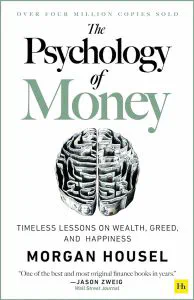
Morgan Housel’s Psychology of money is about our relationship with money.
What did I get out of it?
Few lessons I took from the book:
- One of the most transformative lessons from the book revolves around our motivations for purchasing things. Housel argues that we often buy items with the belief that they will impress others and garner respect. However, when we examine this notion from our own perspective, we realize that we are rarely truly impressed by the shiny new possessions of our friends and family. Instead, we tend to believe that these items will enhance our own image and earn us admiration. This paradoxical thinking rarely yields the desired results.
- It’s not about being smart or good at math. It’s about behavior. We all have different fears, dreams, and ideas about money. If you understand how you think about money, you can see these patterns. Once you see them, you can use the power of your mind to change your life. People often teach finance like it’s all about math. You put numbers into a formula and it tells you what to do. But humans have emotions, we’re not machines. A lot of finance books talk about technical stuff like picking stocks or making the perfect portfolio. But doing well with money is more about controlling your emotions and impulses than about technical skills.
Who Should Read It?
“The Psychology of Money” is a book that everyone should read, regardless of whether they have clearly defined financial goals and are on track to achieve them, or if they feel behind and in need of guidance.
Notes and Highlights
No one’s crazy - people have different views about money
Your personal experiences with money make up maybe 0.00000000001% of what’s happened in the world, but maybe 80% of how you think the world works.
Money’s been around forever, but a lot of us still struggle with saving and investing for retirement. We do weird things with money, but we’re not crazy. If you grew up poor, you think about risk and reward differently than someone who grew up with a rich banker dad.
So, everyone goes through life with their own views on how money works, and they can be totally different from person to person. What seems crazy to you might make perfect sense to me. It’s not about being smarter or having better info. It’s because we’ve had different experiences that shape how we think. We all make choices based on our own unique experiences that feel right to us in the moment.
The key is to make investment decisions based on your goals and options, not just your experiences. The world keeps changing, so if you only rely on what you’ve been through, you’re making choices based on old info from a different time.
Luck & Risk - they have a bigger impact than financial skills
Nothing is as good as or as bad as it seems
Success isn’t always about working hard, and being poor doesn’t mean you’re lazy. Wetend to focus too much on skills and effort, but luck and risk play a big role in how things turn out. No success or failure comes purely from hard work or good choices. We’re just one person in a game with billions of others and a ton of moving parts. The random impact of things outside our control can matter more than what we do on purpose.
When we look at billionaires, CEOs, and other rich people, it’s hard to tell what’s luck, what’s skill, and what’s risk. So when we try to learn the best way to handle money, we shouldn’t just copy what successful people did and avoid what failures did. Those at the top might have gotten lucky, while those at the bottom might have gotten unlucky.
Instead of focusing on specific people, look for broad patterns of success and failure. The more common the pattern, the more it might apply to your life. Trying to copy Warren Buffett’s investing success is tough because his results are so extreme that luck probably played a big role, and you can’t just copy luck. But realizing that people who control their time tend to be happier is a broad, common observation you can actually use.
Finally, recognizing the role of luck in success and risk in failure helps us stay humble when things are going well and have compassion when they’re going badly. When you’re doing well, remember you’re not invincible. When you’re struggling, know that you’re not a disaster.
Never enough - learn to stop shifting the goalpost
There is no reason to risk what you have and need for what you don’t have and don’t need.
There are tons of rich folks who lost it all because they thought the millions they had weren’t enough. The lesson here is simple: don’t risk what you have and need for what you don’t have and don’t need.
It seems like the hardest thing to do with money is to stop moving the goalposts. When we reach our goals, we just look to the next one. It never ends. This happens because we compare ourselves to people who have more than us. When it comes to money, someone will always have more. And that’s okay.
Having enough doesn’t mean you stop trying to do well with money. It means knowing when to avoid doing something you’ll regret. A lot of things aren’t worth the risk, no matter what you might gain - your reputation, freedom, family and friends, love, and happiness.
Getting Wealthy vs Staying Wealthy - both take different skillsets
Good investing is not necessarily about making good decisions. It’s about consistently not screwing up.
Making money means taking risks, being optimistic, and putting yourself out there. But keeping money? That’s a whole different ball game. It requires the opposite of taking risks. Here’s what you need:
- Be frugal and accept that luck played a role in your success. Don’t assume that just because you succeeded before, it’ll keep happening forever.
- Be humble and a little afraid. Understand that what you’ve made can be taken away just as quickly as you got it.
The key is sticking around for the long haul without losing everything or having to give up. That’s what really matters, whether you’re investing, building a career, or running a business. As Morgan Housel says, financial success boils down to one thing: survival.
Tails, You Win - be okay with failures because they are inevitable
You can be wrong half the time and still make a fortune.
The far ends of the outcome distribution, the long tails, have a huge impact in finance. A small number of events can make up the majority of outcomes.
The investment choices you make on most days don’t really matter. It’s the decisions you make on a handful of days when something big is going down - a huge market drop, a crazy bubble, or a frothy market - that make all the difference.
If we can consistently do the average thing when everyone around them is losing their minds is the key to make sure our overall risk to reward ratio is skewed in our favor.
Freedom
Controlling your time is the highest dividend money pays.
The ultimate form of wealth isn’t about having a ton of money. It’s about freedom. It’s being able to wake up every day and say, “I can do whatever I want, whenever I want, with whoever I want, for as long as I want.”
The key is to break the link between your time and your income. This happens when the money you make from investments or other passive sources covers your monthly expenses.
Man in the Car Paradox - money does not buy respect
No one is impressed with your possessions as much as you are.
The “Man in the Car Paradox” is pretty simple. When we see someone driving a nice car, we don’t usually think they’re cool. Instead, we imagine how cool other people would think we are if we had that car. But here’s the catch: those other people would have the same thoughts and wouldn’t actually think we’re cool.
This applies to wealth in general. People chase wealth because they think it’ll make others like and admire them. But wealth just makes other people use it as a measuring stick for their own desire to be liked and admired.
If you’re after respect and admiration, be careful how you go about it. Being humble, kind, and empathetic will earn you more respect than any fancy car ever could.
Wealth is What You Don’t See - difference between rich and wealthy
Spending money to show people how much money you have is the fastest way to have less money.
We usually judge wealth by what’s right in front of us, because that’s the info we have. But the real deal with wealth is what you don’t see. Being rich is about current income. It’s the nice cars and fancy diamonds. But wealth? That’s a different story.
Wealth is hidden. It’s about choosing not to buy something now so you can buy something later. That’s how you stay wealthy for the long haul. Thevalue of wealth is in the options, flexibility, and growth it gives you. It’s about being able to buy more stuff in the future than you could right now.
Not understanding this difference leads to a ton of bad money choices.
Save Money - your savings rate is key
The only factor you can control generates one of the only things that matters.
Building wealth isn’t really about your income or investment returns. It’s mostly about your savings rate. You can build wealth without a high income, but you can’t do it without saving a big chunk of what you make.
You can save more by spending less. And you’ll spend less if you want less. The key to wanting less? Stop caring so much about what others think of you. But saving doesn’t mean you have to be saving up for something specific. You can save just to save. When you save without a spending goal, it gives you options and flexibility. You can wait for the right moment and jump on opportunities. It gives you time to think and change direction when you want to.
With flexibility, you can wait for the good stuff, both in your career and your investments. You’ll be in a better position to learn new skills when you need them. You’ll have more room to find what you’re passionate about and carve out your own path. You can switch things up, slow down, and think about life in a different way.
Surprise! - things that have never happened before happen all the time
History is the study of change, ironically used as a map for the future.
History can be tricky when it comes to predicting the future of the economy and the stock market. It doesn’t always take into account the big structural changes that matter in today’s world. We should look at past surprises as a reminder that we don’t know what’s coming next. The economic events that will make the biggest impact in the future are the ones that history can’t really help us with. They’ll be things that have never happened before. And because they’re unprecedented, we won’t be ready for them, which is partly why they’ll have such a big effect. This goes for both the scary stuff like recessions and wars, and the great stuff like innovation.
History can help us set realistic expectations, look at where people usually mess up, and give us a general idea of what tends to work. But it’s definitely not a roadmap of the future.
The further back you look in history, the more general your takeaways should be. Things like how people react to greed and fear, how they handle stress, and how they respond to incentives - those tend to stay pretty constant over time. The history of money is good for that kind of stuff. But when it comes to specific trends, trades, sectors, and cause-and-effect relationships in markets, those are always evolving.
Room for Error - have a margin of safety
The most important part of every plan is planning on your plan not going according to plan.
Stuff that’s never happened before happens all the time. Avoiding these unknown risks is pretty much impossible. You can’t get ready for what you can’t imagine. If there’s one way to protect yourself from the fallout, it’s steering clear of single points of failure. A solid rule of thumb for a lot of things in life is that everything that can break will break eventually. So if a bunch of things depend on one thing working, and that thing breaks, you’re counting down to disaster.
The biggest single point of failure with money is relying solely on a paycheck to cover your short-term expenses, with no savings to create a buffer between what you think your expenses are and what they might be down the road. Give yourself some wiggle room when estimating your future returns.
You have to realize that you don’t need a specific reason to save. It’s cool to save for a car, a house, or retirement. But it’s just as important to save for things you can’t predict or even wrap your head around. Predicting what you’ll use your savings for assumes you live in a world where you know exactly what your future expenses will be, and nobody does. Save as much as you can because you have no clue what you’ll need those savings for later on.
Nothing’s Free - be willing to pay the price for success
Everything has a price, but not all prices appear on labels.
Just like anything else that’s worth doing, successful investing comes with a cost. But we’re not talking about money here. The price you pay is volatility, fear, doubt, uncertainty, and regret. It’s easy to ignore these things until you’re facing them head-on.
Not many investors can honestly say they’re okay with losing 20% of their money. When you’re in it for the long haul, you have to be willing to stomach the short-term ups and downs of the market.
You & Me - find your personal financial identity and play your own game
Beware taking financial cues from people playing a different game than you are.
We have to figure out if we’re:
- Short-term players who don’t care about the actual price of a stock as long as it’s got momentum and will go up by lunchtime.
- In it for the long haul, believing that the world will see real economic growth over the next 30 years, which will boost our investments.
Few things matter more with money than knowing your own time horizon and not getting swayed by what people with different goals are doing. When investors have different objectives and time frames, prices that seem crazy to one person might make perfect sense to another, because they’re focusing on different things.
The Seduction of Pessimism - there is cause for optimism in the long run
Optimism sounds like a sales pitch. Pessimism sounds like someone trying to help you.
Make an investment plan that clicks with you and stick to it. Don’t bail or change what you’re doing when the market takes a dive. This is super important for long-term success. The media loves to use fear to push investors into making crazy choices about their investments. And it works really well because it’s easier to spin a story around pessimism - the pieces of the story are usually more fresh and recent.
Optimistic stories need you to look at a big chunk of history and how things have unfolded, which people usually forget and takes more work to put together.
Keeping your head on straight during uncertain times is key. You can’t escape market ups and downs. True financial optimism, according to Housel, means expecting things to be rough and being pleasantly surprised when they’re not. Optimism is believing that the odds are in your favor for a good outcome over time, even though there will be bumps along the way.