 Mandelbrot
 The Accountant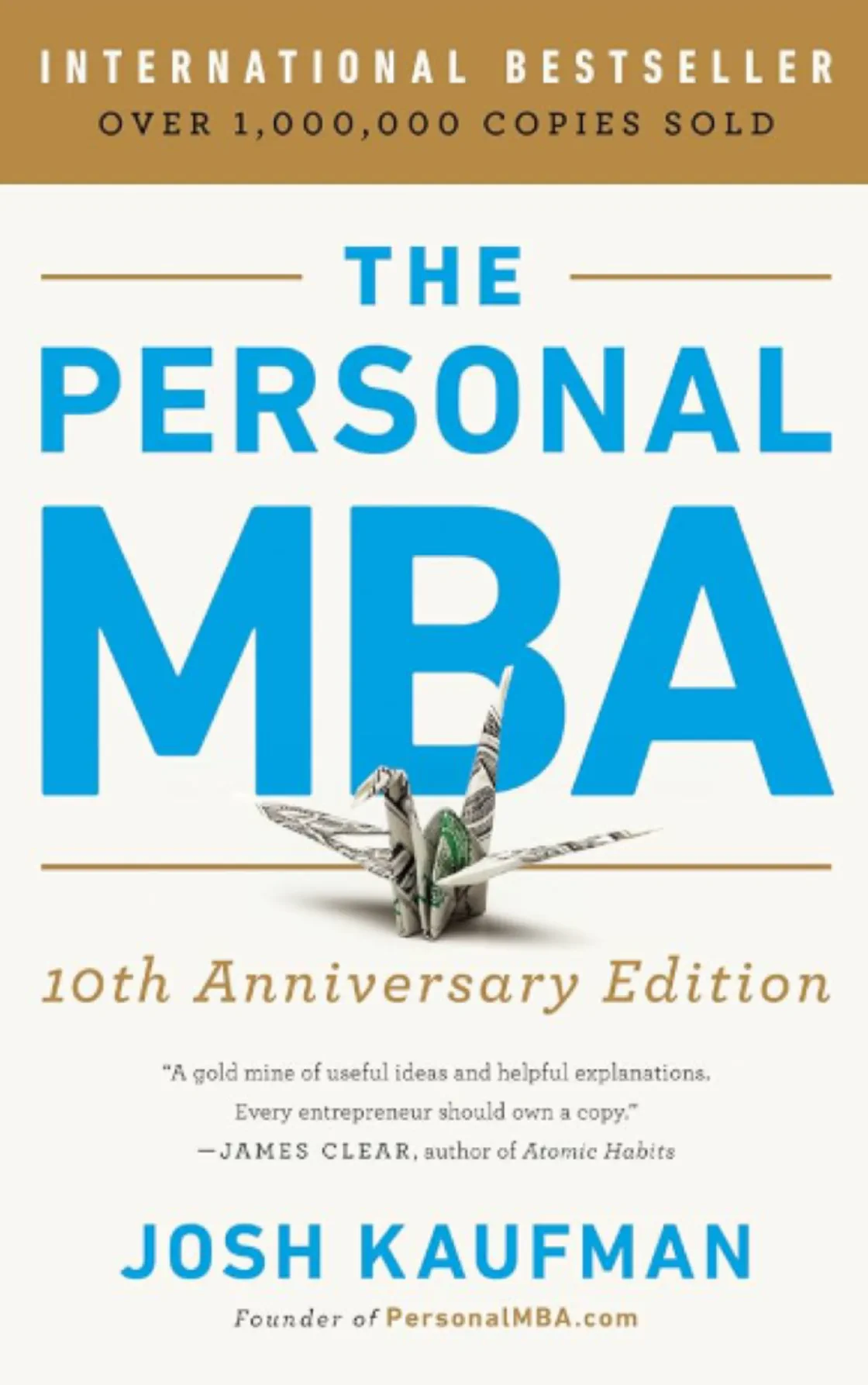
Josh Kaufman borrows the story from Gary Klein’s Sources of Power to make a point that has nothing to do with firefighting:
Experience is valuable primarily because the expert has a larger mental database of related Patterns, and thus a higher chance of noticing an absence. By noticing violations of expected Patterns, experienced people are more likely to get an “odd feeling” that things “aren’t quite right,” which is often enough warning to find an issue before it becomes serious.
The question is whether the chief spotted the danger or his mental model told him that the expected response is not there. The fire failed to behave the way fire was to behave when water is sprayed on, and the failure registered because he had watched hundreds of fires behave. Everything valuable in The Personal MBA follows from that idea. The book is roughly 250 concepts, each given a page or two, arranged across value creation, marketing, sales, delivery, finance, human minds, working with others, and systems. It is an attempt to load a pattern database fast enough that you start noticing absences in domains where you have no experience at all.
Kaufman opens with a line he attributes to Emerson:
The man who grasps principles can successfully select his own methods. The man who tries methods, ignoring principles, is sure to have trouble.
Which sets up the obvious objection. A one-page summary of a principle is not the same as grasping it, and a book of 250 summaries risks producing a reader who can name every model and operate none of them. I went in expecting the finance material to be beneath me and the rest to be filler. Half of that turned out to be right.
What Did I Get Out of It
The Definition That Screens
Kaufman’s definition of a business: a repeatable process that creates something people want, at a price they will pay, delivered in a way that satisfies them, generating enough revenue to be worth continuing. Five conditions and if just one of them fails, the venture has a different name.
A business is a repeatable process that makes money. Everything else is a hobby.
A unit with real customers, real headcount, and a real cost base can still fail the test, because its revenue arrives through a transfer price set by someone with an interest in the answer. Strip the internal pricing and the repeatable process stops making money. The unit is not a business. It is a cost center with a story attached, and the story lives because nobody applies the five conditions in sequence. Kaufman’s framing is crude on purpose, and crude tests are the ones that get used. The related idea, that any skill only earns economically when it plugs into one of the five parts, explains more about compensation than most career advice does. Derek Sivers reaches the same place from the other direction in Anything You Want, where the first paying customer is the only evidence that matters.
Critically Important Assumptions (CIAs) are facts or characteristics that must be true in the real world for your business or offering to be successful. Every new business or offering has a set of CIAs, and if any CIA turns out to be false, the business idea will be vastly less promising than it appears.
The Fitbit founders tested theirs by taking preorders against renderings, collecting verified card details and processing nothing until the device shipped. The elegance is in what they refused to spend. Before building a supply chain, they bought information about whether the demand assumption held, and they bought it at the price of a web page. Most business plans I have read contain their critically important assumptions in the appendix, unlabelled, expressed as growth rates. Writing them out as testable statements changes the conversation from how confident are we to what would we have to observe.
Twelve Ways to Get Paid
The twelve standard forms of value are the most reusable pages in the book. Product, service, shared resource, subscription, resale, lease, agency, audience aggregation, loan, option, insurance, capital. Kaufman treats them as a menu for entrepreneurs. Read them from the reporting side and they are a map of every question a revenue standard asks.
Options are often an overlooked form of value - flexibility is one of the Three Universal Currencies. Find a way to give people more flexibility, and you may discover a viable business model.
Concert tickets, coupons, retainers, licensing rights. All options, all sold as flexibility, all creating an obligation that expires. The accounting consequence is breakage: the portion of gift cards and prepaid rights that will never be redeemed, which has to be estimated and released into revenue on some pattern nobody can observe directly. A business that sells flexibility is a business whose top line depends on a behavioural estimate. Agency raises the principal-versus-agent question and decides whether a company reports gross transaction value or a commission, which is the difference between two wildly different-looking companies with identical economics. Subscription lives and dies on attrition, and Kaufman is right that keeping churn low is the whole game, though he does not mention that the same churn assumption drives the deferred revenue balance. The taxonomy is a business-model list on the surface and a risk register underneath. Optionality as a form of value also shows up in The Unexpected Upside.
- Estimate the risk of that bad thing actually happening, using available data.
That is step two of providing value through insurance, and it is the entire industry compressed into eleven words. Take the risk, collect premiums, pay legitimate claims. The business model is arithmetic performed on a future that has not happened yet, and the balance sheet is mostly an opinion about that arithmetic. Bernstein spends a whole book on how humanity learned to do it in Against the Gods. Kaufman gets you to the shape of it in a paragraph, which is the trade the book keeps offering.
Absence Blindness and the Manager Nobody Rewards
Two pages in the middle of the book that mattered the most.
Great management is boring - and often unrewarding. The hallmark of an effective manager is anticipating likely issues and resolving them in advance, before they become an issue. Some of the best managers in the world look like they’re not doing much, but everything gets done on time and under budget.
Kaufman calls the underlying bug Absence Blindness: we cannot perceive what is not there. The manager who prevents the crisis produces no evidence. The manager who creates the crisis and then works through the weekend produces a visible, thankable performance, and gets promoted for it. I have watched both careers run in parallel and I have watched the wrong one accelerate. A quiet year in a control function reads to a budget committee as an argument for a smaller control function, because the output of prevention is a set of events that failed to occur, and nobody can put a number on those. The same blindness makes it almost impossible to defend a process whose only justification is the failure it stopped, which is the case I made from the other side in Why That Odd Process Exists.
Absence Blindness also makes it uncomfortable for people to “do nothing” when something bad happens, even if doing nothing is the best course of action. Often, the best course of action is to choose not to act, but that’s often difficult for humans to accept emotionally.
The portfolio version of that sentence has cost me more than the management version. After a drawdown, holding a position unchanged looks identical to negligence, and the pressure to act comes from wanting visible evidence of having responded. Kaufman pairs the point with Fukuoka’s natural farming, where deliberate non-intervention produced the most productive fields in the district. Cessation takes guts, he says, and I would add that it takes an audience willing to accept an absence as an answer. Most of us do not have one, so we act.
The Reason Why a Price Is a Price
Kaufman refuses to let price be a feeling. If you expect payment, you owe the buyer a reason the number is the number.
There are four ways to support a price on something of value: (1) replacement cost (2) market comparison (3) discounted cash flow/net present value (4) value comparison. These Four Pricing Methods will help you estimate just how much something is potentially worth to your customers.
Three of those are the valuation approaches in the fair value hierarchy under a different set of names. Cost, market, income. The fourth is the one the standards deliberately exclude. Value comparison asks who this is particularly valuable to, and fair value is defined from the perspective of a market participant precisely so that buyer-specific value stays out of the measurement. Which produces a quiet irony: in an acquisition, the premium a buyer pays because the asset is worth more to them than to anyone else does not disappear. It lands in goodwill, sits there as an unamortised residual, and gets tested for impairment every year until the specific advantage that justified it either shows up in cash flows or does not.
Value Comparison is typically the optimal way to price your offer, since the value of an offer to a specific group can be quite high, resulting in a much better price. Use the other methods as a baseline, but focus on discovering how much your offer is worth to the party you hope to sell it to, then set your price appropriately.
As commercial advice, sound and slightly dangerous. Pricing to buyer-specific value maximises the capture and minimises the margin for error, because the price now rests on the buyer continuing to believe in a benefit they have not yet received. Kaufman notes elsewhere that a pricing mistake eats either your profits or your reputation, and value-based pricing puts more weight on the reputation side of that trade than the other three methods do. The nuts and bolts of translating a price into a return on invested capital, and the discipline that requires, is the terrain of The Rebel Allocator and of my own notes on reading a business from first principles.
Systems That Grew Versus Systems That Were Designed
The systems chapters are where the book stops being a survey and starts being useful.
A complex system that works is invariably found to have evolved from a simple system that worked. The inverse proposition also appears to be true: a complex system designed from scratch never works and cannot be made to work. You have to start over, beginning with a simple system.
Gall’s Law explains most large transformation programmes I have watched. The target operating model is designed whole, from scratch, at a level of complexity the organisation has never operated, and it fails in ways nobody can diagnose because there is no working simpler version underneath to fall back to. What survives instead is the accreted system: the thing that grew, that is held together by spreadsheets and habit, that nobody would design and everybody can run. Meadows makes the same case about stocks, flows, and the futility of designing complexity in Thinking In Systems.
Automation applied to an efficient operation will magnify the efficiency. Automation applied to an inefficient operation will magnify the inefficiency.
Fifteen words that should be printed on the front of every system implementation charter. Automation does not evaluate the process it inherits. Encode a broken approval chain into a workflow tool and you have converted a human problem you could see into a systemic one you cannot, running at machine speed, generating an audit trail that documents the wrong thing being done consistently. Kaufman’s ordering is the correct one: deconstruct, measure a few things that matter, find the constraint, then automate. Goldratt’s five focusing steps get a page, Ohno’s value stream gets a page, and Toyota’s million improvements a year get a sentence. The full weight of that idea is in Toyota Production System. What the compression buys you is the sequence. The trap of measuring the wrong small set, and getting exactly what you measured, is the subject of Chasing Metrics, Missing the Mark.
The Machinery Underneath Wanting
The human-mind chapters are the ones I expected to skim, and they contain the model I have used most since.
Action comes about if and only if we find a discrepancy between what we are experiencing and what we want to experience.
Reference levels. You act when a perception drifts from where you want it to sit, and you do not act when it does not, regardless of how objectively poor the position is. Kaufman’s examples are unflattering and accurate: satisfied with your income, you will not work to earn more. Which reframes what reading does. Good books, competitors, documentaries are valuable when they violate your expectations about what is possible, because they move the reference level rather than the effort. This runs in both directions, which is what makes the Pygmalion effect more than a management platitude; other people’s expectations become an input to your set point.
The best way to use your limited reserves of Willpower is to use Guiding Structure to change the structure of your Environment instead of your behavior.
Willpower as a metabolic resource that depletes, and environment as the substitute. I am wary of the glucose research Kaufman leans on, since the replication record has been rough since he wrote it, but the practical conclusion holds independent of the physiology. Restructuring the environment costs one decision. Overriding an instinct costs a decision every time the instinct fires. He extends the same logic into standard operating procedures and checklists, framed not as bureaucracy but as friction reduction, which is the most honest defence of documented process I have read. Kahneman covers the underlying two-system architecture properly in Thinking Fast and Slow, and Kaufman’s version of prioritisation, three important tasks and an artificial deadline, is a thinner cut of what McKeown builds out in Essentialism.
The section on Reorganization resonates. Random action when a reference level is violated and you have no idea what to do about it, which feels like being lost and is actually the neurological basis of learning. Resisting the impulse to try unfamiliar things slows the process down. I have spent years treating that state as a failure of discipline. Reading it as data collection does not make it comfortable, but it makes it legible.
Who Is This For
The finance chapter will bore anyone who has sat a professional exam. Bonds explained in a paragraph, time value in a worked example, receivables financing described accurately but without the covenant detail that makes it dangerous. Kaufman’s definition of finance as watching money move and deciding whether the results are enough is correct and about as deep as it goes. If you came for that, skip it.
Which is the honest read on the whole book: its value is inversely proportional to your existing coverage of the topic. A technically strong specialist who has never had to sell anything, price anything, or explain why prevention deserves a budget line will get a great deal from it. Someone looking for depth on any single model will be annoyed, because nothing here is stress-tested. Every concept gets a page, an example that worked, and a set of implications. No model is shown failing, and a survey with no failures is a survey that has not been audited.
What it changed in my own thinking is narrower than the book’s ambition and more useful than I expected. I have been bad at arguing for work whose output is an absence. For years I made the case with process quality and coverage statistics, which is the language of someone who has already accepted that prevention cannot be valued. Absence Blindness gave me a better frame: the audience is not being obtuse, they are perceiving accurately, and what they perceive is nothing, because nothing is what a functioning control produces. The work is not to prove the value of the absence. The work is to build the pattern database of near-misses and adjacent failures until the absence becomes visible as an absence, the way the chief noticed a fire that would not shrink.
Kaufman’s opening instruction is to hang a question mark on the things you have long taken for granted. He does not do that to his own material. But he hands you enough patterns to start doing it elsewhere, which is a fair trade for a book that never pretended to be a manual.