 Mandelbrot
 The Accountant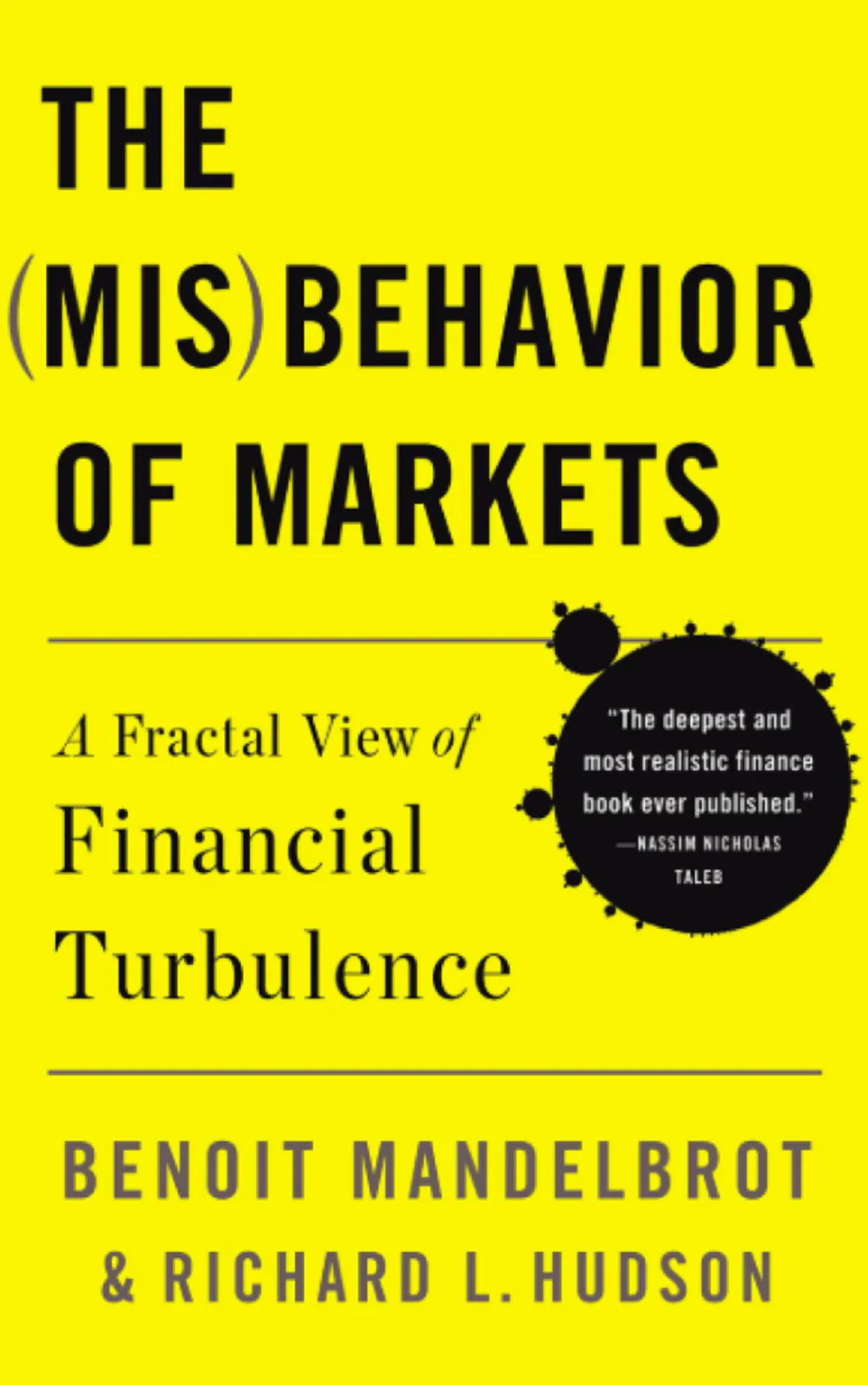
He takes the name for a property he keeps finding in price data. Persistence. Good stretches cluster with good stretches, bad with bad, and the order of events carries information that the standard models discard. He pairs it with the Flood, forty days and forty nights, for the property that has nothing to do with order and everything to do with size.
The Joseph Effect depends on the precise order of events, while the Noah Effect depends on the relative size of each event.
Modern finance was built on Bachelier’s two assumptions: price changes are statistically independent, and they are normally distributed. Independence denies Joseph. Normality denies Noah. Both assumptions survived a century of contrary evidence because they made the mathematics tractable, and the mathematics made the profession look like physics.
Mandelbrot spent decades running cotton prices, wheat prices, exchange rates, and interest rates through the test and finding the same answer every time. The tails are too fat, the movements are too dependent, and the volatility clusters instead of holding steady. The book is a demolition. The replacement is sketched rather than finished, which he admits, and that is the honest part.
The odds of financial ruin in a free, global-market economy have been grossly underestimated.
What Did I Get Out of It
The Bell Curve Was Chosen Because It Was Easy
Kurtosis measures how far real data depart from the ideal bell. A clean Gaussian curve scores three. Mandelbrot calls it the amount of spice in the statistical broth, and financial data comes back from the kitchen with far more spice than the recipe called for. The finding is not new, not disputed, and not obscure. It has simply never displaced the model it contradicts.
Markowitz himself pointed out, it is not certain that using the bell curve is the best way to measure stock-market risk; it is easy, but not necessarily right.
The architects knew. That detail matters more than the critique itself. Markowitz built the models of means and variances and risk-aversion indices, and he flagged the load-bearing assumptions on the way out. Everyone downstream inherited the models without the caveat. By the time these ideas reached business school syllabus, a risk committee pack, or the volatility input in a valuation model, the qualification had been quietly stripped for being inconvenient. We can see the same thing play out elsewhere. A model gets built with three stated limitations. Two years later the limitations live in an appendix. Four years later the appendix is gone and the output is a number in a board paper.
why does the old order continue? Habit and convenience. The math is, at bottom, easy and can be made to look impressive, inscrutable to all but the rocket scientist. Business schools around the world keep teaching it. They have trained thousands of financial officers, thousands of investment advisers. In fact, as most of these graduates learn from subsequent experience, it does not work as advertised; and they develop myriad ad hoc improvements, adjustments, and accommodations to get their jobs done. But still, it gives a comforting impression of precision and competence.
The last clause is the whole diagnosis. A wrong model that produces a defensible number beats a right model that produces a range, because the number can be signed off and the range cannot. Nobody in a review meeting has ever been criticised for using the standard approach. The ad hoc adjustments Mandelbrot describes are exactly what I see in practice: the override, the management overlay, the judgemental buffer sitting on top of a calculation that everyone privately knows underestimates the left side of the distribution. The framework holds its authority while the practitioners quietly patch it. The Black Swan attacks the same target from the philosophical side. Mandelbrot attacks it with the data, which is harder to argue with and easier to ignore.
First, Assume a Can Opener
Mandelbrot is not against models. He is a modeller. His objection is narrower and better aimed: every model discards most of reality, and the skill lies in choosing what to discard.
All models by necessity distort reality in one way or another. A sculptor, when modeling in stone or clay, does not try to clone Nature; he highlights some things, ignores others, idealizes or abstracts some more, to achieve an effect. Different sculptors will seek different effects.
The sculptor keeps what serves the effect. The problem in finance is that the effect being served is computational convenience, and the thing discarded is the part of the distribution that ends careers. Nothing in the standard framework is wrong in the middle. Prices in calm markets behave close enough to the model that the fit looks excellent for years at a stretch. The distortion is concentrated precisely where the consequences are largest, which is the worst possible place to put your abstraction.
engineer, the physicist, and the economist. They find themselves shipwrecked on a desert island with nothing to eat but a sealed can of beans. How to get at them? The engineer proposes breaking the can open with a rock. The physicist suggests heating the can in the sun, until it bursts. The economist’s approach: “First, assume we have a can opener.”
The joke lands differently once you have spent time inside a valuation file. Impairment models, going-concern assessments, expected credit loss calculations, level three fair values: each rests on a chain of assumed can openers, and each chain is disclosed in a note that runs to half a page and is read by almost nobody. The assumptions are not hidden. They are published, audited, and invisible. What I took from Mandelbrot is that the danger is rarely the assumption itself. The danger is that the assumption gets made once, at the design stage, by someone thinking about tractability, and then never gets revisited by anyone thinking about consequence.
The Market Makes Its Own Weather
The standard story treats price as a response function. News enters, prices adjust, equilibrium resumes. Mandelbrot’s data refuses that story. Too much of the movement has no external cause attached to it.
prices are determined by endogenous effects peculiar to the inner workings of the markets themselves, rather than solely by the exogenous action of outside events.
Positioning generates its own shocks. A crowded trade unwinds because it was crowded, not because anything happened. Leverage forces selling that forces more selling. The mechanism sits inside the system, which is why the search for a triggering headline after a violent day so often turns up something too small to have mattered. I wrote about the same idea from a different angle in What Actually Burns, and Mandelbrot supplies what that piece lacked, which is the price data showing the effect rather than the analogy suggesting it.
internal market mechanism is remarkably durable. Wars start, peace returns, economies expand, firms fail—all these come and go, affecting prices. But the fundamental process by which prices react to news does not change.
Durability across two centuries of institutional change is the claim I find hardest to dismiss. The instruments changed, the participants changed, the settlement systems changed, the regulators changed. The statistical signature did not. Whatever generates the fat tails and the clustering sits below the level at which regulation operates, which means the reforms that follow each crisis address the last mechanism rather than the underlying process. A Short History of Financial Euphoria reaches a similar place through history rather than mathematics, and Mandelbrot goes further than Galbraith by treating bubbles as structural rather than behavioural failures. His line is that bubbles and crashes are inherent to markets, an inevitable consequence of the human need to find patterns in the patternless. Not a defect in the participants. A property of the system.
Noah and Joseph
The Gaussian world has one setting. Mandelbrot separates randomness into states, and the distinction reorganised how I read a volatility number.
Mild randomness, then, is like the solid phase of matter: low energies, stable structures, well-defined volume. It stays where you put
Wild randomness is the gaseous phase, with no structure and no volume, and slow randomness sits between them as the liquid state. A dice roll is mild. A market is not, and it does not stay in one phase. The mistake is not using the wrong number for volatility. The mistake is assuming the material stays solid while you measure it. Every stress test I have reviewed applies a shock to a structure assumed to hold its shape under the shock, which works until the phase changes and the correlations that justified the diversification snap together.
Large price changes tend to be followed by more large changes, positive or negative. Small changes tend to be followed by more small changes. Volatility clusters.
Dependence without correlation is the technical version, and it took me a while to see why the distinction matters. Direction stays close to unforecastable. Magnitude does not. Knowing that a large move raises the odds of another large move tells you nothing about which way to lean, and quite a lot about how much to hold. The trading conclusion is thin. The sizing conclusion is not. Chaos Kings traces what a generation of tail-risk traders built on exactly that asymmetry, and Safe Haven prices the cost of carrying the insurance. Mandelbrot supplies the physics underneath both and declines to tell you what to do about it.
Time Made of Balloon Rubber
The multifractal model does something I had not seen anywhere else. Instead of adjusting the distribution of price changes, it deforms the clock they run on.
Time does not run in a straight line, like the markings on a wooden ruler. It stretches and shrinks, as if the ruler were made of balloon rubber.
Trading time runs fast in turbulence and slow in calm. A week in a crisis contains more market than a quarter in a drift, and calendar time has no claim to be the right unit for measuring either risk or return. I recognise the deformation from a completely different domain. An hour during a year-end close carries more control risk than a fortnight in July. Same staff, same systems, same policies, compressed into a window where every error has less room to be caught. When we measure control effectiveness by sampling evenly across the calendar, we are using the wooden ruler on a market that runs on the rubber one.
The genius of fractal analysis is that the same risk factors, the same formulae apply to a day as to a year, an hour as to a month. Only the magnitude differs, not the proportions.
Scaling is the constructive half of the book. If the proportions hold across horizons, then the day trader and the multi-year holder face the same shape of risk at different magnitudes, and the comfort people take from lengthening their holding period is less solid than it looks. Time does not launder the tail. It changes the size of the number attached to it. The lived path matters more than the average, which is the point I keep circling in ergodicity, and Mandelbrot’s data explains why the two diverge so violently in markets and so mildly in dice.
Patterns Are the Fool’s Gold
The most uncomfortable section of the book is aimed at people doing exactly what I do on a Sunday evening with a chart open.
Patterns are the fool’s gold of financial markets. The power of chance suffices to create spurious patterns and pseudo-cycles that, for all the world, appear predictable and bankable. But a financial market is especially prone to such statistical mirages.
Scaling data produces structures that look periodic. Cycles appear in series with no cycle in them. The mirage is not a failure of attention or discipline, and no amount of care in reading the chart removes it, because the mirage is a property of the data rather than the observer. What makes the warning hard to act on is that Mandelbrot also insists real dependence exists. Long memory is in the data. So the analyst is asked to distinguish genuine persistence from manufactured pattern using tools that produce both.
People want to see patterns in the world. It is how we evolved. We descended from those primates who were best at spotting the telltale pattern of a predator in the forest, or of food in the savannah.
The hardware explanation is familiar from Thinking, Fast and Slow and from The Psychology of Control, and Mandelbrot’s contribution is to show that the environment cooperates with the bias. The savannah rewarded false positives cheaply. A market charges for them. Where I remain stuck is the tension with The Man Who Solved the Market. Renaissance found patterns that were real and paid for decades. Mandelbrot’s argument does not forbid that outcome, but it does mean the burden of proof sits far higher than most of us apply to our own observations, and I have no reliable method for telling my genuine signal from my expensive mirage. Reading it back, I suspect the honest answer is that I have found fewer of the former than I believe.
Who Is This For
Anyone who signs off a number that depends on a volatility input should read the first half. Not for the fractal geometry, which is optional, but for the demonstration that the distribution underneath the standard toolkit does not match the data and never has. If your work involves value-at-risk, stress scenarios, option pricing, capital adequacy, or any model that assumes shocks arrive independently at moderate size, the book will make you less comfortable with your outputs and more precise about why.
Anyone looking for a method should look elsewhere. Mandelbrot diagnoses without prescribing. The multifractal model describes market behaviour better than the Gaussian one and gives you almost nothing to trade on, which he concedes and which is the source of most complaints about the book. He also spends more pages than necessary on his own reception among economists, and the history of his career crowds out material that would have served the argument better. Fooled by Randomness is more readable on the same theme, and Against the Gods is better on the lineage that produced Bachelier. Mandelbrot is the one holding the actual data.
What changed for me is narrow and I want to state it accurately, because the temptation after a book like this is to claim a conversion that did not happen. I have not rebuilt anything. I still use the volatility numbers my platform reports, because those are the numbers available. What shifted is what I do with them. I no longer treat a calm stretch as evidence that a structure works, and I have stopped reading a low realised volatility figure as a description of the risk rather than a description of the recent weather.
Greater knowledge of a danger permits greater safety. For centuries, shipbuilders have put care into the design of their hulls and sails. They know that, in most cases, the sea is moderate. But they also know that typhoons arise and hurricanes happen. They design not just for the 95 percent of sailing days when the weather is clement, but also for the other 5 percent, when storms blow and their skill is tested.
The shipbuilder cannot forecast the storm and does not try. He builds a hull that survives one. Mandelbrot’s position throughout is that price is not forecastable and exposure is measurable, and that the profession spent a century getting good at the first problem while treating the second as solved. I find the framing more useful than any model in the book. It moves the question from what will happen to what my structure does when something does, and that is a question I can actually answer on a given evening.