 Mandelbrot
 The Accountant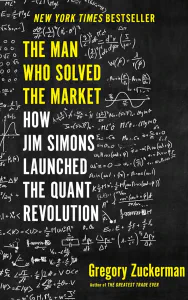
How important is it to understand what you invest in?
It’s a question that’s been debated for ages in the investing world. Warren Buffett and Charlie Munger, two of the most successful investors of our time, swear by the concept of “circle of competence.” They believe that you should only invest in companies and industries that you deeply understand.
But what if there was another way? What if you could consistently make money in the markets without knowing a thing about the assets you’re trading?
The story of Jim Simmons and his quantitative hedge fund, Renaissance Technologies, by Gregory Zuckerman in The Man Who Solved the Market reveals this black box that trades stocks, bonds, forex and commodities with incredible success.
Since 1988, Renaissance’s signature Medallion fund has generated average annual returns of 66%. The firm has recorded trading gains of more than $100 billion. Simons himself is worth $23 billion.
The kicker? Nobody has an MBA or a degree in finance, none of them really understand the financial markets. In fact, the lack of financial knowledge led to a particularly comical situation.
Brown was almost as smooth and capable with investors, but Mercer was another story. RIEF’s marketers tried to keep him away from clients, lest he laugh at an unexpected point in a conversation or do something else off-putting. One time, when neither Simons nor Brown was around to greet representatives of a West Coast endowment, Mercer joined the meeting. Asked how the firm made so much money, Mercer offered an explanation. “So, we have a signal,” Mercer began, his colleagues nodding nervously. “Sometimes it tells us to buy Chrysler, sometimes it tells us to sell.” Instant silence and raised eyebrows. Chrysler hadn’t existed as a company since being acquired by German automaker Daimler back in 1998. Mercer didn’t seem to know; he was a quant, so he didn’t actually pay attention to the companies he traded.
Renaissance Technologies is acclaimed as the best performing investment firm in history, surpassing renowned names like Berkshire Hathaway and George Soros. The firm’s exceptional secrecy is attributed to its extraordinary success, led by founder Jim Simons who was a codebreaker before starting Renaissance Technologies.
Simons developed a unique perspective on talent. He valued killers— those with a single-minded focus who wouldn’t quit.
The firm hired individuals without financial backgrounds and consisted of physicists, astronomers, and researchers. This unconventional team works out of a quiet office on Long Island, a world away from the frenzy of Wall Street. They don’t concern themselves with the usual metrics like earnings reports or market trends. Instead, they rely on complex mathematical models to spot opportunities in the market.
I don’t want to have to worry about the market every minute. I want models that will make money while I sleep.
Simons ignored the basic information most investors focus on, such as earnings dividends, and corporate news.
Nor did they seek to address why the market entered certain states.
With a remarkable 66% annual return before fees, the firm’s flagship medallion fund is exclusive to internal partners due to immense wealth generation.
What Did I Get Out of It?
The best part of “The Man Who Solved the Market” is the story. It’s engaging and keeps you interested, even if you ignore the parts about Renaissance’s former co-CEO Bob Mercer and his political activities.
When I read a book, I always try to find lessons that I can apply to my life. I look for insights that can help me be a better father, husband, son, employee, investor, or just improve my overall well-being.
The strategies used by Renaissance are so complex and heavily based on advanced math that it’s hard to find direct parallels to everyday life.
None the less, I have curated three lessons I took from the book.
The Lesson in Wealth Creation
Simons was filled with preternatural confidence and an unusual determination to accomplish something special.
It’s fascinating to consider the implications of Renaissance’s success. On one hand, their relentless pursuit of excellence and their ability to crack the code of the markets is undeniably impressive. When you combine that kind of drive with exceptional intelligence, the results can be extraordinary.
But on the other hand, it’s worth questioning what this kind of success really means in the grand scheme of things. Unlike tech entrepreneurs who create products or services that people use and benefit from, firms like Renaissance aren’t really producing anything tangible. They’re essentially just moving money around and extracting wealth from the markets like a cassino.
Buying and selling infrequently magnifies the consequences of each move. Make a lot of trades and each individual move is less important. They hoped Medallion could resemble a casino. Casinos handle so many daily bets that they only need to profit from a bit more than half those wagers.
It’s almost like they operate in a separate universe, detached from the physical economy that most of us inhabit. And yet, their actions can have very real consequences.
One day, a data-entry error caused the fund to purchase five times as many wheat-futures contracts as it intended, pushing prices higher. Picking up the next day’s Wall Street Journal, sheepish staffers read that analysts were attributing the price surge to fears of a poor wheat harvest, rather than Renaissance’s miscue.
These kinds of financial machinations can affect commodity prices worldwide, impacting the wallets of people who have nothing to do with the trading itself.
It’s a strange system when you think about it. We’ve created a world where immense wealth can be generated through pure financial speculation, divorced from any concrete value creation. And as this wealth becomes concentrated in fewer and fewer hands, it raises important questions about fairness and sustainability.
I don’t think there are any easy answers here. But I do believe it’s an issue we’ll need to reckon with in the coming years. As quantitative trading becomes ever more sophisticated and influential, we can’t ignore its wider ramifications.
To be clear, this isn’t about demonizing individual success stories. But it is about taking a critical look at the incentives and structures that underpin our financial system. When the rewards for financial engineering so vastly outstrip those for creating real economic value, it’s worth asking whether we’ve got our priorities straight.
The Investment Lesson
With the rise in retail trading and data and news aggregators like Bloomberg, one would think that the days of the efficient market hypothesis are upon us. That the collective wisdom of investors would always ensure that prices reflected all available information. But analyzing Renaissance Technologies’ success would question that stance.
There are definitely inefficiencies out there, waiting to be exploited. The problem is us humans are pretty terrible at spotting them. We’re prone to all sorts of cognitive biases that cloud our judgment.
Simons had a hunch that financial markets moved in orderly ways—just not in ways that could be detected by human intuition and insight. Simons believed that collecting and analyzing data could provide an advantage and that automated trading was possible.
We see patterns where there’s only randomness. We get anchored to certain expectations and find it hard to adjust when new information comes in. We get emotionally attached to our investment decisions, which skews our objectivity.
All these biases don’t just prevent us from exploiting market inefficiencies. In many cases, they’re the very reason those inefficiencies exist in the first place. Our collective irrationality is what creates mispricing and market distortions.
What you’re really modeling is human behavior. Humans are most predictable in times of high stress—they act instinctively and panic. Our entire premise was that human actors will react the way humans did in the past. We learned to take advantage.
But here’s the thing: machines don’t have these biases. A well-programmed algorithm can sift through vast amounts of data, spotting genuine signals amidst the noise. It doesn’t get emotionally invested, it doesn’t anchor to past expectations, and it doesn’t see false patterns.
That’s why quantitative trading firms like Renaissance have been so successful. They’ve leveraged the power of machines to exploit the inefficiencies that human traders create but can’t take advantage of.
It’s a powerful reminder that markets are not the perfectly rational, efficient mechanisms we sometimes imagine them to be. There’s a lot of human psychology at play, and that psychology can be both a source of inefficiencies and a barrier to exploiting them.
Of course, this doesn’t mean we should all rush out and start trying to build trading algorithms. For most of us, the lesson is more about humility. We need to recognize the limits of our own rationality and be cautious about overconfidence in our investment decisions.
At the same time, the success of firms like Renaissance shows that market inefficiencies do exist. The challenge is finding ways to identify and exploit them that aren’t hampered by our own cognitive limitations. It’s a tall order, but one that’s clearly possible, as Jim Simons and his team have so impressively demonstrated.
The Risk Management Lesson
Whenever you come across an investment strategy or course that promises extraordinary returns, it’s natural to be tempted. After all, who doesn’t want to maximize their wealth? But the story of Renaissance Technologies serves as an important reminder about the realities of the investment world.
Here’s the thing: Renaissance’s Medallion fund has achieved returns that are almost unheard of in the industry. We’re talking about annualized returns of over 66% before fees over a 30-year period. That’s the kind of performance that most investors can only dream of.
Renaissance has gone to great lengths to protect their “secret sauce.” They’re notoriously secretive about their methods, and they don’t take outside money anymore. They’ve put up some serious barriers to entry.
Simons and his team are among the most secretive traders Wall Street has encountered, loath to drop even a hint of how they’d conquered financial markets, lest a competitor seize on any clue. Employees avoid media appearances and steer clear of industry conferences and most public gatherings. Simons once quoted Benjamin, the donkey in Animal Farm, to explain his attitude: “‘God gave me a tail to keep off the flies. But I’d rather have had no tail and no flies.’ That’s kind of the way I feel about publicity.”
So, when you see someone offering an investment course or strategy that claims to rival Renaissance’s returns, it’s time to be skeptical. If it were really that easy to achieve such exceptional performance, why wouldn’t everyone be doing it?
Now, this doesn’t mean that all high-return strategies are scams. There are certainly legitimate ways to boost your investment returns. But the reality is, anything that promises Medallion-like performance should be treated with a healthy dose of caution.
Renaissance’s success is the result of decades of research, advanced mathematical models, and a team of brilliant scientists and programmers. It’s not something that can be easily replicated, no matter what the pundits might claim.
For most of us, the lesson here is about managing our expectations. Yes, we should always be looking for ways to optimize our investments. But we also need to be realistic. If a strategy sounds too good to be true, it probably is.
Who is This Book For
If you’re a fan of a good story, “The Man Who Solved the Market” is definitely worth picking up. It’s got all the elements of a captivating narrative: fascinating characters, high stakes, and plenty of twists and turns.
At its core, this is a book about people. It’s a deep dive into the life and mind of Jim Simons, the brilliant mathematician turned investor who founded Renaissance Technologies. But it’s also about the team he assembled, a group of scientists and programmers who used their skills to crack the code of the financial markets.
So if you’re into biographies, particularly those focused on unique and influential figures, this book is right up your alley. You’ll get an intimate look at Simons and his colleagues, understanding what drove them and how they achieved such remarkable success.
But the book isn’t just about personalities. It’s also a fascinating exploration of the world of investing. If you’re interested in the stock market, in the ways that fortunes are made and lost on Wall Street, you’ll find plenty to dig into here.
The story of Renaissance Technologies is really the story of a revolution in investing. It’s about how a group of outsiders, people who came from academia rather than traditional finance backgrounds, used mathematical models and computer simulations to achieve returns that were previously thought impossible.
Along the way, you’ll learn about the early days of quantitative investing, about the development of sophisticated trading algorithms, and about the ways that Renaissance navigated the ups and downs of the market.
But even if you’re not a finance buff, there’s still a lot to appreciate in this book. At its heart, it’s a story about problem-solving. It’s about how a group of brilliant minds tackled one of the most complex challenges out there: predicting the movement of the financial markets.
Simons realized he had a unique approach, mulling problems until he arrived at original solutions. Friends sometimes noticed him lying down, eyes closed, for hours at a time. He was a ponderer with imagination and the instinct to attack the kinds of problems that might lead to true breakthroughs.
In that sense, the book has valuable lessons for anyone who wants to understand how to apply mathematics, statistics, and probability to real-world problems. It shows how these abstract concepts can be harnessed to achieve incredible results.
Of course, the methods used by Renaissance are highly complex and not easily replicable. But the underlying principles – the importance of data, the power of statistical analysis, the value of thinking outside the box – are applicable across many domains.
So, whether you’re a math geek, a computer scientist, or just someone who appreciates the beauty of a well-solved problem, you’ll find something to enjoy in this book.
In the end, “The Man Who Solved the Market” is a multifaceted story. It’s a character study, a financial thriller, and a scientific adventure all rolled into one.