 Mandelbrot
 The Accountant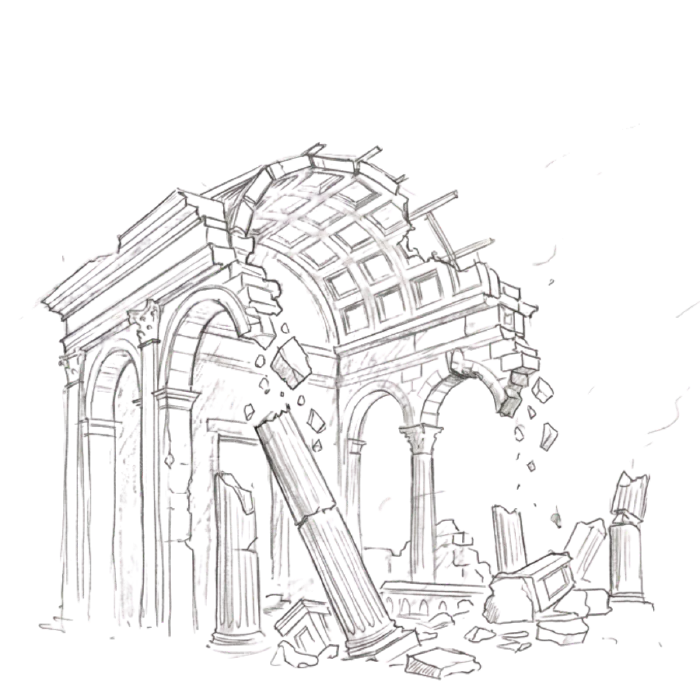
The library at Alexandria didn’t die in a single fire. That’s the version most of us carry around, the dramatic one-act tragedy: the greatest collection of ancient knowledge, consumed in a single blaze of negligence or conquest. But the historical record is murkier. The library declined over centuries, through a succession of smaller destructions, political neglect, and the slow erosion of institutional support. Scholars left. Scrolls deteriorated. Funding dried up. By the time any final fire came, the collection was already a fraction of what it had been.
I keep returning to this because the popular version is so much more convenient. A single catastrophe is easy to process. It has a villain. It has a date. It lets us grieve neatly and move on. The actual story is worse, because the actual story is about drift. About a society that stopped caring about preserving what it had accumulated, one budget cut and one political realignment at a time, until the thing that was supposed to be permanent simply wasn’t there anymore.
I read about Alexandria years ago and filed it away as a tragedy about ancient knowledge. It took me longer than I’d like to admit to recognize it as a pattern I see everywhere. In companies that don’t collapse overnight but hollow out across quarters. In friendships that don’t end with an argument but with a gradual shortening of replies. In my own attention to things that matter, where the erosion is so slow I don’t notice until I look up and something is gone.
The mental model here is History itself. Not as a discipline stored in textbooks, not as dates and dynasties to be memorized, but as a living pattern language. A way of seeing the present through what has already happened, and of recognizing that the forces at work in your own life are rarely original.
The Durants put it plainly:
The present is merely the past rolled up and concentrated in this second of time.
When I first encountered that line, I thought it was poetic. Now I think it’s operational.
The Same Brain, Different Inputs
I had always treated my own era as different. Better educated. Better informed. Surely better at avoiding the traps that caught previous generations. But if the human hardware is identical, then the software upgrades of education and information don’t change the default behavior. They just change the language we use to justify the same defaults. We don’t panic differently than our ancestors. We panic with Bloomberg terminals open.
I watch this happen with organizations and systems. You design process and controls. On day one, the framework is tight. The systems align perfectly with the control requirements. But the erosion doesn’t start with a deliberate breach. It starts with a single, urgent quarter-end exception. A manual override is approved just to hit a deadline, with a promise to fix the system next month. Next month, a new acquisition closes, and a temporary pass is granted.
Nobody decides to hollow out the governance structure. The risk profile shifts because the immediate incentive—speed, avoiding friction, always outweighs the abstract value of the control. Five years later, you look at the balance sheet and realize the actual operating model is held together by spreadsheets and habit.
The architecture didn’t collapse in a fire. It just slowly became a suggestion.
This is why I no longer find the workaround instinct frustrating. I find it useful. If I know the workaround patterns are ancient—driven by the same incentives that drove a 16th-century merchant evading guild regulations, I can design for them instead of being surprised by them.
The Amnesia Problem
John Kenneth Galbraith wrote in A Short History of Financial Euphoria, something that has lodged in my thinking permanently:
There can be few fields of human endeavor in which history counts for so little as in the world of finance.
not a complaint about ignorance. It’s a diagnosis of something more. Financial markets actively punish historical memory. The person who remembers the last bubble and stays cautious during the early stages of the next one underperforms for years. The person with no memory at all, who buys aggressively into every new narrative, looks like a genius right up until they don’t. The market’s incentive structure selects for amnesia.
I see this in how I evaluate investment opportunities. When I’m doing work on a company or a sector, the temptation is always to anchor on the recent past. The last five years of financial statements. The current management team’s track record. The prevailing interest rate environment. And that’s fine as far as it goes. But Taleb opened a different door for me:
We read too much into shallow recent history, with statements like “this has never happened before,” but not from history in general (things that never happened before in one area tend eventually to happen). In other words, history teaches us that things that never happened before do happen.
Every time I hear “this has never happened before” in an earnings call or an analyst note, I now translate it automatically: “I haven’t looked far enough back.” The phrase doesn’t signal novelty. It signals a narrow sample. When someone tells me a company’s leverage ratio is unprecedented in its sector, I want to know what happened in adjacent sectors, in different decades, in different countries, when similar leverage levels were reached. The answer is almost always available. Someone, somewhere, already ran this experiment. We just haven’t bothered to look.
Rhyming, Not Repeating
The Twain line about history rhyming rather than repeating gets quoted so often it’s become furniture. You stop seeing it. But I’ve been trying to take it seriously as an analytical tool rather than a bumper sticker.
The value here isn’t cynicism. It’s calibration. If I know the underlying human behaviors are constant, then the question becomes: what’s the rhyme scheme this time? The melody changes. The key changes. The rhythm holds.
I try to look for structural analogs rather than direct comparisons. The South Sea Bubble and the dot-com bubble don’t look alike on the surface. The assets were different, the technology was different, the regulatory environment was different. But the behavioral architecture was the same: a new financial instrument that people didn’t fully understand, combined with easy access to leverage, combined with a story so compelling that questioning it became socially expensive. Galbraith noticed this too:
As with superb consistency throughout this history, blame did not fall on the speculation and its gulled participants.
After every bubble, the blame migrates. It lands on regulators, on short sellers, on foreign actors, on technology failures. It lands everywhere except on the participants who chose to believe the story. That pattern is so consistent across centuries that you can almost set your watch by it. And if you know the blame will shift, you can be more honest with yourself in real time about your own participation. At least in theory. I’m still testing whether knowing the pattern actually changes my behavior or just makes me more articulate about my mistakes afterward.
The Ambiguity I Can’t Resolve
Here’s where my thinking gets tangled. John Kenneth Galbraith writes:
Lessons of history can, however, be disturbingly ambiguous, and perhaps especially so in economics.
But then, almost in the same breath:
If the controlling circumstances are the same, the lessons of history are compelling — and even inescapable.
Both of these can’t be fully true at the same time. Or maybe they can, and the skill lies in determining which controlling circumstances are actually the same and which merely look the same. where I keep getting stuck. History is a powerful pattern recognition tool, but the patterns aren’t labeled. You have to decide which historical analog applies to the situation in front of you, and that decision is itself subject to all the biases that history warns you about.
When I’m reviewing controls and financials, I look to see patterns that reminds me of a failures I’ve studied, is that genuine pattern recognition or confirmation bias dressed in historical clothing? When I look at a market environment and see structural similarities to a previous downturn, am I reading the rhyme correctly or forcing a rhyme that isn’t there?
What Franklin Meant
There is a Benjamin Franklin quote that reframed how I think about this:
Almost all kinds of useful knowledge would be learned through reading of history.
Franklin wasn’t talking about memorizing dates. He was talking about accumulating a repertoire of patterns so large that you could recognize the shape of new situations before they fully developed. History as a decision-making substrate, not a subject.
I’ve been trying to apply this in a specific way. When I encounter a new situation in my work, whether it’s a control deficiency, an investment thesis, or any problem, I now ask: who has faced something structurally similar? The answer is almost always someone, and almost always more than once. The details differ. The structure rhymes.
With my children, I’ve started noticing this too. The arguments they have with each other, the negotiations they attempt with my wife and me, the way they test boundaries and then retreat: none of it is new. My parents dealt with the same dynamics. Their parents dealt with the same dynamics. Knowing this doesn’t make the arguments less exhausting, but it does make me less reactive. The situation feels less personal when you recognize it as an iteration of something ancient.
What I Haven’t Figured Out
The question I keep circling is this: how deep do you go? At some point, the appeal to historical pattern becomes a way of avoiding the specific. “This has happened before” can become a thought-terminating cliché just as easily as “this time is different” can. Both phrases shut down analysis. One shuts it down by assuming novelty. The other shuts it down by assuming repetition.
I don’t yet have a reliable method for determining when I’m genuinely drawing on historical pattern and when I’m using history as an excuse not to think harder about what’s actually in front of me. The tension between ambiguity and inescapability sits unresolved in my notes. I suspect it will for a long time.
What I do know is that the library at Alexandria didn’t burn once. It faded. And the people living through the fading probably didn’t notice, because each individual moment of neglect was too small to register. That’s the version of history I find most useful and most unsettling. Not the dramatic ruptures, but the quiet ones. The patterns you can only see if you’re looking far enough back, and honest enough to admit you’re living inside one.