 Mandelbrot
 The Accountant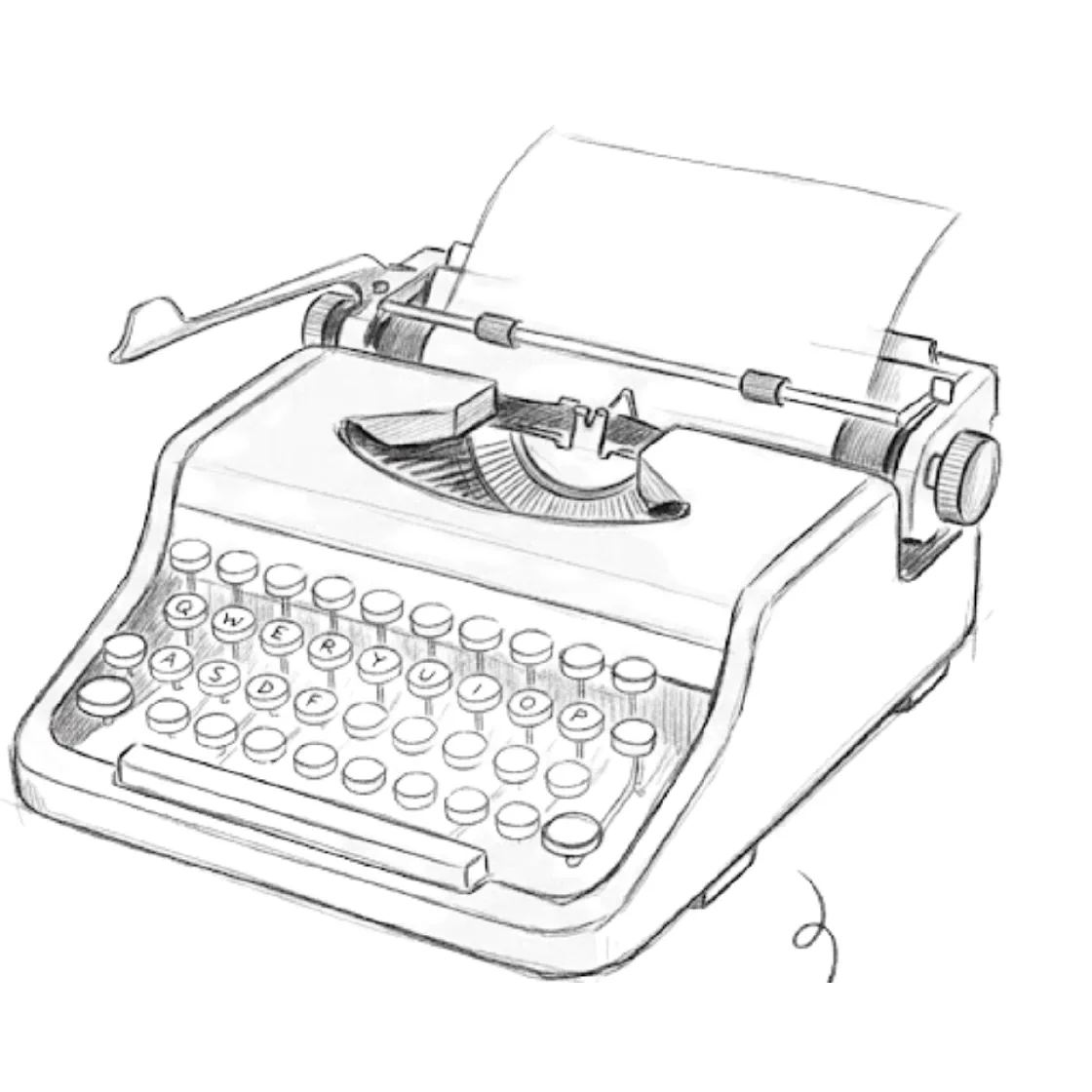
His typewriter jammed. When a typist struck two neighboring typebars in quick succession, the metal arms collided and stuck halfway to the page. The account usually given is that Sholes rearranged the letters to push common pairs apart and slow the rate of collision. Remington bought the design, pushed it into mass production in 1874, and the layout we now call QWERTY went out into the world on the back of the first typewriter anyone actually bought.
That jamming problem was mechanical. It lived in springs and levers. By the time electric machines arrived, and certainly by the time keyboards became plastic over circuit boards, the original constraint had disappeared. The layout did not.
August Dvorak patented a rival arrangement in 1936 and assembled evidence that it was faster and gentler on the hands. None of it mattered. Typists had trained their fingers. Schools taught QWERTY and manufacturers tooled for it, and every new typist learned the layout every employer expected while every employer expected the layout every typist had learned.
Switching had become its own kind of impossible. Not because anyone forbade it, but because the value of the layout lived in the fact that everyone else used it. A faster keyboard in a world that types QWERTY is a worse keyboard, because the typists you hire and the muscle memory you inherit all run on the standard. Whether Dvorak was truly superior is still argued; the lock-in is not.
Economists call the keyboard a case of path dependence. Where you end up is governed less by what would have been best than by the order in which things happened. The choices in front of you have already been narrowed by choices made earlier, even when the reason for those earlier choices has expired.
The State You Are Already In
In 1907 A. A. Markov began studying a class of processes where the probability of the next outcome depends only on the present state, not on the full record of how you arrived there. It sounds like a way of forgetting history. Really it does the opposite. The present state is history compressed, with everything that happened folded into where you stand, and where you stand sets the odds for the next roll.
Yahtzee runs on exactly this. The combinations you chase depend on what you have already banked. Once you have committed your top half to chasing sixes, the lower half of the card is a different game than it would have been. You are never choosing from the full set of moves. What remains are the moves your earlier dice left open.
Nassim Taleb, in Fooled by Randomness, names what this does to anyone trying to model behaviour cleanly:
Forcing rational dynamics on the process would be superfluous, nay, impossible. This is called a path dependent outcome, and has thwarted many mathematical attempts at modeling behavior.
The equilibrium model assumes you can solve for the best answer from first principles. Reality hands you a position, not a blank slate. The starting conditions and every accident since have already done most of the deciding.
Married to the First Idea
Taleb returns to the theme later in the same book, applied to how people hold their convictions:
Many people get married to their ideas all the way to the grave. Beliefs are said to be path dependent if the sequence of ideas is such that the first one dominates.
Of all the forms, this is the one I find most dangerous, because it operates inside my head where I cannot see it. The first frame I build for an investment becomes the frame I defend. New information arrives and gets metabolised into the original story rather than allowed to overturn it. The thesis I wrote on day one keeps voting long after the facts it rested on have changed.
I see the same structure in controls. A process set up wrong at inception rarely gets rebuilt. It gets patched. Each fix accommodates the original error instead of removing it, and years on the architecture is a museum of accommodations to a mistake nobody remembers making. The first design dominates the sequence.
The Gambler Who Bets Only on Red
Scott Patterson, in Chaos Kings, draws a line between two ways of counting the same odds:
Next, a single gambler makes one hundred bets on the roulette wheel, putting all his money on red. Such a gambler will never make it to a hundred. That is the “time probability” way of looking at risk, which is path-dependent in time. It is, Taleb argued, the correct way to think about risk—especially when there’s a chance of ruin.
A hundred different gamblers each placing one bet is a comfortable statistic. One gambler placing a hundred bets in sequence is a death march, because somewhere along the path he hits zero and the path ends. The average tells you nothing about the route.
Compounding works the same way. Order matters when leverage or withdrawals are involved. A position that halves needs to double just to break even, and if the halving comes early enough, on enough size, there is no later sequence of good years that brings it back. The drawdown is not a number on a chart. It is a fork in the path, and some forks do not reconnect.
How Endings Get Written
The Stray Reflections podcast, in an episode on how wars actually end, made a point that has stayed with me well outside its subject:
History suggests the outcome is not determined by how much is hit, but by when each side decides it has seen enough.
An ending is a decision before it is a fact. Whoever does the deciding also writes the account, and the result comes down to us framed as the thing they intended all along, the victory the campaign was always aiming at. The path is reverse-engineered into a plan.
Markets do this constantly. We look at the company that won and reconstruct a clean line from founding to dominance, as though every step was chosen and correct. Howard Marks, in The Most Important Thing, refuses the tidiness:
Many things could have happened in each case in the past, and the fact that only one did happen understates the variability that existed.
QWERTY looks inevitable now. It was not.
You see the exact same lock-in with capital allocation. A board initiates a dividend to distribute early cash flow. That single choice dictates who buys the stock next. The register fills with yield-mandated funds. A decade later, the market shifts and the company needs heavy capex to survive. But cutting the dividend will crash the equity and trigger a revolt from the exact shareholder base the company curated. The directors are no longer solving for the optimal strategy. They are managing the walls of a room built ten years ago. The winner always looks like it deserved to win, and the loser looks like a failure of vision. What survives is only the path that happened, and that path erases every route that nearly did.
The Tyranny of Small Decisions
There is a related idea I keep next to this one. The tyranny of small decisions: a run of choices, each sensible on its own, that together close off an outcome you would have wanted, and close it for good. Nobody chose the bad end. Everybody chose the reasonable next step.
The defence usually offered is optionality. Keep doors open, and prefer bets with high upside and a floor you can survive. On paper it is clean: at each fork, pick the branch that preserves the most branches.
I believe in it, and I cannot make it work all the way down.
Because optionality is not free, and holding it forever is itself a path. Conviction requires closing doors. You cannot size a position to matter and keep every exit open at once. A concentrated book and a fully hedged one will not live in the same account. At some point the uncertainty has not resolved, and you commit anyway, or you wait, and waiting is a position too.
What I have not worked out is where the line sits. How much path do you let run before the order of things has told you enough to commit? Preserve optionality too long and you have bought a permanent ticket to the middle of the distribution, paying carry on open doors you never walk through. Commit too early and you marry the first idea, the one Taleb says dominates the sequence all the way to the grave.
The keyboard tells me the early mover wins by getting there first and locking the standard in before anyone can argue. Sit at the same table as the roulette gambler and getting there first on enough size becomes the fastest route to zero. Both are true. I keep wanting a rule that tells me which one applies before I act. The only honest answer I have found is that the path has to run before it shows you the game. By then, you have already moved.