 Mandelbrot
 The Accountant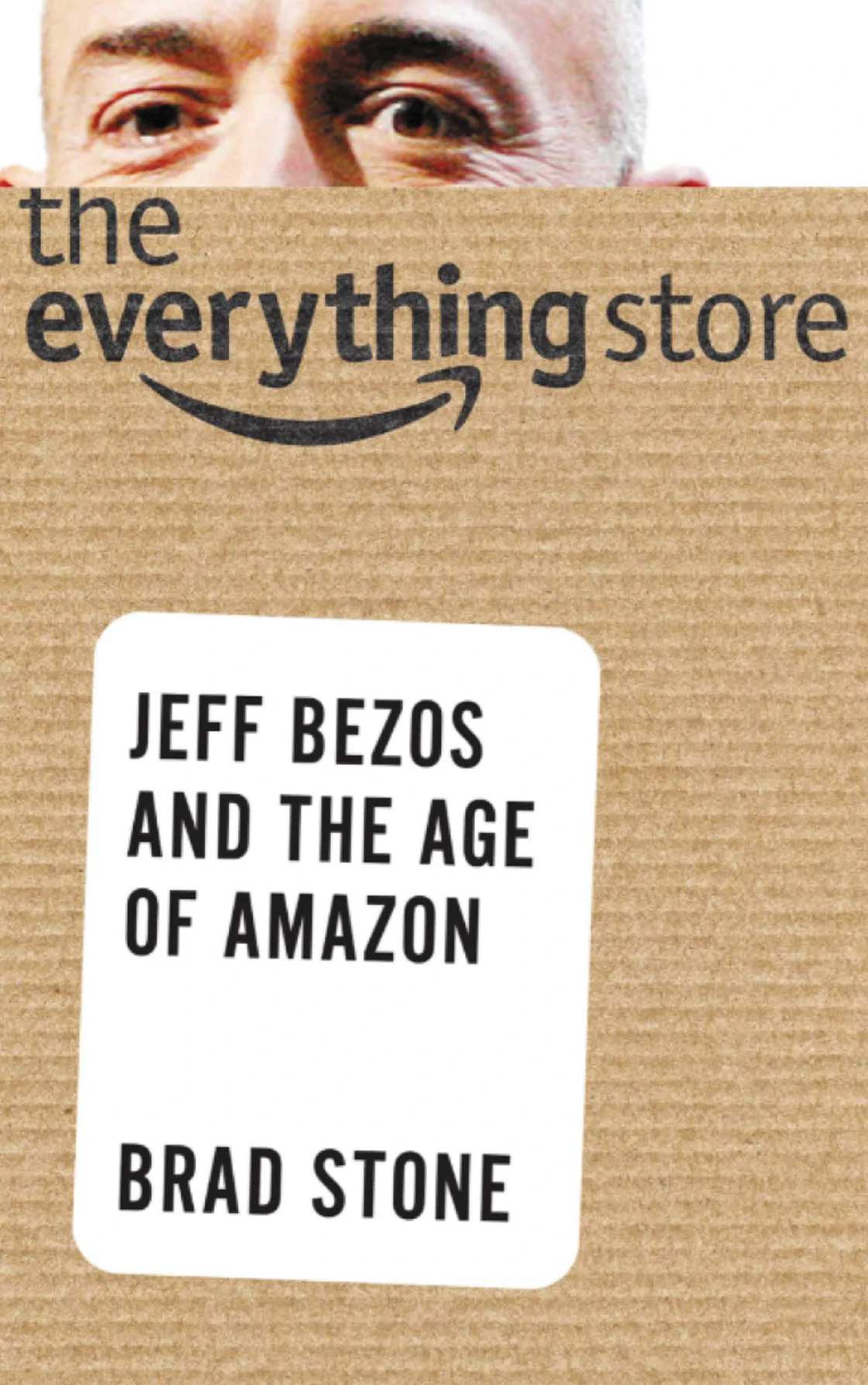
A twenty-nine-year-old running a quantitative fund’s third-market trading business read the chart and ran his own arithmetic. Web activity overall, he figured, had risen roughly 2,300 times in a year.
“Things just don’t grow that fast,” Bezos later said. “It’s highly unusual, and that started me thinking, What kind of business plan might make sense in the context of that growth?”
The second sentence is the entire book. Most people who read that newsletter saw a statistic and thought of it as an obscure stat about a new technology. Bezos thought about it as a constraint. A growth rate of that order eliminates almost every business you could write on a napkin. It eliminates anything that needs floor space per unit of demand, anything that needs a salesperson per transaction, anything with a catalogue small enough to shelve. What emerges is a business with near-zero marginal cost of distribution and a selection too large to physically hold. The everything store falls out of the arithmetic before anyone falls in love with it.
Brad Stone spent years reporting this, and the discipline shows. He is not writing a founder’s gospel. He interviewed the people Bezos fired, the Walmart executives who told a colleague the model would hit a wall once it reached a certain sales volume, and the Harvard MBA class that advised Bezos in 1997 to sell to Barnes & Noble while he still could. What holds the narrative together is not the products. It is a small number of operating decisions, made early, repeated under pressure for two decades.
What Did I Get Out of It
The Question Before the Business Plan
Before the arithmetic, there was a walk in Central Park. David Shaw told Bezos he already had a great job, that the firm was growing, and that it might end up competing with whatever he built. Bezos went away to think, and what he came back with was not a forecast.
“When you are in the thick of things, you can get confused by small stuff. I knew when I was eighty that I would never, for example, think about why I walked away from my 1994 Wall Street bonus right in the middle of the year at the worst possible time. That kind of thing just isn’t something you worry about when you’re eighty years old. At the same time, I knew that I might sincerely regret not having participated in this thing called the Internet that I thought was going to be a revolutionizing event.”
What the framework actually does is swap the evaluation axis. Expected value asks how likely the venture is to work, which is unanswerable in 1994 and invites you to manufacture a number to feel rigorous. Regret minimization asks which of the two errors is recoverable. Forgone compensation is a wound that heals and stops being interesting within a decade. Absence from a structural shift does not heal, because you cannot re-enter the early phase later at the early-phase price. He wasn’t being brave. He was sorting his errors by reversibility, which is closer to what Wild Problems argues about decisions that cannot be modelled from outside.
The book opens with the same idea in Bezos’s own words, stripped of the business context.
In the end, we are our choices.
Which reads like a motto until you notice it is a measurement claim. Not our outcomes, which are mostly the weather. Not our intentions, which leave no record. The choices, because those are the only entries on the ledger we actually authored. I find that a harder standard than the one I usually apply to myself, since I tend to grade my decisions by how they turned out.
Six Pages, Read in Silence
Amazon banned slides. Not de-emphasized, banned. Every proposal is written as a six-page narrative in prose, and every meeting begins with fifteen minutes of silence while the room reads.
“PowerPoint is a very imprecise communication mechanism,” says Jeff Holden. “It is fantastically easy to hide between bullet points. You are never forced to express your thoughts completely.”
I have sat through a lot of packs. The forty-slide deck survives because it distributes accountability across fragments. Each bullet is defensible on its own and no bullet is required to connect to the one above it, so the argument never has to exist in a form anyone can attack. Prose removes that shelter. You cannot write “because the second-half assumption holds, we expect the following, unless the supplier terms tighten” without exposing every joint in the reasoning. The silent reading does something else again. It strips the presenter of the room. No pacing, no eye contact, no managing the sceptic in the corner by talking faster. The document has to stand up alone, which is exactly the test it will face when someone reads it a year later trying to reconstruct why the decision was made.
Then there is the second rule, which is harder.
Bezos didn’t believe anyone could make a good decision about a feature or a product without knowing precisely how it would be communicated to the world.
Every new proposal is written as a mock press release before any resource is committed. Working backwards from the announcement forces the claim into a falsifiable shape at the point of approval rather than at the post-mortem. You have written down, in advance, what the customer is supposed to get. That is a control, though nobody at Amazon called it one. Most governance failures I have looked at were not failures of oversight. They were failures of documented intent, where the original justification was never written in a form specific enough to test against. The connection to first-principles narrative is direct: the writing is not the report of the thinking, it is the thinking.
Value Trumps Everything, and Where He Borrowed It
In 2001, with books decelerating and the stock down, Bezos had coffee with Jim Sinegal. Costco marks up everything at a standard 14 percent across the board, even where it could charge more, carries roughly four thousand items, spends nothing on advertising, and earns most of its gross profit from membership fees.
“My approach has always been that value trumps everything. The reason people are prepared to come to our strange places to shop is that we have value. We deliver on that value.”
This is a self-imposed ceiling on margin. A fixed markup removes the ability to optimize any individual transaction, which is precisely what makes the promise credible over years. Any given quarter, breaking the rule is the profitable move. Sinegal’s insight, which Sol Price taught him and which shows up again in the way Costco compounds, is that the value of the constraint comes entirely from never granting the exception. The Monday after that coffee, Bezos told his executive team that Amazon’s pricing was incoherent, and that July the company cut prices on books, music, and video by twenty to thirty percent.
Bezos then drew the loop, borrowing the flywheel from Jim Collins.
Lower prices led to more customer visits. More customers increased the volume of sales and attracted more commission-paying third-party sellers to the site. That allowed Amazon to get more out of fixed costs like the fulfillment centers and the servers needed to run the website. This greater efficiency then enabled it to lower prices further.
A flywheel is a reinforcing loop, and reinforcing loops have no preference for direction. The reason this one ran forward for twenty years is that every stage was fed by cash from customers rather than by the company’s own paper. Compare it to the structures I wrote about in synthetic equity, where the loop is funded by the share price itself and reverses the moment the marginal buyer stops. Same topology, opposite fuel. Collins supplied the diagram; Sinegal supplied the input. Bezos borrowed both without embarrassment, the way he had already borrowed frugality and bias for action from Sam Walton, whose autobiography he handed out with the passage about copying competitors underlined.
Communication as a Symptom
At a management offsite in the late 1990s, a group of junior executives presented a set of techniques for improving coordination between divisions. Bezos told them they were completely wrong.
“Communication is a sign of dysfunction. It means people aren’t working together in a close, organic way. We should be trying to figure out a way for teams to communicate less with each other, not more.”
My instinct runs the other way. Most of the failures I examine trace back to a handoff nobody owned, and the standard remedy is a forum where the two sides finally speak. Bezos is not arguing against information. He is arguing that the need for the meeting is evidence that the boundary was drawn in the wrong place. A recurring cross-team sync is a workaround for a badly specified interface, and workarounds harden into architecture. Fix the interface and the meeting dissolves; keep the meeting and the interface never gets fixed. The same logic sits under the Toyota principle that the person at the line stops the line, because the person closest to the defect needs no committee to see it.
In 2002 he pushed the idea to its structural conclusion with autonomous teams small enough to be fed by two pizzas.
These teams would be independently set loose on Amazon’s biggest problems. They would likely compete with one another for resources and sometimes duplicate their efforts, replicating the Darwinian realities of surviving in nature.
Duplication and local optimization adds to the cost, because a team measured on its own metric will happily push cost into the team next door. What I am thinking is where the model breaks for control purposes. Decentralization moves risk to the seams, and seams are exactly what a fragmented organization stops looking at. Amazon’s answer, eventually, was not a coordination layer. It was to make the seams into published interfaces that could be tested from outside, which is a more expensive answer than a weekly call and a considerably better one.
Primitives
The AWS argument came out of a book about artificial life. Steve Grand’s Creation proposed building simple computational building blocks and then watching complex behavior emerge, rather than designing the behavior directly. Amazon’s executives read it and applied it to their own infrastructure. If you try to guess which services your developers will want, your guesses come from the patterns of the past.
“Developers are alchemists and our job is to do everything we can to get them to do their alchemy.”
There are myths associated with the birth of AWS. They decomposed the infrastructure into storage, compute, database, payments, messaging, and stopped guessing. The internal paper imagined a student in a dorm room with the same infrastructure available to the largest companies in the world. What interests me most is the accounting consequence. A fixed cost carried for internal use became an external revenue line with an entirely different margin structure, and the company that had been ridiculed for its capital intensity turned that intensity into the product. The reclassification also made Amazon illegible to its competitors, who were still benchmarking it against retailers.
“The best analogy that I know is the electric grid. You go back in time a hundred years, if you wanted to have electricity, you had to build your own little electric power plant, and a lot of factories did this. As soon as the electric power grid came online, they dumped their electric power generator, and they started buying power off the grid.”
The grid comparison is pretty accurate. What made electrification transformative was not cheaper power but a standard interface that let everyone downstream stop solving the same problem. The Box makes the identical case for a steel container of agreed dimensions. Standardize the primitive, and the value accrues to whoever owns it while the innovation happens somewhere you never anticipated.
The Analyst Who Was Nearly Right
In 2000, a Lehman convertible bond analyst named Ravi Suria published a report on Amazon’s credit.
“We believe that the company will run out of cash within the next four quarters, unless it manages to pull another financing rabbit out of its rather magical hat.”
The stock fell twenty percent. Suria kept publishing for eight months, and his work became a proxy war over whether the internet was real. What he got wrong was the outcome. What he got right was the fragility, and the distinction matters more to me. A retailer running on negative working capital is solvent because suppliers extend terms and customers pay first. Neither of those is a contractual right. Both are functions of belief.
In other words, the danger for Amazon was that in their wrongness, Suria and other Wall Street bears might prove themselves right.
Stone states the reflexivity plainly and moves on. The analysis of a confidence-funded balance sheet is an input to the thing it analyses. Credit Suisse did not fail a capital test; it failed a belief test, and the belief moved faster than any ratio could be recalculated. Amazon’s escape route was to raise money in Europe before the window shut and then to keep the suppliers paid. The lesson I take is not that the bears were fools. It is that a solvency opinion on a business funded by other people’s patience is never a pure observation, and anyone writing one should know they have entered the system they are measuring.
Who Is This For
If you build or review operating processes, the two portable ideas are the six-page narrative and the press release written before the work starts. Both are free, neither needs authorization, and both will tell you within a month how much of your current reporting is bullet points protecting a claim nobody wants to make in a sentence.
If you invest, the 1998 shareholder letter is the most useful document in the book and you can read it without buying anything. The book’s contribution is the fifteen-year audit trail. Stone lets you check the promises against the behavior, which is a rarer exercise than reading the letter itself.
Skip it if you want a management system in numbered steps. Bezos told Stone directly that there is no aha moment, that invention is messy, and Stone honors that by reporting rather than systematizing. Skip it too if you want a verdict on the man. The book places his grandfather’s line to a ten-year-old boy who had just calculated the cost of his grandmother’s smoking habit,
“Jeff, one day you’ll understand that it’s harder to be kind than clever,”
a few hundred pages from the scene where a vice president is made to sit in silence for four and a half minutes of hold music while Bezos times the customer service line on his wristwatch. Both are in the same character. Stone does not reconcile them and neither can I.
What the book changed in my own thinking is the frame. I had carried Amazon around as an internet story, which is to say a story about timing, cheap capital, and network effects, none of which are available to me. Reading the reporting, it looks more like a sequence of ordinary decisions made under conditions where the payoff was years away and the cost was immediate. The six-page memo does not require genius. Matching a competitor’s lowest price permanently does not require genius. Both require the willingness to be worse off this quarter.
An email Joy Covey sent to Stone in January 2013, eight months before she was killed on her bicycle, asks the only question that matters
“It may very well be that the absolute intensity of drive and focus is essential and incompatible with all of the nice management thought about consensus and gentle demeanor.”
She was not defending the intensity and not condemning it. She was asking whether the results are separable from the cost, and she had better evidence than most people to answer with. She did not answer. I can copy the memo format tomorrow. Whether the rest of it comes as a package is a question I have written down in my notes and left open, which I suspect is where it belongs.