 Mandelbrot
 The Accountant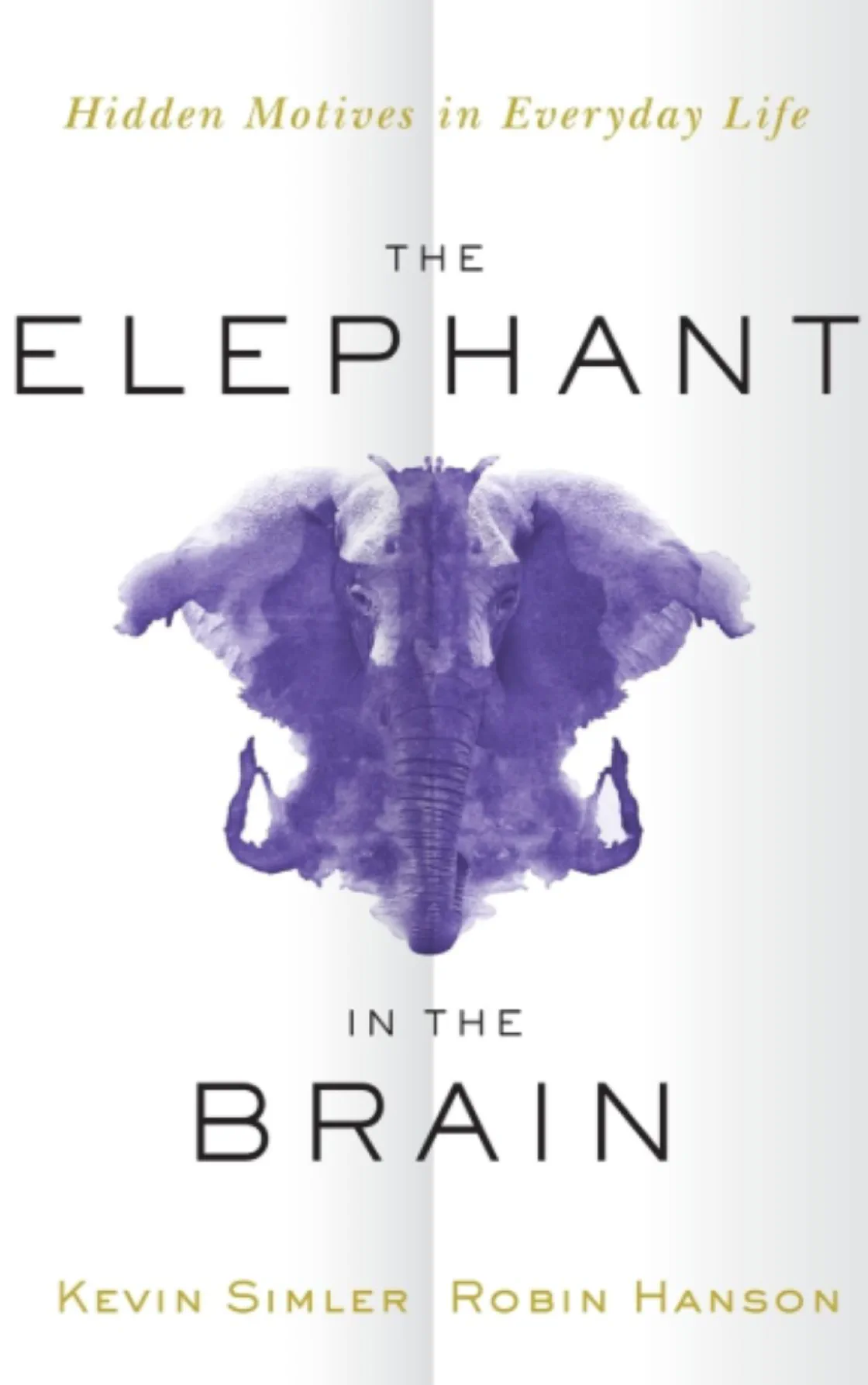
He was using a three-million-dollar Stradivarius. Two nights earlier, he played the exact same music on the same instrument to a sold-out concert hall.
If people were just paying for the music, the setting wouldn’t matter. But it does. Without the stage, the ticket price, and the crowd, the demand disappears. We say we value the art, but the behavior shows we value the context.
Kevin Simler and Robin Hanson use this gap between what we say and what we do as the foundation for The Elephant in the Brain. Their thesis becomes harder to dismiss the longer you sit with it. Human institutions—schools, charities, hospitals, art galleries; are usually optimizing for something other than what they claim. The surface justification and the actual mechanics rarely match. And the people inside these institutions, including the ones running them, often genuinely cannot see the gap. The self-deception is load-bearing.
I picked at the argument for weeks. I came in skeptical of the framing, which has the structure of an unfalsifiable claim where every counterexample becomes more evidence of the hidden motive. By the end, I was less skeptical of the thesis than of my own ability to apply it to myself.
What Did I Get Out of It
The value of this book is not in its individual claims, several of which are contested and would not survive a careful empirical review on their own. The value is in how the authors compose those claims into a single lens. Once installed, that lens is difficult to remove. I started catching it in meetings, in performance reviews, in the way I framed my own decisions to myself.
The Two Reasons for Everything
The thesis can be compressed into a single line, which the book attributes to J.P. Morgan:
Man always has two reasons for doing anything: a good reason and the real reason.
What makes this dangerous is not that we lie to others. We lie to ourselves first, and the lie is rarely a clean fabrication. A pure invention is brittle and easy to puncture. The half-truth is robust because it contains genuine signal. The reasons we give for our promotions, our investments, our breakups, our charitable choices all have a credible surface layer. Beneath that layer, something else is operating. Status. Envy. The desire to be seen. The desire to avoid being seen in a particular way. The authors argue the surface reason and the underlying driver are often pointed in different directions, and we have no privileged access to the difference.
One of the most effective ways to rationalize is telling half-truths. We cherry-pick our most acceptable, prosocial reasons while concealing the uglier ones.
Thinking Fast and Slow covers the cognitive machinery of this from a different angle, showing how System 1 generates conclusions and System 2 generates justifications. Simler and Hanson push the point further. The justification system isn’t just a post-hoc explainer. It’s a public relations department that has captured the executive function and operates without supervision.
Discretion and the Architecture of Plausible Cover
The most useful chapter for me dealt with norms, not the norms themselves, but the ways we route around them while preserving the appearance of compliance.
Discretion creates ready-made excuses or alibis. Skirting a norm instead of violating it outright. Prevents a norm violation from becoming full common knowledge, which makes it more difficult to prosecute. The pretext doesn’t need to fool everyone, just plausible enough to make people worry that other people might believe it.
I have spent a meaningful portion of my professional life looking at exactly this behavior under different names. Override of controls with a documented rationale that’s technically valid but functionally hollow. Procurement structured into amounts just below the approval threshold. Related-party transactions with paperwork clean enough to survive a first-pass review. None of these involve outright fabrication. All of them involve the construction of plausible cover.
Anything that hampers enforcement will improve the odds of getting away with a crime.
The book reframed something I had been treating as a control failure. It is not a failure. It is a feature of how humans navigate rules. The pretext is not the exception to the system. The pretext is the system as actually operated. Chasing Metrics, Missing the Mark makes a related point about how any measurement target generates its own evasion strategies. Once you understand that the workaround is ancient and continuous, you stop being surprised by each new instance of it. You design for it instead.
Prestige, Calibration, and the Replica Museum
A long section of the book treats prestige as a price.
Prestige is your “price” on the market for friendship and association. Price is driven by supply and demand. We all have a similar (and highly limited) supply of friendship to offer to others, but the demand for our friendship varies greatly.
That framing was uncomfortable in a useful way. It strips the soft language off something I had preferred to think about in warmer terms. The way we accumulate associations, the people we spend time with, the conferences we attend, the funds we want to be seen co-investing with. All of it has price-discovery dynamics, even if we don’t talk about it that way.
The discussion of art applies the same lens to a domain that resists it most. The book asks the reader to imagine a replica museum, indistinguishable in every visual particular from the originals, and to notice the immediate response. The thought experiment lands harder when pushed to the absurd:
A sculpture looks like a seashell. It might actually be a seashell. Did she just pick it up off the beach, or did she somehow make it herself? This question is now absolutely central to your appreciation of this “sculpture.” If she found it on the beach: meh. If she made it by manually chiseling it out of marble: whoa!
Beauty is not what we are paying for. We are paying for evidence of effort, skill, and survival surplus expended by a specific person. The visual output is incidental. The signature is the asset. The same logic explains why constraints elevate rather than diminish the art form. A poet bound by meter and rhyme cannot reach for the convenient word. A sculptor working in marble cannot patch errors with putty. The constraint is what makes the skill legible. Take away the constraint and the signal disappears. The connection to The Architecture of Synthetic Equity is closer than it looks. The value of certain assets is socially constructed and dependent on a continuous performance, not on intrinsic properties.
The Conspicuous in Compassion
The charity chapter was the one I expected to reject and ended up most marked up.
Charities bracket donations into tiers and advertise only which tier a given donor falls into. If you donate $900, you’ll earn the same label as someone who donates only $500. Not surprisingly, the vast majority of donations to such campaigns fall exactly at the lower end of each tier. Put another way: few people give more than they’ll be recognized for.
If giving were primarily about the outcome for the recipient, the tier mechanism wouldn’t produce that clustering. The clustering exists because the giver’s experience is dominated by the visibility of the gift, not by the marginal impact of the additional amount. The behavior is consistent across the data. People give more when watched. They give more when the recipient is identifiable. They give more to local rather than global causes, even when the global cause delivers more lives saved per unit of currency. The shape of philanthropy follows what gets witnessed, not what gets needed.
Empathy focuses our attention on single individuals, leading us to become both parochial and insensitive to scale. The mark of a civilized man is the capacity to read a column of numbers and weep.
The point is not that empathy is bad. The point is that empathy is a poor instrument for resource allocation, and the things we feel most moved to do are often the things that perform worst against the goals we claim to be optimizing. The Psychology of Money makes a related observation about behavior dominating outcomes in personal finance. The same dynamic applies to philanthropy. The book left me less confident in my own giving decisions and more attentive to the structural choices charities make when designing what they recognize and how.
Designing for What People Actually Do
The most practical chapter, for me, was the closing argument about institutional design.
Design institutions to account for hidden motives. Institution designers must identify both the surface goals to which people give lip service and the hidden goals that people are also trying to achieve.
A control framework, a compensation structure, an audit committee, a board mandate. All of these are institutional designs. Each tends to be drafted around the surface goals. Each then encounters the hidden goals in operation and degrades accordingly. The Library That Burned Twice traces this same erosion from another angle. Simler and Hanson offer the diagnosis underneath. The design did not fail. The design never accounted for what the participants were actually optimizing for.
While we profess many noble reasons for our behavior, other less-noble motives usually lurk in the background. We need ideals to let ourselves be judged. Promising to behave well (and in staking our reputation on that promise) incentivizes us to behave better than if we refused to be held to any standard.
The closing turn surprised me. After two hundred pages arguing that our professed motives are largely cover stories, the authors land on the position that the cover stories matter. The public commitment to a higher standard, even when it does not perfectly govern behavior, drags the behavior in the right direction. The pretext is not just an evasion mechanism. It also functions as a ratchet. The connection to Skin in the Game became unexpectedly close at this point. Stated commitments create reputational hostages, and the hostages do real work even when the underlying motive is impure. The hypocrisy is doing something useful, as long as the hypocrisy can be measured against the stated ideal.
Who Is This For
The book is an irritant. It is not perfectly balanced, and there are places where the authors let the argument outrun the evidence. If you want a careful empirical treatise, you will be frustrated.
But if you spend your time looking at governance, controls, or institutional design, it provides a vocabulary for what you probably already suspect. It forces you to stop viewing workarounds as deviations from the system, and start viewing them as the system operating exactly as incentivized. You stop taking the stated mission of a charity, a school, or a board at face value, and start looking at what they actually optimize for.
The hardest part is turning the lens on yourself. I caught myself running my own past choices through the framework, noticing how much of what I had attributed to principle could just as easily be explained by an unstated desire for status, association, or plausible cover. It is not a pleasant exercise.
The book pairs most naturally, for me, with Cows, Pigs, Wars & Witches, which makes a similar argument about cultural practices. The explanations cultures offer for their own behavior often miss the deeper function the behavior is performing. Harris focuses on societies. Simler and Hanson focus on individuals. The argument is the same. Take the stated reason seriously, but never confuse it for the only reason.
What the book changed in me was small but durable. When I now hear someone, including myself, offer a clean justification for a decision, I add a quiet second question. Not “is this the real reason,” which is unanswerable. The question is: what would the real reason look like if it were different from the stated one, and would the behavior change? When the answer is no, the stated reason is probably the cover, not the cause. That single question has done more to discipline my own self-narration than anything else I read this year.