 Mandelbrot
 The Accountant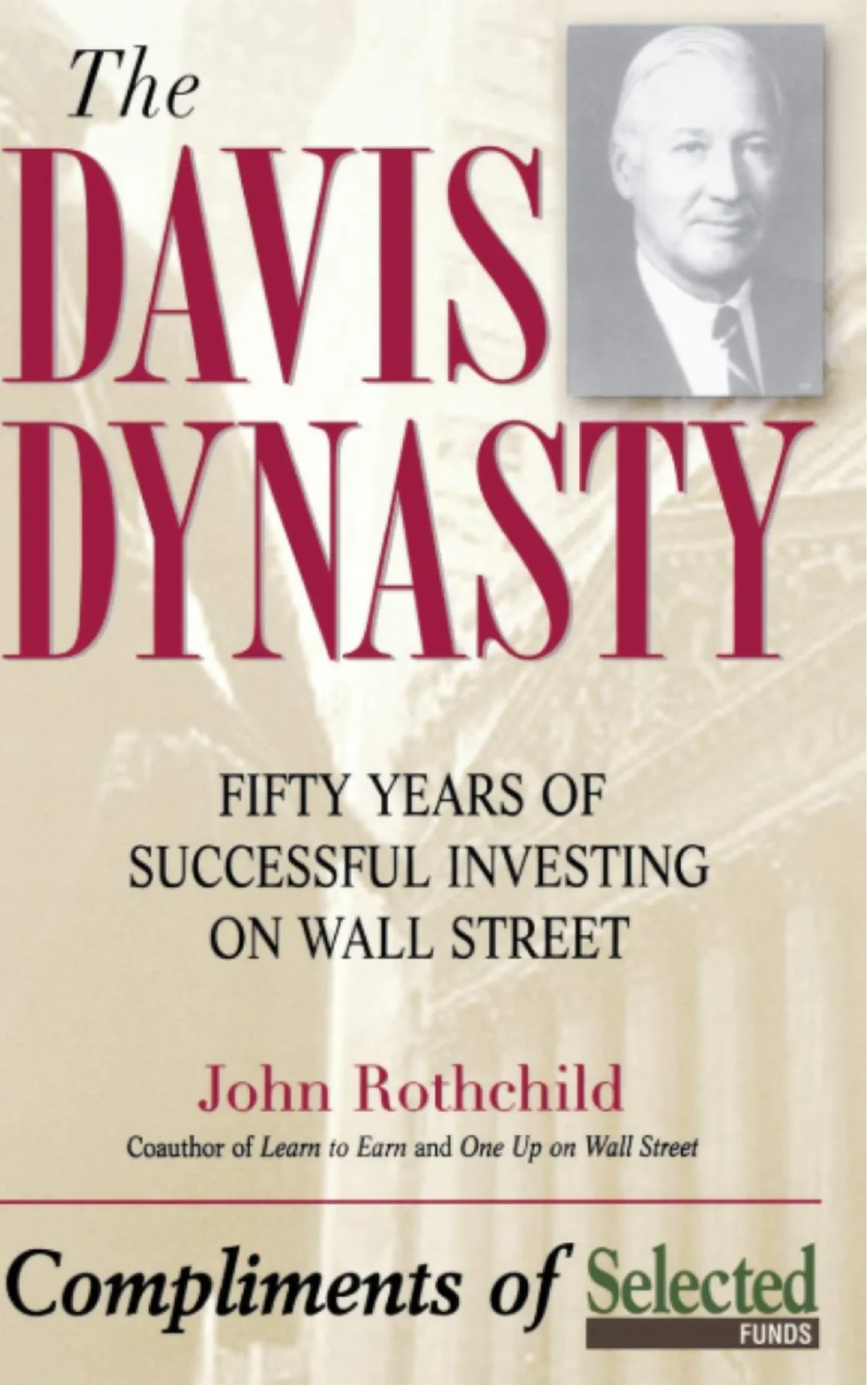
I have been guilty of acting on that discomfort more times than I would like to admit. I have sold too early, called it prudence, and then watched the stock continue higher without me. I have reacted to news that felt urgent in the moment and irrelevant a few months later. I have held on to some losers longer than I should have, partly because selling would have forced me to admit that the thesis was weaker than I wanted to believe. The pattern is not subtle. I can talk like a long-term investor when markets are calm. I find it much harder to behave like one when prices start moving against me.
That was the frame I brought to The Davis Dynasty. Shelby Cullom Davis began investing in the late 1940s with capital from his wife’s family. By the time he died in 1994, that original stake had multiplied roughly 18,000 times. His son ran a fund. His grandson ran a fund. Three generations sat in the same chair, owning broadly the same kinds of businesses and executing broadly the same approach.
The headline number is what gets you to open the book. The boredom of the method is what keeps you reading. There is no secret formula here. There is no model nobody else had. There is a family that found one thing they understood deeply, sized into it with leverage they could service, and then refused to be moved off it for fifty years. Reading the book felt less like learning a strategy and more like watching a metronome.
By the time he died, in 1994, he’d multiplied his original stake 18,000 times.
I kept staring at that line. Not because the number is large. Because the number is the byproduct of a posture, and the posture is the part I cannot seem to hold.
What Did I Get Out of It
The Compounding Machine, Made Personal
The Davis household ran on an almost uncomfortable consistency between what they preached and what they practiced. The frugality wasn’t a marketing line for a future biography. It was lived. The kids dug the hole for their own swimming pool. The hot dog was refused not because the dollar mattered but because the compounded dollar mattered.
“Do you realize,” Buffett said, “how much that is if you compound it over 20 years?” Davis gave the identical speech to his grandson when he refused to buy the boy a $1 hot dog.
What hits me about this is not the discipline. It’s the internal coherence. Davis didn’t practice compounding in his portfolio and abandon it at the deli counter. He treated every dollar of consumption as a dollar removed from the machine. I’ve read enough about Buffett in The Snowball to recognize the same circuitry. The mistake I keep making is treating the mindset as something I can switch on at the brokerage account and switch off at the restaurant. The Davises didn’t operate that way. The arithmetic ran in the background of every decision.
To his son, Davis passed along his infectious passion for owning shares in carefully chosen companies (he called them “compounding machines”), his conviction that owning the best compounding machines would lead to unimagined rewards,
The phrase “compounding machine” reframed a position for me. A stock isn’t a ticker that moves. It is a mechanism, and the mechanism either works or it doesn’t. If it works, the only useful question is whether I’m willing to leave it alone long enough to let it do what it does. The Psychology of Money makes the same point in a softer register: the variable that matters most is time, and time is the variable investors are quickest to negotiate down.
The Cycle You Have to Sit Through
What Davis actually endured, when you list it out, is the part most “long-term investor” branding glosses over.
they invested through two lengthy bull markets, 25 corrections, two savage bear markets, one crash, seven mild bear markets, and nine recessions; three major wars; one presidential assassination, one resignation, and one impeachment; 34 years of rising interest rates and 18 years of falling interest rates; a lengthy struggle with inflation; stretches when bonds gained while stocks lost, or stocks gained while bonds lost, or gold gained while both bonds and stocks lost; and even a stretch when a savings account was more rewarding than the Dow in all its glory.
Read it twice. Each phrase is a period of months or years where the obvious move was to do something. Sell into the rally. Hide in cash. Rotate to bonds. Wait for clarity. The list is what real long-term investing actually looks like before the chart smooths it into a clean upward line.
I’ve written before about how history rhymes rather than repeats, and Rothchild’s catalog is the empirical version of that idea applied to a single career. The lesson Davis kept returning to was that the headlines and the holdings were operating on different time horizons.
It reminded him that stocks don’t read the papers or swoon in response to scary headlines.
This sentence sits in my notes with a circle around it. Stocks don’t read the papers. I read the papers, and then I project my reading onto the stocks, and then I treat the projection as information about the businesses. The companies underneath are running payroll, signing contracts, collecting premiums, paying claims. Whatever I’m doing with my screen is adjacent to that, not part of it.
When they’re priced for desperation, they can rally in the face of desperation, escaping the dumps while the companies to which they’re attached are still wallowing in the dumps.
The point that the price recovers before the business does is one of the most useful pieces of cycle wisdom in the book. It explains why investors who wait for confirmation always arrive late. It also explains why being early and being wrong feel identical for an uncomfortably long stretch. The work of Capital Returns makes the same observation from the supply side. The price moves before the cash flow does because the marginal buyer’s view of the future shifts before the future arrives.
Reading the Numbers Behind the Numbers
Davis’s edge in insurance was not that he saw a sector nobody else was looking at. The edge was that he was willing to learn the accounting that made the sector hard to read.
Without formal CPA training, Davis had learned the quirks of insurance accounting—designed to satisfy state regulators, not inform potential investors.
That single line carries more than it looks like. Insurance accounting is statutory accounting, built to answer one question regulators care about: can this company pay claims if a tail event hits next year? It is not built to tell an investor what the economic earnings of the business actually are. The reserves are conservative or aggressive depending on management’s posture. The investment portfolio carries reliable assets and questionable ones at the same line. Reading these statements without knowing where the levers sit is reading them blind.
he separated reliable assets (government bonds, mortgages, blue-chip stocks) from iffy assets. He was about to invest in an apparently attractive insurer when he noticed its portfolio was loaded with junk bonds. Later, several of these risky issues defaulted, and the insurer collapsed. Davis had sidestepped a total loss.
The work that prevented the loss was unglamorous. It was sitting with a balance sheet, decomposing the assets, flagging the ones that looked solid only because nothing had stressed them yet. The same instinct shows up in From Accounting to Economics, where the difference between reported numbers and economic reality is the entire game. What Davis did with his hot plate breakfasts and his 6 a.m. starts was not a personality quirk. It was the time it took to actually understand what he owned.
Margin Without Recklessness
I came into the book expecting to roll my eyes at the leverage. Then I read the framing.
losses in 1929 to 1932, the public disparaged margin investing, yet people routinely bought houses with margin loans, aka mortgages.
That reframe is uncomfortable because it’s accurate. The same person who refuses to buy stocks on margin will sign a thirty-year mortgage at a leverage ratio they would never tolerate in their portfolio. The objection isn’t to leverage. It’s to volatility. The mortgage stays at par on the statement; the stock account marks to market. The risk of ruin is structurally similar.
“My father hated taxes,” says Shelby, “so margin became his favorite weapon against the IRS. The interest he paid on his loans was tax-deductible, and his deductions wiped out the taxes…”
What Davis did with margin is not what most retail investors do with margin. He borrowed against insurers selling at half their captured asset value, with predictable cash flows and stable underwriting cycles. He didn’t borrow to chase a narrative. The leverage was applied where the asset’s downside was already absorbed by the price. I’ve spent enough time thinking about the geometry of ruin to know how easily this story ends badly when the underlying isn’t actually cheap. Davis’s margin worked because his analysis worked. Strip out the analysis and the leverage is just a faster path to zero.
The instinct I’ve internalized from watching margin go wrong is to avoid it entirely. The instinct Davis would have pushed back on is conflating the tool with the misuse of the tool. Leverage applied to an asset already priced for despair is different from leverage applied to an asset priced for perfection. The first is what survived. The second is what Galbraith catalogs in A Short History of Financial Euphoria.
History Over Accounting
The single line in the book I keep returning to is the one Davis said to his son.
“You can always learn accounting on the side,” he told his son, “but you’ve got to study history. History gives you a broad perspective and teaches that exceptional people can make a difference.”
Coming from someone who had taught himself the quirks of insurance accounting well enough to find a multi-decade edge, this isn’t a dismissal of the technical work. It’s a hierarchy. The accounting tells you what is happening in a single business in a single period. The history tells you what kind of moment you are sitting in, and what people in similar moments did, and how those decisions looked twenty years later. Without the history, the accounting becomes a flashlight pointed at your feet while you’re trying to walk a long road in the dark.
at the end of the worst decade in modern history, Davis realized that past performance was no guarantee of future failure. He was a student of history and a believer in cycles.
“Past performance was no guarantee of future failure” is the inversion that took me a moment to absorb. The standard disclaimer points one way: don’t extrapolate good times forward. Davis pointed it the other way. The worst decade does not predict another worst decade. The structural pessimism that sets in at a market trough is itself a feature of trough conditions. Recognizing that requires holding decades of context in your head, not quarters.
The Patience Discount
Most of what made the family wealthy was not buying things at the right moment. It was the price they refused to be scared out of.
Investors who had no idea of the private worth of their holdings were susceptible to being scared out of them. Their only measure of value was the stock price, so the more the price dropped, the more they were inclined to sell.
The diagnostic I find most useful. If the only number I have for what something is worth is its quoted price, then a falling quoted price is the only signal available to me, and falling signals trigger selling. The way out is to do the work that gives me a separate, independently-arrived-at view of value. Then the falling price becomes information about the market’s mood, not information about the business. The Most Important Thing makes this point as the central pillar of second-level thinking. Davis lived it as a survival mechanism.
Davis was panic-proof. Wall Street’s daily, weekly, monthly, and yearly ups and downs didn’t alter his strategy.
I am not panic-proof. I’m working on it. What this book clarified is that being panic-proof isn’t a personality trait. It’s the behavioral output of having done enough analytical work that the price quote stops being the most important number you see each day. The frugality, the early mornings, the insurance accounting, the seat on the exchange, the refusal to consume the way his peers consumed: it all served the same end. It built a structure where short-term price movement could not dictate long-term action.
“Out of crisis comes opportunity,” Shelby remembers him saying. “A down market lets you buy more shares in great companies at favorable prices. If you know what you’re doing, you’ll make most of your money from these periods. You just won’t realize it until much later.”
The “you just won’t realize it until much later” is the part most investors aren’t built for. The decisions that mattered most in Davis’s career did not feel like wins at the moment they were made. They felt like buying things that were continuing to fall. The realization came years afterward, when the cycle had turned and the sizing of the early purchases compounded into the position. The inverse of how most of us measure ourselves. We grade decisions by their immediate price action. Davis graded them by what they would compound into.
Who Is This For
If you are looking for a tactical playbook, this is not the book. There is no screen, no formula, no checklist (except for the epilogue) of metrics that tells you when to buy an insurer. The lessons are structural, not procedural.
If you tell yourself you’re a long-term investor and you suspect you’re not actually behaving like one, this book is a useful mirror. The Davis family didn’t have access to better information than their peers. They had a willingness to do unfashionable work on unfashionable industries and then leave the work alone. The discipline isn’t visible in any single decision. It accumulates across decades of small refusals: the hot dog, the new car, the quick rotation, the panic sell.
If you work close to financial statements, the section on insurance accounting will land differently than it would for a general reader. Statutory frameworks built for one stakeholder rarely serve another well. That observation extends past insurance into anywhere the reporting was designed to satisfy a regulator rather than inform an owner. The willingness to learn the quirks is what separated Davis from the analysts who dismissed the sector as too complex.
What changed in my own thinking after closing the book is small but specific. I started asking, before reacting to a headline, whether the headline tells me anything about the businesses I own or only something about the mood of the people pricing them. Most of the time, the answer is the second. The reaction was never warranted. I have not fixed the pattern I described at the start of this piece. I still check prices more than I need to. I still feel the pull to act when sitting still would serve me better. But I am more aware now of what the pull actually is, and awareness is at least the beginning of something. The gap between my stated philosophy and my lived behavior has not closed, but I see it more clearly, and I am trying to let it argue with me before I move.
Davis kept the contents of his portfolio to himself for most of his life. The book exists because his family eventually let the record out. What it documents is not a genius. It is a man who picked one industry, learned it more thoroughly than the people around him, sized into it with leverage he could service, and then sat in the chair while three generations of headlines rolled past him. The wealth was the residue of the sitting.