 Mandelbrot
 The Accountant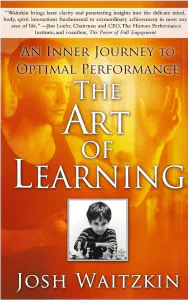
Josh Waitzkin the inspiration for the movie Searching for Bobby Fischer, is no stranger to creating change in his life. He won his first National Chess Championship at nine and later became a Tai Chi Push Hands champion. His life has been all about learning to adapt and excel.
In his book “The Art of Learning,” Waitzkin shares lessons from his chess and Tai Chi mentors. This stuff applies way beyond board games or martial arts. It’s wisdom for learning, life and education.
The book has three parts:
- Waitzkin’s early chess days and what he picked up from the Grandmasters.
- His journey from rookie to master in Tai Chi.
- How the skills and mindset overlap between chess and Tai Chi.
But this book isn’t just for chess nerds or kung fu fans. It’s about reaching your potential in anything you do. Waitzkin mixes his life stories with deep insights on the learning process.
- What did I get out of it?
- Who Should Read It?
What did I get out of it?
I have to confess, a lot of the chess and Tai Chi specifics in the book didn’t resonate with me personally. Those aren’t my areas of cup of tea.
However, where Waitzkin truly shines is in his insights on the psychological aspects of performance. He explores how to effectively harness emotions, cultivate resilience in the face of adversity, and adopt a growth-oriented mindset. As someone who has long grappled with imposter syndrome, I found Waitzkin’s perspectives on skill acquisition and development to be transformative.
The moment we believe that success is determined by an ingrained level of ability as opposed to resilience and hard work, we will be brittle in the face of adversity.
While the book does contain a wealth of wisdom specific to chess and Tai Chi, I believe Waitzkin’s core teachings have far-reaching applications.
The key lessons I took away from the book, with detailed notes and highlights are as follows:
Embracing growth and learning
In this section, we explore Josh’s focus on his journey to mastery and what it took to embrace a lifelong learning mindset. This entails following action points:
Commit to Growth:
- Set a specific goal that requires you to leave your comfort zone, whether it’s learning a new skill or tackling a challenging project.
- Treat every challenge as a creative opportunity to improve.
Master the Basics:
- Review the fundamental skills of your field and identify gaps to focus on in your daily routine.
- Practice these basics consistently until they become second nature.
Integrate Knowledge, Intuition, and Creativity:
- Apply what you’ve learned by trusting your gut in practical situations and finding innovative solutions to challenges.
Balance Confidence with Humility:
- Use setbacks as learning moments and stay open to constructive criticism.
- Identify the skills required to reach your next level and work on developing them.
Value the Journey:
- Reflect on each challenge as a steppingstone to your goals.
- Maintain curiosity and perspective to keep stress at bay and focus on steady progress.
Notes and Highlights
The key to pursuing excellence is to embrace an organic, long-term learning process, and not to live in a shell of static, safe mediocrity. Usually, growth comes at the expense of previous comfort or safety.
True excellence comes from a long-term commitment to learning, even if it means stepping out of your comfort zone.
It is critical to realize that we can always evolve in our approaches to learning.
We can always find new ways to learn and improve. There is no one size fits all approach.
Keep experimenting. Even when we think that things are going well, there is always room for improvement.
I was also gradually internalizing a marvelous methodology of learning—the play between knowledge, intuition, and creativity.
Highlighting the deep interplay between three critical elements of mastery:
- Knowledge: This is about the facts, theories, and structured information we accumulate through study and experience. This is what he refers to as fundamentals.
- Intuition: This comes from internalizing our knowledge to the point where we can make decisions or solve problems on a gut level, often without conscious reasoning. We often refer to as unconscious mastery.
- Creativity: This involves using our knowledge and intuition in novel ways to come up with unique solutions or innovations.
A key component of high-level learning is cultivating a resilient awareness that is the older, conscious embodiment of a child’s playful obliviousness. This journey, from child back to child again, is at the very core of my understanding of success.
True learning involves developing a mindful yet playful awareness, much like returning to the curious and carefree mindset of a child.
Don’t take yourself too seriously? Maintain a curious, experimental approach?
My understanding of learning was about searching for the flow that lay at the heart of, and transcended, the technical.
Learning is about finding the ‘flow’ that goes beyond just technical skills—it’s about understanding the deeper essence.
Flow = in the zone
Look for intrinsic motivation and an inner scorecard. Flow can more easily be achieved if driven by an internal motivation and an intense desire to best our former self.
When aiming for the top, your path requires an engaged, searching mind. You have to make obstacles spur you to creative new angles in the learning process. Let setbacks deepen your resolve.
If you want to reach the top, stay curious and use obstacles as motivation to find creative new ways to learn and grow. Setbacks should make you more determined as they stretch and test your abilities.
Be adaptable and open to experimentation.
The beautiful thing about this approach to learning is that once we have felt the profound refinement of a skill, no matter how small it may be, we can then use that feeling as a beacon of quality as we expand our focus onto more and more material. Once you know what good feels like, you can zero in on it, search it out regardless of the pursuit.
Once we’ve experienced what mastery feels like in one area, we can use that feeling to guide you toward excellence in other pursuits.
Apply successes from one successful project to all future work.
One of the most challenging leaps for Push Hands students is to release the ego enough to allow themselves to be tossed around while they learn how not to resist
Accept criticism or setbacks humbly, treating them as opportunities to learn and adapt without rigidly clinging to past strategies.
As a parent or partner, accept that we might make mistakes or misunderstand situations. Approach these moments as chances to grow, avoiding a defensive mindset.
In my experience, successful people shoot for the stars, put their hearts on the line in every battle, and ultimately discover that the lessons learned from the pursuit of excellence mean much more than the immediate trophies and glory. In the long run, painful losses may prove much more valuable than wins—those who are armed with a healthy attitude and are able to draw wisdom from every experience, “good” or “bad,” are the ones who make it down the road. They are also the ones who are happier along the way. Of course, the real challenge is to stay in range of this long-term perspective when you are under fire and hurting in the middle of the war. This, maybe our biggest hurdle, is at the core of the art of learning.
The real challenge is maintaining that long-term perspective under pressure.
Value lessons from the journey more than the victories.
Have always visualized two lines moving parallel to one another in space. One line is time, the other is our perception of the moment.
Josh Waitzkin is describing two interconnected concepts:
- Time: The objective passage of time as it moves forward, unaffected by perception or emotions.
- Perception of the Moment: Our subjective experience and awareness of what is happening at a given point in time. This is influenced by factors like emotions, focus, stress levels, and mental state.
Josh envisions these two lines as moving parallel to each other because time progresses consistently, while our perception of events and moments varies based on our state of mind. This gap between objective time and our perception of it can lead to differences in how we experience moments, especially under pressure or stress.
For instance, in high-stakes scenarios, people often say that time seems to slow down because they’re so focused on the present moment. Alternatively, in a state of distraction or when under stress, time might feel like it’s speeding up.
Understanding this concept allows us to be more mindful of how our perception shapes our experience, helping us to better manage pressure, pace ourselves, and approach challenges with a clear, focused mindset.
One thing I have learned as a competitor is that there are clear distinctions between what it takes to be decent, what it takes to be good, what it takes to be great, and what it takes to be among the best.
What got us to being decent will not take us to being good. Similarly, what makes us good will not make us great. We have to continuously learn and understand the skills required to level up.
The human mind defines things in relation to one another—without light the notion of darkness would be unintelligible
We understand things by comparing them to their opposites. Our perception is shaped by contrasts. We understand concepts like “success” by comparing it to setbacks and challenges.
Favoring depth of understanding over sheer breadth
Josh Waitzkin’s philosophy in this section is all about going deep rather than wide. Here are some action points:
Master the Fundamentals:
- Focus on understanding the core principles of your field, not just learning facts. Practice them until they become second nature.
Internalize Your Knowledge:
- Study until the knowledge becomes intuitive and you can apply it naturally in any situation.
Apply Principles Across Areas:
- Once you’ve mastered the basics in one area, identify how those same principles can be used in other fields or tasks.
Live Your Values:
- Practice important values like empathy and patience regularly until they influence all your interactions.
Go Deep, Not Wide:
- Instead of trying to learn everything quickly, focus on gaining a deep understanding of a few key concepts and apply them well.
Take Your Time:
- Slow down and learn thoroughly. When your skills are deeply ingrained, you’ll perform better under pressure.
Notes and Highlights
Start with the fundamentals, get a solid foundation fueled by understanding the principles of your discipline, then expand and refine your repertoire, guided by your individual predispositions, while keeping in touch, however abstractly, with what you feel to be the essential core of the art. What results is a network of deeply internalized, interconnected knowledge that expands from a central, personal locus point. The question of intuition relates to how that network is navigated and used as fuel for creative insight.
Building a deep, fundamental understanding of your discipline, and then expand knowledge based on personal strengths and interests.
- Focus deeply on understanding core finance and accounting principles and processes.
- As a father, help kids develop strong fundamentals in math, science and language. Rest is up to them.
One has to investigate the principle in one thing or one event exhaustively…Things and the self are governed by the same principle. If you understand one, you understand the other, for the truth within and the truth without are identical.
Mastery in one area can enhance understanding and skills in seemingly unrelated areas because the core principles of discipline, learning, and growth are universal.
For example: consistency in fitness can teach us how showing up and following a regular workout plan and the value of incremental progress. This same principle applies to our careers — developing a daily routine for working on upgrading our skills ensures steady improvement and productivity.
Eventually the foundation is so deeply internalized that it is no longer consciously considered but is lived. This process continuously cycles along as deeper layers of the art are soaked in.
When you really learn something, it becomes a part of you, almost like it’s on autopilot.
Holds true for values as well. If we practice empathy and patience, they become part of who we are.
From both educational and technical perspectives, I learned from the foundation up.
Mastering anything requires learning basics and fundamentals. Education should focus on foundational values and skills. Children will build on as they grow and face more complex life situations.
Everyone races to learn more and more, but nothing is done deeply. Things look pretty but they are superficial, without a sound body mechanic or principled foundation. Nothing is learned at a high level
People often rush to learn as much as they can, but they don’t learn deeply. It’s not the number of books you read but what you get out of them.
Don’t chase every investment opportunity. Invest in what you understand.
Break down anything into its small, core components and master one at a time
This is the core theme of the book. What Waitzkin refers to as drawing smaller circles.
We have to be able to do something slowly before we can have any hope of doing it correctly with speed.
To do something well and quickly, you first need to learn how to do it slowly and accurately. It’s about moving from conscious skill to unconsciously skilled.
The fact is that when there is intense competition, those who succeed have slightly more honed skills than the rest. It is rarely a mysterious technique that drives us to the top, but rather a profound mastery of what may well be a basic skill set. Depth beats breadth any day of the week, because it opens a channel for the intangible, unconscious, creative components of our hidden potential.
Those who win have slightly better skills. It’s not some secret technique but mastering basic skills deeply. Depth beats breadth because it unlocks hidden creativity and potential.
Strategies for developing resilience
Balance Confidence and Humility:
- Stay confident in your abilities but recognize that setbacks can happen. Accept them as learning opportunities and move forward with a clear head.
Teach Resilience at Home:
- Encourage your kids to see mistakes as part of the learning process. Let them know that it’s okay to fail and that they don’t need to be perfect.
Avoid Repeated Mistakes:
- Learn from past errors and focus on not repeating them. Stay alert and avoid unnecessary risks.
Monitor Quality in Solitary Work:
- In solo projects, like writing or painting, be your own quality checker. Stay focused and self-aware.
Create Action Triggers:
- Set up specific cues, like putting on workout clothes or reading before bed, to initiate positive habits and routines.
Find Peace in Discomfort:
- When facing challenges, remain calm and embrace them as opportunities to grow. Stay grounded and focused, and don’t be deterred by setbacks.
Stay Present:
- Practice staying focused in everyday situations so that you can maintain composure under pressure.
Notes and Highlights
Confidence is critical for a great competitor, but overconfidence is brittle. We are too smart for ourselves in such moments. We sense our mortality like a cancer beneath the bravado, and when things start to go out of control, there is little real resilience to fall back on.
Being confident helps you compete, but being overconfident can break you down when things go wrong because you aren’t prepared to bounce back.
Be confident in investment strategies and trades but always manage risk.
Some of the brightest kids prove to be the most vulnerable to becoming helpless, because they feel the need to live up to and maintain a perfectionist image that is easily and inevitably shattered.
People often struggle because they try to keep up a perfect image, which is hard to maintain and easy to break. This is why it is important to develop an internal scorecard.
Develop a culture where mistakes are seen as opportunities to learn. This is especially true at home, where we have to teach our kids that it’s okay to make mistakes and they don’t always need to be perfect.
Similarly in investments, accept that all decisions are opportunities to learn and some, if not most, will not yield perfect results.
I have long believed that if a student of virtually any discipline could avoid ever repeating the same mistake twice—both technical and psychological—he or she would skyrocket to the top of their field. So the aim is to minimize repetition as much as possible, by having an eye for consistent psychological and technical themes of error.
As Warren Buffet and Charlie Munger say key to long term resilience and survival is in avoiding mistakes.
Avoiding stupidity and learning from mistakes is a recurring theme.
While more subtle, this issue is perhaps even more critical in solitary pursuits such as writing, painting, scholarly thinking, or learning. In the absence of continual external reinforcement, we must be our own monitor, and quality of presence is often the best gauge.
Staying calm and focused under pressure is what sets the best apart from the rest.
The secret is that everything is always on the line. The more present we are at practice, the more present we will be in competition, in the boardroom, at the exam, the operating table, the big stage.
Practice being fully present in everyday tasks, we’ll perform better when it really counts.
My method is to work backward and create the trigger.
Reverse-engineer the process and build a trigger that sets it in motion.
Trigger means creating a specific cue or signal that initiates a desired action or behavior. Examples: reading at bedtime, putting work-out clothes.
Virtually all situations can be handled as long as presence of mind is maintained
Calm and focus.
One idea I taught was the importance of regaining presence and clarity of mind after making a serious error.
Regain calm and focus after a mistake. Clear the head as now is not the time to dwell on the mistakes.
Losing was part of my regular experience. I believe this was important for maintaining a healthy perspective on the game.
Losing teaches us lessons and humility. Both are absolutely essential for developing resilience.
I was a competitor who knew winning and losing and the hair’s breadth between. My rivals didn’t care about reputation—they just wanted to crush me and I had to keep it real.
Our competitors do not care about our reputation. They just want to defeat us. Knowing that, should keep us humble and grounded.
Left to my own devices, I am always looking for ways to become more and more psychologically impregnable. When uncomfortable, my instinct is not to avoid the discomfort but to become at peace with it. When injured, which happens frequently in the life of a martial artist, I try to avoid painkillers and to change the sensation of pain into a feeling that is not necessarily negative. My instinct is always to seek out challenges as opposed to avoiding them.
Developing mental resilience involves getting comfortable with discomfort and pain.
Be it at work, personal life or opportunities in general, change the frame and look at challenges as opportunities to learn and grow.
The critical role of rest and recovery
In this section, Josh emphasizes the importance of rest and recovery in achieving long-term success. Here are some action items I noted down:
Take Short Breaks:
- Schedule short breaks during intense work to recharge. Use them to stretch, listen to music, or step outside for fresh air.
Establish a Recovery Routine:
- Practice deep breathing exercises, listen to calming music, or meditate to build a recovery routine that helps you refocus before any task.
Avoid the Spiral of Mistakes:
- Don’t dwell on your first mistake. Recover quickly to avoid a chain reaction of further errors.
Try Interval Training:
- Alternate between periods of intense exercise and relaxation to train your body and mind to recover more effectively from stress and fatigue.
Integrate Stress and Recovery:
- Add the rhythm of stress and recovery into your everyday life. Take time to reset when focus is lost, then return with a clear mindset.
Create a Pre-Performance Ritual:
- Conserve energy before important tasks. Develop a calming ritual to help you stay centered and focused.
Balance Work and Rest:
- Make sure your schedule has room for intentional rest alongside hard work, so you can maintain peak performance without burning out.
Notes and Highlights
I have come to understand that these little breaks from the competitive intensity of my life have been and still are an integral part of my success.
Take short breaks from intense work to recover. Step back from monitoring and focusing all the time.
Once the routine is internalized, it can be used before any activity and a similar state of mind will emerge.
Importance of having a recovery routine e.g. breathing, counting etc. Once it is ingrained, we can use it before any task to reach the same focused mindset.
Review process before making investment decisions that puts you in a calm, analytical mindset and reinforces your long-term strategy.
The first mistake rarely proves disastrous, but the downward spiral of the second, third, and fourth error creates a devastating chain reaction.
We should aim to recover after the first mistake. It isn’t the first mistake which is usually catastrophic. However, it is when we dwell on it and do not recover properly and make subsequent mistakes without recovering.
The physical conditioners at LGE taught me to do cardiovascular interval training on a stationary bike that had a heart monitor. I would ride a bike keeping my RPMs over 100, at a resistance level that made my heart rate go to 170 beats per minute after ten minutes of exertion. Then I would lower the resistance level of the bike and go easy for a minute—my heart rate would return to 144 or so. Then I would sprint again, at a very high level of resistance, and my heart rate would reach 170 again after a minute. Next I would go easy for another minute before sprinting again, and so on. My body and mind were undulating between hard work and release. The recovery time of my heart got progressively shorter as I continued to train this way.
At LGE they had discovered that there is a clear physiological connection when it comes to recovery—cardiovascular interval training can have a profound effect on your ability to quickly release tension and recover from mental exhaustion. What is more, physical flushing and mental clarity are very much intertwined.
Interval training, where the body alternates between periods of intense effort and relaxation, creates a direct link between physical conditioning and mental clarity.
As the body gets better at quickly recovering from high-intensity sprints, it trains our mind to bounce back from stress and fatigue more rapidly too. This relationship between physical and mental recovery highlights the importance of balancing hard work with intentional rest, creating a rhythm where performance and recovery reinforce each other.
If you are interested in really improving as a performer, I would suggest incorporating the rhythm of stress and recovery into all aspects of your life. Truth be told, this is what my entire approach to learning is based on—breaking down the artificial barriers between our diverse life experiences so all moments become enriched by a sense of interconnectedness. So, if you are reading a book and lose focus, put the book down, take some deep breaths, and pick it up again with a fresh eye.
Integrate stress and recovery into every aspect of life. My approach to learning is about breaking down barriers between experiences, finding connections that enrich all moments. When you lose focus, take a breather and start again with renewed clarity.
If a conversation becomes frustrating, pause to collect your thoughts. Approach the issue again after taking a short break to improve communication.
The more seasoned competitors relax, listen to headphones, and nap. They don’t burn through their tanks before stepping on the mats
Conserve energy and focus my relaxing. Develop a ritual which gets you in focus. Practice the ritual so that focus is associated with that ritual.
Honing and trusting one’s intuition
Practice Chunking:
- Group related information into logical patterns so you can easily recall it when needed.
Create Mental Pathways:
- Practice consistently to build strong mental links between concepts, making it easier to navigate and apply them effortlessly.
Focus on Crucial Details:
- Train your mind to handle technical aspects unconsciously, so your conscious mind can focus on the most important details.
Internalize Principles:
- Master the core principles of your field so well that they guide your actions naturally and consistently.
Channel Your Emotions:
- Observe your emotions without being overwhelmed by them. Use them to fuel creativity and adapt to each situation.
Adjust Your Strategy Daily:
- Reflect on your mood each morning and align your daily strategy to match your current energy and mindset.
Trust Your Intuition:
- Develop principles and routines until they’re second nature, so you can trust your intuition when responding to challenges.
Notes and Highlights
The clearest way to approach this discussion is with the imagery of chunking and carved neural pathways. Chunking relates to the mind’s ability to assimilate large amounts of information into a cluster that is bound together by certain patterns or principles particular to a given discipline.
In a nutshell, chunking relates to the mind’s ability to take lots of information, find a harmonizing/logically consistent strain, and put it together into one mental file that can be accessed as if it were a single piece of information.
Think of ‘chunking’ as the mind’s way of grouping lots of information into meaningful patterns that help you understand a subject better.
By “carved neural pathways” I am referring to the process of creating chunks and the navigation system between chunks.
Creating carved neural pathways involves consistent practice and repetition to build strong mental connections between different pieces of information.
The similarity is that a life-or-death scenario kicks the human mind into a very narrow area of focus. Time feels slowed down because we instinctively zero in on a tiny amount of critical information that our processor can then break down as if it is in a huge font. The trained version of this state of mind shares that tiny area of conscious focus. The difference is that, in our disciplines of choice, we cultivate this experience by converting all the other surrounding information into unconsciously integrated data instead of ignoring it. There is a reason the human mind rarely goes into that wild place of heightened perception: if an untrained fighter were to focus all his energy on his opponent’s breath pattern or blinking eye, he would get punched in the face or thrown on the ground.
In intense situations, our minds focus on a small area, making time seem slower. But in training, we practice absorbing the broader information unconsciously while maintaining sharp focus.
If, through incremental training as described earlier in the book, your unconscious understanding of your discipline of choice has become sufficiently advanced, and you have learned how to trust your physical and intuitive intelligence to handle the technical components of your moment, then your conscious mind can zoom in on very small amounts of data.
With training, your unconscious understanding will handle the technical stuff so your conscious mind can focus on small, crucial details.
Action point: develop routines to the point they become second nature.
At a high level, principles can be internalized to the point that they are barely recognizable even to the most skilled observers.
When you’ve mastered something deeply, the core principles become so ingrained that they’re hard for outsiders to spot.
Internalize risk management principles like inversion so they become second nature when making any decisions. Doesn’t matter the decisions are work related or personal.
Tactics come easy once principles are in the blood.
Once we’ve fully internalized the principles, figuring out the right tactics becomes second nature.
There are those elite performers who use emotion, observing their moment and then channeling everything into a deeper focus that generates a uniquely flavored creativity. This is an interesting, resilient approach based on flexibility and subtle introspective awareness. Instead of being bullied by or denying their unconscious, these players let their internal movements flavor their fires.
Josh is pointing out that elite performers have a flexible, introspective approach to their emotions. Instead of denying or being overwhelmed by their feelings, they observe them and channel that energy into focused creativity. This mindset allows them to stay resilient and adaptive, finding unique ways to leverage their emotions as fuel for peak performance.
The former World Chess Champion Tigran Petrosian was known by his rivals to have a peculiar way of handling this issue. When he was playing long matches that lasted over the course of weeks or even months, he would begin each day by waking up and sitting quietly in his room for a period of introspection. His goal was to observe his mood down to the finest nuance. Was he feeling nostalgic, energetic, cautious, dreary, impassioned, inspired, confident, insecure? His next step was to build his game plan around his mood. If he was feeling cautious, quiet, not overwhelmingly confident, he tended to choose an opening that took fewer risks and led to a position that harmonized with his disposition. If feeling energized, aggressive, exceedingly confident, he would pick an opening that allowed him to express himself in a more creative vein.
Tap into the emotions and then tailor the response to any challenge. This requires:
- Introspection: Understand current emotional state.
- Alignment: Build approach around mood
- Adaptability: Being flexible with plans based on emotions
Who Should Read It?
If you’re someone who struggles with imposter syndrome or self-doubt, “The Art of Learning” offers insights and strategies for overcoming these challenges. Waitzkin’s experiences and lessons learned can help you develop a more resilient and growth-oriented mindset, enabling you to approach skill acquisition with greater confidence and effectiveness.
This book is also an excellent resource for anyone interested in picking up new skills or improving their learning process. Waitzkin delves into the science of learning, exploring the cognitive and psychological principles that underlie skill acquisition. He presents us with a solid guide on how to optimize your learning, drawing from research in fields such as neuroscience, psychology, and education.
The science of learning goes beyond the simple idea that studying leads to skill acquisition. It encompasses an understanding of how the brain processes information, the role of mindset and motivation in learning, and the importance of deliberate practice and feedback. This book provides a practical framework for applying these principles to our own learning journey.
For readers interested in exploring the science of learning further, I highly recommend checking out Barbara Oakley’s Ted Talk, “Learning How to Learn.” Oakley’s talk complements the ideas presented in “The Art of Learning,” providing additional insights into the neuroscience of learning and strategies for effective skill acquisition.
Whether you’re a student, professional, or lifelong learner, “The Art of Learning” offers valuable insights and practical strategies for anyone seeking to cultivate a growth mindset, overcome imposter syndrome, and master new skills more effectively.