 Mandelbrot
 The Accountant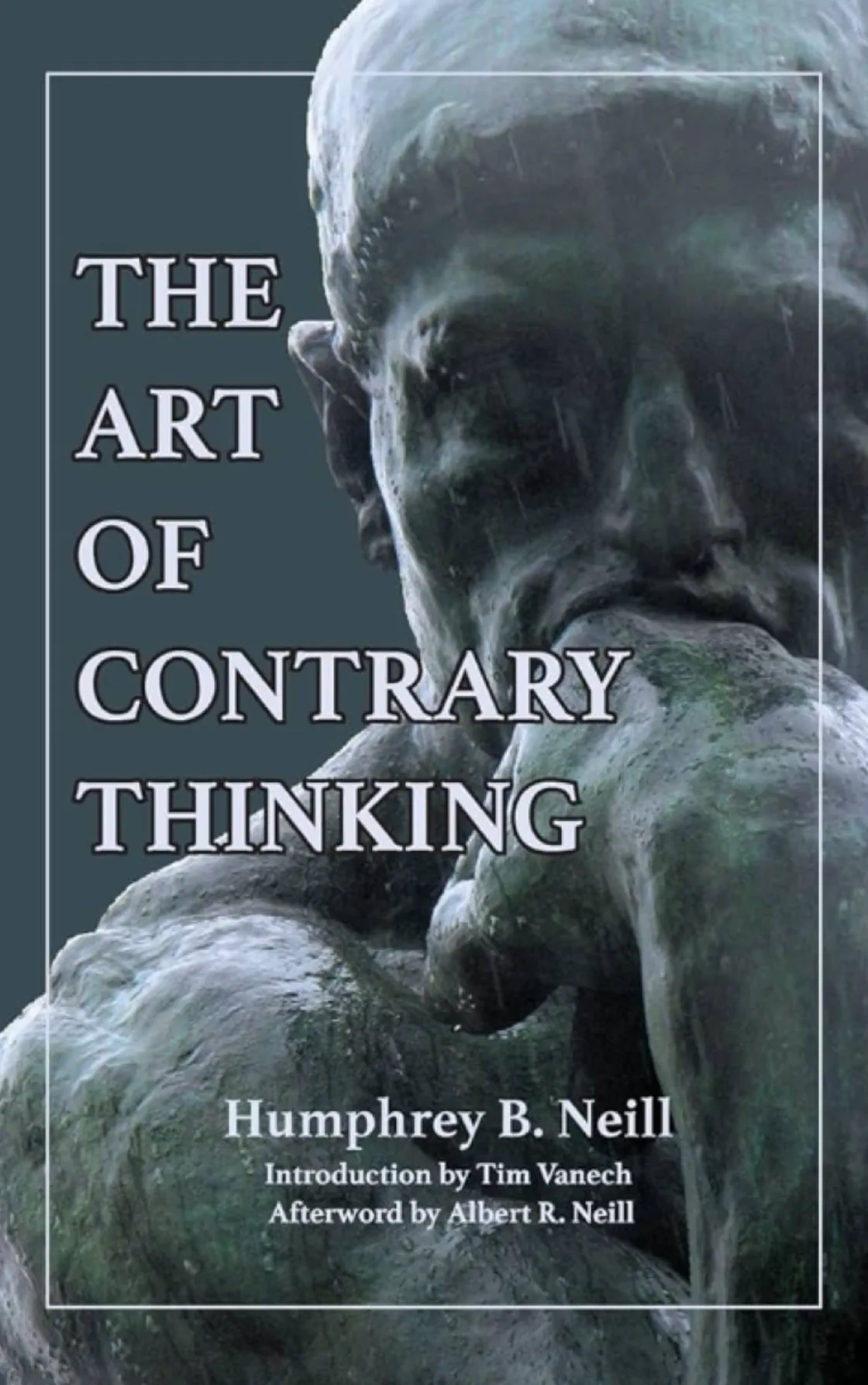
Out on the tracks, the physical business was breaking down. Freight cars vanished by the thousands in disorganized classification yards. Waybills were lost. Winter storms paralyzed the network, and the core operations were bleeding out cash daily. Yet inside the boardroom, the paperwork remained orderly. The directors reviewed the forward estimates, accepted the synergy models, and unanimously voted to pay out millions in dividends using borrowed money.
When the cash finally snapped in June 1970, triggering what was then the largest bankruptcy in history, the shock was absolute. What holds the attention in the episode is not the mechanical failure of the business. It is the unbroken tranquility of the room. The board did not panic. They were not ignorant men. They simply sat together, accepted the prevailing assumptions, and nodded politely right up until the floor gave way.
Humphrey Neill spent a career studying that reflex, and The Art of Contrary Thinking, first published in 1954, is his attempt to name it and, more ambitiously, to position against it.
When everyone thinks alike, everyone is likely to be wrong.
The book is thin and repetitive, closer to a set of notebook fragments than a treatise. Neill circles the same idea from a dozen angles, quotes long-dead French sociologists at length, and rarely lands on anything you could call a method. That is partly the point. Contrary thinking, in his telling, is not a system you install. It is a habit you practice until it runs on its own.
What Did I Get Out of It
When Everyone Thinks Alike
Neill’s crowd is not a mob of fools. It is a room full of capable people who have quietly surrendered the part of themselves that reasons.
“crowd” thinks with its heart (that is, is influenced by emotions) while an individual thinks with his brain.
The distinction matters because it removes the comfort of assuming the crowd is other, dumber people. The trader who panics at the bottom is not stupid the rest of the year. He is intelligent minus his individuality, which the herd strips off the moment the herd forms. I have watched sharp colleagues walk into a meeting with a clear private view and walk out having adopted the room’s consensus, not because they were persuaded but because dissent is expensive and agreement is warm.
An individual may think out his opinions, whereas a crowd is swayed by emotional viewpoints rather than by reasoning or reason-why arguments.
Neill leans on Gabriel Tarde and Gustave Le Bon to argue the same point across a century of writing: imitation and contagion are constants of human wiring, unchanged by education or information. The lesson lands close to home. Diogenes was already mocking conformity in the fourth century BC, and the pull of conformity has not weakened since. We think we panic differently than our ancestors. We just panic with more screens open.
Right During the Trend, Wrong at the Turns
The most useful thing Neill does is refuse the lazy version of contrarianism. Betting against the crowd as a reflex is its own kind of herd behaviour, and he says so plainly.
The public is perhaps right more of the time than not. In stock market parlance, the public is right during the trends but wrong at both ends!
The crowd rides the trend correctly for most of its length. The contrarian who shorts a rising market on day one because everyone is bullish gets carried out long before the top. The edge is not in opposing the crowd but in reading the junctures, the terminals of trends, where consensus has become so total that no marginal buyer is left to recruit.
the public is always wrong when it pays to be right.
That line reads like a paradox until you sit with the arithmetic. When a view goes unanimous, the position is already fully expressed in price, which means the fuel is spent. The same machinery I traced through the South Sea Company and FTX runs here: the market tops when the last sceptic capitulates. Neill’s framework is the psychological companion to what A Short History of Financial Euphoria and Devil Take the Hindmost document from the outside, and to the supply logic of Capital Returns: capital floods where the story is loudest and starves where it is quiet.
The Mirror That Shows Your Own Face
Here is where the book stops being comfortable. To trade against the crowd you first have to measure the crowd, and the instrument you measure it with is your own mind, the least reliable gauge you own.
You will jump to the conclusion that the public opinion is as you wish it were, and thus, unconsciously, you become a member of the “public” and in reality think as the public does.
Neill catches the trap most contrarians never see. You form a private view, look out at the world, and find your view reflected back or opposed, and either way you have mistaken your own projection for a reading of the crowd. He puts the corrective as a question worth taping to a monitor.
Is this truly a generalized viewpoint, or is it perhaps a composite of my own views which the “mirror” misleads me to think are those of the “crowd”?
I read that as confirmation bias wearing a contrarian costume. When I review someone’s forecast or a control assessment, the danger is never that I lack an opinion. It is that I arrive with one and then gather the crowd’s supposed view as corroboration for a conclusion I had already reached. Neill’s own warning is blunt: a person with pre-established views turns to contrary opinion merely for corroboration. The mirror flatters. The discipline is to keep asking whose face is actually in it, a problem I keep circling in borrowed conviction.
The Sin of Extrapolation
Every forecast I have seen carries a hidden assumption that tomorrow will resemble today. Neill names it and treats it as the central error.
the common method of looking ahead is to assume that what is now happening is likely to continue in the same manner? This is termed “extrapolation”.
The straight line is the most seductive shape in finance. It flatters the recent past into a law of nature. Warm today, warm tomorrow. Rising this quarter, rising next. I wrote after a sharp recovery about the posture I failed to take precisely because I let the trend do my thinking for me. Neill’s deeper cut is that the present does not just mislead about the future; it manufactures the opinions that then get extrapolated.
a common error we’re all prone to fall into is mixing cause with effect… how often the prevailing conditions produced the opinions.
Conditions breed the consensus, and then the consensus is mistaken for analysis of the conditions. Good times generate optimistic forecasts, which get read as evidence that good times will persist. The same drift I traced in institutional memory, where each small neglect looks reasonable until you look far enough back, lives inside the earnings model too. The line on the chart is not a forecast. It is a mood with a ruler laid against it.
Not a Crystal Ball, a Check
The claim that reframed the whole book for me is also its most modest.
Contrary opinions do not forecast, but they do check others’ forecasts!
Neill does not promise you will call the top. He promises something smaller and more durable: a tool for finding the error in a consensus before you commit to it. That reframing matters, because a contrarian who believes he is predicting will keep score against reality and lose his nerve when the timing is off. A contrarian who is only stress-testing the crowd’s assumptions can be early, and stay early, without being wrong. The theory, as Neill puts it elsewhere, is worth more for avoiding errors than for making calls.
Visualize, if you will, a management committee sitting around a table discussing forward trends and policies. Suppose a contrary fellow every now and then breaks in and asks: “Have you thought about the matter from this angle?”
The scene is exactly where I spend my working life. The value of the dissenting voice in a meeting is not that it is right. It is that it forces the room to defend an assumption it was about to wave through. Neill’s phrase for the exercise is thoughts before leaping to prevent jumps before concluding, which is inversion by another name. The idea connects to Superforecasting and Thinking in Bets: the good forecaster is not the one with the boldest prediction but the one most willing to hold his own reasoning up to the light and ask what would have to be true for it to be wrong.
The Value of Bewilderment
Neill’s last surprise is a defence of confusion, which cuts against every instinct trained into me to be decisive.
there is value in bewilderment. Consider the opposite of uncertainty and confusion; namely, dogmatism. I dare to say that more important errors in decisions arise from dogmatic opinions than from what I shall call “confused considerations.”
The pressure to be definite is what produces bad forecasts. Forced to commit early, we harden a guess into a conviction and then defend it past the point of evidence. Neill’s counsel is to let a hard problem kaleidoscope around in the back of the mind until the pieces settle, which is patience dressed as method. There is a companion aphorism he keeps returning to.
If you don’t think things through, you’re through thinking.
The line is glib, and it stuck anyway. Sitting with uncertainty is not the same as ducking a decision. It is refusing to let the discomfort of not-knowing stampede you into the nearest available opinion, which is usually the crowd’s.
Who Is This For
The book is short and dated, occasionally cranky. Neill wanders into political asides about socialism and inflation that read as products of their decade, and he quotes his French sources at a length that tests patience. If you want a rigorous framework with rules and back-tests, this is not that book, and you will finish it wondering what exactly you are meant to do on Monday morning.
Read it anyway if you make decisions in rooms full of other people. Anyone who sits on a committee, reviews forecasts, signs off on assessments, or runs money against a consensus will recognise the mirror Neill holds up. The book pairs well with Fooled by Randomness, and it works as the human-nature footnote to every financial history you have read.
What it changed in me is smaller than a strategy and harder to shake. I used to think of myself as an independent thinker because I could argue against a room. Neill made me suspect that reflexive opposition and reflexive agreement are the same failure wearing different clothes, and that the harder discipline is to check whether the crowd I am so proud of resisting is real or just my own face in the glass. I have not solved that. The book does not claim it can be solved. It only insists, correctly, that the practice is worth the effort, and that the person who stops thinking things through is already, quietly, through thinking.