 Mandelbrot
 The Accountant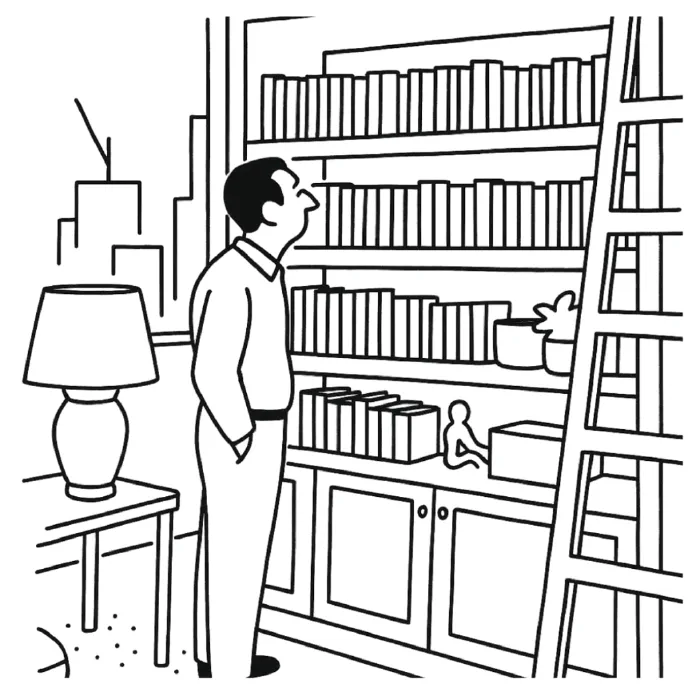
I recently turned 40, and when my wife asked what I wanted for my birthday, I answered without hesitation: “A home library.” Not a trendy shelf for coffee table books, but the real thing: floor-to-ceiling shelves, rows upon rows, the kind of library that demands its own ladder. We live in a small apartment in downtown Dubai. Space is a luxury we don’t have. But my wife, never one to shrink from a challenge, found a way: she designed a custom olive-green bookshelf, stretching from the floor up to our ceiling, cradling more than five hundred books.
It’s not Umberto Eco’s famous library of fifty thousand books. Mine is a humble fraction. And yet, standing in my living room, I see the same paradox that Eco cherished; a monument not to what I’ve read, but to what I haven’t.
Friends come over. Some glance at the shelves in quiet admiration. Others inevitably ask, “Have you read all these?” The question lands like a challenge, as if the value of a book rests on its having been consumed, digested, checked off a list.
Most days, I resist the urge to answer with Eco’s retort:
“It is foolish to think that you have to read all the books you buy, as it is foolish to criticize those who buy more books than they will ever be able to read. It would be like saying that you should use all the cutlery or glasses or screwdrivers or drill bits you bought before buying new ones.”
But the real answer is not about the books themselves. It is about what the unread books signal: possibility, humility, and the quiet thrill of knowing that you don’t know.
Sometimes the question comes with a laugh, sometimes it’s earnest, but it always lingers between us: a subtle accusation or maybe an invitation. I smile and let the question hang, because I’ve realized something quietly radical: wisdom isn’t about scaling a wall and planting a flag at the summit. The further I go, the higher the wall seems, and the shelves only make that more visible.
My library isn’t a trophy case. It’s an inventory of my ignorance, and a daily provocation to keep climbing, rung by rung.
The books I haven’t read are the truest measure of my curiosity and my limits. They chart the boundaries of what I do not know, a horizon that stretches further every year. Their presence is a kind of hope, not evidence of failure: a reminder that there is always something more to be discovered.
Nassim Taleb calls this the “anti-library”, a term that feels almost rebellious, as if the unread books are meant to unsettle, to remind us how small we truly are in the face of knowledge.
“The library should contain as much of what you do not know as your financial means … allow you to put there. You will accumulate more knowledge and more books as you grow older, and the growing number of unread books on the shelves will look at you menacingly. Indeed, the more you know, the larger the rows of unread books. Let us call this collection of unread books an antilibrary.”
Nassim Taleb - Black Swan
Sometimes, I’ll let my eyes drift across the spines: unread biographies, untapped histories, unopened collections of business books. They stare back, patient and enigmatic, promising worlds I may never enter, ideas I might only glimpse out of the corner of my eye. I think of it less as a deficit and more as a form of abundance: a garden left intentionally wild, always teeming with possibility.
The irony is that people keep asking the wrong question. Maybe the better one is: what does it do to a person, to live surrounded by so much you do not know?
But the anti-library is not just a clever philosophical concept; it’s a daily practice in humility. In a world that prizes having answers, it urges us to cultivate the habit of asking better questions. My shelves don’t exist to impress or to pretend mastery. They are a deliberately visible confession that I am a perpetual student, never finished, always in pursuit.
Sometimes, those unread spines remind me how tempting it is to cling to the familiar: to re-read favorites, or to seek comfort in the illusion of certainty. But more often, they nudge me toward curiosity. They insist there is more to learn if I’m willing to admit how little I know.
Living with an anti-library unsettles you, yes. But it also liberates you. It gives you permission to grow older without growing obsolete, to seek wisdom not in the number of books you’ve conquered, but in the humility of standing before what’s unconquered. Each unread book marks the edges of possibility.
The next time I’m asked if I’ve read them all, I think a better answer would be, I hope I never do.