 Mandelbrot
 The Accountant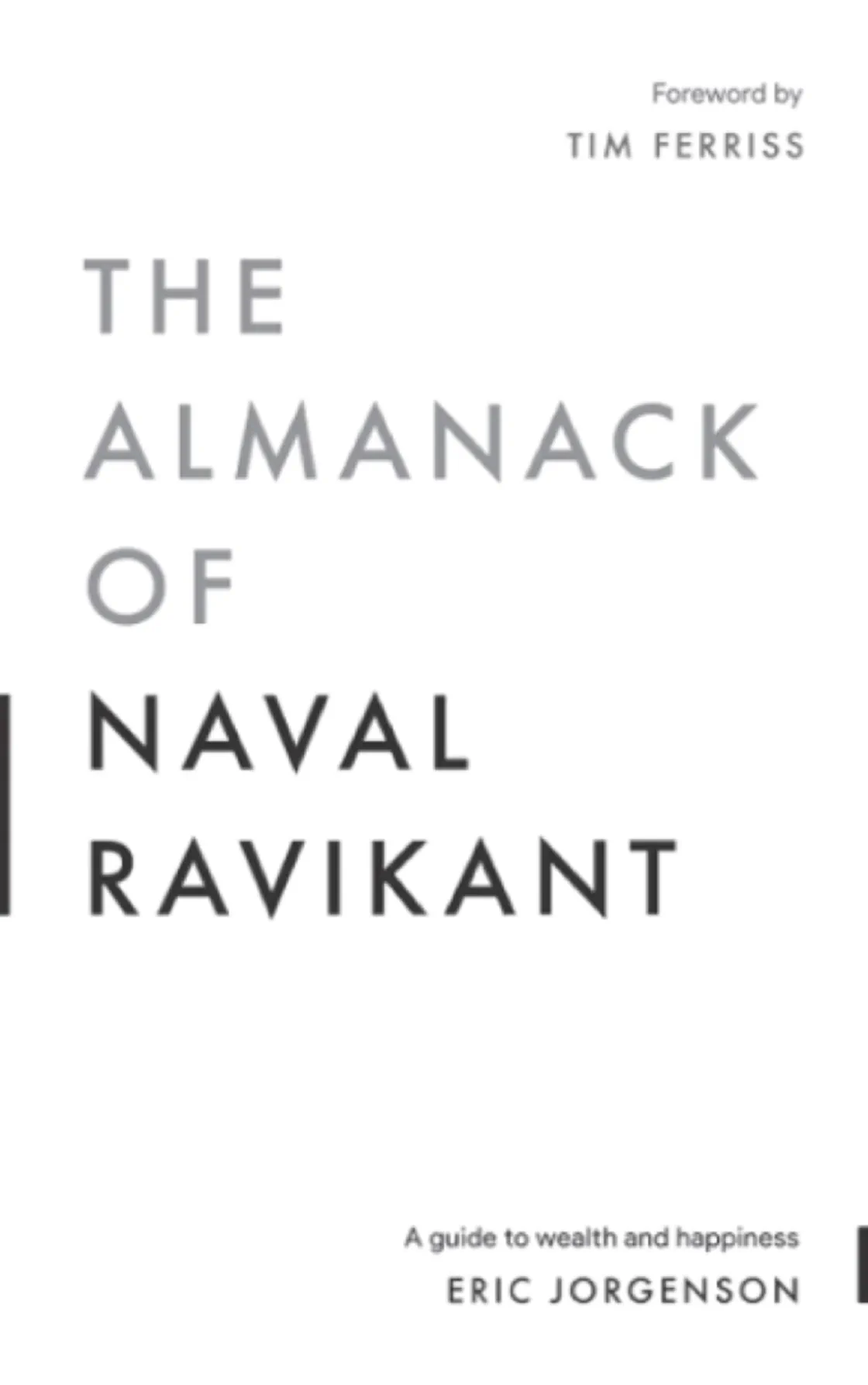
The whole book rests on one act of separation:
Seek wealth, not money or status. Wealth is having assets that earn while you sleep. Money is how we transfer time and wealth. Status is your place in the social hierarchy.
Three things most people treat as one. Wealth is what sits on the balance sheet. Money is a means of settlement, a claim on other people’s time. Status is a relative position that only exists because somebody else occupies a lower one. Once you pull them apart, most career decisions become clear and provide a new perspective, because you can finally see which of the three you have been optimizing for and whether you chose it.
That separation is the strongest thing in the book, because we often confuse them. The aphorism as a form carries insight and error at identical density, and it never tells you which one you’re holding. There are no footnotes, no counterexamples, no population of people who followed the advice and ended up ordinary. So the useful way to read it is as a set of propositions to be tested rather than a set of conclusions to be adopted. Some of them hold weight under pressure. Some wouldn’t make sense to you the moment you ask what would falsify them.
What Did I Get Out of It
Wealth Is a Position in the Capital Structure
Renting out hours has a ceiling and leaves no residue.
You’re not going to get rich renting out your time. You must own equity—a piece of a business—to gain your financial freedom.
A salary is a revenue line with no terminal value. The moment attendance stops, the cash flow stops, and nothing remains on the books to show for the years of production. Equity is a claim on residual cash flow that keeps flowing in your absence. The activity can be identical in both cases. What differs is where you sit relative to the assets, and anyone who has built a valuation model knows how much of the number lives in the tail that a wage simply doesn’t have. Felix Dennis said the same thing more bluntly in How to Get Rich, where ownership is treated as the only variable that finally matters.
Fortunes require leverage. Business leverage comes from capital, people, and products with no marginal cost of replication (code and media).
Capital requires somebody to grant it to you. Labor requires somebody to report to you. Code and media require nobody’s approval, which is why Naval calls them permissionless. What the book skips is the other side of the ledger. Leverage magnifies whatever it’s applied to, and permissionless leverage means the failures scale as freely as the wins, without a credit committee to slow anything down. Taleb’s argument in Skin in the Game sits directly across from this chapter.
Specific Knowledge Is a Cost Advantage, Not a Calling
The most practical test in the book has nothing to do with introspection.
When I talk about specific knowledge, I mean figure out what you were doing as a kid or teenager almost effortlessly. Something you didn’t even consider a skill, but people around you noticed. Your mother or your best friend growing up would know.
Not what you enjoyed, which truthfully we are unsure of and usually changes constantly, but what other people observed you doing well before anyone thought to reward it. Effortless to you, visible to them. Ask three people (other than your parents I suppose) who knew you at fifteen and you’ll get a more honest answer than any amount of reflection produces, because they have no stake in the flattering version.
“Escape competition through authenticity.” Basically, when you’re competing with people, it’s because you’re copying them. It’s because you’re trying to do the same thing. But every human is different. Don’t copy.
On the surface this contradicts Cal Newport’s argument in So Good They Can’t Ignore You, where passion follows competence rather than preceding it. I don’t think the two conflict. Specific knowledge has little to do with your feeling about your work. Almost anyone can learn almost anything, but not at the same price in attention and boredom, and curiosity drops that price. Cal Newport is describing the accumulation. Naval is describing why some people pick things faster in one direction than another.
Output, Not Input
Whenever you can in life, optimize for independence rather than pay. If you have independence and you’re accountable on your output, as opposed to your input—that’s the dream.
Almost every organization claims to measure output and almost none of them do. Hours logged, tickets closed, calls attended, response time on messages. Input metrics survive because they’re cheap to observe and comfortable to defend, and they degrade in the way every proxy degrades once people learn it’s being counted, which is the whole lesson of Chasing Metrics, Missing the Mark. Naval’s version of the knowledge worker as athlete, training and sprinting rather than grinding a fixed week, only works if somebody is genuinely willing to score the result instead of the effort. Most workplaces aren’t, and the book has nothing to say about operating inside one that isn’t.
Intentions don’t matter. Actions do. That’s why being ethical is hard.
That sentence describes my working life more accurately than anything else in the book. Design effectiveness and operating effectiveness are tested separately for a reason. A control that exists in a policy, that was approved, socialized, and mapped to a risk, is not a control if nobody performs the step. Every significant failure I have reviewed came with documentation prohibiting exactly what happened. The intent was on file. The action wasn’t. The distance between the two is where the losses accumulate, quietly, over quarters, until something forces an inspection.
Desire Is an Open Liability
Desire is a contract you make with yourself to be unhappy until you get what you want.
The word doing the work is contract. You sign it. It has a term and a price, and you agreed to both. The move Naval recommends is not eliminating desire, which is a monk’s answer to a householder’s problem, but knowing how many contracts are open at once and what each one costs to carry. Most people can’t name theirs. They just notice a background hum of insufficiency and assume it’s temperament. Morgan Housel gets at the same accounting from a different direction in The Psychology of Money, where the person with no definition of enough keeps moving the line and calls the movement ambition.
The problem is, to win at a status game, you have to put somebody else down. That’s why you should avoid status games in your life—they make you into an angry, combative person. You’re always fighting to put other people down, to put yourself and the people you like up.
Munger kept returning to envy as the engine of financial stupidity, and Poor Charlie’s Almanack treats it as a permanent feature of the human operating system rather than a character flaw. Naval tells us that wealth creation is positive-sum and recent, status is zero-sum and ancient, and the ancient game runs by default (it’s the Lindy effect in its negative form). Where the advice thins out is in the escape. He recommends refusing to play, which reads well until you work anywhere that promotions are finite. The Adlerian framing in The Courage to Be Disliked at least acknowledges what refusal costs socially. Naval treats it as a decision you simply make.
The Decisions That Carry the Weight
Spend more time making the big decisions. There are basically three really big decisions you make in your early life: where you live, who you’re with, and what you do.
Materiality applied to a life. Nobody sensible allocates testing effort evenly across every line of a set of accounts; you size the work to the balance and accept that small things get sampled or skipped. Calendars run flat by comparison. The same hour of deliberation goes to a laptop purchase and to a city. Russ Roberts argues in Wild Problems that the three Naval names are precisely the ones no calculation can settle, which doesn’t contradict the point. Decisions immune to clarity deserve more time, not less, because time is the only input that improves them.
Ways to get lucky: • Hope luck finds you. • Hustle until you stumble into it. • Prepare the mind and be sensitive to chances others miss. • Become the best at what you do. Refine what you do until this is true. Opportunity will seek you out. Luck becomes your destiny.
The ladder converts luck from an event into a position, which is the same argument I’ve made in Beyond Luck. The fourth rung is the interesting one, because it inverts the direction of search. You stop hunting opportunities and wait for them to come to you. The caution is that the ladder is described from the top, by a man for whom it worked, with no view of the people who climbed to the fourth rung and waited.
Where the Aphorism Runs Out
Reading science, math, and philosophy one hour per day will likely put you at the upper echelon of human success within seven years.
There’s no definition of upper echelon, no base rate, no accounting for the people who did it and stayed ordinary. Anyone who reads daily for seven years and arrives nowhere will be told they read the wrong books or read them the wrong way. The reading advice is still good. The number attached to it is just sounds good.
If you want to make the maximum amount of money possible, if you want to get rich over your life in a deterministically predictable way, stay on the bleeding edge of trends and study technology, design, and art. Become really good at something.
Deterministically predictable, from a man whose returns came out of early-stage investing, where a handful of positions carry the entire book and the rest die. Taleb built Fooled by Randomness around exactly this narration, the winner reconstructing a path and mistaking the surviving route for the only route. Naval is probably right about the direction and badly wrong about the certainty. Elsewhere he writes that almost all biases are time-saving heuristics and that important decisions deserve the discarding of memory and identity, which is a fair summary of Thinking, Fast and Slow compressed into a line.
Who Is This For
Read it if your entire income is a function of hours attended and you have not yet worked out what that implies about the ceiling. Read it if you’re early enough to still choose which form of leverage to build under yourself. Read it if you already read widely and want a dense index of positions to argue with, because the arguing is where the value is.
Skip it if you want a method. There is no how to in these pages, no sequence, nothing that survives contact with a difficult quarter or a specific constraint. Skip it if you’re allergic to a wealthy man explaining that happiness is a choice. He is not wrong, and the delivery will still irritate you.
The three big ones in life are wealth, health, and happiness. We pursue them in that order, but their importance is reverse.
I have spent most of my working life optimizing the input side. Being available, being responsive, being the person who answers. It reads like diligence from the inside and it produces a version of status rather than anything on the balance sheet. Naval’s distinction between output and input didn’t teach me something new. It brought to the surface a habit I had been holding dear and calling it professionalism. I haven’t fixed it. I’ve started noticing the substitution while it’s happening, which is a smaller thing than fixing it and still more than I had before.