 Mandelbrot
 The Accountant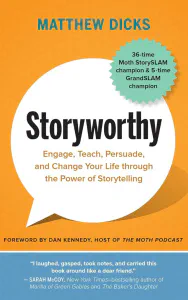
Matthew Dicks is right — every one of us has a story to tell. Whether on stage or on the page, we all possess narratives waiting to be shared. But the art of storytelling isn’t just about having a tale; it’s about how well you can tell it. And in my case, I discovered I had some work to do.
A colleague who brought this to my attention, their words as blunt as they were eye-opening, said, “You need to work on your storytelling skills.” Faced with such candid feedback, I had two choices: ignore the critique and pretend the problem didn’t exist or take action to improve.
Tell me the facts and I’ll learn. Tell me the truth and I’ll believe. But tell me a story and it will live in my heart forever.
— Ancient proverb
How do you tell better stories?
Storyworthy" by Matthew Dicks is a guide to the art of storytelling. The book combines practical advice with personal anecdotes from the author’s experiences. Dicks doesn’t just explain storytelling techniques; he demonstrates them through his own narratives. It’s part memoir, part instruction manual, and entirely engaging.
This book can be seen as a modern counterpart to Dale Carnegie’s “How to Win Friends and Influence People.” While Carnegie’s advice focuses on making others the center of attention, Dicks teaches how to captivate an audience through storytelling.
What Did I Get Out of It?
Calling books life-changing, but this one truly is. Even if you don’t become a better storyteller (the jury’s still out on me), it will change how you view everyday, mundane occurrences. As Dicks explains,
All great stories — regardless of length or depth or tone — tell the story of a five-second moment in a person’s life.
This perspective shift is just the beginning. As you go deeper into “Storyworthy,” you will uncover lessons that transform your life.
For me, some of the key lessons were:
How do you Collect Stories?
How can a single practice elevate your storytelling abilities to a whole new level? Matthew Dicks introduces Homework for Life.
Homework for Life – Every evening, ask yourself “what is my story from today? What is the thing about today that has made it different from any previous day?” Write this down. If you do this, before long you’ll have more stories than you can ever imagine.
Divide a journal into two columns, Date and Story. Each night, write down one story from that day but don’t spend more than five minutes on it.
I give this to you: Homework for Life. Five minutes a day is all I’m asking. At the end of every day, take a moment and sit down. Reflect upon your day. Find your most storyworthy moment, even if it doesn’t feel very storyworthy - Write it down. Not the whole story, but a few sentences at most. Something that will keep you moving, and will make it feel doable. That will allow you to do it the next day. If you have commitment and faith, you will find stories. So many stories.
Imagine you start doing this “Homework for Life” thing. At first, it might feel weird. You sit down at the end of the day and think, “What happened today that was different?”
Day one, you might struggle. “I got coffee. I worked. I watched TV.” Boring?
But then, on day three, you remember how the barista spelled your name wrong in a funny way. You write it down.
A week goes by. You notice more things. The way your coworker laughed at your joke. The sunset that made you stop and stare.
A month in, you’re seeing stories everywhere. That awkward moment in the elevator? Story. The phone call from an old friend? Definitely a story.
Before you know it, you’ve got a notebook full of moments. Some big, some small, but all uniquely yours. You start to realize your life is pretty interesting after all.
And the next time someone asks, “What’s new?” you’ve got a story ready to go.
In searching for stories, I discovered that my life is filled with them. Filled with precious moments that once seemed decidedly less than precious. Filled with moments that are more storyworthy than I’d ever imagined. I’d just been failing to notice them. Or discounting them. Or ignoring them. In some instances, I tried to forget them completely. Now I can see them. I can’t help but see them. They are everywhere. I collect them. Record them. Craft them. I tell them onstage. I share them on the golf course and to dinner companions. But most important, I hold them close to my heart. They are my most treasured possessions.
What is an Interesting Story?
While ‘Homework for Life’ teaches us to spot potential stories, understanding what makes a story truly interesting is a different skill altogether. It’s not about grand adventures or dramatic plot twists. Instead, it’s about finding the extraordinary in the ordinary, the universal in the personal.
You need not spend time in jail or crash through a windshield or have a gun jammed against the side of your head to tell a great story. In fact the simplest stories about the smallest moments in our lives are often the most compelling.
Think about your day yesterday. Maybe you didn’t fight a bear or win the lottery. But did you notice how your kid tied their shoes for the first time? Or how you finally figured out that tricky spreadsheet at work?
These little moments? They’re gold.
Remember when your mom gave you coins from her shopping trip for your piggy bank? It felt like treasure. Stories are like that. The small stuff can be the real treasure.
Like that time, you helped your dad with a simple task on the computer. Or when you finally mastered parallel parking. These aren’t blockbuster movie plots, but they’re real. They’re you.
People connect with these everyday moments. They nod and think, “Yeah, I’ve been there.” That’s the magic.
Next time you think your life is too boring for stories, look closer. The best tales might be hiding in plain sight, right in your ordinary, extraordinary day.
Do you Have a Story to tell?
Now that we’ve learned to spot and collect stories, let’s dive into what makes a story worth telling. It’s not just about having an interesting anecdote; it’s about crafting a narrative that resonates and transforms.
Your story must reflect change over time. A story cannot simply be a series of remarkable events. You must start out as one version of yourself and end as something new. The change can be infinitesimal. It need not reflect an improvement in yourself or your character, but change must happen. Even the worst movies in the world reflect some change in a character over time. So must your story. Stories that fail to reflect change over time are known as anecdotes. Romps. Drinking stories. Vacation stories. They recount humorous, harrowing, and even heartfelt moments from our lives that burned brightly but left no lasting mark on our souls.
Think about your favorite movies. The main character always changes, right? Maybe they start off scared and end up brave. Or they’re selfish at first but learn to care about others.
Now, let’s apply this to our own stories.
Imagine you’re telling a story about a camping trip. If you just say, “We went camping, saw a bear, and came home,” that’s not really a story. It’s just stuff that happened.
But what if you say, “I was terrified of the outdoors. Then we went camping. We saw a bear, and I surprised myself by staying calm. Now, I love nature.”
See the difference? In the second version, you changed. You started as one person and ended as another.
The change doesn’t have to be huge. Maybe you just learned to appreciate silence. Or realized you’re tougher than you thought.
Without this change, we’re just telling “that one time” stories. You know, like “that funny thing that happened at work” or “that crazy thing that happened on vacation.” They’re fun to tell, but they don’t really stick with people.
Real stories show how experiences shape us, even in tiny ways. They’re not just about what happened, but about how it changed us.
So next time you’re telling a story, think: “How was I different after this happened?” That’s where the real story lives.
If you think you have a story, ask yourself: Does it contain a five-second moment? A moment of true transformation? Your five-second moment may be difficult to find. You may have to dig for it.
Who is This Book For?
Storyworthy was easily the best and most impactful book I read in 2023. When I finished it, I felt like I’d been let in on a secret that others don’t know about. It’s that powerful.
But the thing is: this isn’t a quick fix or a one-time read. The techniques Dicks shares take time, effort, and lots of practice to master. You can’t just read it once and become a master storyteller overnight. I was very religious with Homework for life, but then forgot about it. From time to time, I try to make it part of my wind-up routine, but it requires discipline.
Sure, the book is packed with practical tips and actionable advice. I’ve even distilled many of these into a handy checklist below. But the real value of Storyworthy isn’t just in reading it - it’s in doing the work.
You have to apply what you’ve learned, day in and day out.
So, who is this book for? It’s for anyone who’s serious about becoming a better storyteller. It’s for people who are willing to put in the effort to transform their everyday experiences into compelling narratives. It’s for those who understand that great storytelling is a skill that can be learned and honed over time.
If you’re ready to see the world through a storyteller’s eyes and commit to the practice of finding and crafting stories, then Storyworthy is for you. Just remember: the book is just the beginning. The real magic happens when you start doing the work.
The Checklist
How to Find More Stories in Your Life
- Practice “Homework for Life”: Daily journaling of the most “storyworthy” moment
- Conduct “Crash and Burn” sessions: Nonjudgmental brainstorming for a set time
- Use the “First, Last, Best, Worst” exercise for various experiences or objects
How to Craft a Good Story
- Focus on 5-second life-changing moments
- Ensure character change from beginning to end
Crafting Openings
- Start with the opposite of the story’s end
- Begin as close to the end as possible
- Open with movement, not summary
Story Structure
- Include an “Elephant”: A clear statement of need, want, problem, or mystery
- Use “Backpacks” to increase stakes and audience anticipation
- Include struggle and strife before triumph
- Be strategic with inaccuracies for audience benefit
- Omit unnecessary characters
- Attach a location to every moment
- Make the audience laugh before they cry
- Use “But, therefore” principle instead of “and”
Crafting Endings
- End on heart, not humor
- Close with meaning
- Ensure the ending reflects the opposite of the beginning
General Tips
- Make every moment a scene with a setting
- Aim to make the audience laugh within the first 30 seconds
- Craft stories to demonstrate change over time in the teller’s life