 Mandelbrot
 The Accountant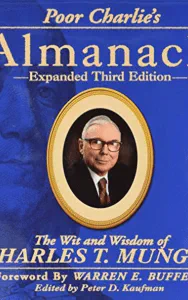
Poor Charlie’s Almanack is a strange name for a book.
It is actually a tip of the hat to Benjamin Franklin, one of Charlie Munger’s heroes. Back in the day, Franklin wrote this book called “Poor Richard’s Almanack.” It was full of all sorts of useful tidbits—weather forecasts, advice, you name it—and it was written under this quirky pseudonym, “Richard Saunders.” Franklin used “Poor Richard” to come off as an everyman, doling out wisdom in a way that was really humble and relatable.
So, fast forward to Charlie Munger. A book filled with his speeches, thoughts, and a good dose of humor, is compiled, aimed at sharing his insight on business and life is compiled by Peter Kaufman. When it came to naming the book, Munger chose “Poor Charlie’s Almanack.” It’s a playful nod to Franklin’s work, using “Poor Charlie” to echo that same relatable, down-to-earth vibe. Plus, it’s a bit ironic too, given that Munger is anything but poor!
Basically, the title is Munger’s way of saying, “Here’s a collection of wisdom, much like Franklin’s, but for the modern world.” It’s a tribute and a continuation of that style of sharing knowledge—packed with wisdom we can all use in our personal and professional lives.
The book is a collection of Charlie Munger’s best advice given over 30 years, in the form of 11 speeches given as commencement addresses and roundtable talks.
This is a truly eye-opening book into the world and thought processes of Charlie Munger. He describes how and why he thinks the way he does, stresses the importance of learning the basics in the fundamental disciplines in order to avoid becoming “the man with a hammer who sees everything as a nail,” and how this has translated into the enormous success that is Berkshire Hathaway.
- What did I get out of it?
- Who Should Read It?
- Notes and Highlights
- Rationality and Decision-Making
- Understanding and Avoiding Psychological Biases
- Reward & Punishment Super-response Tendency.
- Liking/Loving Tendency
- Disliking/Hating Tendency
- Doubt/Avoidance Tendency
- Inconsistency-Avoidance Tendency
- Curiosity Tendency
- Kantian Fairness Tendency
- Envy/Jealously Tendency
- Reciprocation Tendency
- Influence-From-Mere-Association Tendency
- Simple, Pain-Avoiding Psychological Denial
- Excessive Self-Regard Tendency
- Over-Optimism Tendency
- Deprival-Super reaction Tendency
- Social-Proof Tendency
- Contrast-Misreaction Tendency
- Stress-Influence Tendency
- Availability-Mis weighing Tendency
- Use-It-or-Lose-It Tendency
- Drug-Misinfluence Tendency
- Senescence-Misinfluence Tendency
- Authority-Misinfluence Tendency
- Twaddle Tendency
- Reason-Respecting Tendency
- Lollapalooza Tendency
- Building Mental Models
- Understanding Investing and Business
- Character and Living a Good Life
What did I get out of it?
1. Rationality and Decision-Making
Charlie Munger once described himself as “rational.” He knows he’s got the same biases as everyone else, but he’s worked on recognizing and controlling them.
Objectivity and Changing One’s Mind
If you want to make smarter decisions, you need to face the truth, even if it’s uncomfortable. Munger believes in considering different viewpoints seriously. He even tries to argue the other side’s case better than they can themselves. If after that you realize you were wrong, change your mind. Munger thinks if he doesn’t ditch a cherished belief each year, he’s wasted that year.
Practice Divergent and Contrary Thinking
Humans tend to follow the crowd, which can lead to bad decisions. Munger and his business partner, Warren Buffett, often go against the grain to find better investment opportunities.
Invert, Always Invert
Looking at problems backwards can reveal new solutions—Munger swears by this.
Know Your Circle of Competence
You’ve got to know what you’re good at and stick to it. This helps in making better decisions.
Learn Vicariously from Others’ Mistakes
Munger reads a lot, partly to learn from others’ blunders. It’s a way to dodge making the same mistakes yourself.
Reduce Complexity
Charlie likes to simplify complex issues down to their basics. He warns against making things too simplistic, though.
2. Understanding and Avoiding Psychological Biases
Munger has listed 25 psychological biases that mess with our thinking:
- Incentive bias: We repeat behaviors that reward us.
- Doubt-avoidance tendency: Doubt is uncomfortable, so people rush decisions.
- Inconsistency-avoidance tendency: People resist changing their beliefs.
- Influence from mere association: We like things that are linked to what we already like.
- Deprival super-reaction: We react strongly if something is taken from us.
- Social proof: We often mimic others’ actions.
- Authority mis-influence: People tend to follow leaders, sometimes blindly.
- Lollapaloozas: Extreme outcomes from multiple biases acting together.
The best defense? Know these biases and check if they’re affecting your decisions.
3. Building Mental Models
Munger believes in learning the big ideas from different fields and linking them together:
- Critical mass from physics applies to other areas like tech startups.
- Margin of safety from engineering helps in making safer choices.
- Compound interest from math explains why small gains add up.
- Feedback loops from biology show how things can spiral.
Linking these ideas helps solve complex problems that others might miss.
4. Understanding Investing and Business
Munger shares how patience and decisiveness are key in investing. He and Buffett wait for the right opportunity, then go all in. They look for businesses that aren’t just cheap but have a lasting competitive edge.
5. Character and Living a Good Life
Munger values character—hard work, humility, and constant learning. He stresses the importance of keeping good company and maintaining integrity.
Who Should Read It?
This book isn’t for everyone but at the same time everyone should read this book.
It’s a dense book, not a quick read, but it’s packed with insights. If you’re up for a deep dive into better decision-making and investing, it’s definitely worth your time.
Notes and Highlights
Rationality and Decision-Making
Objectivity and Changing One’s Mind
To Charlie, successful investing is simply a by-product of his carefully organized and focused approach to life.
Warren Buffett once said, “Charlie can analyze and evaluate any kind of deal faster and more accurately than any man alive. He sees any valid weakness in 60 seconds. He is a perfect partner.”
Investing becomes easy when you are good at making sound rational decisions.
Einstein said that his successful theories came from “curiosity, concentration, perseverance, and self-criticism.”
And by self-criticism, he meant the testing and destruction of his own well-loved ideas.
Find out where you are wrong.
Opportunity cost is a superpower, to be used by all people who have any hope of getting the right answer.
Use this in all decisions. A comprehensive and realistic approach to decision-making that fully accounts for the trade-offs involved in any action.
If you can get really good at destroying your own wrong ideas, that is a great gift.
Embrace intellectual humility and active self-correction. This ability to destroy one’s own wrong ideas is crucial for adapting to new information and changing circumstances, fostering a learning orientation that is essential in complex, dynamic environments.
I feel that I’m not entitled to have an opinion unless I can state the arguments against my position better than the people who are in opposition.
Ensures a deep comprehension of the issue at hand but also reflects a commitment to intellectual honesty and rigor.
Munger is advocating for a method of critical thinking that involves actively seeking out and considering opposing viewpoints to one’s own beliefs. This method serves as a powerful tool to counteract confirmation bias—the tendency to favor information that confirms one’s preconceptions while disregarding or undervaluing evidence that contradicts them.
Practice Divergent and Contrary Thinking
Charlie’s thinking stands the test of time:
The earliest talk in this collection is almost 20 years old, yet it is as relevant today as the day he first delivered it.
Charlie’s observations and conclusions are based on fundamental 9 human nature, basic truths, and core principles from a wide range of disciplines.
Time is the best filter. History doesn’t repeat. Human nature does.
Let me give an example, roughly remembered, of this sort of teaching by a very wise but untypical Harvard Business School professor many decades ago.
This professor gave a test involving two unworldly old ladies who had just inherited a New England shoe factory making branded shoes and beset with serious business problems described in great detail.
The professor then gave the students ample time to answer with written advice to the old ladies. In response to the answers, the professor gave every student an undesirable grade except for one student who was graded at the top by a wide margin.
What was the winning answer? It was very short and roughly as follows:
“This business field and this particular business, in its particular location, present crucial problems that are so difficult that unworldly old ladies cannot wisely try to solve them through hired help. Given the difficulties and unavoidable agency costs, the old ladies should promptly sell the shoe factory, probably to the competitor who would enjoy the greatest marginal utility advantage.”
Thus, the winning answer relied not on what the students had most recently been taught in business school but instead on more fundamental concepts, like agency costs and marginal utility, lifted from undergraduate psychology and economics.
A story Charlie tells to illustrate the importance of more multidisciplinary education and training. The story also highlights that the best option isn’t usually the most intuitive option.
Such a great story on capital allocation. The story underscores the value of understanding and utilizing broader economic principles rather than relying solely on specific business school teachings.
If you want it totally easy and totally laid out, maybe you should join some cult that claims to provide all the answers.
I don’t think that’s a good way to go.
I think you’ll just have to endure the world, as complicated as it is.
Nothing is certain. The world is complex. Everyone wants shortcuts. I always used to say that I don’t like uncertainty. As I have gotten older, I have realized that it doesn’t matter what I like or dislike. What’s more important is what’s the reality. Reality is that uncertainty is very much part of life and if we want to have any modicum of success, we have to endure and deal with uncertainty.
Everybody in economics understands that comparative advantage is a big deal when one considers first order advantages in trade from the Ricardo effect.
But suppose you’ve got a very talented ethnic group, like the Chinese, and they’re very poor, and you’re an advanced nation, and you create free trade with China, and it goes on for a long time.
Now let’s follow second- and third-order consequences.
You are more prosperous than you would have been if you hadn’t traded with China in terms of average wellbeing in the United States, right? Ricardo proved it.
But which nation is going to be growing faster in economic terms? It’s obviously China.
They’re absorbing all the modern technology of the world through this great facilitator in free trade, and, like the Asian Tigers have proved, they will get ahead fast.
Look at Hong Kong.
Look at Taiwan.
Look at early Japan.So you start in a place where you’ve got a weak nation of a billion and a quarter people, and in the end, they’re going to be a much bigger, stronger nation than you are, maybe even having more and better atomic bombs.
Well, Ricardo did not prove that that’s a wonderful outcome for the former leading nation. He didn’t try to determine second order and higher-order effects.
If you try to talk like this to economics professors-and I’ve done this three times they shrink in horror and offense because they don’t like this kind of talk.
It really gums up this nice discipline of theirs, which is so much simpler when you ignore second- and third order consequences.
Comparative advantage doesn’t factor in second, third, and fourth order consequences.
Munger challenges the simplicity of economic models that often focus solely on immediate or first-order effects (such as increased prosperity through trade). He argues that considering only these immediate benefits without addressing potential long-term strategic disadvantages (like the rise of a competitive superpower) is an oversight. Munger points out the reluctance of some economists to engage with these more complex, multi-order considerations, highlighting a gap between theoretical economics and practical geopolitical strategy.
Invert, Always Invert
It is my opinion, as a certified biography nut, that Darwin would have ranked near the middle of his graduating class.
Yet he is now famous in the history of science.
Darwin’s result was due in large measure to his working method.
He emphasized a backward twist in that he always gave priority attention to evidence tending to disconfirm whatever cherished and hard-won theory he already had.
In contrast, most people early achieve and later intensify a tendency to process new and disconfirming information so that any original conclusion remains intact.
Find out where you are wrong. The roots of principle of inversion. There are so many ways throughout the book where Charlie talks about inversion.
Charlie generally focuses first on what to avoid—that is, on what not to do-before he considers the affirmative steps he will take in a given situation.
Avoiding stupidity is genius. We will all be far more successful, if we concentrated more on avoiding stupid mistakes rather than look for great opportunities. We lose more by stupidity than what we gain by home runs.
Invert, always invert. I sought good judgment mostly by collecting instances of bad judgment, then pondering ways to avoid such outcomes.
His guiding principle.
Munger applies concept of inversion to life and business decisions. It’s about considering not just how things can go right, but more importantly, how they can go wrong.
Instead of solely focusing on the strategies that lead to success, he also studies failures and misjudgments meticulously. By understanding what has led others astray, one can learn to avoid similar pitfalls. This method can be incredibly effective in improving decision-making since avoiding errors can significantly enhance overall performance.
Know Your Circle of Competence
If you play games where other people have the aptitudes and you don’t, you’re going to lose. And that’s as close to certain as any prediction you can make. You have to figure out where you’ve got an edge.
Play within your circle of competence. Develop your circle of competence.
I have succeeded mostly by restricting my action to jobs and methods in which I was unlikely to fail.
Circle of competence and only acting on things which we understand. This is a good investment advice. If we cannot explain how an investment can go wrong, then it means we do not understand it well.
This is rooted in self-awareness and a realistic assessment of his own strengths and weaknesses.
I’d rather be generally right than precisely wrong.
Avoiding the fallacy of false precision—the mistaken belief that highly detailed or complex information is inherently more accurate or useful. Instead, Munger advocates for a more holistic approach that prioritizes essential truths and practical wisdom over potentially misleading or inaccurate details.
This approach is particularly relevant in fields like investing, strategy, and policymaking, where overly precise predictions or models can lead to misguided decisions due to their failure to account for uncertainty and variability in real-world scenarios.
I also was born with a huge craving for synthesis. And when it didn’t come easily, which was often, I would rag the problem, and then when I failed, I would put it aside, and I’d come back to it and rag it again.
Disciplined and tenacious approach to cognitive challenges, emphasizing the virtues of persistence, patience, and iterative learning.
Crucial for anyone looking to excel in fields that require high levels of cognitive performance and problem-solving abilities.
Learn Vicariously from Others’ Mistakes
My nature makes me incline toward diagnosing and talking about errors in conventional wisdom.
This habit made him rich.
Conventional wisdom refers to ideas or explanations that are generally accepted within society or by a majority as true or appropriate. However, just because a concept is widely accepted doesn’t mean it’s accurate or without fault. Munger’s inclination to scrutinize these beliefs comes from his understanding that human judgment can be clouded by biases, misinformation, or a lack of interdisciplinary thinking.
By diagnosing and discussing errors in conventional wisdom, Munger encourages critical examination of the underlying assumptions that guide decision-making in investments, business strategies, and broader societal norms. This approach reflects his broader philosophy of mental models, which advocates for drawing on a broad array of knowledge from various disciplines to inform one’s thinking and decision-making processes.
I don’t want you to think we have any way of learning or behaving so you won’t make a lot of mistakes. I’m just saying that you can learn to make fewer mistakes than other people - and how to fix your mistakes faster when you do make them.
Perfection is unattainable, improving how we learn from and respond to errors is within our control and can significantly enhance our effectiveness and success.
Reduce Complexity
Charlie strives to reduce complex situations to their most basic, unemotional fundamentals.
Crave simplicity. Abhor complexity. Genius has the fewest moving parts.
How many insights do you need? Well, I’d argue that you don’t need many in a lifetime.
If you look at Berkshire Hathaway and all of its accumulated billions, the top 10 insights account for most of it.
Most of the money came from 10 insights.
To get the 10 correct insights you need to hit many shots.
When Warren lectures at business schools, he says, “I could improve your ultimate financial welfare by giving you a ticket with only 20 slots in it so that you had 20 punches, representing all the investments that you got to make in a lifetime. And once you’d punched through the card, you couldn’t make any more investments at all.”
He says, “Under those rules, you’d really think carefully about what you did, and you’d be forced to load up on what you’d really thought about. So you’d do so. much better.”
Again, this is a concept that seems perfectly obvious to me.
And to Warren, it seems perfectly obvious.
But this is one of the very few business classes in the United States where anybody will be saying so.
It just isn’t the conventional wisdom.
Bet heavily when you have a great opportunity. It’s that simple.
There is an old two-part rule that often works wonders in business, science, and elsewhere:
- Take a simple, basic idea and
- take it very seriously.
One of the most important ideas in the book. It is printed on the back cover.
This approach aligns with Munger’s broader advocacy for clarity, reduction of complexity, and deep understanding in tackling problems. The lesson here is that complexity often obscures key insights, and that simplicity, coupled with a serious and thorough application, often leads to more effective solutions and innovations.
In business you’ve got a complex system, and it spews out a lot of wonderful numbers that enable you to measure some factors.
But there are other factors that are terribly important, yet there’s no precise numbering you can put to these factors.
You know they’re important, but you don’t have the numbers.
Well, practically everybody
overweighs the stuff that can be numbered because it yields to the statistical techniques they’re taught in academia, and
doesn’t mix in the hard-to-measure stuff that may be more important.
That is a mistake I’ve tried all my life to avoid.
Don’t confuse the map with the territory.
Another thing I take away is that we can simplify concepts, but businesses are complex systems inherently and we should not lose sight of that fact when simplifying things. In complex systems, there are large number of variables and factors that influence the outcome. The correlation between all the factors and variables is hard to predict and model. This is what makes complex systems complex.
Understanding and Avoiding Psychological Biases
Reward & Punishment Super-response Tendency.
Incentives are superpowers - The power that incentives and disincentives have on changing cognition and behavior in others cannot be overstated.
Charlie recognizes that even among the most competent and motivated of people, decisions are not always made on a purely rational basis.
For this reason, he considers the psychological factors of human misjudgment some of the most important mental models that can be applied to an investment opportunity.
We are not rational creatures. We are rationalizing creatures.
Munger says this should be obvious but so many people don’t understand the how important incentives are for shaping people’s motivation to complete a task.
Appeal to people’s interests, not their rationality in order to get your point across.
Prompt rewards much more effective than delayed rewards in changing and maintaining behavior.
Incentive-caused bias - man slowly drifts into immoral behavior in order to get what he wants if the incentives are improper. Man can rationalize anything. Should often distrust or at least take with a grain of salt whatever is being sold to you when the salesman has a lot to gain.
Almost everyone thinks he fully recognizes how important incentives and disincentives are in changing cognition and behavior.
But this is not often so.
I think I’ve been in the top 5 percent of my age cohort almost all my adult life in understanding the power of incentives, yet I’ve always underestimated that power.
Never a year passes but I get some surprise that pushes a little further my appreciation of incentive superpower.
One of my favorite cases about the power of incentives is the Federal Express case.
The integrity of the Federal Express system requires that all packages be shifted rapidly among airplanes in one central airport each night.
The system has no integrity for the customers if the night work shift can’t accomplish its assignment fast.
And Federal Express had one hell of a time getting the night shift to do the right thing. They tried moral suasion.
They tried everything in the world without luck. And finally, somebody got the happy thought that it was foolish to pay the night shift by the hour when what the employer wanted was not maximized billable hours of employee service but fault-free, rapid performance of a particular task.
Maybe, this person thought, if they paid the employees per shift and let all night shift employees go home when all the planes were loaded, the system would work better. And, lo and behold, that solution worked.
Early in the history of Xerox, Joe Wilson, had a similar experience.
He couldn’t understand why its new machine was selling so poorly in relation to its older and inferior machine.
He found out that the commission arrangement with the salesmen gave a large and perverse incentive to push the inferior machine on customers
This maxim is a wise guide to a great and simple precaution in life:
Never, ever, think about something else when you should be thinking about the power of incentives.
The most important rule in management is “Get the incentives right.”
We all underestimate the power of incentives.
Never, ever think about anything else before the power of incentives.
The most important rule: get the incentives right.
What I’m against is being very confident and feeling that you know, for sure, that your particular intervention will do more good than harm, given that you’re dealing with highly complex systems wherein everything is interacting with everything else.
You must have the confidence to override people with more credentials than you whose cognition is impaired by incentive-caused bias or some similar psychological force that is obviously present.
A lot of people want a formula or a high level of specificity. Charlie avoids and discourages this recurring behavior.
Appealing to his interest is likely to work better as a matter of human persuasion than appealing to anything else.
That, again, is a powerful psychological principle with deep biological roots.
Works in sales, marketing, leadership, your personal life etc.
History demonstrates the truth of Benjamin Franklin’s observation in Poor Richard’s Almanack:
“If you would persuade, appeal to interest and not to reason.”
The man changed his silly view when his incentives made him change it and not before.
Again, appeal to interest and not to reason if you want to change conclusions.
This is something Charlie repeats again and again: To persuade other people you must appeal to interest.
Behavior, whether good or bad, is intensely habit-forming when it is rewarded. Make sure you reward what you want.
There is not enough attention placed on virtue and vice effects - set up the system so that it is hard to cheat
Create structures that not only promote ethical behavior but also actively discourage wrongdoing.
The emphasis on making it difficult to cheat highlights the proactive approach needed in policymaking, corporate governance, and other fields where ethical behavior is critical. This strategy not only reduces the likelihood of unethical actions but also promotes a culture of integrity and trustworthiness, crucial for the long-term success and sustainability of any institution.
Man “games” every system he can - avoid as much as possible rewarding people for what can easily be faked.
All human systems are gamed.
One of the most important sentences in the book.
No matter how a system is designed—whether it’s legal, financial, educational, or corporate—people will find ways to exploit it to their advantage. This isn’t necessarily always done with malicious intent; often, it’s just a natural consequence of people trying to optimize outcomes for themselves within the rules and structures provided.
This perspective is rooted in the understanding that humans are inherently strategic and will seek to maximize their own benefits, sometimes in ways that the creators of those systems did not anticipate.
One must anticipate this human tendency and build safeguards or checks to mitigate exploitation or unintended consequences. It’s a call to be realistic about human nature when crafting policies, regulations, or systems, acknowledging that they will be “gamed” to some degree and thus should be designed to be as robust and fair as possible despite this.
Granny’s rule - first do the unpleasant and necessary tasks before rewarding yourself by proceeding to the pleasant tasks.
“Granny’s rule” provides another example of reward superpower, so extreme in its effects.
You can successfully manipulate your own behavior with this rule, even if you are using as rewards items that you already possess!
Granny’s rule is the requirement that children eat their carrots before they get dessert.
The business version requires that executives force themselves daily to first do their unpleasant and necessary tasks before rewarding themselves by proceeding to their pleasant tasks.
The application of Granny’s rule in both personal and business contexts highlight a strategic approach to leveraging innate human responsiveness to rewards to enhance productivity and ensure that necessary but potentially unpleasant tasks are completed. It illustrates a practical application of psychological insights into everyday and professional behaviors, ensuring that critical responsibilities are not neglected in favor of more enjoyable but less crucial activities.
Liking/Loving Tendency
One very practical consequence of liking/loving tendency is that it acts as a conditioning device that makes the liker or lover tend to
ignore the faults of, and comply with the wishes of, the object of his affection;
favor people, products, and actions merely associated with the object of his affection, as we shall see when we get to influence-from-mere association tendency; and
distort other facts to facilitate love.
We all tend to think that are are rational and unbiased. However, even the best of us suffers from this. Nothing wrong with it. But we should be aware of how decisions and choices are are being impacted because we are making them because of inherent bias due to liking someone.
We ignore the faults of other people, products or companies that we admire and distort other facts to facilitate love
Man often likes and loves what likes and loves him.
Admiration also causes or intensifies liking or loving.
Those who like love admirable people, virtues, good books, etc. have a huge advantage.
Disliking/Hating Tendency
Ignore virtues in the objects, products, companies, people we dislike and distort other facts to facilitate this hatred.
Persian messenger syndrome:
Ancient Persians actually killed some messengers whose sole fault was that they brought home truthful bad news, say, of a battle lost.
It was actually safer for the messenger to run away and hide instead of doing his job as a wiser boss would have wanted it done.
Persian messenger syndrome is alive and well in modern life,
The proper antidote to creating Persian messenger syndrome and its bad effects, is to develop, through exercise of will, a habit of welcoming bad news.
At Berkshire, there is a common injunction: “Always tell us the bad news promptly. It is only the good news that can wait.”
Tell us the bad news because the good news takes care of itself.
The negative reaction to the messenger can lead to a culture where important information is suppressed or ignored because individuals fear retribution or disfavor.
Doubt/Avoidance Tendency
If we are unsure about a decision we try to quickly remove any doubt by making an ill-informed, quick decision.
Institute a “delay before decision” rule into your life and you will thank yourself over and over.
Value of patience and thoughtful deliberation in achieving better outcomes in both personal and professional contexts. By instituting a deliberate delay, we give ourselves the opportunity to gather more information, consider alternative options, weigh potential consequences, and consult with others if necessary.
This approach is particularly effective in combating cognitive biases such as the urgency bias or immediacy effect, where the pressure to make quick decisions can lead to suboptimal outcomes.
Puzzlement and stress often trigger doubt-avoidance tendency
Relevant in situations requiring critical thinking under pressure. When we encounter stressful conditions, the discomfort of not knowing or the pressure to resolve a situation can precipitate hasty conclusions or actions. This tendency can undermine decision-making processes.
Recognizing and managing this bias involves cultivating a tolerance for ambiguity and developing strategies to cope with stress without rushing to judgment. This might include taking deliberate pauses, seeking additional information, consulting with others for diverse perspectives, and evaluating available options.
Inconsistency-Avoidance Tendency
Avoid extremely intense ideology because it cabbages up one’s mind.
The tendency for extreme ideologies to cloud judgment and inhibit the ability to think freely and adaptively. By advising to avoid intense ideology, he’s advocating for a more open, flexible approach to thinking that values evidence and reason over dogma. This mindset allows for more balanced, well-rounded decision-making by reducing the risk of becoming overly attached to a particular viewpoint that may blind an individual to other valuable perspectives or new information.
We have a reluctance to change. Eliminating bad habits is a rare trait.
Form good habits as early as possible
Also tend to be maintained in place - previous conclusions, human loyalties, reputational identity, commitments, accepted role in a civilization, etc.
Consider skillful counterarguments to any position you hold before making a decision.
People tend to accumulate large mental holdings of fixed conclusions and attitudes that are not often reexamined or changed, even though there is plenty of good evidence that they are wrong.
Must intensively consider any evidence tending to disconfirm any hypothesis you might have, especially one you think is particularly good.
Tough initiation ceremonies which are often public serve to make the new member even more loyal.
The human mind works a lot like the human egg. When one sperm gets into a human egg, there’s an automatic shut-off device that bars any other sperm from getting in. The human mind tends strongly toward the same sort of result
What an excellent analogy. Humans do not like changing their mind.
Munger’s observation emphasizes the human tendency to resist changing one’s mind after making an initial decision, like to how a human egg seals itself off after fertilization. This psychological pattern can lead to rigid thinking where new, potentially more accurate or useful information is ignored because it contradicts previously accepted ideas.
Understanding this bias is crucial for personal development, decision-making, and learning. Recognizing the tendency can help individuals remain open to new information and perspectives, promoting a more flexible and adaptive mindset.
Curiosity Tendency
There is a lot of innate curiosity in mammals, but its nonhuman version is highest among apes and monkeys. Man’s curiosity, in turn, is much stronger than that of his simian relatives. In advanced human civilization, culture greatly increases the effectiveness of curiosity in advancing knowledge.
Take a curious, lifelong learning approach to life and it is hard to be unhappy or unsuccessful.
Kantian Fairness Tendency
Tolerating a little unfairness should be okay if it means a greater fairness for all. The example Munger uses is letting in other drivers on the freeway knowing they will reciprocate in the future.
Small sacrifices can lead to larger benefits for the community. This approach is rooted in the understanding that absolute fairness is often unattainable in complex social settings, and that a flexible, considerate attitude can foster a more cooperative and harmonious environment.
We make these small sacrifices for selfish reasons as we expect others to reciprocate these same sacrifices towards us in future.
Envy/Jealously Tendency
Generally speaking, envy, resentment, revenge, and self-pity are disastrous modes of thought.
It is not greed that drives the world, but envy.
So much of what we do and how we react is driven by envy/jealous but it has become such a taboo that even though it is so ubiquitous, it is rarely talked about and is even left out of most psychology textbooks.
Envy/jealousy is extreme in myth, religion, and literature, wherein, in account after account, it triggers hatred and injury.
It is not greed that drives the world but envy.
Cure yourself of envy. Envy is a weakness.
Understanding the role of envy and jealousy is crucial for managing personal behavior and making informed decisions that consider the broader impacts of these emotions on relationships and organizational dynamics.
Reciprocation Tendency
The automatic tendency to reciprocate both favors and disfavors.
Sam Walton agreed with this idea of absolute prohibition. He wouldn’t let purchasing agents accept so much as a hot dog from a vendor. Given the subconscious level at which much reciprocation tendency operates, this policy of Walton’s was profoundly correct.
How Sam Walton avoided the reciprocation tendency. We feel compelled to return favors, often leading to a cycle of exchange that can subtly influence professional decisions and actions.
A good rule to have to prevent any potential conflicts of interest and maintain the ethical standards.
The standard antidote to one’s overactive hostility is to train oneself to defer reaction.
Reciprocation is built into us that it often operates at a subconscious level, allowing others to easily mislead us if they want to. If you want to protect yourself as much as possible, avoid favors, especially from vendors, at all costs.
Guilt is caused by wanting to be consistent and reciprocate but also being pulled in the opposite direction by the reward super response tendency.
Influence-From-Mere-Association Tendency
We can be easily manipulated by mere association. It can be a group of people, the quality of a product, advertising, etc.
some of the most important miscalculations come from what is accidentally associated with one’s past success, or one’s liking and loving, or one’s disliking and hating, which includes a natural hatred for bad news.
Carefully examine each past success, looking for accidental, non-causative factors associated with the success that might mislead you to making correlative assumptions and look for dangerous aspects of the new undertaking that were not present when past success occurred.
Hating and disliking cause equally many miscalculations based on mere association. Undervalue the competency and morals of people / businesses / products you dislike.
Must develop a habit of welcoming bad news in order to live in reality.
Be cautious of using classification stereotypes to judge others.
Simple, Pain-Avoiding Psychological Denial
Distort reality until they become bearable to us because they are too painful to deal with
The tendency to distort reality as a means of coping can have significant implications for decision-making and mental health. While it can provide temporary relief from emotional pain, this distortion can lead to long-term negative outcomes if it prevents us from addressing the root causes of their distress or from taking appropriate actions based on accurate perceptions of their circumstances.
Excessive Self-Regard Tendency
Generally speaking, envy, resentment, revenge, and self-pity are disastrous modes of thought.
Avoid: intense ideology, overspending your income, envy, resentment, revenge and self-pity
We all think we’re above average. This is where overconfidence comes from. Also tend to over-appraise our belongings (endowment effect) 1. If allow people to personalize anything (choose own numbers in the lottery, make own speculative bet) they will believe much more wholeheartedly that they will win.
The greatest type of pride should be taking pride in being trustworthy to avoid developing an ego.
Tend to like people more who are similar to ourselves, and this leads to cliques.
Man’s excess of self-regard typically makes him strongly prefer people like himself.
Munger’s observation about the Excessive Self-Regard Tendency highlights the human proclivity to gravitate towards familiarity and similarity, which can inadvertently lead to biased decisions and reinforce existing prejudices. This bias can skew personal and professional decisions, influencing everything from whom we choose to befriend to whom we decide to employ, often without conscious awareness.
Addressing this bias involves fostering self-awareness and actively seeking to understand and appreciate differences in others. By challenging ourselves to engage with people who have different backgrounds, opinions, and experiences, we can mitigate the effects of this bias, leading to richer, more varied interpersonal interactions and more balanced decision-making processes.
Underweight face-to-face encounters and overweight an applicant’s past record. The past is the strongest indicator of future results.
Fixable but unfixed bad performance is bad character and tends to create more of itself.
Do not give excuses, simply perform and behave as you should.
Also extremely counterproductive is man’s tendency to bet, time after time, in games of skill, like golf or poker, against people who are obviously much better players. Excessive self-regard tendency diminishes the foolish bettor’s accuracy in appraising his relative degree of talent.
Munger is emphasizing how an inflated sense of self can cause individuals to make irrational choices, such as consistently participating in unfavorable competitions like poker or golf against much better players. This behavior is not only counterproductive but also financially and psychologically costly.
Only play games where you have an edge. —Ed Thorp
The best antidote to folly from an excess of self-regard is to force yourself to be more objective when you are thinking about yourself, your family and friends, your property and the value of your past and future activity.
While an excess of self-regard is often counterproductive in its effects on cognition, it can cause some weird successes from overconfidence that happens to cause success.
Never underestimate the man who overestimates himself.
Munger is highlighting a nuanced perspective on the bias of excessive self-regard, suggesting that its effects are not uniformly negative. In some scenarios, the overestimation of one’s capabilities can drive individuals to attempt and achieve goals that others, who might be more realistic or cautious, would not dare to pursue.
This is also referred to as winners’ edge.
Of all forms of pride, perhaps the most desirable is a justified pride in being trustworthy.
Over-Optimism Tendency
People tend to exhibit an excess of optimism when they are already doing well.
One standard antidote to foolish optimism is trained, habitual use of the simple probability math of Fermat and Pascal.
Mathematical principles developed by Blaise Pascal and Pierre de Fermat, which underpin modern probability theory. Incorporating these mathematical principles into regular decision-making processes can help temper overly optimistic expectations that may not align with reality.
Deprival-Super reaction Tendency
Loss aversion - having something taken away hurts more than being given something feels good. Applies to things we already possess and those things we nearly possess. Applies to property, love, friendship, territory, opportunity, status, anything that is valued
The Mungers once owned a tame and good-natured dog that displayed the canine version of deprival-super reaction tendency. There was only one way to get bitten by this dog, and that was to try and take some food away from him after he already had it in his mouth. If you did that, this friendly dog would automatically bite. He couldn’t help it. Nothing could be more stupid than for the dog to bite his master. But the dog couldn’t help being foolish. He had an automatic deprival-super reaction tendency in his nature.
Humans are much the same as this Munger dog. A man ordinarily reacts with irrational intensity to even a small loss, or threatened loss, of property, love, friendship, dominated territory, opportunity, status, or any other valued thing. As a natural result, bureaucratic infighting over the threatened loss of dominated territory often causes immense damage to an institution as a whole.
Deprival-super reaction tendency has ghastly effects in labor relations. Most of the deaths in the labor strife that occurred before World War 1 came when employers tried to reduce wages.
We can exhibit extreme reactions to even minor losses or the mere threat of losing something we hold dear. This can manifest in various destructive ways, such as intense bureaucratic infighting within organizations or even wars.
Recognizing this is crucial because it helps in anticipating and mitigating overreactions in both personal and professional scenarios.
One antidote to intense, deliberate maintenance of groupthink is an extreme culture of courtesy, kept in place despite ideological differences and the other is to deliberately bring in able and articulate disbelievers (devil’s advocates)
Social-Proof Tendency
Being so well known has advantages of scale—what you might call an informational advantage.
Psychologists use the term social proof. We are all influenced-subconsciously and, to some extent, consciously-by what we see others do and approve.
Therefore, if everybody’s buying something, we think it’s better.
We don’t like to be the one guy who’s out of step.
The social proof phenomenon, which comes right out of psychology, gives huge advantages to scale.
Advantages of scale: social proof leads to more sales, distribution, winner take all/most flywheel, greater specialization.
I was aware that man was a social animal, greatly and automatically influenced by behavior he observed in men around him.
Individuals tend to conform to what they perceive as the majority behavior or opinion within their social groups or society at large.
This awareness also speaks to the value of independent thinking and the dangers of herd mentality in both business and personal life. It suggests that to make wise decisions, one must be cognizant of these social influences and, where necessary, be prepared to question or counteract them with reasoned, independent analysis.
Herd mentality - people tend to think and act like those around us.
Triggering most easily occurs in the presence of puzzlement and stress, especially so when both are present.
In the highest reaches of business, it is not uncommon to find leaders who display followership akin to that of teenagers. If one oil company foolishly buys a mine, other oil companies often quickly join in buying mines.
So too if the purchased company makes fertilizer. Both of these oil-company buying fads actually bloomed, with bad results.
Of course, it is difficult to identify and correctly weigh all the possible ways to deploy the cash flow of an oil company. So oil company executives, like everyone else, have made many bad decisions that were quickly triggered by discomfort from doubt.
Going along with social proof provided by the action of other oil companies ends this discomfort in a natural way.
When will social-proof tendency be most easily triggered?
Here, the answer is clear from many experiments: Triggering most readily occurs in the presence of puzzlement or stress, and particularly when both exist.
Munger explains how social proof, the tendency to emulate the actions of others in an attempt to reflect correct behavior in uncertain situations, can lead to suboptimal decisions, especially under conditions of doubt and stress. This tendency simplifies decision-making by providing a clear, albeit potentially misguided, path forward when executives face the uncomfortable pressure of uncertainty.
Important therefore to stop bad behavior before it spreads and foster and display any good behavior.
Not only action, but also inaction that leads to social proof.
One of the most important skills you can foster is learning to ignore the examples of others when they are wrong.
Contrast-Misreaction Tendency
As perception goes, so goes cognition. What we see tends to be what we believe.
The way we perceive events, data, and interactions shapes our understanding and subsequent reasoning. If our perception is skewed or limited, our cognitive conclusions will likely reflect those distortions.
When something crappy is compared to something even crappier, it seems less crappy.
Small steps tend to be disastrous precisely because we can’t contrast them to our current position.
Small steps or changes often fail to trigger a response because they do not seem significant in isolation. This can lead to complacency or underestimation of their cumulative impact.
Stress-Influence Tendency
Adrenaline tends to produce faster and more extreme reactions. Some stress can improve performance, but heavy stress often leads to dysfunction.
Pavlov found that he could classify dogs to predict how easily they would breakdown, the dogs hardest to break were also the hardest to return to prebreakdown state, any dog could be broken and he couldn’t reverse a breakdown without reimposing stress.
Importance of recognizing limits in stress tolerance, even in those who initially appear most resilient.
In professional settings, for instance, it’s vital to acknowledge that high-performing individuals may also be vulnerable and require support to maintain their psychological health.
Availability-Mis weighing Tendency
We overweight what’s easily available.
People might judge risks not based on their actual statistical probability but on how easily examples of those risks can be recalled. If a certain type of unfortunate event has been heavily covered in the media, we might believe it is more common than it actually is.
Checklists or a set of rules can help with this tendency.
Embrace disconfirming evidence
Surround yourself with people who are skeptical and who oppose your views.
Vivid evidence should be underweighted, and less vivid evidence should be overweighed.
Vividness bias is a cognitive bias where people tend to remember and be influenced by information that is more emotionally striking or vividly presented, rather than information that is presented in a more neutral or less sensational manner.
That’s why story telling is such an essential skill.
An idea or a fact is not worth more merely because it is easily available to you.
It is crucial to assess information and ideas based on in-depth analysis and evidence, rather than relying solely on how quickly and easily they can be recalled. This might involve seeking out less readily available data that could provide a completer and more accurate picture.
Use-It-or-Lose-It Tendency
If you truly understand the skill, instead of just cramming it in, you will lose it more slowly and it will come back quicker when refreshed.
Integrating it into one’s cognitive framework, which helps in retaining the skill longer.
Consistently practice skills that you can’t afford to lose and create checklists to routinely use.
Drug-Misinfluence Tendency
Avoid drugs at all costs.
Senescence-Misinfluence Tendency
As we age there is a natural loss of certain skills and abilities. Continuous thinking and learning help to slow the decay.
Authority-Misinfluence Tendency
man is often destined to suffer greatly when the leader is wrong or when his leader’s ideas don’t get through properly in the bustle of life and are misunderstood.
and
Some of the misinfluences are amusing, as in a case described by Cialdini. A physician left a written order for a nurse treating an earache, as follows: “Two drops, twice a day, ‘r. ear.’” The nurse then directed the patient to turn over and put the eardrops in his anus.
This is what happens when instructions are not clear, and we expect our subordinates to know what we are thinking.
After Corporal Hitler had risen to dominate Germany, leading a bunch of believing Lutherans and Catholics into orgies of genocide and other mass destruction, one clever psychology professor, Stanley Milgram, decided to do an experiment to determine exactly how far authority figures could lead ordinary people into gross misbehavior. In this experiment, a man posing as an authority figure, namely a professor governing a respectable experiment, was able to trick a great many ordinary people into giving what they had every reason to believe were massive electric shocks that inflicted heavy torture on innocent fellow citizens.
Following orders just because someone says so.
Be careful whom you appoint to power because a dominant authority figure will often be hard to remove.
Leaders in positions of authority tend to establish mechanisms that reinforce their status and control within the organization or society. This can include appointing loyalists to key positions, influencing policy to safeguard their status, or manipulating resources to maintain their base of support.
Twaddle Tendency
It’s a very important part of wise administration to keep prattling people pouring out twaddle far away from the serious work.
The principal job is to keep the people who don’t matter from interfering with the work of the people who do.
Certain people tend to do very little actual work and disturb those who are productive. Limit the twaddlers.
A honeybee normally goes out and finds nectar and then comes back and does a dance that communicates to the other bees where the nectar is. The other bees then go out and get it. Well some scientist—clever, like B. F. Skinner—decided to see how well a honeybee would do with a handicap. He put the nectar straight up. Way up. Well, in a natural setting, there is no nectar a long way straight up, and the poor honeybee doesn’t have a genetic program that is adequate to handle what she now has to communicate. You might guess that this honeybee would come back to the hive and slink into a corner, but she doesn’t. She comes into the hive and does an incoherent dance. Well, all my life I’ve been dealing with the human equivalent of that honeybee.
We often try to address or communicate about new challenges using their existing frameworks and skills, which might not be entirely adequate or appropriate.
Reason-Respecting Tendency
There was very great businessman named Carl Braun who created the C.F. Braun Engineering Company.
It designed and built oil refineries, which is very hard to do.
And Braun would get them to come in on time and not blow up and have efficiencies and so forth. This is a major art.
He had another rule, from psychology-which, if you’re interested in wisdom, ought to be part of your repertoire.
His rule for all the Braun Company’s communications was called the five Ws:
You had to tell who was going to do what, where, when, and why.
And if you wrote a letter or directive in the Braun Company telling somebody to do something and you didn’t tell him WHY, you could get fired.
In fact, you would get fired if you did it twice.
That’s a rule of psychology.
If you always tell people why, they’ll understand it better, they’ll consider it more important, and they’ll be more likely to comply. Even if they don’t understand your reason, they’ll be more likely to comply.
In communicating with other people about everything, you want to include why, why, why.
Even if it’s obvious, it’s wise to stick in the why.
The power of WHY
Few practices are wiser than not only thinking through reasons before giving orders but also communicating these reasons to the recipient of the order.
Must tell Who was to do What, Where When and Why
Continuously ask “Why?” of everything and everyone
Reasons, even poor/meaningless reasons, will increase compliance in others.
Some people just want the answers, not the reasons or a better understanding.
Lollapalooza Tendency
The tendency to get extreme consequences when you combine a number of these misjudgments when trying for a particular outcome.
Lollapalooza effects, very big effects, tend to only come from large combinations of factors
In the context of human psychology, particularly how various cognitive biases can interact synergistically to lead to outsized outcomes, whether positive or negative.
Munger has used this concept to explain various phenomena, from investment bubbles to large-scale business failures and successes, and even crowd behavior.
Building Mental Models
His models supply the analytical structure that enables him to reduce the inherent chaos and confusion of a complex investment problem into a clarified set of fundamentals.
Especially important examples of these models include
the redundancy and backup system models from engineering;
the compound interest model from mathematics;
the breakpoint, tipping moment, and autocatalysis models from physics and chemistry;
the modern Darwinian synthesis model from biology;
and cognitive misjudgment models from psychology.
Charlie combines big ideas from multiple disciplines to build a more accurate understanding of the world.
Disney is an amazing example of autocatalysis.
They had all those movies in the can.
And just as Coke could prosper when refrigeration came, when the videocassette was invented, Disney didn’t have to invent anything or do anything except take the thing out of the can and stick it on the cassette.
And every parent and grandparent wanted his descendants to sit around and watch that stuff at home on videocassette.
So Disney got this enormous tailwind from life. And it was billions of dollars’ worth of tailwind.
Obviously, that’s a marvelous model if you can find it. You don’t have to invent anything. All you have to do is to sit there while the world carries you forward.
By the time it’s done, The Lion King alone is going to do plural billions.
And by the way, when I say “when it’s done,” I mean 50 years from now or something. But plural billions—from one movie?
Stay in the game long enough to long enough to get lucky. Charlie is using a term from chemistry. Autocatalysis: a chemical reaction is said to be autocatalytic if one of the reaction products is also a catalyst for the same reaction.
If you skillfully follow the multidisciplinary path, you will never wish to come back.
It would be like cutting off your hands.
By applying these varied lenses to analyze situations, individuals can see dimensions and solutions that would be invisible if they were operating within the narrow confines of a single discipline.
Cicero is famous for saying that a man who doesn’t know what happened before he’s born goes through life like a child. That is a very correct idea. Cicero is right to ridicule somebody so foolish as not to know history.
And it doesn’t help you much just to know something well enough so that on one occasion you can prattle your way to an A in an exam.
You have to learn many things in such a way that they’re in a mental latticework in your head and you automatically use them the rest of your life.
Learning is changing behavior. The importance of reading books and learning from history. We don’t have to learn the history by heart but we should draw lessons from history and adapt and apply them in our decisions and choices we make on a daily basis.
Munger advocates for the development of a “mental latticework,” where various pieces of knowledge from different disciplines are interconnected and readily accessible for decision-making and problem-solving. This approach not only emphasizes the importance of historical awareness as foundational to understanding the present and navigating the future but also highlights the necessity of integrating knowledge deeply enough that it becomes an automatic part of one’s thinking processes.
Munger’s reference to Cicero points to the broader educational philosophy that values history not just as a subject to be studied but as essential context that informs a more comprehensive understanding of the world. This view promotes a more nuanced, informed approach to life, reflecting the principle that lifelong learning is critical for maturity and wisdom.
Understanding Investing and Business
Warren once called him the “abominable no-man.”
The difference between successful people and very successful people is that very successful people say no to almost everything.” — Warren Buffett.
The importance of having a reputation.
During the homecoming dinner, Charlie and Warren realized they shared many ideas. It also became evident to the others at the table that this was going to be a two-way conversation.
As the evening progressed, the two young men-Warren was 29 and Charlie 35-became engrossed in a wide-ranging dialogue covering many aspects of business, finance, and history.
Where one was knowledgeable, the other was just as excited to learn.
Warren was unenthusiastic about Charlie’s continued practice of law.
He said that while law might be a good hobby for Charlie, it was a far less promising business than what Warren was doing.
Warren’s logic helped Charlie to decide to quit law practice at the earliest point he could afford to do so.
When Charlie returned to Los Angeles, the conversations continued via telephone and lengthy letters, sometimes as long as nine pages.
It was evident to both that they were meant to be in business together.
There was no formal partnership or contractual relationship-the bond was created by a handshake and backed by two Midwesterners who understood and respected the value of one’s word.
The first meeting of Warren and Charlie. That last paragraph reminds me of this excellent quote by Charlie: “Trust is one of the greatest economic forces on Earth.”
Both Charlie and Warren built their business empire on one sound risk management principle. Only work with people you trust.
Durability has always been a first-rate virtue in my father’s view.
Aim for durability. Don’t over optimize for growth at the expense of durability.
He will not deviate from these principles, regardless of group dynamics, emotional itches, or popular wisdom that “this time around it’s different.”
When faithfully adhered to, these traits result in one of the best-known Munger characteristics: not buying or selling very often.
Munger believes a successful investment career boils down to only a handful of decisions.
So when Charlie likes a business, he makes a very large bet and typically holds the position for a long period.
Charlie is willing to commit uncommonly high percentages of his investment capital to individual, “focused” opportunities.
Charlie is content to swim imperturbably against the tide of popular opinion—indefinitely, if necessary.
Charlie is simply content to trust his own judgment even when it runs counter to the wisdom of the herd.
This lone-wolf aspect of Charlie’s temperament is a rarely appreciated reason why he consistently outperforms
Entrepreneurship only works if you can trust your own judgement.
Above all, he attempts to assess and understand competitive advantage in every respect—products, markets, trademarks, employees, distribution channels, societal trends, and so on—and the durability of that advantage.
Charlie refers to a company’s competitive advantage as its moat: the barrier it presents against incursions.
Charlie only focuses on great businesses and great businesses have moats.
There are huge advantages for the early birds.
When you’re an early bird, there’s a model that I call surfing—when a surfer gets up and catches the wave and just stays there, he can go a long, long time.
But if he gets off the wave, he becomes mired in shallows.
But people get long runs when they’re right on the edge of the wave, whether it’s Microsoft or Intel or all kinds of people, including National Cash Register.
Surfing is a very powerful model.
Charlie’s surfing model. The importance of getting into a great business and staying in it. There’s a tendency in human nature to mess up a good thing because of an inability to sit still.
The wise ones bet heavily when the world offers them that opportunity.
They bet big when they have the odds. And the rest of the time, they don’t.
It’s just that simple.
That is a very simple concept. And to me it’s obviously right.
And yet practically nobody operates that way.
Interesting investing advice. Not sure I agree with Charlie here. Risk management says otherwise.
You must stop slop early.
It’s very hard to stop slop and moral failure if you let it run for a while.
You must stop slop and corruption early. Otherwise, it becomes a norm.
One of the worst examples of what physics envy did to economics was cause adoption of hard-form efficient-market theory.
Then, when you logically derived consequences from this wrong theory, you would get conclusions such as it can never be correct for any corporation to buy its own stock.
Because the stock price, by definition, is totally efficient, there could never be any advantage.
And they taught this theory to some partner at McKinsey when he was at some school of business that had adopted this crazy line of reasoning from economics, and the partner became a paid consultant for The Washington Post.
And Washington Post stock was selling at a fifth of what an orangutan could figure was the plain value per share by just counting up the values and dividing.
But he so believed what he’d been taught in graduate school that he told The Washington Post it shouldn’t buy its own stock.
Well, fortunately, they put Warren Buffett on the board, and he convinced them to buy back more than half of the outstanding stock, which enriched the remaining shareholders by much more than a billion dollars.
Munger criticizes the “physics envy” in economics, which leads to the adoption of overly simplistic and often incorrect models like the efficient-market hypothesis. This theory posits that stock prices always incorporate and reflect all relevant information, making it impossible to purchase undervalued stocks. Munger highlights a real-world counterexample where the application of simple valuation principles, as advocated by Warren Buffett, proved the market inefficiency and led to significant shareholder gains. This story underscores the importance of pragmatic decision-making in business and investing, challenging rigid adherence to academic theories that may not hold in real-world scenarios.
Another idea that I found important is that maximizing nonegality will often work wonders.
What do I mean?
Well, John Wooden of UCLA presented an instructive example when he was the number one basketball coach in the world.
He said to the bottom five players, “You don’t get to play; you are practice partners.”
The top seven did almost all the playing.
Well, the top seven learned more-remember the importance of the learning machine-because they were doing all the playing.
And when he adopted that non-egalitarian system, Wooden won more games than he had won before.
I think the game of competitive life often requires maximizing the experience of the people who have the most aptitude and the most determination as learning machines.
If you want the very highest reaches of human achievement, that’s where you have to go.
You want to provide a lot of playing time for your best players.
Maximize the experience of the people who have the most aptitude and the most determination as learning machines.
In fields where performance is critical to success, allocating resources and opportunities to those who are most capable and determined can optimize outcomes. He emphasizes the importance of recognizing and leveraging talent where it is most impactful, suggesting that such an approach not only benefits the individuals who receive more opportunities but also enhances the overall success of the team or organization.
Charlie Munger refers to “nonegality,” he’s discussing the practice of not treating everyone equally in terms of the opportunities or resources provided to them, particularly in contexts where performance and outcomes are critical. This concept is based on the recognition that different individuals have varying levels of skill, determination, and potential impact, and that allocating resources according to these differences can often lead to better overall results.
It’s a very important part of wise administration to keep prattling people pouring out twaddle far away from the serious work.
The principal job is to keep the people who don’t matter from interfering with the work of the people who do.
Key aspect of effective leadership and wise administration is to prevent unnecessary interference and ensure that the efforts of valuable team members are not hindered by those less invested or involved in the core objectives.
The underlying principle here is about the efficient and effective use of organizational resources, including time and human capital. By ensuring that individuals who are crucial to the organization’s success are supported and unencumbered by those who may distract or detract from the mission, leaders can foster an environment where productivity and innovation thrive.
“Our game is to recognize a big idea when it comes along, when one doesn’t come along very often. Opportunity comes to the prepared mind.
This approach to investing that focuses on positioning and the ability to discern when a unique or highly advantageous situation unfolds.
The idea that “opportunity comes to the prepared mind” underscores the importance of continuous learning, situational awareness, and strategic thinking.
Beta and modern portfolio theory and the like - none of it makes any sense to me. We’re trying to buy business with sustainable competitive advantages at a low, or even a fair, price.
Munger dismisses these models as being disconnected from the practical realities of business investing, suggesting that they don’t make sense to him because they overlook the intrinsic value and quality of the businesses being invested in.
His philosophy is grounded in understanding the fundamental characteristics of businesses, such as their market position, the durability of their competitive advantages, and their pricing power, rather than relying solely on statistical measures of market behavior or diversification to achieve optimal investment outcomes.
…there are some things you should pay up for, like quality businesses and people.
The concept is particularly relevant in investment decisions where paying a fair or even premium price for a business with strong fundamentals and a sustainable competitive edge can lead to better financial returns over time.
Additionally, this philosophy extends to human resources, where investing in skilled, capable people can drive an organization’s success.
Has never tried to make a single dollar, ever, from foreseeing macroeconomic changes.
The importance of investing based on thorough analysis of a company’s operations, competitive advantages, and market position rather than on uncertain macroeconomic predictions.
How Warren and Charlie evaluate a possible acquisition - “We’re light on financial yardsticks; we apply lots of subjective criteria. Can we trust management? Can it harm our reputation? What can go wrong? Do we understand the business? Does it require capital infusions to keep going? What is the expected cash flow? We don’t expect linear growth; cyclically is fine as long as the price is appropriate.
Munger and Buffett’s method involves asking critical questions:
- Can we trust management? This addresses the competence and ethical standards of those who will continue to run the business post-acquisition.
- Can it harm our reputation? This reflects a concern for maintaining Berkshire Hathaway’s standing and ethical image.
- What can go wrong? This question seeks to identify potential risks and challenges the business might face.
- Do we understand the business? This ensures that they invest only in industries and companies that they comprehend deeply.
- Does it require constant capital infusions? This checks the financial sustainability of the business.
- What is the expected cash flow? This assesses the business’s ability to generate revenue over time.
a horse (company) may clearly be a favorite, but the odds (price) are such that decision in which horse to bet on (invest) is not so obvious.
Essential consideration of value versus price in investment decisions. It’s not just about identifying the best company; it’s about determining whether the company is a good investment at its current price. Just as a gambler evaluates whether the odds on a horse justify a bet, an investor must assess whether a company’s stock price justifies an investment.
Wealth effects have some disgusting effects on spending and aren’t taken into account. Most foundations are unwise through failure to understand their own investment operations, related to a larger system.
Increase in spending, driven by perceived increases in wealth (wealth effects), often leads to imprudent financial decisions that are not sufficiently accounted for in financial planning and management.
Munger is pointing out a common oversight in financial management—both personal and institutional—where entities may increase their spending based on increases in the value of their assets or endowments without considering the potential volatility or sustainability of those values. This can lead to vulnerabilities if asset values decline.
“Febezzlement” from excessive investment costs has significant macroeconomic effects.
This term is coined by Charlie, a blend of “fee” and “embezzlement”. The term describes the negative impact of excessive investment costs on investors and, more broadly, on the macroeconomic environment.
High fees in investment management can significantly erode investment returns, effectively ‘stealing’ wealth from investors without adding corresponding value.
Character and Living a Good Life
Life is one damn relatedness after another.
This statement reflects his belief in the complex, interwoven nature of the world and the importance of understanding these connections to make informed decisions.
Munger’s perspective is deeply rooted in the concept of systems thinking, where every action or decision is part of a larger network of interactions. This approach acknowledges that choices made in one area can have ripple effects across other areas, sometimes in ways that are not immediately obvious. By understanding these relationships, one can better anticipate consequences and make wiser decisions.
Keep things simple but recognize that most systems in life are complex systems.
Poor Charlie’s Almanack is a testament to the power of thinking across disciplines.
It’s not just a book about investing; it’s a guide to learning how to think for yourself to understand the world around you.
That 2nd sentence is a great summary of the value proposition of this book and Charlie in general.
Although Charlie didn’t invent the concept of compounding growth, his success, and that of Berkshire Hathaway, is a testament to its existence.
The practical wisdom of Poor Charlie’s Almanack, this ode to curiosity, generosity, and virtue, will similarly compound, as successive generations of entrepreneurial readers extend his lessons to their own circumstances.
Compounding isn’t just a valuable concept in investing and business. It holds true for most things we do in life.
Even in his last years — when he knew death would come soon and he had little time left — he spent a lot of his time with young investors and entrepreneurs sharing everything he learned. He taught millions while he was alive and —because of this book —will teach any more in death.
I encourage you to read Charlie’s speeches and essays with an open, curious mind. You will be rewarded with insights that stay with you for a lifetime.
As Charlie once said, “There is no better teacher than history in determining the future. There are answers worth billions of dollars in a $30 history book.”
The same might be said of Poor Charlie’s Almanack.
It is the ultimate value investment.
This foreword was written by John Collison. Cofounder of Stripe.
Charlie believed in learning from others and learning from history. The best and fastest way to learn history and from others is by cultivating a habit of reading books and then reflecting on them.
I’d like to offer some “Advice on the Choice of a Partner.” Pay attention.
Look first for someone both smarter and wiser than you are.
After locating him (or her), ask him not to flaunt his superiority so that you may enjoy acclaim for the many accomplishments that sprang from his thoughts and advice.
Seek a partner who will never second-guess you nor sulk when you make expensive mistakes.
Look also for a generous soul who will put up his own money.
Finally, join with someone who will constantly add to the fun as you travel a long road together.
All of the above is splendid advice.
In fact, it’s so splendid that I set out in 1959 to follow it slavishly. And there was only one partner who fit my bill of particulars in every way-Charlie
Warren Buffett’s advice on picking a partner. This holds true for picking life partners and business partners.
Charlie also employs historical and business case studies to great effect.
In these presentations, he makes his points with subtlety and texture, often using a story-like context instead of abstract statements of theory.
He regales his audience with humorous anecdotes and poignant tales rather than with a blizzard of facts and figures.
He well knows, and wisely exploits, the traditional role of the storyteller as a purveyor of complex and detailed information.
As a result, his lessons hang together in a coherent latticework of knowledge, available for recall and use when needed.
“The storyteller is the most powerful person in the world” — Steve Jobs “The art of storytelling is critically important. Most entrepreneurs can’t tell a story. Learning to tell a story is incredibly important because that’s how the money works. Money flows as a function of stories.” — Don Valentine founder of Sequoia
Becoming good at story telling is probably the most valuable and highest ROI skill we can develop.
It is clear throughout these talks and speeches that Charlie places a premium on life decisions over investment decisions.
Charlie once said, “I wanted to get rich so I could be independent.”
Independence is the end that wealth serves for Charlie, not the other way around.
From the biography of Socrates: “Education is the process whereby the ability to lead a good life is acquired.” Building a great business is in service of building a great life.
The twin fonts of Charlie’s amazing success:
unconventional way of thinking and extraordinary work ethic.
Nothing meaningful can be attained without work ethic.
A special note: Charlie’s redundancy in expressions and examples is purposeful; for the kind of deep “fluency” he advocates, he knows that repetition is the heart of instruction.
Repeat, repeat, repeat. Reread, reread, reread. We cannot achieve mastery without repetition.
Charlie’s teachers remember a smart kid who was also inclined to be a bit of a wiseacre.
He enjoyed challenging the conventional wisdom of teachers and fellow students with his ever-increasing knowledge gained through voracious reading, particularly biographies.
Charlie started reading biographies from an early age.
Despite outward appearances, all was not sunny in Charlie’s world.
His marriage was in trouble, and he and his wife finally divorced in 1953.
Not long thereafter, Charlie learned that his adored son, Teddy, was terminally ill with leukemia. It was a significant burden for 29-year-old Charlie.
In that era, before bone marrow transplants, there was no hope.
A friend remembers that Charlie would visit his dying son in the hospital and then walk the streets of Pasadena crying.
The tragic death of his son. As a father, I can imagine that there could be no pain greater than losing your child.
Charlie’s grandfather was a respected federal judge.
Charlie’s immediate family was not dramatically affected by the Depression, but some members of Charlie’s extended family were.
This era provided real learning experiences for young Charlie.
He witnessed the generosity and business acumen of his grandfather as he helped rescue a small bank that was owned by Charlie’s uncle Tom.
Because of the miserable economy and drought-damaged crops, the bank’s farm-based clients were defaulting on loans.
Tom had rolled up $35,000 in uncollectible notes when he called upon Grandpa Munger for support.
The judge risked nearly half of his assets by exchanging $35,000 in sound first mortgages for the bank’s weak loans, thus enabling Tom to open his doors after Roosevelt’s bank holiday.
The judge eventually recovered most of his investment, but not until a great many years later.
Judge Munger also sent his daughter’s husband, a musician, to pharmacy school and helped him buy a well-located pharmacy that had closed because of the Depression.
The business prospered and secured the future for Charlie’s aunt.
Charlie learned that by supporting each other, the Mungers weathered the worst economic collapse in the nation’s history.
A mission larger than yourself: Be dependable for your tribe. This is the role I want to play. I want to work hard not just for myself but to be able to help my family. The higher your net worth the more you can serve.
The objective of accumulating wealth should not be self-serving. While there is nothing wrong with buying things for yourself, the greater and overarching goal should be to me our tribe better. To make the tribe feel, that their lives are better off because of your being part of the tribe.
With many new responsibilities, Charlie worked hard at his law practice.
Even so, his earnings were unsatisfactory to him
as they were based on a combination of billable hours and seniority.He wanted more than what a senior law partner would be able to earn.
He sought to be like his firm’s leading capitalist clients.
He turned to outside ventures and alternative ways to generate income.
However, he never forgot the sound principles taught by his grandfather: to concentrate on the task immediately in front of him and to control spending.
Following this conservative approach, Charlie seized opportunities to build wealth.
He began investing in stocks and acquired equity in one of his clients’ businesses.
Charlie would sell an hour of his time to himself every day. He would use that time to learn investing and real estate.
Take time out to invest in yourself.
Warren had heard of Charlie a few years earlier when he was raising investment capital in Omaha.
At one point, Warren had met with Dr. Davis and his wife, Dorothy, to explain his investment philosophy, and they agreed to place a large part of their life savings-$100,000-with him.
Why?
The doctor explained that Warren reminded him of Charlie Munger.
Warren didn’t know Charlie but already had at least one good reason to like him.
Reputation counts for a lot.
Charlie’s affinity for Benjamin Franklin’s expansive career in government, business, finance, and industry can be found in his many speeches and whenever he holds an audience, large or small.
At the 75th anniversary of See’s Candies, Charlie said:
I am a biography nut myself. And I think when you’re trying to teach the great concepts that work, it helps to tie them into the lives and personalities of the people who developed them. I think you learn economics better if you make Adam Smith your friend.
That sounds funny, making friends among the “eminent dead,”
but if you go through life making friends with the eminent dead who had the right ideas, I think it will work better for you in life and work better in education. It’s way better than just giving the basic concepts.
They end of this short section on Charlie’s life with advice to do exactly what you and I do together every week: learn from biographies and become friends with the eminent dead.
During the work weeks, he was off before dawn and home about dinner time, and then studied Standard & Poor’s and, later, would spend a couple of hours on the phone with Warren.
Charlie’s schedule when he was on the come up. No wasted time.
Father night after night in his favorite chair poring over something, all but deaf to the roughhousing younger children, blaring TV, and Mom trying to summon him to dinner.
Father’s ability to wall off the most intrusive distractions from whatever mental task he was engaged in accounts as much as anything else for his success.
Charlie’s son on Charlie’s ability to focus and his long attention span.
Charlie painstakingly created his own largely self-taught system.
The “selftaught” statement is no exaggeration; he once said, “To this day, I have never taken any course, anywhere, in chemistry, economics, psychology, or business.”
Develop your own personal curriculum. Take charge of your personal development.
How to guarantee misery:
Ingesting chemicals in an effort to alter mood or perception
Envy
Resentment
How to be miserable. These are to be avoided at all costs.
The Disraeli compromise is designed for people who find it impossible to quit resentment cold turkey.
Benjamin Disraeli, as he rose to become one of the greatest prime ministers, learned to give up vengeance as a motivation for action, but he did retain some outlet for resentment by putting the names of people who wronged him on pieces of paper in a drawer.
Then, from time time, he reviewed these names and took pleasure in noting the way the world had taken his enemies down without his assistance.
The Disraeli Compromise. How to deal with resentment. Remember that we have most on and people are resenting are part of past. We have left them behind.
(1) First, be unreliable.
Do not faithfully do what you have engaged to do. If you will only master this one habit, you will more than counterbalance the combined effect of all your virtues, howsoever great.
If you like being distrusted and excluded from the best human contribution and company, this prescription is for you
(2) My second prescription for misery is to learn everything you possibly can from your own experience, minimizing what you learn vicariously from the good and bad experiences of others, living and dead.
This prescription is a sureshot producer of misery and second-rate achievement.
You can see the results of not learning from others’ mistakes by simply looking about you.
How little originality there is in the common disasters of mankind: drunk driving deaths, reckless driving maimings, incurable venereal diseases, conversion of bright college students into brainwashed zombies as members of destructive cults business failures through repetition of obvious mistakes made by predecessors, various forms of crowd folly, and so on
The other aspect of avoiding vicarious wisdom is the rule of not learning from the best work done before yours. The prescription is to become as non-educated as you reasonably can.
Perhaps you will better see the type of non-miserable result you can thus avoid if I render a short historical account.
There once was a man who assiduously mastered the work of his best predecessors, despite a poor start and very tough time in analytical geometry.
Eventually, his own work attracted wide attention, and he said of his work,
“If I have seen a little farther than other men, it is because I stood on the shoulders of giants.”
The bones of that man lie buried now, in Westminster Abbey, under an unusual inscription: “Here lie the remains of all that was mortal in Sir Isaac Newton.’
(3) My third prescription to you for misery is to go down and stay down when you get your first, second, or third severe reverse in the battle of life.
Because there is so much adversity out there, even for the lucky and wise, this will guarantee that, in due course, you will be permanently mired in misery.
(4) My final prescription to you for a life of fuzzy thinking and infelicity is to ignore a story they told me when I was very young about a rustic who said, “I wish I knew where I was going to die, and then I’d never go there.”
Invert, always invert. It is the nature of things that many hard problems are best solved only when they are addressed backwards.
How to guarantee misery:
- Be unreliable.
- Ignore the best work done by others.
- Give up at the first setback.
- Approach problems in a standard way and only believe information that agrees with your previous conclusion.
Masterclass on what to avoid, if we want a more fulfilling and happier life.
There’s no way that you can live an adequate life without making many mistakes.
This perspective aligns with a broader educational and philosophical view that failures and mistakes are rich sources of insight. Each mistake provides a unique opportunity to deepen understanding, refine skills, and adjust strategies. By confronting and analyzing errors, individuals develop resilience and adaptability—qualities crucial for long-term success in any field.
Munger’s use of the word “adequate” in describing life suggests that a life devoid of mistakes would be lacking in depth and learning opportunities. It implies that to fully engage with the complex challenges of life, one must be willing to experiment, take risks, and sometimes fail.
Are you, in effect, fulfilling your responsibility to share the wisdom that you’ve acquired over the years?
Sure. Look at Berkshire Hathaway. I call it the ultimate didactic enterprise.
Warren’s never going to spend any money. He’s going to give it all back to society.
He’s just building a platform so people will listen to his notions.
Needless to say, they’re very good notions.
And the platform’s not so bad either. But you could argue that Warren and I are academics in our own way.
Warren and Charlie are teachers. Charlie talks about the benefits of all their teaching. Teaching gave them very real advantages in building their business.
Munger describes Berkshire Hathaway as a didactic enterprise, meaning it’s as much about imparting knowledge and principles as it is about making investments.
Munger points out that their approach to business is not merely about wealth accumulation but also about building a platform to influence and educate others, thereby contributing positively to society. This dual focus on business acumen and educational impact underscores their commitment to living responsibly and beneficially, using their positions to disseminate valuable insights and practices.
Is there something that you’re irrationally passionate about?
Yeah, I’m passionate about wisdom.
I’m passionate about accuracy and some kinds of curiosity.
Perhaps I have some streak of generosity in my nature and a desire to serve values that transcend my brief life.
But maybe I’m just here to show off. Who knows?
I believe in the discipline of mastering the best that other people have ever figured out.
I don’t believe in just sitting down and trying to dream it all up yourself.
Nobody’s that smart.
What Charlie is irrationality passionate about.
His candid reflection also humorously acknowledges the possibility that some of his motivations might stem from a desire to “show off,” adding a layer of self-awareness to his character.
Envy is so much a part of human nature. The best way to avoid envy, as recognized by Aristotle,” is to plainly deserve the success we get.
Charlie says to live a good life you must cure yourself of envy. Warren Buffett said the world doesn’t run on greed. It runs on envy.
By advocating for a life where one’s successes are justly earned, Munger and Buffett highlight the role of integrity and merit in creating a life free from the destructive influences of envy.
I have a black belt in chutzpah. I was born with it.
Believe in yourself. Like your life depends on it. Because it does.
This self-assessment reflects the importance he places on courage and assertiveness in navigating the complexities of life and business, advocating for a fearless approach to challenges and opportunities.
Luckily I had the idea at a very early age that the safest way to try to get what you want is to try to deserve what you want.
It’s such a simple idea.
You want to deliver to the world what you would buy if you were on the other end.
By and large, the people who have had this ethos win in life.
Philosophy on personal integrity and the principle of merit in achieving success.
It underscores the importance of ethical behavior and fairness as foundations for long-term success. Munger suggests that those who adhere to this ethos of delivering value as if they were the customer themselves tend to be more successful. This principle is about creating a virtuous cycle where quality and integrity lead to deserved success, reinforcing the idea that personal character and professional practices are deeply interconnected, and that true success is built on a foundation of deserving what one seeks.
Without lifetime learning, you people are not going to do very well.
You are not going to get very far in life based on what you already know.
You’re going to advance in life by what you learn after you leave here. (After college)
Consider Berkshire Hathaway, one of the best-regarded corporations in the world. It may have the best long-term, big-assets involving investment record in the history of civilization.
The skill that got Berkshire through one decade would not have sufficed to get it through the next decade with comparable levels of achievement.
Warren Buffett had to be a continuous learning machine.
I constantly see people rise in life who are not the smartest, sometimes not even the most diligent. But they are learning machines.
They go to bed every night a little wiser than they were that morning. And boy, does that habit help, particularly when you have a long run ahead of you.
The people that rise in life are learning machines. It’s not about how smart you are. What is more important is if we are constantly learning and updating our beliefs and assumptions.
Avoid working directly under somebody you don’t admire and don’t want to be like.
It’s dangerous.
This is a good career advice. We only get limited number of years to work. We should strive to only work under people we admire and want to emulate.
This advice underscores the significance of integrity and positive role models in fostering a constructive and fulfilling work life. Munger emphasizes that professional relationships should not only be beneficial in terms of career advancement but should also contribute positively to personal character development and ethical alignment.
Another thing that I have found is that intense interest in any subject is indispensable if you’re really going to excel in it.
What are you intensely interested in? Do that. The idea that intense interest is indispensable for excelling reflects a broader understanding that passion is a key component of sustained achievement.
Another thing to cope with is that life is very likely to provide terrible blows, unfair blows. Some people recover and others don’t.
There I think the attitude of Epictetus helps guide one to the right reaction. He thought that every mischance in life, however bad, created an opportunity to behave well.
Its easy to fall prey to self-pity, but it doesn’t do us any good and it doesn’t make things any better.
Munger is discussing how adopting a Stoic attitude—seeing every adversity as an opportunity to demonstrate strength and good character—can significantly influence one’s ability to recover from life’s inevitable difficulties. According to Stoic philosophy, it’s not the events themselves that disturb people, but their judgments about the events. By choosing to view hardships as opportunities to behave virtuously and grow, one can maintain control over their responses and remain resilient in the face of adversity.
The rare life that is wisely lived has in it many good habits maintained and many bad habits avoided or cured.
Excellent life advice in general. A life lived wisely isn’t just about making occasional good choices; it involves a consistent practice of nurturing beneficial habits and diligently addressing harmful ones.
Skills of a very high order can be maintained only with daily practice. The pianist [Ignacy Jan] Paderewski once said that if he failed to practice for a single day, he could notice his performance deterioration, and that after a week’s gap in practice, the audience could notice it as well.
The public praises people for what they practice in private. A compelling reminder of the dedication required to sustain excellence and the tangible impact of neglecting regular practice.
The ethos of not fooling yourself is one of the best you could possibly have. It’s powerful because it’s so rare.
Stresses the importance of intellectual honesty and self-awareness in personal and professional development.
Commitment to seeing the world and oneself as accurately as possible, free from the distortions of wishful thinking, bias, or ego.
When you don’t have any special competence, don’t be afraid to say so
Admitting a lack of expertise or competence in certain areas is not only an honest assessment but also a prudent practice that can prevent errors and poor decision-making.
The last idea that I want to give to you is that complex bureaucratic procedure does not represent the highest form civilization can reach.
One higher form is a seamless, non-bureaucratic web of deserved trust.
Not much fancy procedure, just totally reliable people correctly trusting one another.
In your own life, what you want to maximize is a seamless web of deserved trust.
Any high-functioning group or relationship—lies not in the complexity of its rules and regulations but in the quality of its relationships, characterized by mutual respect, integrity, and trust.
On a personal level one of the most valuable goals we can pursue is to cultivate such relationships and be a person who others can trust implicitly. This environment of trust leads to efficiency, harmony, and the ability to achieve goals without the need for “fancy procedures.”