 Mandelbrot
 The Accountant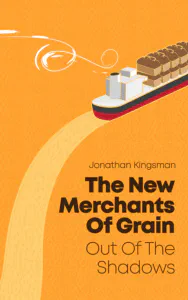
We all have a story we tell ourselves about how food reaches our table. A farmer harvests wheat under the sun. The grain travels to storage silos rising against the horizon. From there, it moves through processors and manufacturers, eventually landing on shelves at Carrefour or Spinneys as bread or pasta. A neat, linear journey from field to fork.
I believed this story too, until I didn’t.
The realization came after I invested in a food and grocery platform. Like any investor trying to understand their portfolio, I started asking questions. Basic ones at first: How does grain actually move across continents? Who coordinates these massive shipments? Why do prices fluctuate so dramatically?
What I uncovered was a hidden world that made my simple farm-to-table story look like a child’s drawing. Between those distant fields and my local supermarket exists a shadow network of trading houses; modern merchants of grain who control most of the world’s food trade from discrete offices in Geneva and Singapore. They operate with more power than many nations, yet most people don’t know they exist.
These aren’t public companies with transparent operations and quarterly reports. Apart from Glencore and ADM, they remain private, preferring to conduct their billion-dollar deals away from public scrutiny. They’re the invisible hand feeding the world, and they like it that way.
Jonathan Kingsman’s “Out of the Shadows” became my guide into this hidden realm. What started as simple investment research turned into something far more fascinating - a journey into understanding how our global food system really works, and why its most powerful players prefer to stay in the shadows.
What Did I Get Out of It
The global food trade runs on a simple truth: moving grain from where it grows to where it’s needed requires enormous scale, deep expertise, and precise risk management. The merchants who master this create fortunes. Those who don’t often disappear entirely.
Kingsman’s book reveals the inner workings of these grain merchants: their origins, their methods, and most importantly, their evolution from simple traders to sophisticated financial operators. Here are the key lessons that emerged from his detailed look inside this hidden world.
The ABCD+ Oligopoly: How Seven Companies Feed the World
The global grain trade operates through an elite group known as the ABCD+ companies - ADM, Bunge, Cargill, Dreyfus, plus Glencore, COFCO International, and Wilmar. Together, these seven giants handle just under 50% of international grain and oilseed trade. Their dominance extends beyond mere trading - they crush and process 35% of the world’s soybeans, with a total crush capacity approaching half a billion tonnes.
Each player has carved out its own niche in this oligopoly. As Kingsman notes:
“The media often refers to them as the ABCD group of companies, with ABCD standing for ADM, Bunge, Cargill and Dreyfus. The acronym, though, ignores the other three giants of the food supply: Glencore, COFCO International and Wilmar.”
The companies operate with vastly different structures and strategies. Cargill and Dreyfus remain private, giving them freedom from quarterly earnings pressure. Glencore, ADM, Bunge, and Wilmar are public, forcing them to balance long-term strategy with shareholder demands. COFCO International, backed by the Chinese government, operates with yet another set of priorities.
These different ownership structures create distinct advantages and challenges. As one industry veteran explains in the book:
“I believe that trading companies generally are better off as private companies. The business is seasonal and cyclical. It’s also prone to disruption by politics and weather. It leads to fluctuating P&Ls (Profits & Losses) that investors have difficulty understanding.”
Yet the real power of these companies comes not from their size but their integration. They don’t just trade - they own the infrastructure that makes trade possible. Their control extends from farms to ports, from processing plants to shipping fleets. This vertical integration lets them capture value at every step in the supply chain.
This dominance might suggest there’s no room for smaller players. But Kingsman reveals a more nuanced reality. While the giants control the major commodity flows, specialized niches remain viable for smaller traders. As the book explains:
“There is room for smaller traders in certain products and specific geographies. It’s harder for them to compete in the bigger commodities… There are successful companies, such as those trading pulses or yellow peas in Asia.”
These smaller players succeed by focusing on specific products or regions where the giants’ scale becomes less relevant. However, they face growing challenges, particularly in financing:
“Traditional TCF is changing. The amount of due diligence we must now do is such that smaller merchants will have increasing difficulty obtaining financing. We don’t have the mandate to do business with companies with capital below $25 million simply because the income we can create from this kind of client is too small - and the risk is too big.”
The Mathematics of Trading: It’s All About Differentials
The fundamental principle of commodity trading is disarmingly simple. As Kingsman explains:
“Commodity trading is usually defined as: ‘storing and/or transporting and/or processing a commodity from when, where or in what form it is not needed to when, where or in what form it is needed.’”
What makes this business complex is how profits are generated. Trading houses focus not on absolute prices but on differentials - the spread between prices across time, location, or form. This creates multiple layers of risk that must be precisely measured and managed.
Risk Components in Commodity Trading
- Price Risk: The volatility in absolute commodity prices
- Basis Risk: The relationship between cash and futures prices
- Freight Risk: Fluctuations in transportation costs
- Currency Risk: Exchange rate movements
- Counterparty Risk: Potential default by trading partners
Measuring Risk: The DVAR Framework
Modern trading houses use Daily Value at Risk (DVAR) as their primary risk metric. DVAR calculates the potential loss a trading position might experience in a single day, typically with a 95% confidence interval. The calculation involves:
- Historical price volatility analysis
- Position size evaluation
- Correlation assessment between different risk factors
The formula for DVAR typically follows:
DVAR = Position Size × Price Volatility × √Time Horizon × Confidence Level Factor
Statistical Foundation of DVAR
DVAR calculations assume returns follow a normal distribution, though in reality, commodity returns often exhibit fat tails (more extreme events than a normal distribution would predict). The confidence level factor used in DVAR depends on the desired probability threshold:
- 95% confidence = 1.65 standard deviations (one-tailed)
- 99% confidence = 2.33 standard deviations (one-tailed)
- 99.9% confidence = 3.09 standard deviations (one-tailed)
Why one-tailed? Unlike general risk metrics that consider both positive and negative deviations (two-tailed, using 1.96 for 95%), DVAR focuses solely on potential losses (one-tailed). This makes the calculation more relevant for risk management purposes.
Trading performance is measured through DVAR multiples:
“Traders will be judged by the multiple DVARS that they achieve. Good traders should achieve a multiple of six to seven times”
This means successful traders should generate returns 6-7 times greater than their daily risk allocation.
Let’s say a trading house holds a position in wheat futures worth $10 million. Here’s how they would calculate and interpret their DVAR:
Step 1: Calculate Historical Volatility
- Analyze daily price changes over the past year
- Assume wheat prices show a daily volatility of 1.5%
- At 95% confidence level (standard in trading), multiply by 1.65
Step 2: Calculate Base DVAR DVAR = $10 million × 1.5% × 1.65 = $247,500
This means that with 95% confidence, the trading house shouldn’t lose more than $247,500 in a single day on this position.
Step 3: Evaluate Trading Performance If a trader is expected to achieve a 6x DVAR multiple:
- Expected annual return = $247,500 × 6 × 252 trading days = $3.74 million
- This represents a 37.4% return on the $10 million position
Risk Limit Application:
- If the company sets a DVAR limit of $500,000
- The trader can only take positions that generate this level of daily risk
- In this example, they could roughly double their position size
This is why Kingsman emphasizes:
“Traders will be judged by the multiple DVARS that they achieve. Good traders should achieve a multiple of six to seven times”
A trader consistently achieving less than 6x DVAR is underperforming relative to their risk allocation, while consistently exceeding it might indicate excessive risk-taking.
The Risk Dashboard
Modern risk management has evolved beyond simple DVAR calculations. As Kingsman details:
“We combine all these tools into what we call a dashboard, and then we try to find a balance, a way to incorporate each of the various legs, such as flat price, spreads, premiums and freight positions, within limits”
The dashboard approach integrates:
- DVAR limits
- Position limits (by commodity and total portfolio)
- Stress testing scenarios
- Drawdown controls
- Correlation matrices between different risk factors
A unique feature of commodity trading is risk symmetry:
“The risk of being long or short of equities is asymmetric: there’s more risk in being short than in being long. It doesn’t apply to commodities… If a short seller of a particular commodity runs out of time, they risk being squeezed… if a trader is long of a commodity, they also risk being squeezed”
This symmetry means risk management must account for both upside and downside scenarios equally, unlike in equity markets where downside protection is prioritized.
The complexity of these risk measures reflects a fundamental truth about modern commodity trading: in a business where margins are “wafer thin,” sophisticated risk management is all about creating sustainable profits.
The Evolution of Supply Chains: From Commodities to Ingredients
The traditional commodity trading model is undergoing a fundamental transformation. As Kingsman explains:
“The fact is that trading bulk commodities is no longer a viable way to make sustainable money. The big trading houses must evolve into a more integrated process to generate recurrent profits.”
This evolution is happening along three distinct but interconnected paths:
From Commodities to Ingredients
The definition of what constitutes a commodity is changing. Investopedia’s traditional definition cited in the book states:
“A basic good used in commerce that is interchangeable with other commodities of the same type… The quality of a given commodity may differ slightly, but it is essentially uniform across producers.”
But modern market demands are breaking down this fungibility. As Kingsman notes:
“It’s often said that traceability and certification are turning many commodities into ingredients… An ‘ingredient’ can also be a commodity, but it is usually considered a specific grade or quality to make a success of a recipe or to be consumed directly. Cocoa is becoming an increasingly specialized ingredient; buyers are becoming even stricter about the quality of their raw ingredients.”
The Traceability-Tradability Tension
This transformation creates a fundamental tension. Buyers increasingly demand verification of specific traits:
“Buyers are asking traders to verify specific traits that pose reputational risks to retailers and brands more inclusive than weights, measures, and physical properties.”
But this verification comes at a cost:
“If a trader puts systems in place to verify how a product is produced, it costs money. They need multi-year contracts to offset those costs… A trading company may make 1.5 to 3 per cent on a single trade. If the verification cost is 1 per cent, then on a 1.5 per cent margin, you’ve already lost more than half of your profit.”
Vertical Integration as the Solution
Trading houses are responding by moving up and down the supply chain. As one industry veteran explains:
“For a trading company to succeed, it needs that integration. The margin is in integrating the whole supply chain, not any section of the supply chain… This move up and downstream is not discretionary. It’s mandatory. To fail to do that risks disappearance.”
However, this integration comes with its own challenges:
“One problem with moving up or down a supply chain is that you can end up competing against your suppliers or customers. Another issue is that you can end up in unfamiliar businesses. Growing sugarcane requires a different mindset than trading sugar.”
The end result is a fundamental reshaping of what it means to be a commodity trader. Success now requires managing not just price risk, but entire value chains - from production to processing to final delivery. In this new world, the traditional skills of a trader must be complemented by expertise in manufacturing, logistics, and consumer preferences.
The Zero-Sum Game: Understanding Margin Dynamics
Trading house profitability follows a fundamental principle that Kingsman lays bare:
“Commodity producers and merchants are price takers: they can only take what the market offers them. It means that if one participant in the supply chain makes more money, someone else along the supply chain has to make less.”
This zero-sum dynamic manifests in two critical ways:
Margin Mathematics
The profit equation for commodity traders operates within strict constraints:
“Competition between traders is so intense that profit margins are wafer thin - and have grown thinner over the years.”
A typical trade’s economics breaks down as follows:
- Gross margin: 1.5% to 3%
- Verification/compliance costs: ~1%
- Operating costs (storage, transport, etc.): ~0.5-1%
- Net margin: 0-1.5%
The pressure on these margins comes from two directions:
- Market Efficiency*“Non-commercials inadvertently play a role beyond risk assumption. Buying before a supply deficit hits or selling before a surplus hits, speculative activity often results in the price moving before the deficit or surplus”*
- Operating Leverage*“We found was better to continue throughput and obtain revenue to cover some of our variable costs… keeping facilities running, even at low throughput margins, is better than closing them. It’s better to extract some revenue to cover something against variable expenses than to have no revenue and still pay total overhead costs.”*
The Cost-Cutting Paradox
Attempts to improve margins through cost reduction often backfire:
“In a zero-sum supply chain, reducing costs is the only way to increase profits without picking others’ pockets. Unfortunately, what may work for an individual company (or farmer) may not work collectively… if everyone does it, the resulting extra production can result in a fall in price that negates the costs saved.”
This creates what economists call the marginal cost trap:
“Economic theory tells us that the price of a commodity is determined in the long term by the marginal cost of production of that commodity’s most efficient producer. The more efficient the producer, the lower the cost”
Breaking the Zero-Sum Game
Trading houses employ three primary strategies to generate sustainable profits despite these constraints:
- Risk Premium Capture Non-commercials resolve timing mismatches between producers and consumers:“Producers like to lessen their risk by selling in advance, and consumers want to reduce their risk by buying as late as possible, often for immediate delivery. Non-commercials resolve this mismatch in the appetite for risk by buying forward from the producers and selling spot to the consumers”
- Operational Arbitrage*“For a trader, logistics are paramount. The only added value of the trader nowadays lies with the efficiency and the smoothness with which he meets the needs of the destination by sourcing at various origins, come rain or shine.”*
- Financial Engineering*“Another path most large trading houses take is to complement their trading business with risk management and trade finance activities… Figures aren’t disclosed, but all five are making profits out of these activities, some quite handsome.”*
The mathematics of modern commodity trading thus becomes an optimization problem across multiple variables: physical margins, risk premiums, operational efficiency, and financial engineering - all while maintaining position limits and risk parameters discussed in our previous DVAR analysis.
The Digital Transformation: Technology Reshapes Trading
The traditional information asymmetry that trading houses relied on is rapidly eroding. As Kingsman explains:
“The ease of communication and the spread of information have led to what’s known as disintermediation… a buyer, either the consumer or importer of a commodity, can bypass the trade houses by directly contacting the seller.”
This transformation occurs across three critical dimensions:
Information Flow Architecture
Market power distribution has fundamentally shifted:
“In the past couple of centuries, farmers slowly lost pricing power to the merchants who moved the food to market. The merchants then gradually lost their market power to food processors and retailers. The growth of the Internet and social media has, in turn, weakened the power of the brands and the supermarkets, empowering consumers at the expense of farmers, merchants, processors and retailers.”
Blockchain and Supply Chain Verification
While blockchain technology promises enhanced transparency, its implementation faces specific technical constraints:
“I don’t see blockchain as revenue transformative. I see it as a mandatory evolution of the value chain. Overcoming the integration challenges, interoperability, and industry standards will create a more robust, efficient and transparent way to manage flows and reduce operational risk.”
Data Analytics Evolution
The transformation of data analytics in commodity trading has been revolutionary, moving through distinct phases that Kingsman carefully documents:
1. Position Management Evolution
“Thirty years ago, we managed risk in terms of the size of the position measured in tonnes. We then looked at the risk in monetary terms, the value. We then began to incorporate tools developed by the financial industry, such as daily value at risk, DVAR, drawdowns and stress.”
This evolution reflects a shift from simple volume-based metrics to sophisticated financial risk measures.
2. Market Structure Changes
“Discretionary capital in the futures markets has declined relative to non-discretionary capital. We now have a dominance of long-only products, high-frequency traders or macro-capital - which, to be fair, can be discretionary - that creates a distorting effect.”
These changes require new analytical approaches as traditional market patterns become less reliable.
3. Integration Challenges
The key challenge isn’t just gathering data, but integrating it effectively:
“The risk is that a manager makes decisions on reports based on incomplete or incorrect information. It is a real struggle for companies to collect the correct data in these fast-moving and complex markets.”
Modern trading houses must build systems that can:
- Process real-time market data
- Track physical commodity movements
- Monitor counterparty risk
- Analyze trade economics
- Project market trends
4. Competitive Edge
Despite these technological advances, traditional trading expertise remains crucial:
“Traditional trading companies still have an edge in their deep understanding of production and consumption economics, the value chain, and the associated timing. Detailed supply and demand analysis still works.”
The future belongs to firms that can combine traditional trading expertise with modern data analytics:
“Senior management must embrace technology and not leave it to their IT staff alone… information is data, which is the key to running any business but is essential in commodity trading. You must get to the data, clean and organize it. Only then can you start using analytics and business solutions to make informed and solid decisions.”
This evolution means trading houses must maintain two distinct but complementary skill sets:
- Traditional trading expertise (market understanding, relationship management, risk assessment)
- Modern analytical capabilities (data processing, algorithmic trading, predictive analytics)
Success in modern commodity trading requires mastering both dimensions - the human and the technological - while maintaining the flexibility to adapt as technology continues to evolve.
The Physical-Financial Nexus: How Paper Markets Drive Physical Trade
The relationship between physical and financial markets in commodity trading follows precise mechanisms. As Kingsman explains, it starts with a fundamental principle from Adam Smith:
“Adam Smith introduced the idea of an ‘invisible hand’. He realized that the price of something brings supply and demand into equilibrium. If demand increases or supply falls, prices increase to encourage supply while reducing demand. If supply increases or demand drops, prices fall, signalling producers to reduce output or consumers to increase demand.”
The Futures Market Mechanism
The futures exchange plays a critical intermediary role:
“As a futures contract relates to a transaction that is due to take place in the future, the futures exchange aims to act as an intermediary and mitigate the risk of default by either party in the intervening period. The futures exchange requires both parties to the transaction to put up an initial amount of cash, called the original margin, to guarantee against default.”
This creates a complex dynamic between three types of market participants:
- Producers (Natural Longs):“Producers like to lessen their risk by selling in advance”
- Consumers (Natural Shorts):“Consumers want to reduce their risk by buying as late as possible, often for immediate delivery”
- Non-Commercials (Speculators):“Non-commercials resolve this mismatch in the appetite for risk by buying forward from the producers and selling spot to the consumers”
Risk Distribution Mechanics
Unlike equity markets, commodity futures present symmetric risk:
“The risk of being long or short of equities is asymmetric: there’s more risk in being short than in being long. It doesn’t apply to commodities… If a short seller of a particular commodity runs out of time, they risk being squeezed: at some stage, they will have no choice but to buy the commodity, whatever the prevailing price. However, if a trader is long of a commodity, they also risk being squeezed and having to ship and sell the commodity at the prevailing price.”
Market Psychology and Price Formation
Markets exhibit predictable but imperfect behavior:
“Agricultural markets aren’t perfect: they overreact in both directions and can take time to correct. Prices tend to rise too far in times of shortage and fall too far in times of plenty. They also tend to stay higher for longer and lower for longer than one would expect.”
However, long-term economics prevail:
“In the long term, prices revert to what they call the equilibrium price, the price at which the marginal supply of a commodity equals the marginal demand for that commodity. The equilibrium price is the cost of producing an extra (or marginal) unit of that commodity by the most efficient producer.”
The Scale Dynamic
Physical trading operations often dwarf speculative positions:
“The public perception is that hedge funds take big swings in the market, and no doubt, some of them do. I managed much smaller positions in the fund space than in Bunge. Because of its physical merchandising business and global scale, Bunge often has no choice but to take significant positions in the futures markets.”
Basis Risk Dynamics
The relationship between cash and futures prices isn’t static. ‘Basis’ - the difference between local cash price and the futures price - fluctuates based on:
- Storage costs
- Transportation costs
- Local supply/demand conditions
- Quality differentials
A trader holding hedged positions must manage this basis risk. As Kingsman notes:
“Everyone involved in that supply chain is taking and managing price risk. The farmer takes a risk by planting wheat in the first place but offsets that risk by selling some of it in advance. Traders take a risk when they buy wheat from a farmer but offset that risk by hedging in the futures market.”
Physical Delivery Mechanics
As futures contracts approach expiration, a unique phenomenon occurs. Physical delivery requirements force convergence between cash and futures prices. This creates what traders call the “delivery squeeze” - where holders of short positions must either:
- Close their positions in the futures market
- Acquire physical commodity for delivery
- Pay premium prices to avoid delivery
Squeeze Dynamics
The symmetrical risk in commodity markets creates complex squeeze scenarios:
For Short Positions:
“If a short seller of a particular commodity runs out of time, they risk being squeezed: at some stage, they will have no choice but to buy the commodity, whatever the prevailing price.”
For Long Positions:
“If a trader is long of a commodity, they also risk being squeezed and having to ship and sell the commodity at the prevailing price.”
This creates what’s known as a “double squeeze” potential, where both longs and shorts can face delivery pressure. The risk intensifies when:
- Storage capacity is limited
- Transportation bottlenecks exist
- Quality specifications are strict
- Market participants concentrate positions
Understanding these technical mechanics is crucial because they affect not just pricing but the entire physical supply chain’s operation.
Who Is This For
“Out of the Shadows” isn’t for everyone. It’s dense, technical, and at times feels more like an industry manual than a book. But that’s precisely what makes it valuable for the right reader.
I debated whether to write about this book. Most people would find detailed discussions of basis risk and DVAR calculations painfully boring. Yet these technical details reveal something fascinating: the hidden infrastructure that feeds our world.
This isn’t a book you read for entertainment. It’s a book you study to understand how global commodity trading actually works. If you want to understand how grain moves from fields to food processors, how traders manage risk across continents, or how technology is reshaping centuries-old trading practices, the insights here are invaluable.
I approached this book as part of my research after investing in Apricart. What I found was a detailed blueprint of how the world’s food supply chain operates - from the mathematics of trading to the evolution of supply chains to the impact of digitalization. These aren’t just academic insights; they’re crucial understanding for anyone involved in food supply chains, commodity trading, or agricultural technology.
The book’s value lies not in its readability but in its depth. It’s a reference guide to the mechanics of global trade, the kind of resource you return to when you need to understand specific aspects of how commodity markets really work.