 Mandelbrot
 The Accountant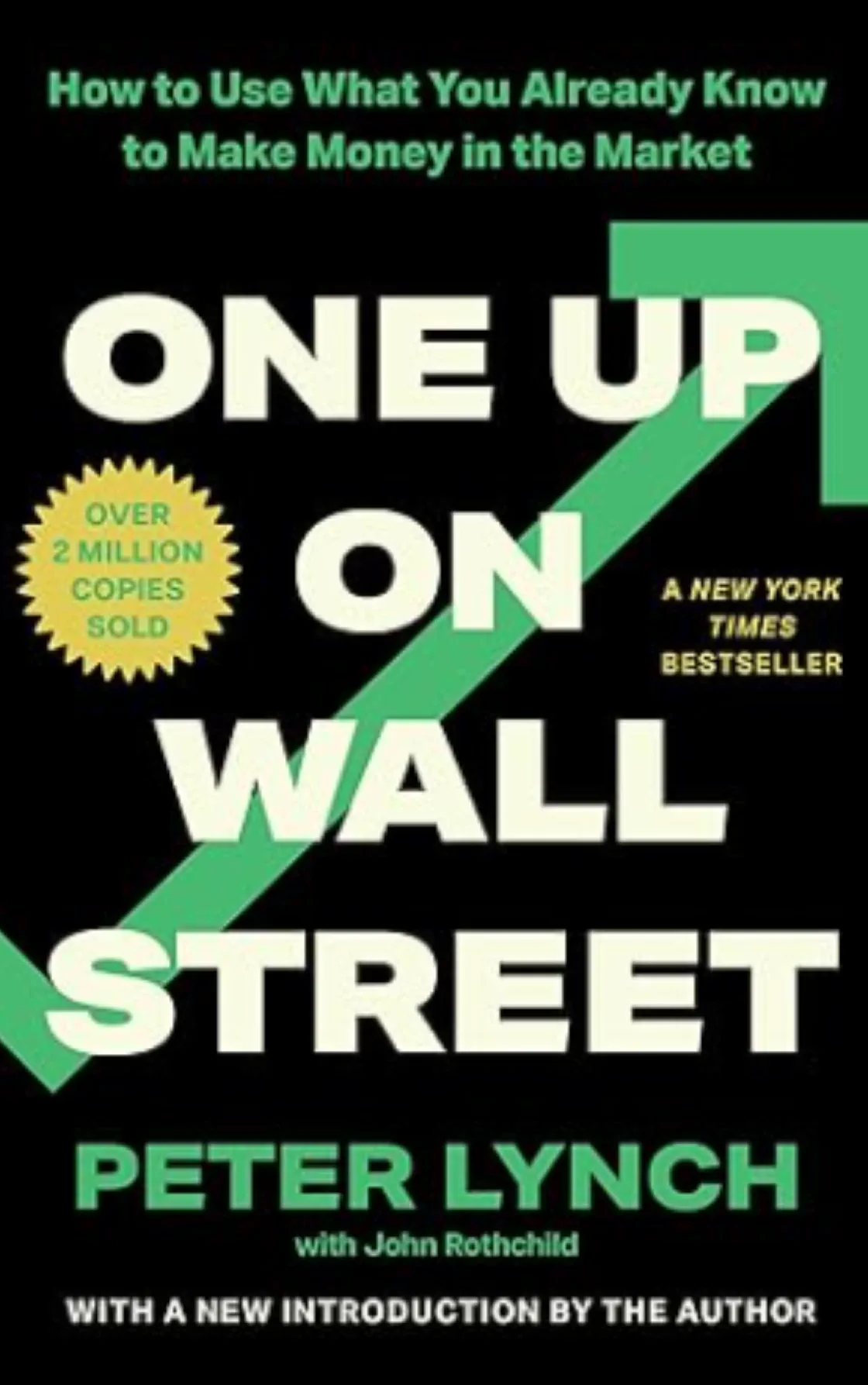
Peter Lynch tells this story in the middle of a book about picking stocks, which tells you most of what you need to know about how he thinks. The mechanics of finding a good company are the smaller part of One Up on Wall Street. The larger part is a study of why people, holding more data than any generation before them, keep losing money in the same predictable ways.
No matter how we arrive at the latest financial conclusion, we always seem to be preparing ourselves for the last thing that’s happened, as opposed to what’s going to happen next.
He ran Fidelity’s Magellan fund through one of the great runs in the history of the industry. The book reads less like a victory lap than a catalogue of things he taught himself to stop doing. That is the part I keep returning to. The stock-picking framework is useful and dated in equal measure. The behavioural diagnosis has not aged a day.
What Did I Get Out of It
The Price Is the Distraction
Lynch builds the entire book on a single inversion: the number everyone watches is the number worth ignoring.
To my mind, the stock price is the least useful information you can track, and it’s the most widely tracked.
I read that and recognised a habit I have never fully broken. The quote is a single sentence, but it indicts a whole industry of screens, tickers, and alerts that present price movement as information when it is mostly noise about other people’s moods. A price tells you what the marginal buyer or seller felt this morning. It tells you nothing about whether the business behind the share is earning more or less than it did last year. Lynch insists on holding those two things apart, and most of the discipline in the book flows from that one separation.
People may bet on the hourly wiggles in the market, but it’s the earnings that waggle the wiggles, long term.
What anchors me here is that earnings are not a clean number either. Cash flow gets quoted as a reason to buy when the figure being quoted is gross, not free, and the difference is the part that actually belongs to the owner. Reading the book against the way companies report, I kept translating Lynch’s plain language into the colder vocabulary of accounting: the story has to survive contact with the statements. A rising line on a chart is the easiest thing in the world to admire and the least reliable thing to own.
The Edge You Already Have
Lynch’s most quoted idea is that the amateur is not as outgunned as he assumes. The professional has speed and access. The amateur has a different asset entirely.
The person with the edge is always in a position to outguess the person without an edge—who after all will be the last to learn of important changes in a given industry.
A doctor knows a drug is working before the oil analyst does. A retail manager sees the new store outsell the old one before the quarterly print lands. That kind of knowledge is not insider trading; it is just attention paid to the thing in front of you. The trap Lynch warns against is mistaking the noticing for a decision. He keeps repeating that a good restaurant or a product you love is a reason to start looking, not a reason to buy.
However a stock has come to your attention, whether via the office, the shopping mall, something you ate, something you bought, or something you heard from your broker, your mother-in-law, or even from Ivan Boesky’s parole officer, the discovery is not a buy signal.
The remedy he proposes is a discipline I now use as a test of whether I actually understand anything: be able to give a two-minute account of why you own it, what has to go right, and what stands in the way, in language a child could follow. If the story collapses into a tip you overheard, you never owned a thesis. You owned a feeling.
Six Boxes for the Whole Market
The most practical thing in the book is a sorting rule. Before valuing anything, decide what kind of animal you are looking at.
place it into one of six general categories: slow growers, stalwarts, fast growers, cyclicals, asset plays, and turnarounds.
The categories matter because each one rewards a different question and punishes the wrong expectation. You buy a slow grower for the dividend and a fast grower for the runway, and confusing the two is how people lose money while believing they are being careful. Lynch reserves his sharpest warning for one box in particular, the one most investors mistake for safety.
Cyclicals are the most misunderstood of all the types of stocks. It is here that the unwary stockpicker is most easily parted from his money, and in stocks that he considers safe.
The thing that makes cyclicals dangerous is that they look healthiest at the top, when earnings are high and the price-to-earnings ratio looks reassuringly low, which is precisely when the next downturn is loading. The error is treating a peak as a floor. The same lesson the capital cycle teaches from the supply side: high returns invite capacity, capacity kills the returns, and the misread happens because people study the recent past instead of the structure underneath it.
What the Professionals Can’t Afford to Do
The part of the book that earns its title is Lynch’s account of why the people who manage money for a living are structurally prevented from doing their best work.
it’s more important not to look bad if you fail. There’s an unwritten rule on Wall Street: “You’ll never lose your job losing your client’s money in IBM.”
I have watched a version of this incentive operate well outside investing. In any function where you can be blamed for an outcome, the safe move is to be conventionally wrong with everyone else rather than unconventionally right alone. The penalty for the lonely mistake is career-ending; the penalty for the crowded one is a shrug. That asymmetry shapes behaviour long before anyone admits it, and it produces a quiet preference for the defensible over the correct.
If you invest like an institution, you’re doomed to perform like one, which in many cases isn’t very well.
The freedom Lynch keeps pointing at is the freedom not to be benchmarked every quarter. The amateur can hold the awkward, unglamorous position that no committee would sign off on, and can wait through the years when it looks foolish. That is the entire premise of a small-cap, ignored-corner strategy: the edge is not a smarter model, it is the absence of the constraints that force the professional toward acceptable mediocrity.
Capital Allocation Is Character
Lynch reads a company’s treatment of its own cash as a confession about how management really thinks.
Buying back shares is the simplest and best way a company can reward its investors. If a company has faith in its own future, then why shouldn’t it invest in itself, just as the shareholders do?
A buyback shrinks the share count and hands the remaining owners a larger slice of the same business, and it works only when the price is sensible, which means it is also a statement about discipline. The alternative he keeps cataloguing is the company flush with cash that cannot sit still, that mistakes activity for stewardship and goes shopping for businesses it does not understand.
psychologists should analyze this. Some corporations, like some individuals, just can’t stand prosperity.
Synergy is the word that gets used to dress this up, the two-plus-two-equals-five accounting that rarely survives the integration. The pattern is so reliable that the acquisition spree often signals the end of the very prosperity that funded it, a transfer of value from the buyer’s shareholders to the seller’s. The best operators treat every dollar of retained earnings as something that has to earn its keep, and the worst ones treat it as something burning a hole in the pocket. The way a company allocates capital is the truest thing it will ever tell you about itself.
Temperament Beats Forecasting
Underneath the framework, Lynch keeps circling back to the conclusion that the deciding variable is not analysis. It is the investor.
There’s no point in studying the financial section until you’ve looked into the nearest mirror.
He describes the unwary investor passing through three states, concern, complacency, and capitulation, always in the wrong order relative to the market. Pessimistic at the bottom, comfortable at the top, and selling in the trough they should be buying. None of that is an information problem. It is a problem of self-knowledge, which is why he spends as much time on temperament as on balance sheets. The market does not punish people for being uninformed. It punishes them for being unable to hold a position when holding it hurts.
You don’t need to make money on every stock you pick. In my experience, six out of ten winners in a portfolio can produce a satisfying result.
This only works because the downside on any single stock stops at zero while the upside has no ceiling, the asymmetry that lets a couple of big winners carry a portfolio of mediocrities. But the arithmetic is useless without the stomach to sit with the four losers and add to the winners instead of doing the opposite. Lynch separates investing from gambling not by the instrument but by the skill and dedication of the participant, and the skill he prizes most is the unglamorous one: knowing why you own a thing, so that you know when the reason has stopped being true. That is also the only honest basis for selling.
Who Is This For
This is a book for the person early enough in their investing life to still believe the answer is more information, faster. Lynch will not cure that belief, but he will name it, and naming it is the start. The mechanical chapters, the Internet plays and the specific tickers, are a museum of the late nineties and can be read quickly. The behavioural spine is permanent.
It is not the book for someone who wants a system that removes judgement. Lynch offers the opposite, a set of habits that demand judgement at every step and refuse to tell you in advance which historical analog applies. If you came looking for certainty, the six categories will feel like more work, not less.
What it changed in me was smaller and more uncomfortable than I expected. I track price more than I admit. I tell myself I am watching the fundamentals while a green or red number quietly does the steering, and the Mayan story landed because I recognised the posture: defending against the last drawdown, building stone houses along the fissure. Lynch does not pretend to have solved this. He just keeps holding the mirror up and saying, plainly, that the company is attached to the share and the price is the least of it. I have read more sophisticated books on investing. I am not sure I have read a more honest one about the investor.