 Mandelbrot
 The Accountant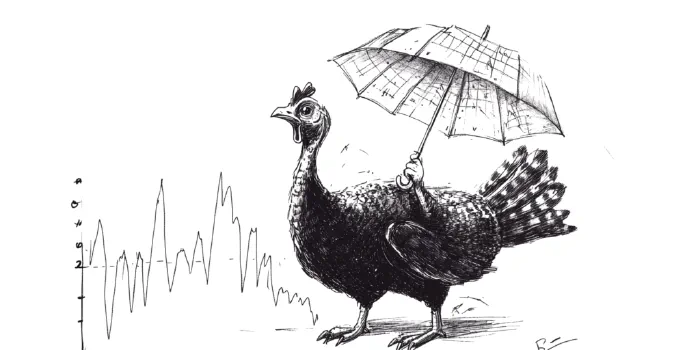
Nassim Taleb, the author of The Black Swan and Antifragile, often illustrates the dangers of unforeseen events with a story he calls the “Turkey Problem.” A turkey lives a comfortable life for 1,000 days, fed and cared for by humans, believing that each day reaffirms its safety. On the 1,001st day, Thanksgiving arrives, and the turkey’s world changes drastically. Taleb uses this story to show how past stability can lull us into a false sense of security, leaving us unprepared for sudden, catastrophic events.
In the context of investing, these unexpected events—or “black swans”—can devastate unprotected portfolios. Taleb argues that we should build strategies that prepare for the worst-case scenario. Protective measures, like using options, are an embodiment of this mindset. They help investors guard against the rare but impactful market drops that could erase years of gains in an instant.
There are times when the market takes a sudden, sharp downturn, and it can be unsettling. Without some form of protection, my portfolio could experience losses that would take a long time to recover. This is why having a risk management strategy in place is important. Using options as a protective measure might seem complex, but it can be a practical way to reduce potential losses during significant market drops. While I’m still learning and figuring out the best approach, these measures help me feel a bit more secure when markets get unpredictable.
What’s the Deal with Protective Puts?
Think of a protective put like buying insurance for your car. I pay a premium, and if an accident (or in this case, a market crash) happens, my financial loss is capped. Here’s how it works: I pay for the right to sell my stock at a specific price (known as the strike price) before a certain date. If the market tanks, that put becomes more valuable, and I’m protected from taking a major loss.
Why Use Protective Puts?
- Real Protection: It’s a safety net that directly guards against drops in my stock’s value.
- Control: I choose whether to use it or let it expire if the market stays steady.
- No Surprises: Unlike some other strategies, protective puts work regardless of sudden price dips.
The Trade-Offs:
- Cost: Just like any insurance, protective puts come with a price tag.
- Timing: If the market is already volatile, those puts might cost more.
- Effort: I’ll need to pay some attention to my positions.
An Example to Bring It Home: Say I have shares of an ETF trading at $100. To protect myself, I buy a put option with a $95 strike price for $3.00 per share. If the market drops to $80, I can still sell my shares at $95, limiting my loss.
A Simple Two-Step Strategy
I’m still learning and experimenting with ways to make my portfolio work for me, even in choppy waters. So, I set up a plan with two phases:
- Phase One: I start by selling a type of options setup called a deep out-of-the-money (OTM) put credit spread. This earns me some income upfront.
- Phase Two: Once that spread loses most of its value, I switch gears to a back ratio spread for more robust protection.
The goal is to find a balance—generating income while maintaining a safety net if things go south. I’m exploring different methods to achieve this, and while I’ve found some success, I’m aware there’s always more to learn and refine.
The Step-by-Step Walkthrough
Step 1: Selling Deep OTM Put Credit Spreads
- What’s This About? I sell a put option (betting the market won’t drop too far) and buy another at a lower strike price to limit my risk.
- A Quick Example:
- SPX is at 4650, and I sell 6 puts at a 4600 strike (deep OTM) for $3.00 each.
- To keep it safe, I buy 6 puts at the 4550 strike, creating a 50-point spread.
Choosing the Right Duration: When selecting the duration for a put credit spread, it’s all about balance. I aim for an expiration window between 45 to 90 days. Why? This timeframe offers a sweet spot where the time decay (known as theta) accelerates, allowing me to capitalize on the rapid decline in option value. Holding positions too close to expiration can increase the risk of sharp price moves, while longer durations might slow the income potential.
Why It Works: If SPX stays above 4600, I keep the premium. If it drops, those lower-strike puts cushion my loss.
Step 2: Transition to a Back Ratio Spread
- Watching the Market: I keep an eye on my spread as it loses value. When the time is right, I make my move.
- The Shift: I buy 4 extra puts at the 4600 strike. Now, I hold 10 long puts and have sold 6—a back ratio spread that offers strong protection.
Why It Matters: If the market drops sharply, my long puts gain value faster than the short ones. Plus, when the VIX (volatility index) climbs, my protection is even more effective.
Sizing the Hedge
Beta-Weighting: To decide how many puts to buy, I check my portfolio’s sensitivity to market moves (known as beta-weighting). Here’s how it works:
- Calculate Portfolio Beta: If my portfolio has a beta of 1.2, it means it’s 20% more volatile than the market.
- Determine Hedge Size: Let’s say I have a $100,000 portfolio. To hedge, I use this formula:
Hedge Size = (Portfolio Value * Portfolio Beta) / (Value of One Option Contract * Index Level)If one SPX option contract covers $465,000 (SPX at 4650 * $100 multiplier), my hedge size would be:($100,000 * 1.2) / $465,000 ≈ 0.26 contractsI round this to the nearest whole number based on my risk tolerance.
How Does This Compare to Other Strategies?
- Stop Orders: Good for limiting losses, but no guarantee they’ll trigger at the expected price.
- Index Puts: These are a great tool for larger portfolios because they offer broad market protection without the need to buy puts on individual stocks. Index puts, such as those on SPX or SPY, can simplify the process by providing comprehensive coverage tied to the performance of the entire index. However, buying index puts can be an expensive strategy due to the premium paid, particularly during periods of high volatility. This helps offset losses across multiple holdings if the market drops, but they may not align perfectly with the specific volatility or movement of certain stocks in my portfolio.
- Collars: A collar strategy involves buying a protective put and simultaneously selling an out-of-the-money call on the same asset. This setup caps potential losses while generating income from the call option to offset the cost of the put. It’s an effective way to manage downside risk with minimal out-of-pocket expense, but it comes with a trade-off: my potential gains are limited if the stock price rises above the call strike. Collars are perfect for when I want to lock in current gains without spending too much on protection. Limits upside but makes hedging cheaper.
Risks Associated with This Strategy
While this strategy offers a way to generate income and protect against significant market downturns, there are notable risks that I need to keep in mind:
- Market Timing Risk: The success of this strategy heavily relies on market timing. If I misjudge the market direction or timing, the protective measures may become costly rather than beneficial. Selling credit spreads requires the market to remain above the sold put strike, and miscalculating this can lead to significant losses.Example: If I sell a put spread assuming the market will stay above 4600, but instead the SPX falls sharply, my losses on the sold puts could outpace the premium I received. The long puts might not provide enough protection if the timing or size of the move isn’t favorable.
- Volatility Risk: Volatility plays a big role in options pricing. If volatility drops significantly, the value of my long options may fall, making it harder to cover potential losses. This is especially true if I rely on the increase in VIX for my back ratio spread to work effectively.Example: Suppose I establish a back ratio spread expecting the VIX to spike. If volatility instead declines, the value of my long puts decreases, and the protective benefits diminish, potentially resulting in a net loss.
- Assignment Risk: When selling options, there is always a risk of being assigned, especially as expiration nears. If the short options are in the money, I might be assigned unexpectedly, resulting in a large capital requirement or an unplanned position.Example: If the market drops and my short put options become in the money, I could be assigned on those options. This would require me to purchase the underlying at the strike price, which could lead to significant capital being tied up or even a forced liquidation if I am unable to meet the requirements.
These risks highlight that while options can provide valuable protection and income, they also introduce complexities and potential downsides. Being aware of these risks and continuously learning how to manage them is crucial to improving my overall strategy.
Strategies to Mitigate Risks
To manage and mitigate the risks associated with this options strategy, I can take several approaches:
Harvesting Gains:
One of the most counterintuitive lessons I’ve learned about options trading is that you don’t need to wait until expiration to profit. As the puts I sold lose value, I buy them back when they’re cheap (around $0.20) to lower my risk. Let’s break down the math: Say I sold 6 puts at $5.00 each, earning $30. If the value of each put drops to $0.20, I can buy them back for $1.20 total ($0.20 * 6), locking in a net gain of $28.80 ($30 - $1.20). This reduces my exposure and frees up capital for other opportunities.
The beauty of this approach is in its efficiency. Instead of waiting for that last bit of profit and keeping capital tied up, I can redeploy it into new trades. Think of it like a farmer harvesting crops slightly early when the yield is good, rather than risking bad weather just to get a marginally better harvest. By taking profits at 80-90% of maximum potential, I reduce my exposure to sudden market moves while maintaining a healthy return on capital. This strategy has helped me develop a more sustainable and less stressful approach to options trading.
Rolling Positions:
Rolling involves closing an existing option position and opening a new one, usually with a different expiration date or strike price. If a put credit spread moves against me, I can roll the spread to a later expiration to give the trade more time to become profitable.
Suppose I sold a put credit spread on SPX with a 4600/4550 strike price and an expiration date two weeks from now. If the market starts moving towards 4600 and I believe it might drop further, I could roll the spread to a new expiration one month out, keeping the same strikes or adjusting them slightly to provide more protection. This gives me additional time for the trade to work in my favor.
Another example let’s say I have a put credit spread that is close to expiring, and the short put is now in the money, meaning the market has dropped below my sold strike of 4600. To avoid assignment, I roll the position by buying back the in-the-money spread and selling a new spread further out in time, perhaps at 4550/4500 strikes with a new expiration date. This allows me to reduce the immediate risk of assignment and potentially recover losses if the market stabilizes or rebounds. For example, if my put spread is approaching expiration and is in danger of being in the money, I could close it and reopen a similar position further out in time.
Monitoring Volatility:
Volatility is a critical component of options pricing. By keeping an eye on the VIX (the ‘fear index’), I can better gauge market sentiment and adjust my strategies accordingly. For instance, if the VIX is low, it might indicate that the market is calm, which could be a good time to enter into protective positions while options premiums are cheaper. Conversely, if the VIX is high, it may signal increased market fear, which could mean that options are more expensive but also more valuable for protection.
Regular monitoring of the VIX and implied volatility, helps me make informed decisions about whether to enter, hold, or exit positions based on market sentiment. This proactive approach helps ensure that my strategies are responsive to changing market conditions, reducing unnecessary costs and optimizing protection.
Conclusion
As Nassim Taleb points out in The Black Swan, we cannot predict the future, but we can prepare for unexpected events. Through my journey of implementing various protective strategies—from protective puts to more complex approaches like put credit spreads and back ratio spreads—I’ve learned that portfolio protection is more art than science. While these strategies come with their own complexities and challenges, they’ve provided me with valuable tools to navigate market uncertainty.
My experience has shown that the most effective approach isn’t necessarily about finding the perfect strategy, but rather about maintaining consistency and adapting to changing market conditions. There have been times when my protective positions seemed like unnecessary expenses during bull markets, but they’ve proved their worth during sudden market corrections. These moments have reinforced Taleb’s wisdom about preparing for the unexpected.
The strategies I’ve outlined won’t eliminate risk—nothing can—but they’ve helped me sleep better at night knowing my portfolio has some built-in resilience against market shocks. By remaining vigilant about potential pitfalls, regularly monitoring market conditions, and learning from each trade, I’ve gradually built a more robust approach to portfolio protection. In the end, the goal isn’t to predict the next black swan event, but to be prepared when it arrives, much like keeping an umbrella handy for the unexpected storm.
Disclaimer: This post documents my personal journey and understanding of portfolio protection strategies using options. It reflects my learning process and experiments with these concepts. While I aim to be accurate, this content is for educational and informational purposes only and should not be considered financial advice. Options trading involves substantial risk and is not suitable for all investors. I take no responsibility for any trading decisions or losses that may result from using this information. Always do your own research and consult with qualified financial professionals before making any investment decisions. Your circumstances, risk tolerance, and financial goals may differ significantly from mine.