 Mandelbrot
 The Accountant
A few months ago, my five-year old son (Hamza) got into board games. We started from Uno, moved on to Snakes and Ladders, until he came across Monopoly. But given that he is too young to understand the intricacies of monopoly, I decided to give him a head start by more than doubling his starting money.
This got me thinking, the game became an illustration of a question posed by the Gambler’s Ruin: if one player has a superior skill set and the other more resources, who’s likely to come out on top?
The Monopoly board offers a tangible visualization.
Consider the dynamics surrounding the light blue properties on the Monopoly board. These properties, including the likes of Euston Road, Petionville Road, and The Angel, Islington, are among the first that players encounter after passing ‘Go’. Not only are they more affordable, but their relatively low purchase cost also makes them attractive early-game investments. Acquiring the complete set and developing them with houses or hotels can create a consistent revenue stream, which can be particularly advantageous for a player banking on strategy.
For Hamza, the game began differently. His massive starting capital meant he had the luxury of exploring different areas of the board without being overly cautious. He could focus on immediate acquisitions, even if they weren’t always the most strategic. A few poor purchases here and there wouldn’t significantly impact his game because of his financial cushion.
However, the board’s dynamics change considerably as players navigate towards the pricier green and dark blue properties. The cost of landing on an unowned Regent Street, Oxford Street, or the coveted Mayfair can be substantial. These properties command higher purchase prices and, once developed, can deal crippling rents to opponents. An unplanned landing on one of these squares without the funds to acquire them, or worse, to pay rent, could see a sizeable chunk of wealth evaporate.
It’s in these high-stakes moments that the essence of our game was distilled. Would my understanding of Monopoly’s strategy and my calculated risks balance out against Hamza’s formidable financial buffer? Each turn, each decision became a test of this balance.
The question becomes: Will my strategy be enough to counter Hamza’s resource advantage, especially if he owns these expensive properties?
Beyond the board, there’s a mathematical lens to view this through Markov chains, with certain assumptions about skill levels. A Markov chain calculates probabilities in situations where the next outcome depends only on the current state, not on the sequence of states that preceded it. In our game, each roll of the dice, each decision to buy or not, is such a state. By creating a model that factors in our respective advantages and then running a Markov chain simulation, we can predict the tipping point. At what point does my superior skill surpass Hamza’s capital advantage?
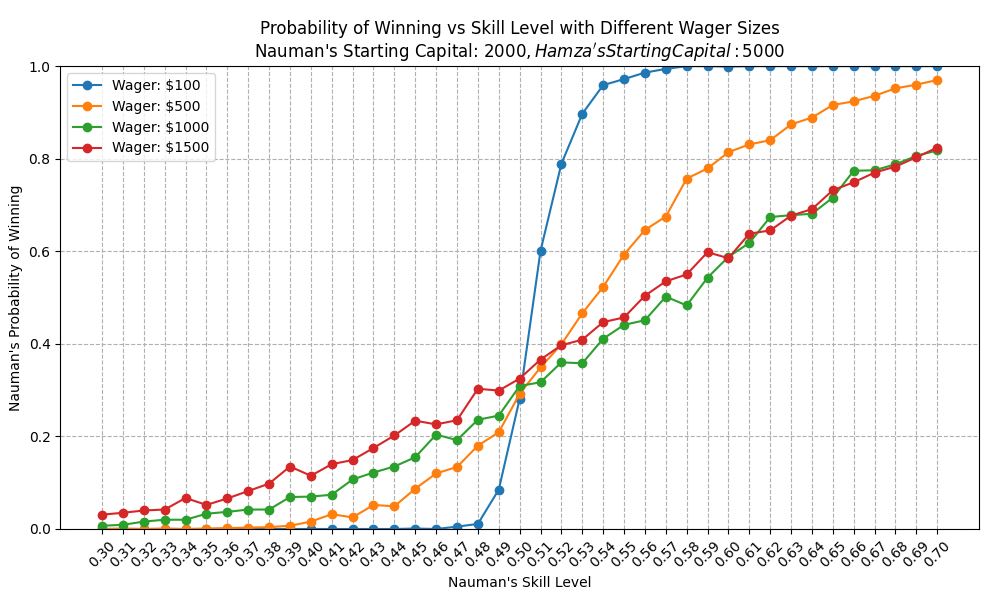
The arithmetic of Markov Chains is beyond my capabilities but a simplified simulation in python (with some help from AI on the code), we can see the relationship between varying skill levels and the outcome because of resource imbalance at various risk (wager) levels. With small wagers (e.g., cheaper properties), my skill level made a significant difference, and I am going to win every time because of my superior skill. However, as wagers increased, Hamza’s resource advantage began to overshadow my strategic prowess.
Despite all these calculations and ponderings, we didn’t finish the game because of Hamza’s waning enthusiasm. I couldn’t help but think any child might lose interest when their parent is musing over a math problem during playtime. As I reflected back on our game, pondering over the skill-resource continuum, I took the following notes as lessons learnt from our game:
- Life’s Uncertainties: The dice in Monopoly, much like life’s events, are unpredictable. Even if I have a strategic advantage, there’s no guarantee of continuous success.
- Value of Resilience: Despite several setbacks because of lower skill, Hamza’s resource advantage allowed him the resilience to bounce back, teaching us the importance of having a buffer or safety net.
- Probabilistic Thinking: Life’s outcomes often depend on probability. Even if I had a clear skill advantage, there’s always a chance, however small, for Hamza to win. The key is to weigh risks and rewards probabilistically, avoiding the pitfall of deterministic thinking.
- Value of Low-Cost Experiments: By risking less in each move, outcomes can shift in favor of the skilled player, demonstrating the power of cautious experimentation.
- Non-Zero Sum Dynamics: Life is more harmonious when it’s not a zero-sum game. In Gambler’s Ruin, one player’s gain is the other’s loss. However, in non-zero-sum scenarios, collaboration can lead to mutual benefits.
Through the lens of Monopoly, the concept of Gambler’s Ruin became a tangible, engaging lesson. It revealed the delicate balance between skill and resources, strategy and luck, underscoring that while life might be a game of chances, understanding probabilities can help us make better decisions.