 Mandelbrot
 The Accountant
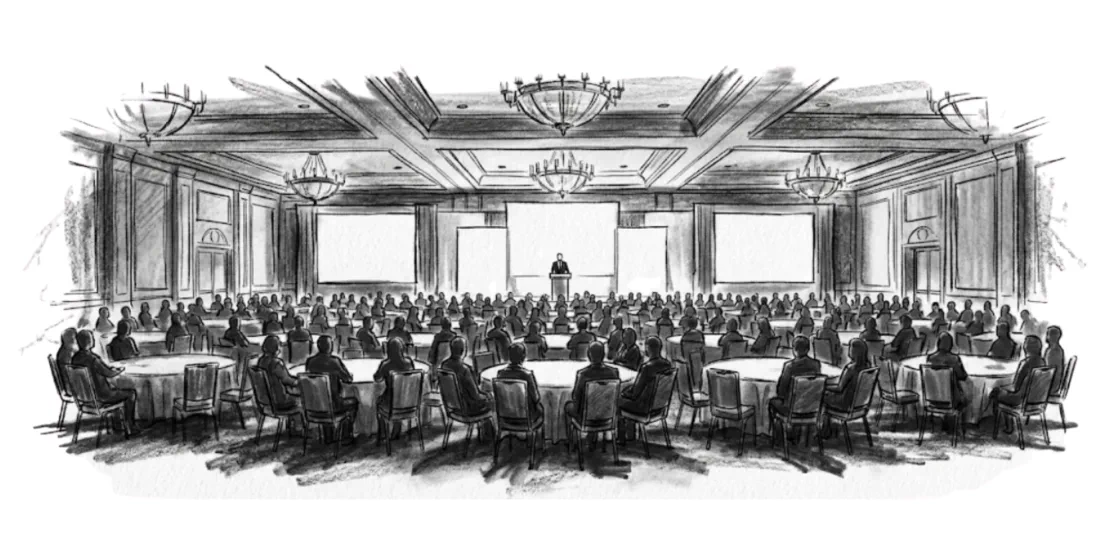
On the morning of my pitch I opened my diary and wrote one question. How do I hold my nerve?
I had six minutes to fill that afternoon in front of sixty investors, most of whom had been doing this far longer than me. The market was having one of its worst days of the year. My portfolio had just gone red for 2026. I am an accountant who feels drained after socializing and sick at the thought of small talk, and I should explain how I ended up in that room.
It started earlier this year with a LinkedIn message to a stranger. Ram, Ramanathan P.V. on his profile, had written a post about his early days as an accountant at Schlumberger and the work it took to achieve mastery and understand the business. He invests the way Munger and Buffett taught, and he lives in Dubai. So do I. I did not think much about the message, which is the only reason it got sent. Give me a day and I would have talked myself out of it. I have never believed I was successful or interesting enough to be worth an hour of someone’s time.
He said yes. I dropped my kids at school and drove to the Creek Club, and we sat in the Lakeview restaurant. The air conditioning was on and I still felt hot. I ordered an Americano anyway, and a cold water to go with it. What I got out of that conversation is something to be reflected upon in another essay, but if there is one nugget I could drop here it was on patience and humility. Ram told me he had always known he would be wealthy. He said it the way you would state your age. He never hurried, he stayed within his principles, and he trusted compounding to do its work if he gave it enough time. Patience and humility, he said, in investing and in life.
Before I left he invited me to ValueX Middle East, the conference he hosts every November for people who are, in his words, in the business of making mistakes.
I knew the name. Guy Spier started the first VALUEx in Switzerland in 2011. His idea was a conference with no audience. It is private, you come by invitation, and everyone who attends has to stand up and present. Ram’s is the one in Dubai. So the invitation I had just accepted was an invitation to join the club.
I knew how that yes would fare by November. Kevin Kelly says never accept an invitation far in the future unless you would also accept it for tomorrow, because a distant calendar looks empty and we fill it with promises we cannot keep. That rule doesn’t work on me. The day before anything that puts me out of my comfort zone, I am a man looking for the exit. To avoid this, I try to close exits while I still can and I am not in a state of mild panic. I registered and paid the day the invitation came. I booked leave so that work could not rescue me. If I was going to run, it would cost me money and leave me at home on a day off with nothing to do.
It worked, in that I did not cancel. It did nothing about the fear. The fear of man never leaves us. As the day drew closer the imposter syndrome crept back out. I was afraid of not getting the validation, and of not getting the recognition.
Four days before the conference, the fear was handed something to feed on. Ram’s team sent round a file with a bio of every attendee. I opened it at my desk in the office the following morning and read all thirty-two pages. A man who grew a fund from ten million dollars to ten billion. The head of public equities at a sovereign wealth fund. A former intelligence officer. People who had run billions in London and retired to run their own money. Some of them needed a full page. Mine was three short paragraphs, and I had struggled to write even that. I find it hard to write about myself.
That week I tried to argue my way out of it in my diary. Why did I sign up for this? I am not competing with any of these people, so why do I fear them? If I were more successful than someone, I would not think less of him for it. Surely I am not the only person in the world who does not judge.
It was a good argument. It did nothing to ease the feeling of sickness in my stomach.
The first test was the night before the conference, cocktails at Copperhead in the hotel’s lobby. I picked up my badge at the door. Arun, one of the organisers, greeted me and said he would take me to where everyone was, and I felt a small rush of relief. Maybe he would introduce me to someone. He walked me over to the crowd and left.
I had stood in exactly that spot once before, at an Alchemy Research event. That night I circled the room and was gone within five minutes. The only thing I did differently this time was stay, and staying was enough for luck to find me. Across the room I spotted Darshan, whom I knew from the TIP Mastermind Community. I still do not know whether he recognised me. He saw that I was coming over and made it easy. He had been talking to a young analyst who was there with his father, an impressive kid, and the three of us got talking. Ram came over, more people followed, and things eased up.
First night had gone better than I feared. That still left the pitch. Ram opened the next morning by reminding sixty of us what business we were all in, and for two days the pitches did not stop. Six minutes to speak, three for questions, one to change speakers. A grocery chain, a tobacco company, six slides each and a reason the market was wrong. I was down for Friday, second after lunch, which gave me a day and a half of watching other people do their thing. Each good pitch made mine heavier.
So by Friday I had prepared everything I could think of. My stock was CATL, the best battery company in the world. I had spent a month inside its accounts and I knew something the screens do not show: half the cash on its balance sheet belongs to its suppliers, its valuation above replacement cost has already invited a flood of new capacity, and the worst of the cycle is still ahead of the numbers. I had recorded the whole presentation as a video for myself, and I watched it once more before lunch. After lunch I wrote talking points against every slide on my reMarkable. I had thought my slides fit the six-minute limit.
I had never once timed them.
As the speaker ahead of me finished, I walked up, muttered a thank you and started. I want to start with a number. Thirty-nine. That part came out the way I had practised it. But there is a presenter in my head, and there is the one who actually stands up, and as I spoke I could feel myself falling short of the first one. Does everyone feel that? I knew what I meant and I could hear that I was not saying it. I looked at the clock, skipped to the end and sat down.
The moment I sat I wondered why I had cut it short. The clock has to be respected, I know. A couple of extra minutes would not have hurt anyone. Speaker after speaker ran past their time that afternoon and nobody so much as looked at a watch.
I braced for the room to notice. It never did. People who had managed billions asked me real questions about batteries, and I had answers. Someone said that in any room you should try to be the stupidest, the poorest and the youngest person there. At forty-one it’s difficult to find a room where I would be the youngest, but for the other two, I was in the right room.
On Saturday, with the pitches over, we stood for a group photograph and sat down to a long lunch: sixty people who had spent two days telling each other where they might be wrong. Nobody at that table had made me feel small. Sitting among them, I could see how far I still have to go. I can live with that. A distance is something you can walk. In a business where everyone is wrong for a living, there is nobody to compete with except yourself.
So, how do I hold my nerve? I do not. I paid, made a commitment and went through the whole thing despite the fear.
I plan to be in that room again next November. I already know I will dread it.