 Mandelbrot
 The Accountant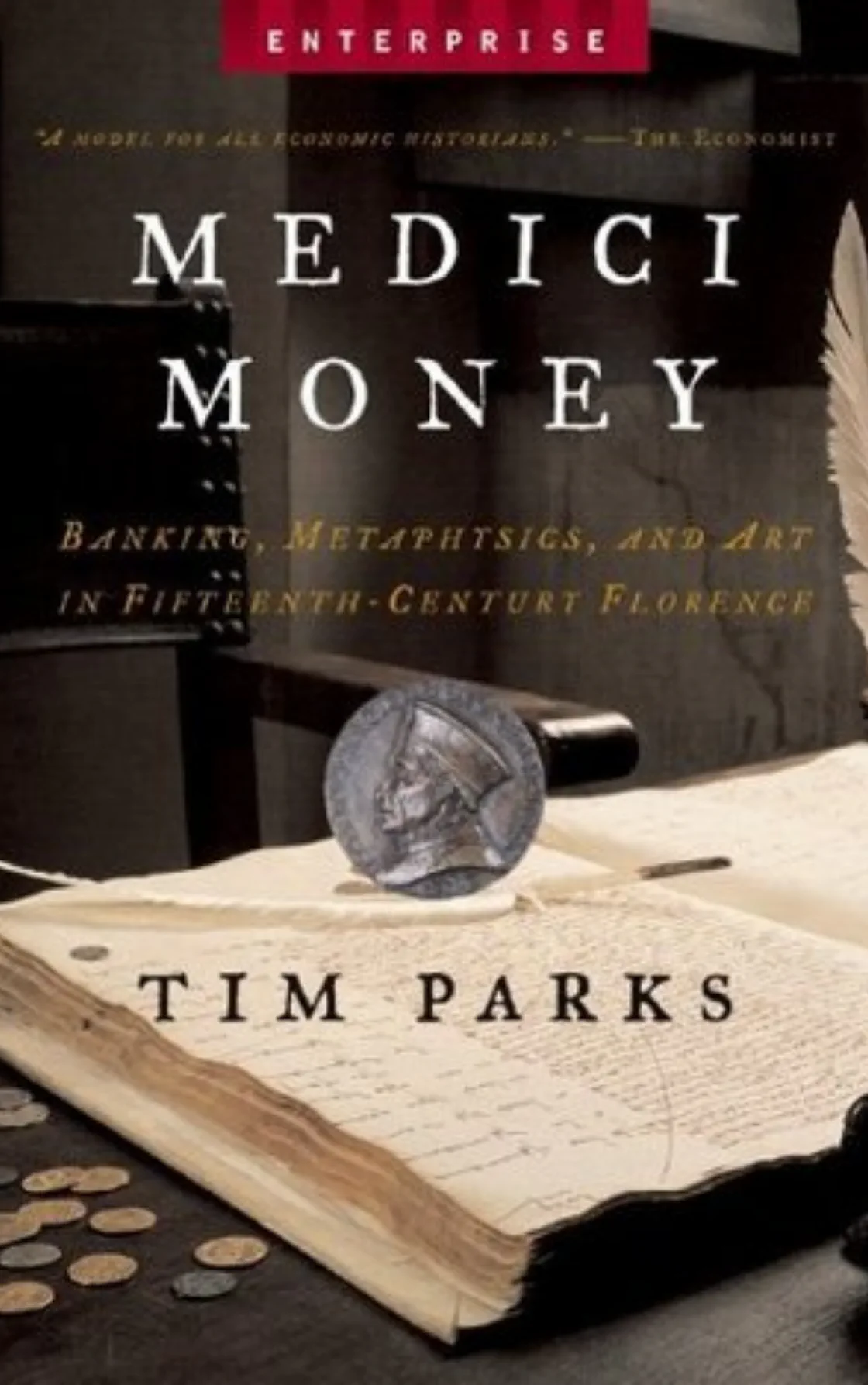
A merchant took florins from a Medici office in Florence on the fifteenth of June. Custom set repayment in London, in sterling, for the thirteenth of September. The parties could settle earlier if they wanted. They could not settle later.
Ninety days was roughly the time a letter needed to travel between the two cities. That was the justification. Because the money changed currency, because it crossed a real distance, and because the rate on the return leg was unknown when the deal was struck, the transaction was an exchange, not a loan. Loans at interest were usury. Usury was the sin that occupied dying men more than any other, and the Church councils of 1179 and 1274 denied usurers Christian burial, recommending ditches shared with dogs and cattle.
referring, very discreetly, to the time between the payment in florins and the repayment in sterling. If our man has taken his florins on June 15, the custom is that the pounds should be ours on September 13. We could agree on an earlier day if we wanted. But we can’t postpone it, because in that case the whole thing would begin to look rather like a loan and not an exchange deal at all.
The time value of money did not vanish when the Church banned interest. It relocated. It moved into the gap between two cities and took shelter inside a currency quote. Every element of a modern credit facility is present in the bill of exchange: a principal, a term, a yield, a settlement date. Only the vocabulary was missing, and the vocabulary was the entire compliance regime.
Tim Parks tells the whole arc of the family that industrialized this arrangement, and he tells it without the reverence the Uffizi tends to impose.
One hundred years. Five generations. A vertiginous rise of fortune-first economic, then political-in the hands of two most able administrators. A brief hinge period presided over by a grumpy, middle-aged man in bed. Then two and a half decades of political ascendancy predicated on a wealth that is rapidly disappearing. Followed by sudden and complete collapse
What Did I Get Out of It
Parks is a novelist and a translator, not a financial historian, and the book carries the marks of both. What I liked was not the art or the assassinations. It was the workings of a bank that had to earn a return on money while operating under a rule that forbade earning a return on money.
The Distance Between Florence and London
The prohibition on usury was not a soft norm. It carried eternal consequences, and men who had spent fifty years lending believed in those consequences enough to fund chapels on their deathbeds. What the Church could not do was suppress the underlying economics.
Usury alters things. With interest rates, money is no longer a simple and stable metal commodity that just happens to have been chosen as a means of exchange Projected through time, it multiplies, and this without any toil on the part of the usurer. Everything becomes more fluid
The theologians did not surrender. They negotiated. They produced a test, and the test was structural rather than economic, which is why it failed. Distance, currency conversion, and genuine uncertainty of outcome would make a transaction lawful. Nobody thought to ask whether the uncertainty was real or whether it merely looked real on the face of the contract.
As long as the geographical distance was maintained, the theologians decided, as long as there was a real exchange of currencies, as long as there was an element of risk, it wasn’t usury.
Risk was the load-bearing element of the exemption, and the records show what that risk actually amounted to. Of sixty-seven documented exchanges among London, Bruges, and Venice, one produced a loss for the bank. The remaining sixty-six produced gains between roughly eight and twenty-nine percent. A distribution that one-sided is not speculation. Bankers set the rates in both cities, they knew the customary spread, and the currency leg was decoration. The exemption depended on a probabilistic claim that the bank’s own ledger disproved. Long before anyone could price a contingent claim, as Against the Gods traces, the Florentines had worked out that risk was the magic word, and that nobody was checking the distribution behind it.
What the Rule Actually Cost
The interesting question is not whether the prohibition was evaded. Of course it was. The interesting question is what the evasion did to the shape of European capital.
Usury was abominable but people needed loans and bankers a return for giving them. The complex system of differing exchange rates, possible only because of the time it took to travel from one financial center to another, provided an ambiguous territory that kept trade moving and many in a constant state of anxiety as to the destination of their eternal souls. Some merchants steered clear of the whole business, convinced it was a sin. Some less scrupulous operators were happy about the Church’s position because it scared off the squeamish and reduced the competition. The practical effect was that long-term loans became difficult, because a bill of exchange must always be paid in no more than the time officially required to reach one of the major European centers. Capital investment suffered The bank became anchored to trade rather than manufacturing and was forced to become international, when otherwise it might well have stayed local.
The rule did not stop lending. It capped tenor at the speed of a horse, pushed credit toward trade finance and away from productive assets, raised the cost of borrowing, and handed a margin advantage to whoever had the loosest conscience. None of those were intended. All of them followed directly from the definition chosen. When a prohibition is written around a form rather than a substance, capital reorganizes itself around the form and the prohibition ends up shaping the economy without ever changing behavior. I have watched smaller versions of the same in Chasing Metrics, Missing the Mark and in every policy that measures the artefact instead of the exposure.
The Church, meanwhile, was the bank’s largest counterparty on both sides of the balance sheet.
When the Church asked for loans from a bank, for example, the bank could not ask for interest in return, because usury was a sin. So in its role as trading company, it would increase the price of the goods it sold to the Church to the tune of the interest it felt it deserved from the loans it had made.
Interest recharacterized as a mark-up on unrelated goods. Reverse the direction and the same institution wanted a return on deposits without the return being named, which produced the discretionary deposit: a gift, at the bank’s discretion, that everyone understood to be a rate. The rule-setter was the most sophisticated user of the workaround. That detail does more to explain the durability of the arrangement than any amount of commentary about medieval hypocrisy.
Three Locks on One Chest
The Exchangers’ Guild had no theological ambiguity to manage, so its rules are startlingly clean.
Once completed, the entry is read out loud. Any member of the Exchangers’ Guild found to have destroyed or altered his accounts is expelled without appeal. Whereas the Church’s rules may be open to debate, these are not. And when a banker dies leaving no one to carry on the business, his ledgers are held by the guild in a chest with three locks so that three officials, each with his own key, must all be present before the accounts can be consulted. Money, like mysticism, thrives on ritual
Reading the entry aloud is a completeness check performed by a second pair of ears. Expulsion without appeal for altering records is a rule with no materiality threshold. The three keys are segregation of duties, enforced by carpentry. Fifteenth-century Florence understood that the integrity of the record is a separate problem from the integrity of the transaction, and that the record needs its own custody arrangements once the person who made it is gone. Six centuries of audit standards have added length rather than insight, and the immutable-ledger enthusiasts arrived at the same design and thought they had invented it.
The same guild produced something stranger. Because the florin was too valuable to break into small change, and letting it break would have put it in the hands of the poor, bankers invented a unit of account that existed only in the books.
Even the feudal lord in the country keeps an army and hires it out, governs his lands. That is understandable. Even the priest helps your soul to paradise when the solid flesh finally melts and the breath rattles its last. Who would deny the need for a church? But what on earth are these bankers doing counting in coins that don’t exist?
I find the question harder to dismiss than Parks probably intends. A functional currency of account that nobody can hold is a genuine abstraction, and the population living outside it had no way to verify anything denominated in it. Most of what I reconcile now is denominated in units of that kind: notional amounts, translated balances, measurement bases agreed by convention. The abstraction is useful and the discomfort of the fifteenth-century observer was not irrational. He simply could not audit it.
Structuring the Branch So the Center Never Loses
The organizational design is the most intriguing part of the book, because it is recognizably modern and nobody had done it before.
Each branch was to be a separate company. The shareholders were: the branch director, to the tune of something between 10 and 40 percent, and then the Medici bank for the rest. Not the Medici family personally, and not the Florence branch, which had the same status as the other branches, but rather a separate holding company located in a separate office in Florence. In this way, a large number of capital-bearing partners could be brought in-one or two in each branch and one or two more important figures in the holding-without the Medici themselves ever losing control of either the parts or the whole.
A holding company sitting above legally distinct operating entities, minority partners contributing capital without control, and directors paid a share of profits well above their share of the equity so their incentive would outrun their investment. Alongside it, an explicit credit policy: caps by counterparty type, a prohibition on lending to Roman merchants, none to feudal barons even against security, none at all to Germans, on the ground that their courts would not enforce the claim. Real skin in the game at the branch, combined with a written statement of who the bank would not lend to and why. Both practices decayed at precisely the moment they were most needed.
Then there is the naming decision, which is the whole of modern structuring in one paragraph.
If a branch was registered with the Medici name, it would have more prestige and attract more investment. But in that case, the Medici holding would have to assume unlimited liability. If it took the name of the resident local partner who actually ran the branch, then Medici liability was limited to the capital actually invested, but the branch’s prestige would suffer. Despite his ceremonial armor and incendiary reading, cautious Cosimo almost always opted for the latter solution, at least for the first few years
Cosimo traded balance-sheet appearance for liability containment and accepted a slower ramp in each new market. Legal separation with economic unity holds only as long as the center is willing to let a branch fail, and that willingness is never tested in good years. Credit Suisse ran a version of the same architecture, decentralized legal entities under one brand, and discovered late that reputational liability does not respect the corporate veil, which is the thread running through Too Close to the Wind. Cosimo grasped in 1435 what a modern group structure only pretends to solve.
When the Borrower Is the Court
The bank’s decline is usually attributed to Lorenzo’s disinterest. The credit facts are more specific.
The bank was paying the price for its fatal attraction to political power. To lend to people whose reputation and position do not depend on honoring their debts will always be dangerous, but to give huge sums to people who actually feel it is undignified to repay is madness. These were not the kind of people you could take to court. They were the court. Often a condition of lending to one of them was that you must not lend to another
Concentration risk, an unenforceable claim, and an exclusivity covenant running in the wrong direction. The bank could not diversify because the borrower forbade it, and could not recover because the borrower controlled the recovery. Sovereign lending has never solved that problem, only renamed it, which is the argument Lending to the Borrower from Hell works through in detail. By the 1480s Lorenzo himself was among the bank’s principal debtors, and the amount of his own capital left in the business was trivial against what he had inherited. He had become the counterparty and the shareholder at once, with no incentive to be rigorous as either.
In 1482, a proposal for restructuring the whole bank was drawn up. There would be two holdings, one under Tornabuoni, running Rome and Naples, the other under Sassetti, running Florence, Lyon, and Pisa. Two barons, two entirely separate entities to satisfy two considerable egos. Nothing became of the plan. Nothing was done to coordinate the remaining branches or to have their directors care about each other’s losses
The restructuring was designed around personalities rather than exposures, and then it was not executed. Nobody made the branch directors accountable for group outcomes. Nobody rebuilt the holding structure that Spinelli proposed in Lyon. The bank did not blow up in a single fraud or a single default; the number of Florentine banks fell from seventy-two in the 1420s to thirty-three by 1470, and the Medici simply drifted into the same current. The failure looks like the pattern I wrote about in The Library That Burned Twice. Governance that was never formally dismantled, only allowed to become optional, one urgent exception at a time.
Envy Is a Weed Best Left Unwatered
Cosimo held power for thirty years without holding office, and the technique deserves study on its own.
“He mixed power with grace,” Machiavelli tells us in his Florentine Histories. “He covered it over with decency.” “And whenever he wished to achieve anything,” says Vespasiano da Bisticci, “to avoid envy he gave the impression, as far as was possible, that it was they who had suggested the thing, not he.”
He understood that power seized rather than inherited is permanently provisional, and that any definitive settlement becomes a fort for the next determined man to storm. So he negotiated continuously and kept the lid on. The behavior sounds like modesty but functions as risk management. Attribution given away is influence retained, and the person who insists on credit for a decision also inherits sole ownership of it when it fails.
By not asking for recognition or imposing yourself as benefactor, you actually attract even greater recognition
Parks is sharper than that line suggests, because he refuses to let the patronage stand as generosity. The chapels and the commissions were penance for the money and an advertisement for the family in the same gesture, and the Church colluded in calling it glory to God. Botticelli used the same model for a Madonna and for a Venus, and either way the viewer felt elevated. Motives that flatter us tend to be the ones we report, which is what The Elephant in the Brain illustrates. Five hundred years later the frescoes are still working, and almost nobody asks which bank paid for them.
Who Is This For
Not for anyone wanting a management case study. Parks digresses into Dante’s seventh circle, into what the streets of Florence smelled like, into the fate of a preacher’s donkey after his admirers stripped it of hair for relics. If you want the Medici extracted into transferable lessons, the wandering will irritate you. The book also assumes you can hold a dozen Italian names in your head at once, and I could not, so I kept a list.
It is for people who work with rules and their evasions. Anyone who drafts policy, tests controls, or reviews a structure whose legal form and economic substance have quietly separated will find the medieval version cleaner than the modern one, because the medieval version has three centuries of documented outcomes attached. It is also for anyone who thinks financial engineering began with derivatives. The bill of exchange was a synthetic loan built to satisfy a definitional test, and it worked for two hundred years, which is longer than most modern structures manage. If you enjoyed the nuts and bolts in Devil Take the Hindmost, this sits directly upstream of it.