 Mandelbrot
 The Accountant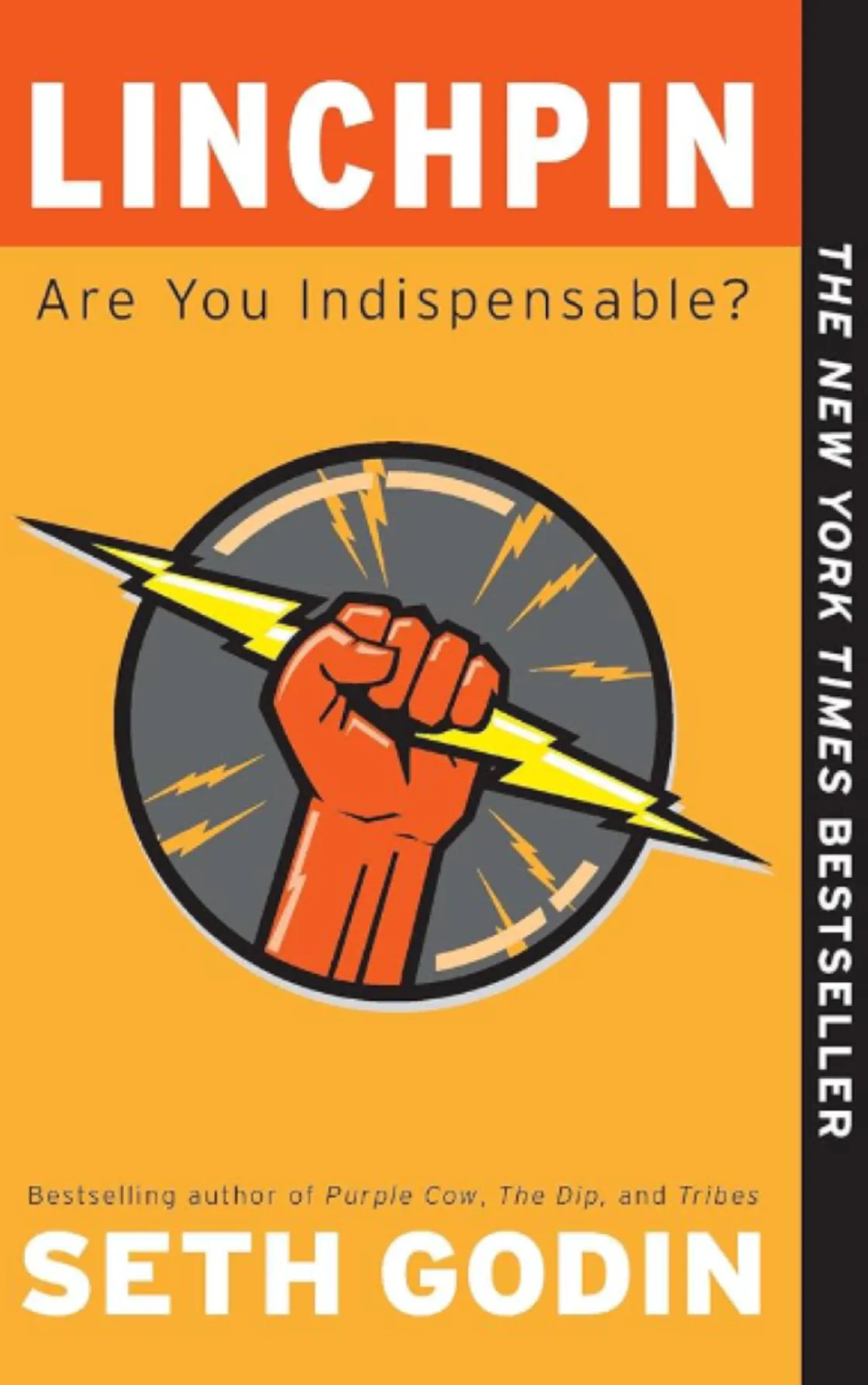
Godin tells this story early in Linchpin, and it works as the whole book compressed into one anecdote. Transcription used to be a job you could build a living on. Then someone wrote down exactly how to do it. The moment the task could be described precisely enough to hand to a stranger, it could be handed to the cheapest stranger, and eventually to a piece of software. The skill did not vanish. Its price collapsed.
The book is about the other kind of work. The work that resists the manual, that cannot be chopped into fragments and reassembled, that loses its value the instant you try to standardize it. Godin calls the person who does that work a linchpin. I spent much of the book arguing with it, which is usually the sign that I needed to read it.
What Did I Get Out of It
The Manual Is the Beginning of the End
Godin’s definition of factory work has nothing to do with machinery. It has to do with predictability.
It’s factory work because it’s planned, controlled, and measured. It’s factory work because you can optimize for productivity. These workers know what they’re going to do all day—and it’s still morning.
That sentence landed uncomfortably close to home. I spend a good part of my professional life writing exactly the kind of documentation Godin is warning against. Process maps, control matrices, procedure documents that describe a task so tightly that anyone can execute it and any deviation can be flagged. The entire discipline is built on the premise that the work should be reproducible, auditable, and independent of the person performing it. That is the point of a control. It is also, by Godin’s logic, the precise mechanism by which work becomes cheap.
If we can put it in a manual, we can outsource it. If we can outsource it, we can get it cheaper.
The uncomfortable resolution I arrived at is that both things are true at once. The routine execution of a control belongs in a manual, and should be, because you do not want the reliability of your financial reporting to depend on one person’s mood. But the judgment about which controls matter, where the real risk sits, what the numbers are quietly failing to say, none of that survives being written down. The commodity is the checklist. The linchpin is the person who knows when the checklist is lying to them. Godin drew the line for me between the parts of my work that a service like the Turk could absorb tomorrow and the parts that no vendor can price, and I had never separated them so cleanly before. The same commoditizing force that The Box unleashed on physical goods is now loose on white-collar tasks, and the only defense is to be doing the part that cannot be containerized.
The Race to the Top
Godin frames the strategic choice as a fork with only two honest branches.
Win by being more ordinary, more standard, and cheaper. Or win by being faster, more remarkable, and more human.
Most organizations pretend there is a comfortable middle, a way to be both cheap and special. There isn’t. The middle is where margins go to die, because the moment you compete on standardization you have entered a contest that the lowest-cost operator always wins eventually. I have watched this dynamic play out the way the Red Queen Effect describes it, everyone running faster to cut cost and staying in the same place, until the whole field has raced itself down to a floor nobody wanted to reach. Godin puts the mechanics of that spiral plainly:
If you make your business possible to replicate, you’re not going to be the one to replicate it. Others will. If you build a business filled with rules and procedures that are designed to allow you to hire cheap people, you will have to produce a product without humanity or personalization or connection. Which means that you’ll have to lower your prices to compete. Which leads to a race to the bottom. Indispensable businesses race to the top instead.
The insight I took is that replicability and pricing power are inversely related, and you choose which one you optimize for early, usually without realizing you are choosing. A firm built for cheap labor is architecturally committed to competing on price, because it has removed everything a customer would pay a premium for. The design decision precedes the strategy. By the time the price war arrives, the outcome was set years earlier in how the thing was built.
Emotional Labor and the Indispensable
The linchpin’s currency is not effort in the physical sense. It is emotional labor, the willingness to bring judgment and care to a situation that a rulebook cannot fully specify.
The only way to get what you’re worth is to stand out, to exert emotional labor, to be seen as indispensable, and to produce interactions that organizations and people care deeply about.
What makes this hard is that emotional labor is invisible on a productivity report. You cannot count it, and the things you cannot count tend to get starved of attention. The person who makes a hard call under ambiguity, who has the difficult conversation nobody else will have, who notices the thing that isn’t in the data, produces enormous value that shows up nowhere in a metrics dashboard. Godin’s argument is that this is exactly why it is worth so much. Scarcity lives in the work that cannot be measured, because measurement is the first step toward standardization, and standardization is the first step toward commoditization. He extends the same logic to what buyers actually want:
We have everything we need, so we’re not buying commodities. We’re not even buying products. We’re buying relationships and stories and magic.
In a market saturated with adequate options, the differentiator moves upstream from the object itself to the narrative around it, a point that Made to Stick makes from the other direction. The product is table stakes. The story is the margin.
The Superpower and the Handshake
One of the more practical passages uses an unlikely source, the introductions in old comic books, where lesser heroes had to announce what they could actually do.
When you meet someone, you need to have a superpower. If you don’t, you’re just another handshake.
I found this more useful than the entire genre of personal-branding advice, because it reframes the question away from self-promotion and toward usefulness. A superpower is not a slogan about yourself. It is a clear statement of how you can help, specific enough that the other person immediately knows whether you fit their problem. Vagueness is not modesty. Vagueness is friction. If nobody can tell what you are for, they cannot route the right opportunities to you, and you become interchangeable by default. The same terrain Beyond Luck covers when it argues that positioning does more work than talent. Godin points to research on the signals people actually read in each other:
Five traits that are essential in how people look at us: Openness, Conscientiousness, Extra-version, Agreeableness, and Emotional Stability.
He connects this to Sandy Pentland’s work on honest signals, the information that flows between people beneath the words, and it echoes the argument in The Elephant in the Brain that much of human interaction is signaling we barely notice we are doing. What you say about your competence matters less than the signals you cannot fake.
Do Your Art, but Don’t Wreck It
The part of the book most likely to be misread is the section on art and money, because Godin refuses the comfortable romantic answer. He does not tell you to follow your passion and the money will come.
When what you do is what you love, you’re able to invest more effort and care and time. That means you’re more likely to win, to gain share, to profit. On the other hand, poets don’t get paid.
The honesty here is what makes it credible. Loving the work genuinely improves the work, because care is an input that shows up in the output. But that does not repeal economics, and pretending otherwise has bankrupted plenty of sincere people. Godin’s resolution avoids both the delusion that passion pays and the cynicism that says give it up:
Maybe you can’t make money doing what you love (at least what you love right now). But I bet you can figure out how to love what you do to make money (if you choose wisely).
The inversion that made the section stick. The question is not only whether you can monetize what you love. It is whether you can bring the linchpin’s care to work that does pay, and protect the art you love from the corrosion that comes when you force it to earn. So Good They Can’t Ignore You argues the same case with more evidence, that mastery generates passion rather than the reverse. Godin adds the emotional dimension the harder version leaves out: the giving. His view is that the work you give freely signals abundance, that you have more where that came from, and that this generosity is itself a form of scarcity in a world optimizing for extraction.
Who Is This For
Linchpin is a book for anyone whose work has started to feel describable. If you can write down your job in enough detail that a stranger could do it, that is not job security, that is a countdown. The people who most need this book are often the ones who feel safest, the reliable, the compliant, the ones who never miss a step, because Godin’s uncomfortable claim is that reliability of that kind is precisely what gets automated first.
It will frustrate readers who want a system. There is no framework here, no numbered process, and given the argument, there could not be. A manual for becoming irreplaceable would be self-refuting the moment it was published. The book is repetitive, it circles the same handful of ideas from a dozen angles, and if you are allergic to motivational cadence you will feel it. I was, in places.
What it changed in me was narrower and more specific than the book’s own ambitions. I came in expecting a manifesto against process, and process is the water I swim in. What I left with was a sharper line between the two halves of my own work. The routine execution belongs in a manual and should stay there, ruthlessly documented, because that is where reliability comes from. But I had let that same instinct creep into the part of the job that lives on judgment, the part that has no procedure because the whole value is that it has no procedure. I had been quietly trying to systematize the one thing that pays precisely because it cannot be systematized. Godin did not teach me a new skill. He showed me which of my skills were already commodities, and which one was the linchpin, and that distinction has changed how I decide where to spend the hours that are actually mine.