 Mandelbrot
 The Accountant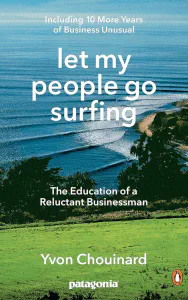
Let My People Go Surfing is part biography, part company memoir by Patagonia founder Yvon Chouinard. The first third of the book is an inspiring story about Yvon following his passion and finding his calling. The rest of the book shifts to a manual on designing business systems that align with nature’s grand design.
Yvon created Patagonia to challenge conventional wisdom and introduce a new style of responsible business. Patagonia and its two thousand employees show the business world that doing the right thing can be both good and profitable. Although Patagonia is a private company and its detailed financials aren’t publicly disclosed, it’s estimated to generate about $1 billion in annual revenue and $100 million in profit. This success demonstrates that a commitment to sustainability and ethics can go hand-in-hand with financial performance
What did I get out of it?
According to Brad Stone, the author of The Everything Store, Amazon Unbound, and multiple other business history books, a great business book must have two essential elements. It has to be both a thriller and a how-to book. In this regard, Let My People Go Surfing succeeds on both fronts.
In 1968, during a journey to Patagonia in Argentina, Yvon Chouinard took a dip in a jungle river without checking its depth. This mistake led to a serious injury, a compression fracture that almost left him paralyzed. This story, which Chouinard recounts in the book, underscores a vital lesson for both life and business: “Take risks, but always do your research first.”
This book is a captivating mix of thrilling adventures and solid business advice. It narrates the journey of Patagonia, an extraordinary company led by a founder who constantly questions the status quo. Although Chouinard might describe himself as a “reluctant businessman,” the success of Patagonia tells a different story. His dedication to living thoughtfully, challenging norms, and acting with integrity makes him a standout figure worth emulating.
I absolutely loved reading about Chouinard and Patagonia. The takeaways include highlights and key lessons from his personal and business history in the first section and the remaining sections focus on principles of building business systems for a true benefit corporation.
The Journey
Principles to Live by
A master in the art of living draws no sharp distinction between his work and his play; his labor and his leisure; his mind and his body; his education and his recreation. He hardly knows which is which. He simply pursues his vision of excellence through whatever he is doing, and leaves others to determine whether he is working or playing. To himself, he always appears to be doing both.
Find joy in what you do and teach kids to find joy in learning.
Invest in what you believe in. Align your investments with your values and passions. When you care about where your money goes, you’re likely to make more thoughtful and rewarding decisions.
If you want to die the richest man, then just stay sharp.
Keep investing. Don’t spend anything. Don’t eat any capital. Don’t have a good time. Don’t get to know yourself.
Don’t give anything away. Keep it all. Die as rich as you can. But you know what? I heard an expression that puts it well: There’s no pocket on that last shirt.
-Susie Tompkins Buell
“There is no pocket on that last shirt”
Reminds us that accumulating wealth for its own sake can lead to an empty life. While it’s important to be financially responsible, it’s also crucial to enjoy life, understand yourself, and share with others. True richness comes from experiences, relationships, and generosity.
Remember that money is a tool, not the end goal.
Never exceed your limits. You push the envelope, and you live for those moments when you’re right on the edge, but don’t go over. You have to be true to yourself; and you have to know your strengths and limitations and live within your means. The same is true from business. The sooner a company tries to be what it is not, the sooner it tries to “have it all,” the sooner it will die. It was time to apply a bit of Zen philosophy to our business.
Approach to business and life, emphasizing the importance of understanding and respecting limits. It’s about pushing your boundaries but knowing when to stop.
What was your single toughest climb? Probably when my friends, including [Patagonia founder] Yvon Chouinard, and I did the Kautz Glacier on Mount Rainier. I had never really done ice climbing before, and they gave me a 30-second lesson in crampons and ice-ax use. At one point, we were going across a very steep patch of black ice, and if you slipped, you would’ve gone about 1,000 feet. I said to Yvon, “We should rope up here,” and he said, “No way—if you go, then I go, and I don’t want to do that. This is like catching a taxi in New York on a rainy day: It’s every man for himself.” It’s been helpful to me to be [Yvon’s] friend. . . . He makes me think about things in new ways.
Something to be said about the importance of facing challenges head-on and learning quickly. Sometimes, the toughest situations provide the best learning experiences. Surround yourself with friends who challenge you to think differently and push your boundaries.
I’ve always thought of myself as an 80 percenter. I like to throw myself passionately into a sport or activity until I reach about an 80 percent proficiency level. To go beyond that requires an obsession and degree of specialization that doesn’t appeal to me. Once I reach that 80 percent level I like to go off and do something totally different; that probably explains the diversity of the Patagonia product line—and why our versatile, multifaceted clothes are the most successful.
Being versatile can make you more valuable. Learning and excelling in various skills up to a high proficiency level allows you to adapt to different roles and challenges.
The first part of our mission statement, “Make the best product,” is the raison d’être of Patagonia and the cornerstone of our business philosophy. Striving to make the best quality product is the reason we got into business in the first place. We are a product-driven company, and without a tangible product there would obviously be no business and the other goals of our mission statement would thus be irrelevant. Having high-quality, useful products anchors our business in the real world and allows us to expand our mission. Because we have a history of making the best climbing tools in the world, tools that your life is dependent on, we are not satisfied making second-best clothing. Our clothes—from Baggies to flannel shirts, from underwear to outerwear—have to be the best of their kind. Trying to make the best product also inspires us to create the best child-care center and the best production department and to be the best at our jobs. “Make the best” is a difficult goal. It doesn’t mean “among the best” or the “best at a particular price point.” It means “make the best,” period.
How you do one thing is how you do all things.
Yvon’s Story
I had an “attitude” and was always in detention. For being a troublemaker, I often had to write lines like “I will not . . .” five hundred or so times. As a budding entrepreneur I would take three pencils and line them up with sticks and rubber bands so I could do three lines at once. I excelled at athletics like baseball and football, but when it came time to perform while people were watching, I would fumble the ball. I learned at an early age that it’s better to invent your own game; then you can always be a winner. I found my games in the ocean, creeks, and hillsides surrounding Los Angeles.
Early inclination towards creativity and non-conformity.
When faced with challenges or conventional paths that don’t suit you, invent your own way.
The European attitude toward climbing mountains was to “conquer them.” All the gear was left in place to make it easier for others to follow. If you tried to take out and reuse the iron pitons, the head would often break off. We American climbers were brought up reading the transcendental writers like Emerson, Thoreau, and John Muir. You climb the mountains or visit the wilderness but leave no trace of having been there. Better pitons had once been made out of old Model A Ford axles by John Salathé, a Swiss blacksmith and climber who had used them on the first ascent of Lost Arrow Chimney in Yosemite, but he had stopped making them.
He did not like the status quo and wanted to change that.
I made my first pitons from an old chrome-molybdenum steel blade from a harvester, and TM Herbert and I used them on early ascents of the Lost Arrow Chimney and the North Face of Sentinel Rock in Yosemite. These stiffer and stronger pitons were ideal for driving into the often incipient cracks in Yosemite and could be taken out and used over and over again. I made these Lost Arrow pitons for myself and the few friends I climbed with; then friends of friends wanted some. I could forge only two of my chrome-molybdenum steel pitons in an hour, and I started selling them for $1.50 each. You could buy European pitons for twenty cents, but you had to have my new gear if you wanted to do the state-of-the-art climbs that we were doing.
Yvon saw the limitations of existing gear, he created something better. it’s a reminder to look for opportunities to improve the tools and methods we use in our daily life.
We were our own best customers from the start. We made the tools, gear, clothes that we wanted.
If we do any work or develop anything that we would be the primary users of, we will never compromise on quality.
This is a good parenting lesson as well. If we encourage ids to solve their own problems creatively, it will foster self-reliance and creativity.
I began to see clothing as a way to help support the marginally profitable hardware business. At the time we had about 75 percent of the climbing hardware market, but we still weren’t making much of a profit.
Where the idea for Patagonia started as Chouinard Equipment wasn’t making much money. The clothing business later rebranded as Patagonia was initially started to boost profitability.
One day it dawned on me that I was a businessman and would probably be one for a long time.
I also knew that I would never be happy playing by the normal rules of business; I wanted to distance myself as far as possible from those pasty-faced corpses in suits I saw in airline magazine ads.
If I had to be a businessman, I was going to do it on my own terms.
Even if you find yourself in a role you never envisioned, you can still make it your own.
I continued to practice my MBA theory of management, management by absence, while I wear-tested our clothing and equipment in the most extreme conditions of the Himalayas and South America. In 1981, three friends and I set off an avalanche while trying to climb the 23,000-foot Gongga Shan in Tibet. We were carried for 1,500 feet and stopped 30 feet from the edge of a 300-foot vertical cliff. One friend died from a broken neck, another had a broken back, and I had a concussion and broken ribs. I’ve never had much interest in climbing mountains over 25,000 feet, and now with this accident and having two young children, my interests waned even more. I was the outside guy, responsible for bringing back new ideas. A company needs someone to go out and get the temperature of the world, so for years I would come home excited about ideas for products, new markets, or new materials.
Chouinard’s commitment to his management philosophy and his adventurous spirit. Despite a near-fatal accident, his experiences in extreme conditions provided invaluable insights for Patagonia’s product development.
At one point we decided we needed another perspective, and Malinda and I, along with our CEO and CFO, sought the advice of a well-regarded consultant. We contacted Dr. Michael Kami, who had run strategic planning for IBM and, at some point, had turned Harley-Davidson around. We all flew to Florida to see him. Dr. Kami was a small man in his seventies with a squeaky, heavily accented voice, a full beard, and a lot of restless energy. He lived on an enormous yacht and wore a captain’s cap and an open shirt with epaulets.
Before he could help us, he said, he wanted to know why we were in business. I told him the history of the company and how I considered myself a craftsman who had just happened to grow a successful business. I told him I’d always had a dream that when I had enough money, I’d sail off to the South Seas looking for the perfect wave and the ultimate bonefish flat. We told him the reason we hadn’t sold out and retired was that we were pessimistic about the fate of the world and felt a responsibility to use our resources to do something about it. We told him about our tithing program, how we had given away a million dollars just in the past year to more than two hundred organizations, and that our bottom-line reason for staying in the business was to make money we could give away.
Dr. Kami thought for a while and then said, “I think that’s bullshit. If you’re really serious about giving money away, you’d sell the company for a hundred million or so, keep a couple million for yourselves, and put the rest in a foundation. That way you could invest the principal and give away six or eight million dollars every year. And, if you sold to the right buyer, they would probably continue your tithing program because it’s good advertising.”
“What are you worried about?” Dr. Kami said, turning to them. “You’re young. You’ll find other jobs!” I said I was worried about what would happen to the company if I sold out. “So maybe you’re kidding yourself,” he said, “about why you’re in business.” It was as if the Zen master had hit us over the head with a stick, but instead of finding enlightenment we walked away more confused than ever.
It is so important to understand our true motivation and purpose. It goes for anything in life and is not restricted to a business venture. Be it relationships or career, understanding our true motivations require honesty and clarity of thought.
Writing helps and so does getting an external perspective.
Product Design Philosophy
Our guiding principle of design stemmed from Antoine de Saint-Exupéry, the French aviator: Have you ever thought, not only about the airplane but whatever man builds, that all of man’s industrial efforts, all his computations and calculations, all the nights spent working over drafts and blue-prints, invariably culminate in the production of a thing whose sole and guiding principle is the ultimate principle of simplicity? It is as if there were a natural law which ordained that to achieve this end, to refine the curve of a piece of furniture, or a ship’s keel, or the fuselage of an airplane, until gradually it partakes of the elementary purity of the curve of the human breast or shoulder, there must be experimentation of several generations of craftsmen. In anything at all, perfection is finally attained not when there is no longer anything to add, but when there is no longer anything to take away, when a body has been stripped down to its nakedness. Studying Zen has taught me to simplify; to simplify yields a richer result.
Embrace Simplicity: Focus on refining products until only the essential elements remain. Aim for designs that are functional and uncluttered.
Iterate and Improve: Continuously experiment and refine designs. Small, incremental improvements over time lead to perfection.
At the base of a mountain wall, where you spread out your gear to organize for a climb, it was easy to spot the tools made by Chouinard Equipment. Ours stood out because they had the cleanest lines. They were also the lightest, strongest, and most versatile tools in use. Where other designers would work to improve a tool’s performance by adding on, Tom Frost and I would achieve the same ends by taking away—reducing weight and bulk without sacrificing strength or the level of protection.
Focus on Minimalism: Design products with clean, simple lines. Reduce weight and bulk while maintaining strength and functionality.
Other designers improve by adding on. Patagonia would improve by taking away.
Prioritize Versatility: Ensure that each product can serve multiple purposes effectively. Strive to make tools that are adaptable and efficient in various situations.
Koshun Miyamoto complimented his fencing teacher’s wife on the beauty of her gravel garden, a square of coarse-grained sand, set off by three stones from a nearby stream that conveyed a “powerful, evocative image of space and balance.” The fencing teacher’s wife protested that the garden wasn’t complete and wouldn’t be until she could “express the same feeling it has now using only one stone instead of three.” The functionally driven design is usually minimalist. Or as Dieter Rams, head of design at Braun, maintains, “Good design is as little design as possible.”
Good design is as little design as possible. Embracing minimalism and focusing on the essence.
Complexity is often a sure sign that the functional needs have not been solved.
Take the difference between the Ferrari and the Cadillac of the 1960s. The Ferrari’s clean lines suited its high-performance aims. The Cadillac really didn’t have functional aims. It didn’t have the steering, suspension, torque, aerodynamics, or brakes appropriate to its immense horsepower. But then nothing about its design really had to work. All it had to do was convey the idea of power, creature comfort, of a living room floating down the highway to the golf course. So, to a basically ugly shape were added all manner of useless chrome gingerbread: fins at the back, breasts at the front.
Once you lose the discipline of functionality as a design guidepost, the imagination runs amok. Once you design a monster, it tends to look like one too.
Once you design a monster, it tends to look like one too.
Prioritize Functionality: Ensure that the design of product meets its functional needs first. Avoid adding unnecessary elements that do not contribute to its primary purpose.
Maintain Design Discipline: Use functionality as guidepost to prevent the design from becoming overly complex or ornamental. Simplicity and purpose should drive the design process.
I’d rather design and sell products so good and unique that they have no competition…The value of our products even seems to grow over time. In Tokyo there are stores that deal only in vintage Patagonia clothing
Leverage Brand Legacy: Promote the longevity and lasting appeal of your products. Whether the product is a tangible product or an intangible piece of content. Make it timeless.
Because of our commitment to quality, we run at such a slow pace that we’re the turtles in the fashion race. Our design and product development calendar are usually 18 months long, too long to be a contender in any new fads
Avoid Chasing Fads: Stick to a consistent design and production process that emphasizes longevity and timelessness rather than short-lived trends. This approach ensures that your product remains valuable and relevant over time.
Successful inventing requires a tremendous amount of energy, time, and money. The big inventions are so rare that even the most brilliant geniuses think up only a few marketable inventions in their lifetimes. It may take thirty years to come up with an invention, but within a few years or months there can be a thousand innovations spawned from that original idea. Innovation can be achieved much more quickly because you already start with an existing product idea or design.
Rapid Innovation: Build on existing products and ideas to create new innovations quickly. Use the foundation of existing designs to drive improvements and adaptations.
Some companies are based on having proprietary designs and patents, but far more successful ones are based on innovation. In the clothing fashion business especially, there is simply no time for long, drawn-out pure research. Patagonia didn’t invent bunting fleece. The idea came from my seeing Doug Tompkins wearing a brushed wool Fila pullover. Since it could only be dry-cleaned, it was impractical for outdoor use, but it spawned an idea that led to polyester bunting, Synchilla, and a host of microfleeces.
Practical Innovation: Focus on adapting existing ideas into more practical and useful products. Innovation can often come from improving or modifying existing designs to meet new needs.
The ship’s carpenter on Shackleton’s lifeboat took only three simple hand tools with him on the passage from Antarctica to South Georgia Island, knowing that, if he needed to, he could build another boat with only those tools.
Mastery requires simplicity: Focus on the essential tools and skills needed to achieve your goals. Simplicity in design and resources can often lead to greater efficiency and effectiveness.
Ensure Versatility: Equip yourself with versatile tools and knowledge. The ability to adapt and use basic tools to solve complex problems is invaluable, both in business and in life.
I believe the way toward mastery of any endeavor is to work toward simplicity; replace complex technology with knowledge. The more you know, the less you need. From my feeble attempts at simplifying my own life I’ve learned enough to know that should we have to, or choose to, live more simply, it won’t be an impoverished life but one richer in all the ways that really matter.
Pursue Simplicity: Focus on simplifying processes and designs.
Value Knowledge Over Tools: Emphasize learning and mastery in your field.
Production Philosophy
To stay ahead of the competition, our ideas have to come from as close to the source as possible. With technical products, our “source” is the dirtbag core customer. He or she is the one using the products and finding out what works, what doesn’t, and what is needed.
Core Users: Staying connected with most dedicated and frequent users. Gathering feedback directly from them to understand their needs and improving the products.
Coming in second, even with a superior product at a better price, is often no substitute for just plain being first. This doesn’t mean we should be “chasing” trends or products. It applies more to “discovering” a new fabric or a new process. Again, the key word is discovering instead of inventing. There’s imply no time for inventing. Maintaining a sense of urgency throughout a company is one of the most difficult challenges in business. The problem is further compounded by having to depend on outside suppliers who may not have the same sense of expediency. I constantly hear people giving lame excuses of why something is impossible or why a job didn’t get done on time
Prioritize Being First: Strive to be the first to market with new discoveries. Get the first mover advantage.
The designer must work with the producer up front. this applies to every product. This team approach is concurrent rather than assembly-line manufacturing. A concurrent approach brings all participants together at the beginning of the design phase. Only about 10% of a product’s costs are incurred during the design phase, but 90% of the costs are irrevocably committed
Adopt Concurrent Design: Implement a team-based, concurrent design approach where designers and producers collaborate from the start. This method ensures better integration and efficiency in product development.
Control Costs Early: Focus on the design phase to manage and minimize product costs. Engage all stakeholders early to make informed decisions that control product’s costs before they are irrevocably committed.
Distribution Philosophy
In growing the business, however, we used traditional textbook practices—increasing the number of products, opening new dealers and new stores of our own, developing new foreign markets—and soon we were in serious danger of outgrowing our breeches. We had nearly outgrown our natural niche, the specialty outdoor market. By the late 1980s the company was growing at a rate that, if sustained, would have made us a billion-dollar company in a decade. To reach that theoretical billion-dollar mark, we would have to begin selling to mass merchants or department stores. This challenged the basic design principles we had established for ourselves as the makers of the best hardware. Can a company that wants to make the best-quality outdoor clothing in the world be the size of Nike? Can a ten-table, three-star French restaurant retain its third star when it adds fifty tables? Can you have it all? The question haunted me throughout the 1980s as Patagonia evolved.
Respect Your Market Niche: Focus on maintaining the quality and integrity of your products by staying within your natural market. Expanding too quickly can dilute your brand and compromise your core values.
Evaluate Growth Strategies: Carefully consider the impact of expanding into new markets and distribution channels. Ensure that growth strategies align with company’s principles and long-term goals without sacrificing quality.
In owning our own retail stores, we’ve learned that it is far more profitable to turn that inventory more quickly than to have high margins or raise prices. This was especially true when we had to pay high interest rates on our loans. You want sharp customers who know the market and its customers. They place small orders from suppliers but more often. You don’t want to waste expensive retail space to carry extra inventory. You display the products as if it were a showroom but keep the backstock in the basement or nearby stockroom
Optimize Inventory Turnover: Focus on turning inventory quickly rather than relying on high margins or increased prices. This approach is especially beneficial when dealing with high-interest rates on loans.
Efficient Use of Retail Space: Use retail space as a showroom to display products attractively to facilitate turnover.
Key benefits of having a working partnership with a few good dealers
- We don’t have to expend the effort, time, and money to seek out new dealers
- We limit our credit risks
- We minimize the legal problems associated with cutting off a dealer whose bad service is a reflection on us
- We develop loyal buyers who make a commitment to the line and either carry a broad representation of the line, or in the case of a small specialty shop, in-depth inventory
- We maintain better control over our product and image
- We receive better information about the market and our products
Focus on Strong Partnerships: Develop and maintain partnerships with a few reliable dealers.
Marketing Philosophy
When I die and go to hell, the devil is going to make me the marketing director for a cola company. I’ll be in charge of trying to sell a product that no one needs, is identical to its competition, and can’t be sold on its merits. I’d be competing head-on in the cola wars, on price, distribution, advertising, and promotion, which would indeed be hell for me.
Focus on Unique Value: Ensure that product stands out by highlighting its unique features and benefits. Avoid competing solely on price and promotions, which can lead to a race to the bottom.
Market Products with Purpose: Choose to market products that have genuine value and differentiation. This makes it easier to sell based on merits and creates a more fulfilling and effective marketing strategy.
On the contrary, sales representatives, shop owners, salesclerks, and people in focus groups are usually not visionaries. They can tell you only what is happening now: what is in fashion, what the competition is doing, and what is selling. They are a good source of information if you want to be a player in the “cola wars,” but the information is too old if you want to have leading-edge products.
Forward-Thinking Insights: Focus on insights from visionary users and innovators rather than relying solely on current market trends and competition.
Even if he or she isn’t aware of it, every individual spends an entire lifetime creating and evolving a personal image that others perceive. A company too creates and evolves an image that can stem from its reason to be in business, can grow out of its actions, or perhaps is assembled from pieces by the creative mind of an advertising person. A company’s public image can be very different from who they really are.
Be authentic, ensure that actions are consistent with core values.
Our branding efforts are simple: tell people who we are. We don’t have to create a fictional character like the Marlboro Man or a fake responsible caring campaign like Chevron’s “we agree” advertising. Writing fiction is so much more difficult than nonfiction. Fiction requires creativity and imagination. Nonfiction deals with simple truths. This is not to say that invented brand images through traditional advertising and marketing are not successful. Otherwise, why would an intelligent person be persuaded to take up a tobacco habit that is guaranteed to kill you? Why would a real man smoke Marlboros but never a Virginia Slim? Powerful messaging, yes, but phony.
Authenticity builds lasting trust.
Simple Truths: Clear, honest messaging rather elaborate fiction.
Patagonia’s image arises directly from the values, outdoor pursuits, and passions of its founders and employees. While it has practical and nameable aspects, it can’t be made into a formula. In fact, because so much of the image relies on authenticity, a formula would destroy it. Ironically, part of Patagonia’s authenticity lies in not being concerned about having an image in the first place. Without a formula, the only way to sustain an image is to live up to it. Our image is a direct reflection of who we are and what we believe.
Actions and culture genuinely reflect its core values and passions.
Financial Philosophy
Our mission statement says nothing about making a profit. In fact, our family considers our bottom line to be the amount of good that the business has accomplished over the year. However, a company needs to be profitable in order to stay in business and to accomplish all its other goals, and we do consider profit to be a vote of confidence, that our customers approve of what we are doing. The third part of our mission statement, “use business to inspire and implement solutions to the environmental crisis,” puts the responsibility of leadership directly on us. If we wish to lead corporate America by example, we have to be profitable. No company will respect us, no matter how much money we give away or how much publicity we receive for being one of the “100 Best Companies,” if we are not profitable. It’s okay to be eccentric, as long as you are rich; otherwise, you’re just crazy.
Profit with Purpose: Understand that profitability is essential for sustaining and expanding the mission.
Got to be profitable and wealthy to gain respect and influence. Hard to inspire and influence others if you are broke.
Our philosophy does not hold that finance is the root of all business. Rather, it complements all other segments of the company. We recognize that our profits are directly tied to the quality of our work and our product. A company that doesn’t take quality seriously will attempt to maximize profits by cost cutting, increasing sales by creating an artificial demand for the goods, and hammering the rank and file to work harder.
Integrate Quality and Finance: Lasting financial success stems from quality products and services.
Again, like the Zen approach to archery or anything else, you identify the goal and then forget about it and concentrate on the process.
Focus on the Process: Goals are important focus should be on the steps required to achieve the goals. Concentrating on the process helps ensure consistent progress.
We believe that quality is no longer a luxury. It is sought out by the consumer, and it is expected. For example, the Strategic Planning Institute has been collecting data for years on the performance of thousands of companies. It publishes a yearly report, titled PIMS (Profit Impact of Market Strategy). That report has begun to show quite clearly that quality, not price, has the highest correlation with business success. In fact, the institute has found that, overall, companies with high product- and service-quality reputations have on average return-on-investment rates twelve times higher than their lower-quality and lower-priced competitors.
Same as above, lasting financial success can only be achieved through quality. Avoid short cuts.
Whenever we are faced with a serious business decision, the answer almost always is to increase quality.
Quality as a Guiding Principle
We are a privately owned company, and we have no desire to sell the company or to sell stock to outside investors, and we don’t want to be financially leveraged. In addition, we have no desire to expand Patagonia beyond the specialty outdoor market. So how does finance react to these very clear-cut dictates?
Maintaining independence and focus on core.
First of all, by growing only at a “natural rate.” When our customers tell us they are frustrated by not being able to buy our products because of constant out-of-stock situations, then we need to make more, and that leads to “natural growth.” We do not create artificial demand for our goods by advertising in Vanity Fair or GQ or on buses in inner cities, hoping to get kids to buy their black down jackets from us instead of the North Face or Timberland. We want customers who need our clothing, not just desire it.
Grow Naturally: Expand production in response to genuine customer demand. Focus on meeting the needs of existing customer base.
Prioritize attracting customers who genuinely need your products, ensuring sustainable and organic growth.
We never wanted to be a big company. We want to be the best company, and it’s easier to try to be the best small company than the best big company. We have to practice self-control. Growth in one part of the company may have to be sacrificed to allow growth in another. It’s also important that we have a clear idea of what the limits are to this “experiment” and live within those limits, knowing that the sooner we expand outside them, the sooner the type of company we want will die.
Prioritize financial stability over growth: Focus on being the best rather than the biggest.
Slow growth or no growth means the profits have to come from our being more efficient every year. Unlike the government, we cannot rely on an expanding economy to “burn the fat away.” It’s easier for a company to make a profit when it’s growing at 10 percent or 15 percent a year. We have been profitable in years when we grew only a few percent by increasing the quality of our product, maximizing the efficiency of our operations, and living within our means. Because of our pessimism about the future of a world economy based on limited resources and on endlessly consuming and discarding goods we often don’t need, not only don’t we want to be financially leveraged, but our goal is to have no debt, which we have achieved.
Congruence between beliefs and strategy: A good financial strategy should be aligned with the underlying belief. A bearish outlook on economy and world should be accompanied with an aligned financial strategy.
Financial Prudence: Aim to operate without debt and avoid financial leverage.
HR Philosophy
The presence of children playing in the yard or having lunch with their mothers and fathers in the cafeteria helped keep the company atmosphere more familial than corporate.
An organization well ahead of its time.
Twenty years ago we hired a psychologist who specialized in organizational development who told us that Patagonia has a far-above-average number of very independent-minded employees. In fact, our employees were so independent, we were told, that they would be considered unemployable in a typical company.
A workplace culture that accommodates and supports independent thinkers.
We don’t hire the kind of people you can order around, like the foot soldiers in an army who charge from their foxholes without question when their sergeant yells, “Let’s go, boys!” We don’t want drones who will simply follow directions. We want the kind of employees who will question the wisdom of something they regard as a bad decision. We do want people who, once they buy into a decision and believe in what they are doing, will work like demons to produce something of the highest possible quality—whether a shirt, a catalog, a store display, or a computer program. How you get these highly individualistic people to align and work for a common cause is the art of management at Patagonia.
Again, the emphasis is on independent thinking. Question the status quo.
When you look to hire management, it’s important to know the difference between a manager and a true leader. For instance, the branch manager of a bank is expected to avoid risks (not make loans without approval from higher up), implement strategic plans, and keep things running as they always have. It is like the difference between a cook and a chef. They both cook food, but the chef creates recipes and manages a kitchen while the cook only follows the recipes. Leaders take risks, have long-term vision, create the strategic plans, and instigate change.
Maintain balance between management (maintaining status quo) and strategic / visionary leadership.
Maybe a few people take advantage of our flextime policy, but none of our best employees would want to work in a company that didn’t have that trust. They understand that my so-called MBA (management by absence) style of management is as much a sign of my trust in them as my desire to be out of the office.
Trust: Use management by absence (MBA). Treat people like adults and trust that they will fulfill their responsibilities without constant supervision.
Management Philosophy
We never had to make a break from the traditional corporate culture that makes businesses hidebound and inhibits creativity. For the most part, we simply made the effort to hold to our own particular tradition. At one time that tradition looked peculiar, but it no longer does. Many American industries have adopted more casual workplaces, and we played a role in starting that trend.
Stay True to Your Culture: Maintain your unique company culture and traditions, even if they seem unconventional. This can foster a creative and dynamic work environment.
Competitors can copy the products and strategy, but they cannot copy the culture as that is ingrained.
There are different ways to address a new idea or project. If you take the conservative scientific route, you study the problem in your head or on paper until you are sure there is no chance of failure. However, you have taken so long that the competition has already beaten you to market. The entrepreneurial way is to immediately take a forward step and if that feels good, take another, if not, step back. Learn by doing, it is a faster process.
Bias for Action: Move quickly on new ideas and projects. Take initial steps and adjust based on feedback rather than waiting for perfect certainty.
Decisions based on compromise, as in politics, often leave the problem not completely solved, with both sides feeling cheated or unimportant or worse. The key to building a consensus for action is good communication.
Avoid Half-Measures: Close the loop - strive to fully address issues rather than settling for compromises that leave problems partially solved.
The best leadership is by example. Malinda’s and my office space and the CEO’s is open to anyone, and we always try to be available. We don’t have special parking spaces for ourselves or for any upper management; the best spaces are reserved for fuel-efficient cars, no matter who owns them. Malinda and I pay for our own lunches in our cafeteria; otherwise, it would send a message to the employees that it’s okay to take from the company. A familial company like ours runs on trust rather than on authoritarian rule.
Hard to lead by example if top management is sitting in the ivory tower. Leading by example requires demonstration of behaviors and values expected from employees, being accessible and adhering to the same rules as everyone else.
I’ve found that whenever we have had a top manager or CEO leave the company, there is no chaos. In fact, the work continues as if they were still there. It’s not that they were doing nothing but that the system is pretty much self-regulating.
Build Self-Regulating Systems: Develop processes and systems that can operate efficiently without constant oversight from top management. This ensures continuity and stability even when key leaders leave.
Empower Employees: Encourage a culture where people are capable of managing their responsibilities independently.
Finding that balance between the management problems that come with growth and maintaining our philosophy of hiring independent-minded people and trusting them with responsibility is key to Patagonia’s success. Every company also has its ideal size. Alexander Paul Hare, author of the classic Creativity in Small Groups, showed that groups sized between four and seven were most successful at problem solving, largely because small groups, as Hare observed, are more democratic: egalitarian, mutualistic, cooperative, inclusive. Hundreds of studies in factories and workplaces confirm that workers divided into small groups enjoy lower absenteeism, less sickness, higher productivity, greater social interaction, higher morale—most likely because the conditions allow them to engage what is best in being human, to share the meaning and fruits of their labor.
Balance Growth with Philosophy: Focus on retaining your values, even if it means forgoing some growth opportunities which require compromise on core values.
Climbing mountains is another process that serves as an example for both business and life. Many people don’t understand that how you climb a mountain is more important than reaching the top.
You can solo climb Everest without using oxygen, or you can pay guides and Sherpas to carry your loads, put ladders across crevasses, lay in six thousand feet of fixed ropes, and have one Sherpa pulling and one pushing you. You just dial in “10,000 Feet” on your oxygen bottle, and up you go.
Typical high-powered, rich plastic surgeons and CEOs who attempt to climb Everest this way are so fixated on the target, the summit, that they compromise on the process.
The goal of climbing big, dangerous mountains should be to attain some sort of spiritual and personal growth, but this won’t happen if you compromise away the entire process.
Value the Journey: Focus on how you achieve your goals, not just the end result. The process of achieving your goals should promote personal and professional growth, integrity, and fulfillment.
Avoid Shortcuts: Resist the temptation to take shortcuts that compromise the integrity of your journey. Achieving success through authentic effort and perseverance is more rewarding and meaningful than simply reaching the target.
You might think that a nomadic society packs up and moves when things get bad. However, a wise leader knows that you also move when everything is going too well; everyone is laid-back, lazy, and happy. If you don’t move now, then you may not be able to move when the real crisis happens. Teddy Roosevelt said, “In pleasant peace and security, how quickly the soul in a man begins to die.” And as Bob Dylan says, “He not busy being born is busy dying.”
Proactively Seek Change: Don’t wait for a crisis to make changes. Move and innovate even when things are going well to avoid complacency and ensure readiness for future challenges.
Maintain Vigilance: Encourage a culture of continuous improvement and vigilance. Recognize that periods of peace and success can lead to stagnation, so always strive for growth and adaptation.
When I look at my business today, I realize one of the biggest challenges I have is combating complacency. I always say we’re running Patagonia as if it’s going to be here a hundred years from now, but that doesn’t mean we have a hundred years to get there! Our success and longevity lie in our ability to change quickly. Continuous change and innovation require maintaining a sense of urgency—a tall order, especially in Patagonia’s seemingly laid-back corporate culture. In fact, one of the biggest mandates I have for managers at the company is to instigate change. It’s the only way we’re going to survive in the long run. It’s the same in nature. Nature is constantly evolving, and ecosystems support species that adapt either through catastrophic events or through natural selection. A healthy environment operates with the same need for diversity and variety evident in a successful business, and that diversity evolves out of a commitment to constant change.
Change or be changed. Continuous improvement and adaptation are crucial for long-term survival.
Environmental Philosophy
Systems in nature appear to us to be chaotic but in reality are very structured, just not in a top-down centralized way.
Decentralized Organization: Recognize that effective systems don’t always require centralized control. Foster decentralized, self-organizing structures to enhance adaptability and resilience.
Learn from Nature: Study natural systems to understand how they maintain balance and structure amidst apparent chaos.
A top-down central system like a dictatorship takes an enormous amount of force and work to keep the hierarchy in power. Of course, all top-down systems eventually collapse, leaving the system in chaos. SEAL team soldiers have a leader but are really self-managed as they have all bought into the mission, know what their individual job is, and know the others’ jobs as well. If the leader is disabled, any of the others can take over.
Avoid Rigid Hierarchies: Implement flexible and decentralized management structures.
The lesson to be learned is that evolution (change) doesn’t happen without stress, and it can happen quickly.
Recognize that environmental changes often occur due to stressors. Anticipate and adapt to environmental shifts, both in nature and in business.
Think of Patagonia as an ecosystem, with its vendors and customers an integral part of that system. A problem anywhere in the system eventually affects the whole, and this gives everyone an overriding responsibility to the health of the whole organism. It also means that anyone, low on the totem pole or high, inside the company or out, can contribute significantly to the health of the company and to the integrity and value of our products…The whole supply chain has to be a functioning, interconnected system.
Recognize that issues in any part of the system can impact the whole.
Anyone who thinks you can have infinite growth on a finite planet is either a madman or an economist. – Kenneth Boulding
Shift the focus from infinite growth to sustainable practices that balance economic, social, and environmental needs.
I have a definition of evil different than most people. Evil doesn’t’ have to be an overt act; it can be merely the absence of good. If you have the ability, the resources, and the opportunity to do good and you do nothing, that can be evil
Recognize that inaction in the face of opportunity can be harmful. Failing to do good when you have the chance can be considered an ethical failure.
It seems to me if there is an answer, it lies in these words: restraint, quality, and simplicity. We have to get away from thinking that all growth is good. There’s a big difference between growing fatter and growing stronger
Build muscles, not fat.
Focus on sustainable growth rather than unchecked expansion.
Who Should Read It?
If you’re looking for a business book that’s both a thrilling read and a practical guide, this one fits the bill. However, be prepared for some parts to feel a bit detailed and instructional. Yvon Chouinard intended this book to serve as a manual for his employees, outlining the company’s mission and values. This intent is evident in several sections.
That said, the book offers a fresh perspective on business and life. If you’re unhappy with your current job or company and are seeking inspiration for something better, this book is packed with ideas that could help you find your path. It’s not just about business; it’s about finding meaningful work that aligns with your values. Whether you’re an entrepreneur, an employee, or someone searching for purpose, this book provides valuable insights and practical advice.