 Mandelbrot
 The Accountant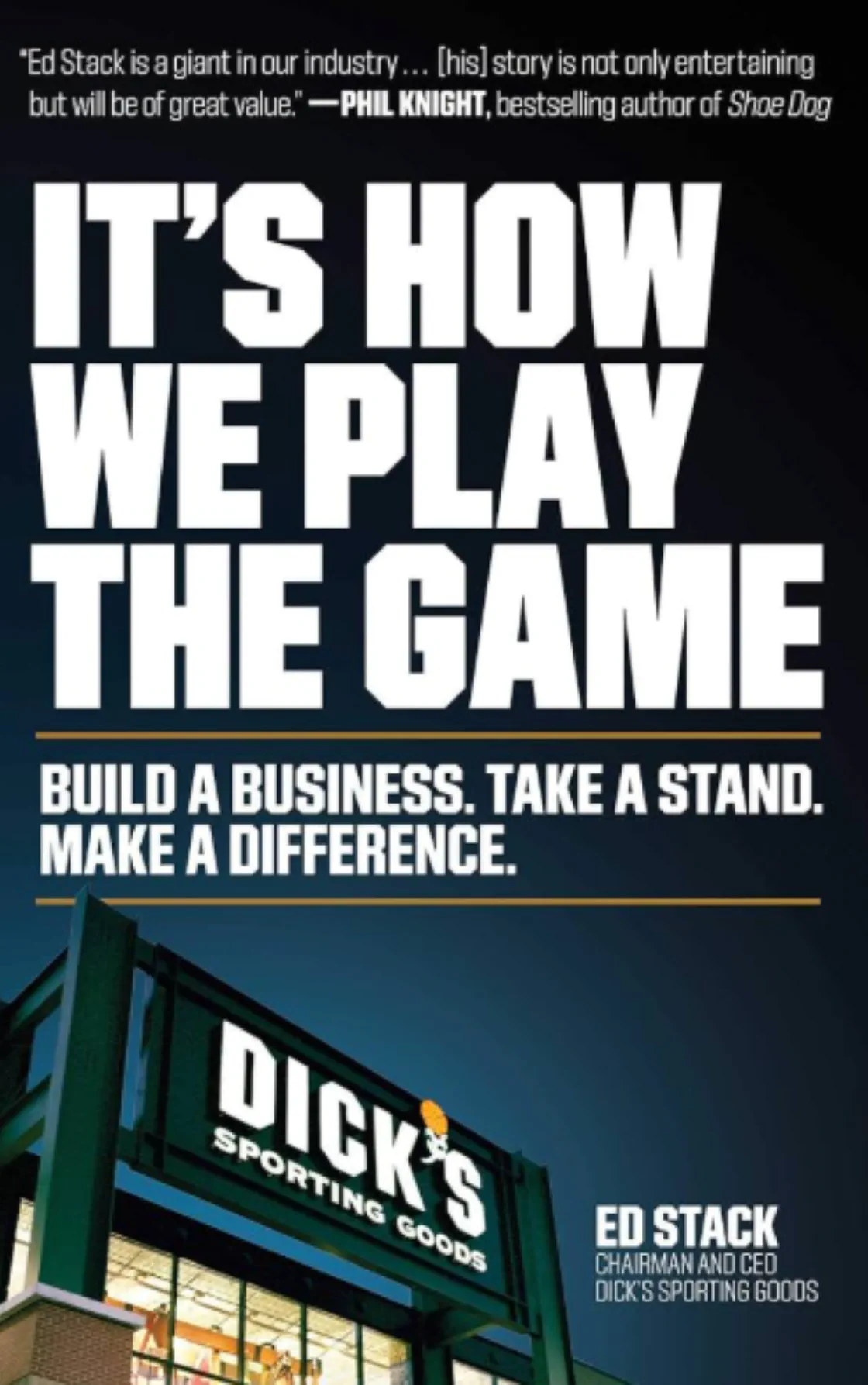
In December 1957, Dick Stack ran newspaper ads offering a “$50,000 stock reduction” three weeks before Christmas. He had been a sporting goods retailer for less than a decade. He had opened a second store the year before, in a suburban strip center called Hillcrest, against the better judgment of pretty much everyone around him. By the time those ads ran, he was selling everything in the store as a loss leader. Within months the second store was gone, and so was the first.
What he did next is the part of the story that stayed with me. He could have filed for Chapter 11. The path was open, the legal machinery existed, and most people in his position took it. He refused. He returned what merchandise he could, then sold the house he had only recently bought, sold his car, and liquidated whatever else was left until every supplier had been paid. None of his creditors lost money when Dick’s folded. He and his wife moved back in with their parents.
That was the foundation on which the eventual Dick’s Sporting Goods was built. Not the cookie jar of $300 his grandmother handed him to start the first store, not the customer service catechism, not the IPO. The foundation was a man choosing the harder version of his obligations when the easier version was available and legal.
The Debt That Was Not Discharged
I keep coming back to that decision because the easy version of the story is so seductive. Bankruptcy laws exist precisely to let entrepreneurs fail without ruin. Using them is rational. It is what the system is designed for. Almost any business school case would treat Hillcrest as a learning experience and move the founder along.
Dick Stack was a proud man, and he refused to declare bankruptcy. He could not abide the thought of making others pay for what he saw as his mistake.
There is something old-fashioned in that phrasing, “make others pay for what he saw as his mistake,” that doesn’t survive easily in modern capital structures. We have built entire industries around the legal transfer of consequence. Limited liability, securitization, structured products, the whole apparatus of moving downside onto someone else’s balance sheet. Most of it is fine. Some of it is necessary. But it does something quiet to the cultural muscle that says the loss is mine to absorb.
Ed Stack writes this about his father with admiration, not nostalgia. He understands that the cost was severe.
he returned what merchandise he could, then sold virtually everything he had—the house he’d only recently bought, his car, anything he could liquidate—to pay off his creditors. He succeeded.
You can read this as stubborn pride. You can also read it as something closer to what Skin in the Game calls the actual cost of doing business with someone: the willingness to share the downside you have created. The decision didn’t pay off in any measurable sense for years. It made the family’s life harder. But it preserved every relationship Dick Stack had with the people who had trusted him. Decades later, those relationships were still there. The new Dick’s borrowed from suppliers who remembered who he was.
Running Without a Ledger
If the ethical foundation of the book is the creditor decision, the operational foundation is the absence of almost anything resembling financial discipline. Dick Stack ran his store the way many small operators do: by feel, by a kind of grocer’s arithmetic that worked until volume made it stop working.
wasn’t until we did that, and extended the inventory into dollars and cents, that my dad knew whether he’d made money during the year. He had no idea. He used a line of credit from the bank to buy merchandise, pay out salaries, and cover the stores’ utilities, and all the while didn’t know until the end of the year whether he’d break even.
A man who had been in business for decades only knew whether he was profitable once a year, after an annual count. The line of credit absorbed the noise. The bank statement told him there was money in the account, which he treated as evidence the business worked. The actual answer to “are we making money” was something he discovered, retroactively, in July.
Reading this with a controls lens is almost painful. There is no open-to-buy. There is no margin tracking. There is no aged inventory report. The mechanism by which he checked the basic question of whether the year produced a profit was the same mechanism a hobbyist would use to settle his fishing club’s books. And then his son tries to do something about the dead stock sitting on the shelves.
But the value of inventory drops with time, and keeps dropping until it’s virtually worthless. You have to keep it moving. So without talking to him first, I put together a warehouse sale, piled those cords and a variety of other dated merchandise on tables out in the parking lot, and slashed the price on all of it.
Anyone who has worked through a sunk cost discussion recognises Dick Stack’s objection. He paid X for those corduroys. Selling them below X means accepting a loss. The accounting answer is that the loss was already taken, the day the goods stopped moving. Selling below cost is just recognising the loss in cash terms instead of leaving it parked as a fictitious asset. The book doesn’t put it in those words, but the lesson is the same. Inventory that doesn’t move is capital that doesn’t work.
When Borrowed Money Stops Being Yours
The company grew. The mistakes scaled with it. Two near-death moments in the book hinge on the same thing: relying on capital that someone else controlled.
Dick’s had always relied on debt, from the company’s earliest days—we couldn’t have supplied our stores with inventory, or made payroll, or kept the lights on if we hadn’t had a credit line that we were able to carry for most of the year. We’d never missed a payment.
The savings and loan crisis took that line away. The bank had to dump them. They had done nothing wrong. They had performed on every payment. The regulator decided their lender’s portfolio was too risky and they were the account that had to go. Sixty days to find a new home for the working capital that was running the business.
The bigger version of this came later. After expanding too fast, opening stores that were too big, building cathedrals with floors no one looked at, Dick’s was thirty days from running out of money. Ed Stack writes about a mirror, a hotel room, and the kind of internal monologue you only see in books written years after the fact. GE Capital eventually gave them the loan, with covenants that effectively ran the company for them for the next stretch. That worked out, in that it forced the discipline they had refused to build internally, but the conclusion he draws is the one I find most useful from the entire book.
I will never again be comfortable relying on someone else’s capital. I will always be a little paranoid and insist that we finance all we do from our own earnings. It seems to me that it’s the only way to control your own destiny. The banks can’t take away your business if you don’t owe them any money.
That is the thread that connects the father’s bankruptcy decision to the son’s GE Capital deal. Both stories are about who has a claim on you when things go wrong. Dick Stack refused to let his suppliers carry the cost of his Hillcrest mistake. Ed Stack, decades later, refused to remain in a position where outside capital could decide his fate. The lesson is the same, told twice. It rhymes with what Capital Returns has to say about who really owns a business that is funded primarily by debt, and with what What Actually Burns describes about leverage that doesn’t look like leverage until it does.
What the Customer Was Owed
The retail philosophy in the book is straightforward, almost old-fashioned. None of it is novel. All of it is rare.
Treat him as you would a guest at your house: “If you had a visitor there, you wouldn’t keep doing what you’re doing. You’d drop it to say hello and make him feel at home.”
The frame is what matters. The customer is not an opportunity or a number on a daily report. The customer is a guest. The merchant has obligations that exist before money has changed hands and continue after. This shows up in the book’s most memorable scene, the kid caught stealing a baseball glove.
“Why’d you steal the glove?” The kid, about nine years old, looked up, eyes as big as saucers. Tears streamed down his cheeks. “I just want to play baseball.” My dad nodded. “You can’t steal,” he said. “No matter how bad you want something, you cannot steal it. I want you to promise me you’re not going to do this again.”
Then Dick Stack walked the kid to the baseball section, picked out a ball and a bat to go with the stolen glove, and sent him home with the lot. You can read this as soft-headed retail. You can also read it as the same operating principle that made him sell his house to pay his creditors, that the relationship is the thing and not the transaction. The financial arithmetic of giving away a glove, a ball, and a bat is trivial. The arithmetic of being the kind of merchant who does that is not.
I don’t want to romanticise it. Dick Stack was, by his son’s account, also a difficult man. He worked his staff twelve-hour days. He drove fastballs into the dirt to teach his son not to miss. The book does not present him as a moral hero. It presents him as a man with one inviolable line, and the line was the obligation he felt to the people on the other side of the counter and on the other side of the invoice.
Strategy by Counting Swing Sets
The other thing I appreciated about the book is how honestly Ed Stack admits that, for years, there was no plan. The expansion that nearly killed the company was, in retrospect, not a strategy at all.
Fact is, we didn’t think strategically at all. Tim and I would drive around a new town, counting swing sets in people’s yards, and if we figured an area had lots of kids, we were good to go.
It’s the kind of admission you only get from someone who has come out the other side. Survivorship bias usually does the editing. The successful version of the story sounds like a thesis. The actual decision was made by counting backyard playsets from a moving car. Most companies that grow this way don’t make it. Dick’s did, and the book is honest enough to credit luck for the early stages of that survival.
We were lucky that we had only so much money in those early days and couldn’t get too far ahead of ourselves. As undisciplined and excited as we were, we could have worked ourselves into trouble.
Constraints saved them. The same scarcity that made the business feel precarious also limited the size of the mistakes they could make. Once GE Capital removed the constraint and they had room to over-expand, they did. The lesson in that pairing is one I keep finding everywhere: that early-stage discipline is often borrowed from external limits, and that the moment those limits are lifted, the internal discipline has to be ready to take over. Grinding It Out tells a version of this. So does Sam Walton: Made in America. The patterns are not new.
Who Is This For
It isn’t a great business book in the analytical sense. It isn’t The Outsiders. It is not going to give you a framework for capital allocation or a mental model you can apply tomorrow. It is a founder’s son writing about his father, mostly with affection, occasionally with honesty about the difficulty of being raised by him. The retail lessons are conventional. The expansion mistakes are common. The IPO chapter reads like every other IPO chapter.
What the book does well is hold up a specific kind of obligation as the load-bearing wall of a long-running business. The refusal to declare bankruptcy. The insistence on paying suppliers when there was no legal need to. The decision, decades later, to finance growth from earnings rather than borrowed money. These threads connect, and they connect to something that controls frameworks and governance manuals try to capture but usually don’t.
If you want a memoir about retail in the back half of the twentieth century, with some honest writing about a complicated father and a son trying to build something larger than what he inherited, it is worth your time. If you are looking for operational depth, read Becoming Trader Joe instead.
What I took from it, more than anything, is that there is a version of business where your name on the door is not branding but obligation. Dick Stack lost his first business and used the proceeds of his own life to pay the people he owed. Most of what came after, the customer-as-guest doctrine, the son’s refusal to be controlled by outside capital, the long arc to a public company, was built on top of that one decision. The decision had no immediate payoff. It only paid off over the lifetime of the people who remembered who he was.
That’s the part of the book I’ll keep.