 Mandelbrot
 The Accountant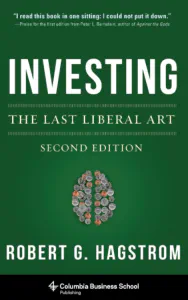
Imagine you’re standing on a watchtower overlooking a vast, wintry landscape. Down below, the scene is a blizzard: swirling snow, howling winds, flashes of news headlines, blinking price tickers, anxious voices in every direction. From ground level, visibility is nearly zero. The snowstorm is all around you, demanding constant attention and filling you with the urge to react quickly. Every gust feels like a missed opportunity, if only you moved fast enough.
But in this storm, the real risk isn’t missing the next big move; it’s losing your sense of direction entirely.
In Robert Hagstrom’s “Investing: The Last Liberal Art,” inspired by Charlie Munger’s advice to build a “latticework of mental models,” the lessons go far beyond picking the right asset. Instead, Hagstrom urges you to construct a mental framework; one that cuts through daily chaos and noise, letting you focus on what endures over the long run. Hagstrom argues that depth in one discipline isn’t enough. A true long-term investor brings together insights from multiple disciplines; each lens clarifies a different part of the foggy landscape.
Standing in the watchtower with these lenses, the snowstorm doesn’t disappear, but its underlying patterns become visible. You notice how human psychology amplifies market swings, how evolution and adaptation shape entire sectors, how compounding returns are quietly at work beneath the churn. Instead of struggling to track every snowflake, you start seeing the signal in the weather itself.
For most, the path is uncertain and highly dependent on the turns they take and the noise they let in. But with a latticework of mental models, the fog lifts just enough to reveal the contours of the landscape. That’s when patient, long-term thinking finally has a chance to lead somewhere meaningful.
What Did I Get Out of It
Reading Hagstrom’s book changed the way I think about investing, but also about decision making and understanding the world at large. We do not have to restrict these lessons to finance, as they are equally applicable to how we build knowledge, process uncertainty, and improve the mental models we use to navigate life’s complexities.
Worldly Wisdom Comes from Mental Models Across Disciplines
Hagstrom’s core argument echoes Charlie Munger’s: broad, lasting success, whether as an investor or a thinker, depends on assembling a wide base of mental models, each drawn from a separate field. An overreliance on one discipline leads to narrow, fragile decision-making. By intentionally seeking key ideas from physics, biology, history, psychology, mathematics, and literature, we create a “latticework” that can handle complexity and unexpected change.
“Each discipline entwines with, and in the process strengthens, every other. From each discipline the thoughtful person draws significant mental models, the key ideas that combine to produce cohesive understanding.”
The payoff is what Hagstrom calls “worldly wisdom”, a practical, robust way to understand both markets and life. Worldly wisdom brings a second-order advantage: it allows you to think in systems, spot patterns that specialists miss, and sidestep errors that come from overconfidence in a single framework. And its utility isn’t limited to investing:
“Those who cultivate this broad view are well on their way to achieving worldly wisdom, that solid mental foundation without which success in the market—or anywhere else—is merely a short-lived fluke.”
In short, learning the “big ideas” from as many disciplines as possible doesn’t just make you a better investor; it makes you a better thinker, better leader, and more adaptive in confronting any challenge.
Everything is Connected: Seek the Patterns and Interactions
A recurring theme in the book is that disciplines don’t exist in isolation. Each field not only offers its own models, but also interlocks with others, creating a web of understanding. Seeing these connections, rather than focusing narrowly on finance or economics, lets you uncover insights that specialists often miss.
“Broader understanding makes us better investors. It will be immediately obvious, however, that the ramifications are much wider.”
Hagstrom argues that truly useful knowledge isn’t confined to a single domain. Instead, it emerges when we make connections between fields, recognizing how history informs psychology, how biology shapes markets, or how mathematics clarifies risk. By seeking out these patterns and interactions, we transform fragmented knowledge into a cohesive map of reality.
“Those who strive to understand connections are well on the way to worldly wisdom. This makes us not only better investors but better leaders, better citizens, better parents, spouses, and friends.”
In investing, and in life, progress comes from looking for relationships and feedback loops, not from chasing isolated facts. Seeing the bigger picture means noticing how systems interact and using those connections to guide your decisions.
The World is a Complex, Adaptive System, not a Machine
Hagstrom challenges the classic view of markets as orderly, predictable machines. Instead, he urges readers to think of markets, and the world at large, as complex adaptive systems: environments that evolve, self-organize, and respond to constant change. Unlike machines, these systems operate far from equilibrium, with feedback loops and unpredictable events driving adaptation.
“Equilibrium may indeed be the natural state of the world, and restoring it when it is disturbed may be nature’s goal, but it is not the constant condition that Newtonian physics would suggest. At any given moment, both equilibrium and disequilibrium may be found in the market.”
This perspective is crucial because it highlights the limits of rigid models. While traditional economics looks for static balance, real markets are always shifting, much like biological populations or weather systems. Change can occur gradually, or through sudden, dramatic shifts (“punctuated equilibrium”), and old paradigms can quickly fall apart.
“Complex adaptive systems operate with multiple elements, each adapting or reacting to the patterns the system itself creates. Complex adaptive systems are in a constant process of evolving over time.”
For investors, accepting the world’s complexity means letting go of simple, linear predictions and embracing flexibility. Success lies in recognizing that markets, and life, are defined by continual adaptation, feedback, and evolution, not mechanical regularity.
Diversity and Independence are Critical for Better Decisions
Superior decision-making, whether in markets or groups, requires diversity and independent thinking. Systems work best when they include a variety of viewpoints and when individuals are free from the direct influence of others. Homogeneous groups and herd mentality can lead to blind spots and breakdowns.
“The two critical variables necessary for a collective to make superior decisions are diversity and independence. If a collective is able to tabulate decisions from a diverse group of individuals who have different ideas or opinions on how to solve a problem, the results will be superior to a decision made by a group of like-minded thinkers.”
Independence doesn’t mean working in isolation but being able to contribute freely without simply echoing others. It guards against correlated errors and introduces new perspectives. When diversity breaks down, often due to dominant leaders or groupthink, systems become fragile and prone to sudden failure.
“Independence is important to the collective decision-making process for two reasons… Errors in individual judgment won’t wreck the group’s collective judgment as long as those errors aren’t systematically pointing in the same direction. Second, independent individuals are more likely to have new information rather than the same old data everyone is already familiar with.”
Seek out different viewpoints, encourage independent analysis, and resist the temptation to follow the crowd. Healthy decision-making and robust systems depend on maintaining both diversity and independence.
Human Psychology Drives Markets More Than Rational Models
Markets aren’t driven solely by rational analysis or efficient models. Instead, human psychology: our biases, emotions, and pattern-seeking tendencies; plays a fundamental role in shaping market behavior. Investors routinely fall prey to loss aversion, herd mentality, and magical thinking, and these psychological traps often outweigh logic in decision-making.
“The single greatest psychological obstacle that prevents investors from doing well in the stock market is myopic loss aversion.”
Loss aversion causes investors to focus on short-term losses rather than long-term outcomes, often leading to poor decisions. Frequent portfolio checks magnify this effect, making volatility seem far more painful and prompting rash actions.
“If you don’t check your portfolio every day, you will be spared the angst of watching daily price gyrations; the longer you hold off, the less you will be confronted with volatility and therefore the more attractive your choices seem.”
Hagstrom also warns against the illusion of accurate predictions and the seductive power of market forecasters. Our tendency to seek patterns, whether real or imagined, drives us to act on questionable information, reinforcing beliefs instead of challenging them.
“We look for information that confirms our beliefs while ignoring information that contradicts them. Shermer calls this ‘belief dependent reality.’”
Ultimately, understanding and managing your own mental quirks and biases is as crucial as mastering financial data. The best investors learn to recognize these psychological traps, reduce noise, and prioritize rational, long-term decisions over emotional, short-term reactions.
Beware the Illusion of Certainty: Embrace Uncertainty and Probability
The world, especially the financial markets, is far less certain and predictable than we tend to believe. Investors often cling to models or predictions that promise certainty, but this confidence can be dangerous. Markets are shaped by surprises and rare “black swan” events just as much as by averages or expected outcomes.
“We are never certain; we are always ignorant to some degree. Much of the information we have is either incorrect or incomplete.”
The wiser approach is to acknowledge uncertainty and learn to work with probabilities instead of absolutes. Strong models adapt as new information arrives, updating prior beliefs with fresh data, a concept captured by Bayesian analysis.
“Bayesian analysis is an attempt to incorporate all available information into a process for making inferences, or decisions. Colleges and universities use Bayes’s theorem to help students learn decision making.”
Crucially, Hagstrom reminds us that risk can be measured, but true uncertainty often cannot. Our best defense is humility, flexibility, and a willingness to regularly revise our beliefs and models.
“Vast ills have followed a belief in certainty.”
In investing, and life, from accepting ambiguity and using probability to guide choices. Be wary of anyone who claims to know the future for sure, and remember, smart decision makers thrive in unknowns, not in rigid certainty.
Critical Reading and Thinking are Survival Skills
Success in investing, and in any form of decision-making, depends on your ability to read critically and think independently. Skimming headlines or passively absorbing information is not enough. Real understanding comes from rigorous analysis: questioning assumptions, separating fact from opinion, and being willing to dig deeper when something doesn’t add up.
“The mental skill of critical analysis is fundamental to success in investing. Perfecting that skill—developing the mind-set of thoughtful, careful analysis—is intimately connected to the skill of thoughtful, careful reading. Each one reinforces the other in a kind of double feedback loop.”
One practical approach Hagstrom shares is Mortimer Adler’s four-question method for active reading: What is the book about as a whole? What is being said in detail? Is the book true? What of it? Applying these questions systematically helps uncover deeper insights and build stronger mental models.
“Good readers are good thinkers; good thinkers tend to be great readers and in the process learn to be even better thinkers.”
Cultivating the twin habits of critical reading and analytical thinking is like placing a filter on the information you consume. It not only improves your odds of making wise investment decisions but equips you with the ability to face complexity and ambiguity in any field.
Pragmatism and Flexibility Win in a Changing World
Hagstrom argues that rigid adherence to a single framework or theory is dangerous in a world that’s constantly changing. True success requires a pragmatic approach: a willingness to adapt, update your models, and entertain new possibilities without becoming attached to dogmas or absolutes. The best investors are those who continuously revise their understanding as new experiences and evidence arrive.
“Pragmatism, in summary, is not a philosophy as much as it is a way doing philosophy. It thrives on open minds and gleefully invites experimentation. It rejects rigidity and dogma; it welcomes new ideas. It insists that all possibilities should be considered, without prejudice, for important new insights often become disfigured as frivolous, even silly notions. It seeks new understanding by redefining old problems.”
Pragmatism treats models and beliefs as tools. If a model stops working, it’s set aside in favor of one that better fits reality at that moment. Rather than seeking absolute truths, the pragmatic thinker asks what works now, and isn’t afraid to let go of theories that no longer deliver results.
“The only way to do better than someone else, or more importantly, to outperform the stock market, is to have a way of interpreting the data that is different from other people’s interpretations. To that I would add the need to have sources of information and experiences that are different.”
In practice, this means constantly challenging your assumptions, updating your approach, and remaining open to experimentation.
The Cash Value of Models Is in Their Consequences
True worth of any mental model, theory, or belief lies in its practical consequences: what it enables you to do in the real world. Models that only look good on paper, without producing tangible results, are of limited use. To judge any idea or strategy, ask: Does it make a meaningful difference in my decisions and outcomes?
“An idea or an action is true, and real, and good, if it makes a meaningful difference. To understand something, then, we must ask what difference it makes, what its consequences are.”
This pragmatic focus means you’re always evaluating your models and beliefs against the reality they produce. A model has “cash value” if it helps you get from one place to another, navigate uncertainty, or avoid costly errors in markets and life.
“A belief is true and has ‘cash-value’ if it helps us get from one place to another. Truth then becomes a verb, not a noun, So we can say that pragmatism is a process that allows people to navigate an uncertain world without becoming stranded on the desert island of absolutes.”
The implication for investors and for anyone seeking wisdom is clear: prioritize models and beliefs that generate actionable insight and help you make better choices. The value is not in abstract perfection, but in practical results.
Who Is This For
After reading Hagstrom’s book, I can say it sits right alongside the wisdom you find in the letters of Charlie Munger and Warren Buffett. Much like their writing, it’s not really about spotting the next hot stock. It’s about building the mental scaffolding needed to make better decisions. Investing, yes, but also in every part of life.
That’s what makes this book so valuable. The lessons here don’t just apply to finance. They have utility that reaches across your career, your health, your relationships, and nearly anything you choose to pursue. The logic and practicality of “worldly wisdom” are not restricted to markets; good thinking is universally useful.
Hagstrom doesn’t promise simple formulas or quick wins. Instead, he gives you the intellectual tools to see complexity clearly, to adapt when circumstances change, and to respond rationally amid uncertainty and noise. For anyone who cares about long-term results over short-term thrills. Whether you’re an investor, a decision-maker, or just someone trying to navigate a noisy world, this book delivers lessons meant to last a lifetime.