 Mandelbrot
 The Accountant
Every Sunday morning, I’d grab the kids’ supplement from our newspaper and flip straight to the maze puzzle. Like most children, I’d start at the beginning, trying to find my way through the twisting paths to the end. My page would end up a mess of scribbled lines - false starts and dead ends marked in heavy graphite.
Then one day, I tried something different. Instead of starting at the beginning, I began at the end and worked backwards. You’d think it wouldn’t matter which direction you solved the maze - the path is the same either way. But somehow, working backwards made everything clearer, cleaner, quicker.
It seemed I’d discovered a secret shortcut, though I couldn’t quite explain why it worked.
Years later, my wife came home from a career coaching session, wrestling with a question that had left her stuck: “What do you want to do with your life?”
It’s the kind of question that sounds simple but isn’t. The kind that makes you realize that all those maze puzzles didn’t prepare you for real life. Because unlike those Sunday morning puzzles, life doesn’t come with a clearly marked endpoint. There’s no X marking your destination, no way to work backwards from a goal you can’t even see.
Or at least, that’s what I thought.
On the surface, I had it figured out. I enjoyed my work, found satisfaction in my daily routine, loved my family life. But her question made me pause. In the blur of meetings and deadlines and family dinners, we rarely stop to consider the bigger picture. And even when we think we know what we want, life has a way of unraveling our certainties.
What we want might not work out. Even when it does, reaching our carefully planned goals often feels different than we imagined. And sometimes, achieving exactly what we thought we wanted leaves us wondering if we wanted the right thing at all.
Maybe we’ve been asking the wrong question.
The Power of Thinking Backwards
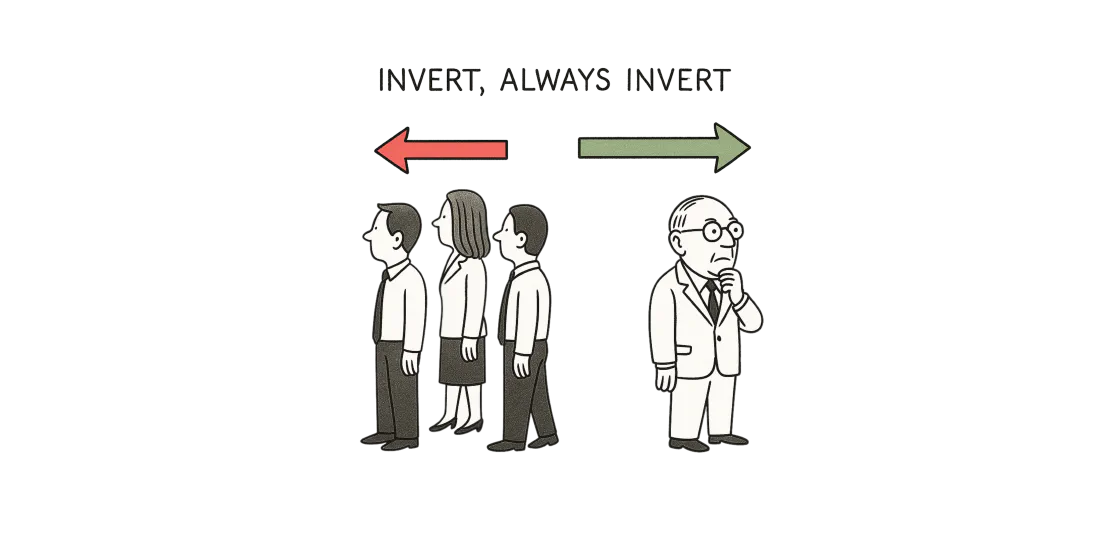
Charlie Munger is known for repeating one particular phrase:
“All I want to know is where I’m going to die, so I’ll never go there.”
At first glance, it seems like a joke. But Munger, who has spent decades studying decision-making, uses this to illustrate a mental model he calls inversion. The concept is straightforward: instead of focusing on what you want to achieve, start by identifying what you want to avoid.
“It is remarkable how much long-term advantage people like us have gotten by trying to be consistently not stupid, instead of trying to be very intelligent.”
This isn’t just clever wordplay. It’s an acknowledgment that in many areas of life, it’s easier to identify what we don’t want than to specify exactly what we do want. Success often comes from avoiding obvious mistakes rather than making brilliant moves. In life, as in chess, sometimes the best strategy is to eliminate the losing moves before searching for winning ones.
The Clarity of No
It’s often difficult to know what we want out of life. We are more often than not confused about our goals, our direction, our purpose. This confusion can leave us feeling lost, stuck in a maze of possibilities without a clear path forward.
I almost had to laugh at myself while writing this piece. Here I am, extolling the virtues of saying “no,” when I’ve spent years being called out for exactly that. My wife has often dubbed me “negative Nancy,” a title I’ve earned through countless dinner table debates and family decisions where my first instinct is always to find why something won’t work.
The pattern started early in my career. I can still remember sitting at my desk in A.F Ferguson (PwC), fresh after qualifying as a CA. The partner leaned back in his chair, fixed me with a steady gaze, and said something that would stick with me for years: “You know what your problem is? Your answer to everything starts with ’no.’ You find problems before you look for solutions.”
He was right. Whether it was a new client proposal, a different approach to an audit, or even lunch plans with colleagues, my default response was to identify why it wouldn’t work. It wasn’t that I meant to be difficult - I genuinely believed I was being thorough, practical, protecting against potential failures. But I was also closing doors before I’d properly looked inside them.
But there’s a crucial difference between reflexive negativity and intentional boundary-setting. One comes from fear or habit, closing doors before we’ve really looked through them. The other comes from clarity about our values, helping us navigate choices with purpose rather than reaction.
By focusing on what we don’t want, while keeping an open mind about everything else, decision-making becomes simpler. We can explore any path that doesn’t cross our fundamental boundaries. If something doesn’t conflict with our core values or what we know we don’t want, we can approach it with curiosity rather than uncertainty.
This approach frees us from the paralysis of trying to predict exactly where each choice will lead. Instead of requiring perfect foresight, we only need to know our non-negotiables. Everything else becomes an opportunity for discovery.
Inversion in Business
This distinction between reflexive negativity and intentional inversion isn’t just a personal lesson - it’s a powerful framework for business thinking. Just as there’s a difference between instinctively saying “no” and thoughtfully setting boundaries, there’s a difference between pessimistic business analysis and strategic inversion.
“Invert, always invert… It is the nature of things that many hard problems are best solved only when they are addressed backwards.”
When analyzing companies, most people start by asking what makes a business successful. They look for growth strategies, competitive advantages, and market opportunities. But what if we inverted the question? What kills businesses? Too much debt, poor capital allocation, misaligned incentives, breakdown of customer trust, loss of competitive advantage. By understanding these failure points first, we can better evaluate any business opportunity.
This isn’t about being negative - it’s about being clear. Richard Hamming captures this distinction in his work on learning and problem-solving:
“Vicarious learning from the experiences of others saves making errors yourself, but I regard the study of successes as being basically more important than the study of failure. As I will say several times, there are so many ways of being wrong and so few of being right, studying successes is more efficient.”
At first glance, this might seem to contradict the principle of inversion. But look closer: studying successes through the lens of what they didn’t do wrong often provides clearer insights than trying to copy what they did right.
Jeff Bezos demonstrates this at Amazon. Instead of trying to predict what will change in retail, he inverts the question:
“I almost never get the question: ‘What’s not going to change in the next 10 years?’ And I submit to you that that second question is actually the more important of the two – because you can build a business strategy around the things that are stable in time.”
Customers wanting lower prices, faster delivery, and better selection - these fundamentals won’t change. By inverting the question of innovation, Bezos found stable ground for long-term decisions. It’s not about predicting the future; it’s about identifying the constants and building around them.
The Accountant’s Narrative
The principles of inversion prove especially valuable in financial analysis and reporting. Here, the difference between reflexive negativity and systematic elimination transforms how we approach business intelligence.
Eliminating Noise from Signal
Most businesses build their internal reports by addition - more metrics, more variances, more forecasts. They create dense documents trying to serve every stakeholder’s needs. But what if we inverted this approach?
Instead of asking what to include, start by identifying what prevents clear business intelligence. Delayed reporting cycles that miss critical decision windows. Overcomplicated charts of accounts that bury key metrics in unnecessary detail. Meaningless comparisons that create noise instead of insight.
This isn’t about simplification for its own sake. It’s about stripping away everything that doesn’t serve operational decision-making. Think of financial reporting as a lens - each unnecessary element doesn’t just add complexity; it distorts the view of business performance.
The Architecture of Clear Reporting
Traditional reporting design starts with statutory requirements, then adds layers of detail for internal needs. This creates a foundation built on compliance rather than insight. Inverting this approach means first identifying what kills clarity: reconciliation breaks, manual adjustments, complex allocations, nested hierarchies that obscure rather than illuminate.
The solution isn’t in adding more controls or details - it’s in eliminating these failure points at the source. A clean chart of accounts structure. Automated interfaces that prevent reconciliation issues. Direct cost attribution that eliminates arbitrary allocations. Performance metrics that don’t need manual manipulation to tell their story.
Necessary vs. Unnecessary Complexity
Let’s be clear - I’m not suggesting we throw out all our controls and processes. That would be chaos. What I am suggesting is that we get smarter about which complexities actually serve a purpose and which ones we’ve just inherited from “that’s how it’s always been done.”
Think about your monthly close process. We all have that massive checklist of reconciliations and reviews. But when was the last time you asked why each item is there? Some of these checks are absolutely crucial - like matching purchase orders to invoices to catch duplicate payments, or making sure intercompany accounts net to zero. Skip these, and you’re asking for trouble.
But then there are the processes we do just because… well, just because. Those five layers of overhead allocation that nobody uses for decisions. The reconciliations of accounts that haven’t shown a meaningful variance in years. The reports that take days to produce but never actually drive action.
Here’s where inversion helps. Instead of starting with what we could add to our process, start with what could go wrong. What could cause us to miss something material? What might make us miss a critical business insight? Build your processes around preventing those failures, and you’ll find yourself with a system that’s both robust and purposeful.
From Analysis to Action
Let’s talk about variance analysis. The standard approach? Compare everything to plan, flag every deviation, create detailed explanations for each variance. Soon you’re drowning in a sea of red and green numbers, most of which don’t actually matter for decision-making.
Inversion flips this on its head. Start by asking what variations would change your decisions. A 2% miss in revenue might look concerning, but if it’s driven by timing of customer orders rather than lost business, does it warrant immediate action? Meanwhile, a seemingly small shift in product mix could signal a fundamental change in customer behavior that needs addressing now.
This isn’t about ignoring variances - it’s about understanding which ones matter. Revenue misses that reflect market share loss. Margin erosion that signals pricing problems. Cost increases that reveal operational inefficiencies. These are the variations that should drive action.
The same principle applies to the decisions themselves. Instead of asking “What should we do?” start with “What must we avoid?” A pricing decision isn’t just about maximizing short-term revenue - it’s about avoiding customer alienation, margin erosion, and competitive retaliation. A cost-cutting initiative isn’t just about hitting a savings target - it’s about preventing damage to operational capabilities and employee morale.
Beyond Compliance
Financial reporting isn’t just about recording what happened. It’s about winning. Too often, we treat our reporting processes like a compliance exercise - a box to tick, a requirement to meet. But treating financial analysis this way misses the point entirely.
Think of financial reporting as combat intelligence. In battle, you don’t want a comprehensive list of everything that moved on the field. You want to know what movements matter, what threats are real, what opportunities are actionable. The same principle applies to business intelligence.
This is where inversion proves its worth. Instead of creating reports that prove we followed the rules, we build intelligence that helps us win. Instead of showing everything that could be measured, we highlight what must be known. The goal isn’t documentation - it’s victory.
Closing Thoughts
That childhood insight about solving mazes backwards led somewhere I never expected. From puzzles to life decisions to financial analysis, the power of inversion remains the same: sometimes the clearest path forward starts by understanding what you’re trying to avoid.
This isn’t about being negative. It’s about being clear. Whether you’re wrestling with career choices, building business strategy, or designing financial reports, knowing what you don’t want often illuminates the path more brightly than trying to define exactly what you do want.
The maze may have gotten more complex since those Sunday morning puzzles, but the principle holds true. Success isn’t always about finding the perfect path forward. Sometimes it’s about eliminating the paths that lead nowhere, avoiding the dead ends, and keeping your options open for whatever opportunities emerge along the way.