 Mandelbrot
 The Accountant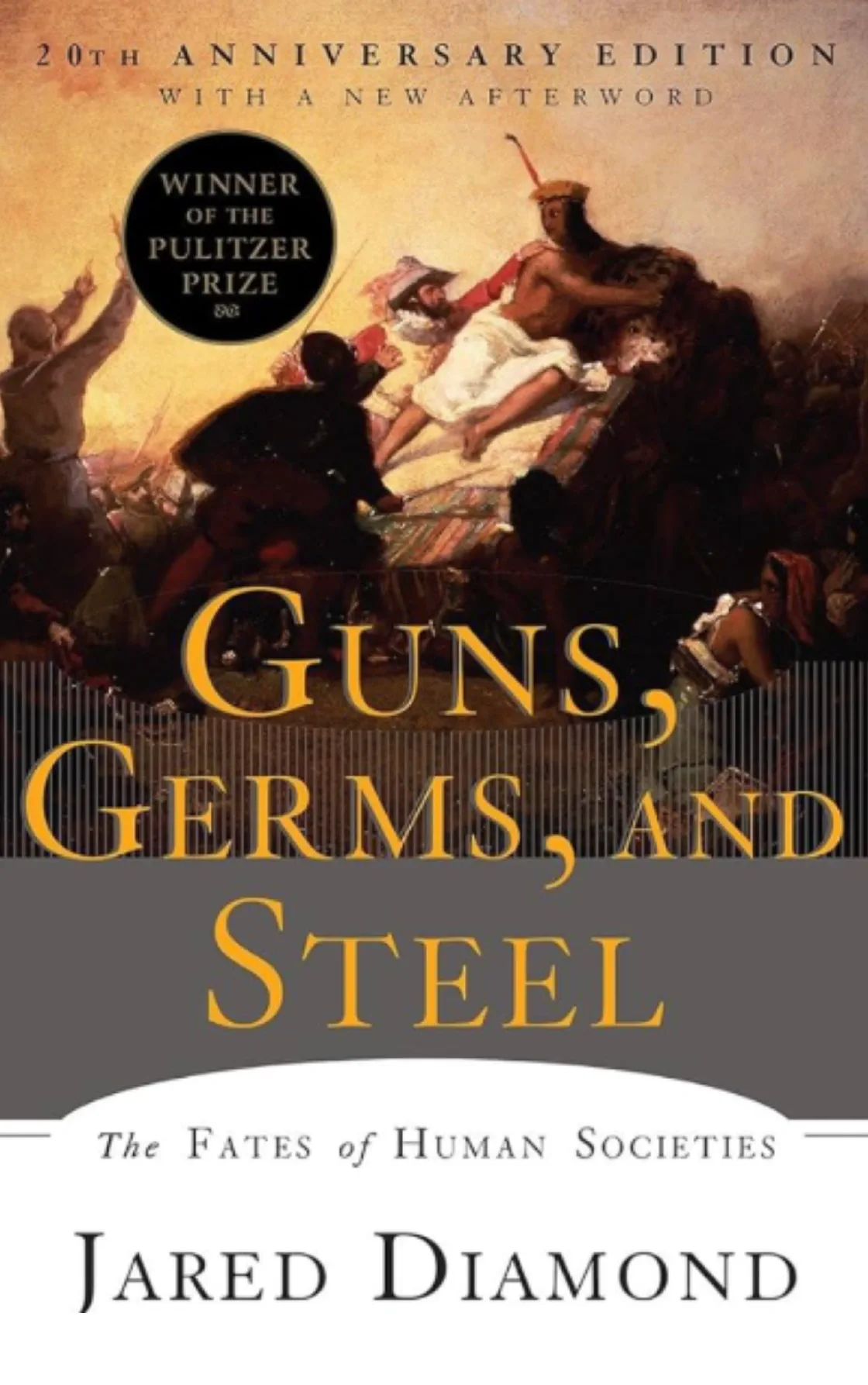
The scene is where most people start the story of European conquest, and it is exactly where Jared Diamond refuses to stop. The interesting question is not how the ambush worked. The question is why the men at Cajamarca were Spanish and not Inca. Why did Pizarro sail to Peru instead of Atahuallpa sailing to Seville? Diamond spends the book pushing that question backward, past guns and steel and the smallpox that had already gutted the Inca line of succession, until it lands somewhere no one expects: on wild grasses, animal herds, and the shape of continents.
His answer strips race and intelligence out of the account and replaces them with geography. Peoples turned out differently because their land offered different raw material, not because their minds did.
What Did I Get Out of It
Guns, Germs, and Steel is a book about causation. Its subject is human history, but its method is the thing I kept stealing for my own desk: the refusal to accept the first explanation as the real one.
The Environment Wrote the Script
Diamond states his thesis without hedging.
“History followed different courses for different peoples because of differences among peoples’ environments, not because of biological differences among peoples themselves.”
The claim is plain and its consequences are large. Some regions came stocked with grasses that bred into wheat and barley, and with big mammals that would tolerate a fence. The Fertile Crescent held both. Much of the world held neither. The people who happened to live where food could be farmed built surpluses, and surpluses bought everything downstream: cities, specialists, standing armies, writing, and the crowd diseases that ride along with domesticated herds. None of that required a cleverer population. It required a richer starting board. I have watched the same logic run in far smaller arenas. A team that inherits clean data and a sane system looks brilliant beside a team drowning in a legacy mess, and the gap owes nothing to talent. Positioning comes before performance.
“Spaniards’ superior weapons would have assured an ultimate Spanish victory in any case, the capture made the conquest quicker and infinitely easier.”
The seizure of Atahuallpa gets remembered as the decisive stroke. Diamond treats it as a detail. The ambush hurried along an outcome the underlying conditions had already settled: steel against quilted armor, horses against infantry on foot, and above all the epidemics that had killed perhaps half the population before the first shot. The event felt like the cause. The structure was the cause. That distinction is the whole game in risk. A CPI print or an earnings miss is a match. Whether it burns depends on what was stacked underneath long before the match arrived, which is the point I keep circling in What Actually Burns.
Peeling the Onion
“I seem to view world history as an onion, of which the modern world constitutes only the surface, and whose layers are to be peeled back in the search for historical understanding.”
Every answer in the book opens a deeper one. Guns won the battle. Why did the Spanish have guns? Metallurgy. Why did they have metallurgy and the Inca did not? Larger populations, older cities, more specialists freed from the fields. Why those? Food surplus. Why the surplus? The plants and animals available ten thousand years earlier. Diamond never stops at the proximate cause, and stopping at the proximate cause is the most common error I meet in an incident review. A control failed. That is the skin of the onion. The real work starts when you ask why the override was easier than compliance, and why the incentive to override existed at all. Root cause is a direction of travel, not a single finding.
“world history is indeed such an onion! But that peeling back of the onion’s layers is fascinating, challenging—and of overwhelming importance to us today, as we seek to grasp our past’s lessons for our future.”
The reason to peel is not antiquarian. Diamond wants the lessons to travel forward. History read this way becomes a pattern language rather than a list of dates, the same use I tried to make of the slow fading of Alexandria in an earlier essay. Once you see that the same causal chain produced the same result across four continents, you stop treating any single outcome as fate and start treating it as a set of conditions you might recognize the next time they assemble.
Understanding to Interrupt the Chain
Diamond spends part of the book defending himself against a charge that surprised me: that explaining European dominance amounts to excusing it.
“Understanding is more often used to try to alter an outcome than to repeat or perpetuate it. That’s why psychologists try to understand the minds of murderers and rapists, why social historians try to understand genocide, and why physicians try to understand the causes of human disease. Those investigators do not seek to justify murder, rape, genocide, and illness. Instead, they seek to use their understanding of a chain of causes to interrupt the chain.”
The confusion between explanation and endorsement is everywhere, and it does real damage in my line of work. Assign blame and the chain stays intact, because the next person in the same seat, facing the same incentives, will make the same choice. Map the causes and you get somewhere to intervene. A physician who understands how an infection spreads is not soft on the infection. He is finally equipped to break the transmission. Diamond is arguing that determinism, honestly traced, is not fatalism. You cannot interrupt a chain you refuse to look at, which is why I keep working the problem backward. Systems produce their behavior whether or not anyone designed them to, a lesson Diamond happens to illustrate at the scale of continents.
The Same Factors, Different Continents
“factors that resulted in Pizarro’s seizing Atahuallpa were essentially the same ones that determined the outcome of many similar collisions between colonizers and native peoples elsewhere in the modern world.”
Cajamarca was not special. The same bundle of advantages replayed in Mexico, in North America, in Australia, in southern Africa, with local variation laid over an identical spine. Diamond’s move is to treat one vivid event as an instance of a general form, and the habit is worth stealing. The architecture of a financial collapse rhymes the same way across three centuries: a phantom asset, easy leverage, a story too profitable to question. Swap the props and the mechanism holds. When you can name the form, a single case stops being an anecdote and becomes a template you can test against the next situation that looks superficially new. The rhyme sits in the structure, not the surface, and a long history of speculation reads that way once you learn to hear it.
The Leap That Widened the Range
“Neanderthals had brains slightly larger than our own. They were also the first humans to leave behind strong evidence of burying their dead and caring for their sick.”
Larger hardware, and it lost. For most of human history our ancestors were unremarkable animals with big skulls and modest results. Then something shifted.
“GREAT LEAP FORWARD coincides with the first proven major extension of human geographic range since our ancestors’ colonization of Eurasia.”
Around fifty thousand years ago the tools grow sophisticated, art appears, and the species suddenly spreads into terrain it had never held. Diamond stays careful about what triggered the leap, but the timing tells its own story. The capacity had been sitting there for a long time. Something unlocked its use, and the unlocking, not the raw brain size, redrew the map. I find the sequence humbling. Potential is not outcome. The Neanderthal carried the bigger instrument and left the fainter mark, a warning I would hand to any organization that mistakes its resources for its results.
The Extinctions No One Claims
Diamond handles the arrival of humans in new lands with a plainness most popular history avoids.
“Initially, archaeologists considered the possibility that the colonization of Australia / New Guinea was achieved accidentally by just a few people swept to sea while fishing on a raft near an Indonesian island.”
The accidental version is the comfortable one. A few fishermen blown off course, no intent, no achievement to reckon with. Diamond weighs it and sets it aside for the evidence of deliberate voyages across open water, which demanded planning and watercraft tens of thousands of years ahead of anything else on record. The pull toward the accidental account is familiar. We reach for the story that asks the least of us.
“The near-simultaneous disappearance of so many large species raises an obvious question: what caused it? An obvious possible answer is that they were killed off or else eliminated indirectly by the first arriving humans.”
Wherever humans landed for the first time, the large animals vanished within a geological blink. The simplest reading points at us. Diamond does not soften it. The reflex to look anywhere else is the same reflex Galbraith diagnosed in every financial post-mortem, where blame settles on regulators, on short sellers, on foreign actors, on everyone but the participants who believed the story. Owning the causal role is unpleasant, which is exactly why the honest accounts stay rare and worth more.
Who Is This For
Guns, Germs, and Steel is for the reader who wants a discipline more than a story. If you are trying to build the habit of pushing past the first cause, of asking what conditions made an outcome likely before any single actor stepped in, the book is a long, patient master class in the move. The book rewards systems thinkers, investors who hunt for structural analogs, and anyone whose job involves explaining why something failed without lazily naming a villain.
The book will frustrate readers who want moral clarity delivered fast. Diamond refuses the satisfying villain. He also, in places, overreaches. The environmental thesis is so powerful that it can flatten the role of choice, and a careful reader will catch moments where geography is asked to carry more than it can. Environment explains a great deal. It does not explain everything, and the book is stronger where it admits the seams than where it papers over them. Treated as the only lens, “the environment did it” becomes its own thought-terminating cliché, the mirror image of “this time is different.” Both stop the analysis one layer too early. Pair it with Factfulness if you want the hopeful counterweight, a reminder that the same long view which explains conquest also measures how much has improved.
What the book changed in me is smaller and more specific than its grand thesis. My instinct, when a control breaks or a number is wrong, has always been to find the person. Diamond retrained the instinct. Now I look first at the board the person was playing on. Not to excuse the choice, but to see whether the same seat would have produced the same failure under a different name. Most of the time the honest answer is yes, and the fix lives in the structure, not the individual. The discomfort of landing there is real for someone whose profession is built partly on accountability. The discomfort is also, I have come to think, the more useful place to stand.