 Mandelbrot
 The Accountant
Ever wonder how a 52-year-old milkshake mixer salesman became the mastermind behind one of the world’s biggest fast-food empires? That’s the story of Ray Kroc and McDonald’s.
Ray wasn’t your typical entrepreneur. He spent decades grinding it out in various jobs - selling paper cups, working as a real estate agent, even playing piano in bands. But it was his keen eye for opportunity that changed everything.
In 1954, Ray stumbled upon a small burger joint run by the McDonald brothers while on a sales call in California. What he saw there wasn’t just another restaurant. It was a revolution in the making.
The McDonald brothers had cracked the code on fast food. They had a limited menu - just burgers, fries, and shakes. But they were efficient like a Toyota assembly line. They could serve up meals in half the time and at half the price of their competitors. No waiters, no fuss - just quick, quality food.
Ray saw the potential immediately. He thought, “What if we could take this idea and spread it across the country?” And that’s exactly what he did. He bought the rights to franchise McDonald’s and opened his first restaurant near Chicago in 1955.
Ray Kroc didn’t invent McDonald’s. But he knew how to scale it up and bring it to the masses. In doing so, he changed the way we eat and live. Not bad for a guy who was just getting started at an age when most people are thinking about retirement, right?
This is the story of “Grinding It Out” - how Ray Kroc turned a small-town burger stand into a global phenomenon. It’s a tale of perseverance, vision, and the power of never giving up on your dreams, no matter how old you are.
There’s almost nothing you can’t accomplish if you set your mind to it.
What Did I Get Out of It?
Reading “Grinding It Out” was like getting two books in one. It’s not just about burgers and fries - there’s a lot more to chew on.
First, there’s the business stuff - the story of how McDonald’s grew from a single restaurant into a global giant. This part got me so curious that I ended up digging into McDonald’s financial statements. I wanted to see if the company was as good a business as Ray made it sound, and if it might be worth investing in.
Then there’s the other part - the life lessons from Ray Kroc himself. These are a mixed bag. Some are pretty inspiring, while others might make you raise an eyebrow.
In the next sections, we’ll take a closer look at both these parts. We’ll see what we can learn from the McDonald’s story, and what Ray’s life can teach us about success, failure, and everything in between.
The Business of McDonald’s
Burgers or Real Estate?
You might think McDonald’s is all about flipping burgers, but there’s more to the story. Ray Kroc’s book shows us that real estate played a huge part in McDonald’s growth.
McDonald’s owns a lot of land. The financial statements show book value of over $35 billion in real estate assets. Remember that’s the book value. The value of this real estate is probably a few multiples higher.
But it’s not just about owning property. Most of McDonald’s money comes from its franchises. And guess what? A big chunk of that franchise revenue is actually rent. That’s right - McDonald’s charges its franchisees rent for using those golden arches.
This setup is pretty clever. McDonald’s gets a steady income from rent, plus a cut of the sales. It’s like having your burger and eating it too.
This real estate strategy wasn’t just a happy accident. Ray Kroc and his team planned it from the start. In his book, Kroc explains:
…building dream castles was one thing; actually, getting into the restaurant development business was a seemingly insurmountable problem. Harry’s solution, the formation of Franchise Realty Corporation, was to my mind a stroke of financing genius. Franchise Realty was the supreme example of a guy putting his money where his mouth is. I did a lot of talking about the ideal way to develop McDonald’s with the kind of quality and uniformity that would ensure our success. And when Harry came up with a way to make it possible, I backed it by going into hock for everything I had—my house, my car, you name it. Talk about grinding it out!
We started Franchise Realty Corporation with $1,000 paid-in capital, and Harry parlayed that cash investment into something like $170 million worth of real estate. His idea, simply put, was that we would induce a property owner to lease us his land on a subordinated basis. That is, he would take back a second mortgage so that we could go to a lending institution (in the early days it was a bank) and arrange a first mortgage on the building; the landlord would subordinate his land to the building. I must admit that I was a bit skeptical: Why would a landlord want to do that? But I let Harry plunge ahead without interference.
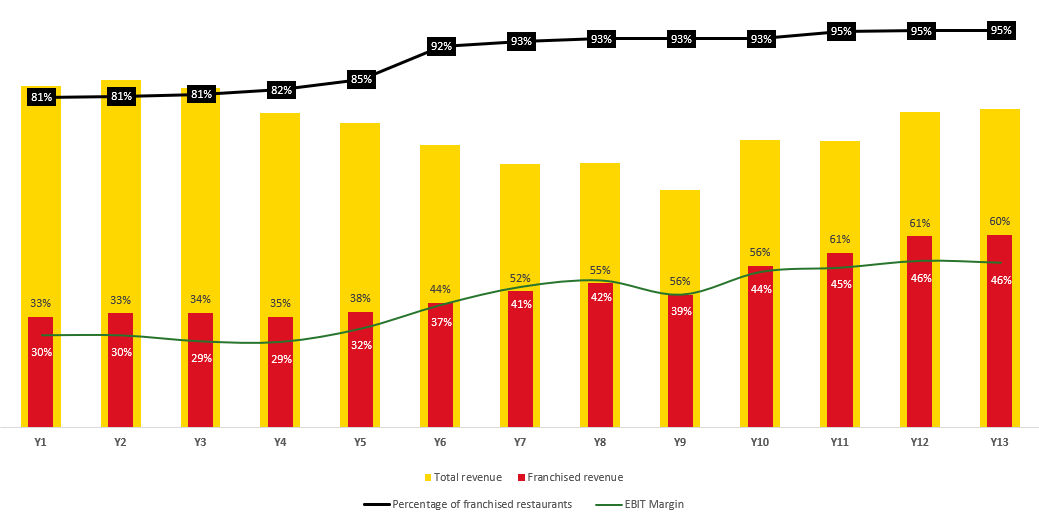
Here’s something interesting: I looked at McDonald’s numbers over the past decade. Franchise revenue has gone from about 30% of total revenue to over 60% now. That’s a big shift.
Most of this franchise revenue goes straight to the bottom line. You can see it in the company’s EBIT margins, which have jumped from 30% to almost 50%. The gross margins on McDonald’s own restaurants are only in the early to mid-teens. So, where’s the rest of that 50% EBIT margin coming from? You guessed it - the franchise business.
Kroc realized early on that this real estate model was the key to McDonald’s profitability.
This was the beginning of real income for McDonald’s. Harry devised a formula for the monthly payments being made by our operators that paid our own mortgage and other expenses plus a profit. We received this set monthly minimum or a percentage of the volume the operator did, whichever was greater. After a time we began realizing substantial revenues from the formula, and we could see that we were merely nibbling around the edges of this huge hamburger frontier we were exploring.
When you break it down like this, you start to see that McDonald’s isn’t really in the restaurant business at all. It’s in a specialized kind of real estate business.
So next time you bite into a Big Mac, remember - you’re not just eating at a restaurant. You’re sitting in one of the most successful real estate ventures in history. Who knew a burger could come with such an interesting business model?
Building a Fast-Food Empire
McDonald’s didn’t become a global powerhouse overnight. It took more than just flipping burgers and selling real estate. Ray Kroc had a bigger vision, and he was smart about making it happen.
Ray’s secret? Partnerships. He got both franchisees and suppliers to buy into his vision. His slogan was, “In business for yourself, but not by yourself!” He made believers out of his suppliers by selling them on future volumes and did that pay off.
The corporation has purchased stores—many of them, as I will show in later chapters. But our procedures for doing so are clearly spelled out to franchisees. We bend over backward to be fair in every case. We recognize that it would be unwieldy and counterproductive for the corporation to own more than about thirty percent of all stores. Our slogan for McDonald’s operators is ‘In business for yourself, but not by yourself,’ and it is one of the secrets of our success.
This just shows how deeply ingrained the franchise model was in McDonald’s strategy. It wasn’t just about expanding quickly; it was about creating a network of motivated owner-operators who had a stake in the business’s success.
Think of McDonald’s as a three-legged stool: suppliers, franchisees, and McDonald’s itself. Each leg needs to be strong for the whole thing to work. And work it did. Today, over 95% of McDonald’s restaurants are franchised.
Ray Kroc’s approach to franchising was unique and forward-thinking. He understood that the success of McDonald’s depended on the success of its franchisees. In his book, he explains a crucial decision he made:
One of the basic decisions I made in this period affected the heart of my franchise system and how it would develop. It was that the corporation was not going to get involved in being a supplier for its operators. My belief was that I had to help the individual operator succeed in every way I could. His success would insure my success. But I couldn’t do that and, at the same time, treat him as a customer.
Kroc recognized a potential conflict of interest in being both a partner and a supplier to franchisees. He continues:
There is a basic conflict in trying to treat a man as a partner on the one hand while selling him something at a profit on the other. Once you get into the supply business, you become more concerned about what you are making on sales to your franchisee than with how his sales are doing.
This decision set McDonald’s apart from many other franchise systems. Instead of profiting from supplying its franchisees, McDonald’s focused on building a purchasing system that would benefit everyone. Kroc explains:
Our method enabled us to build a sophisticated system of purchasing that allows the operator to get his supplies at rock-bottom prices. As it turned out, my instinct helped us avoid the antitrust problems some other franchise operations got into.
This approach not only helped McDonald’s avoid legal issues but also fostered a sense of true partnership with its franchisees. It’s another example of how Ray Kroc’s long-term thinking and focus on mutual success helped build McDonald’s into the powerhouse it is today.
Now that we understand Ray’s philosophy, let’s break down McDonald’s business model using the Business Model Canvas framework. This will give us a clear picture of how all the pieces fit together:
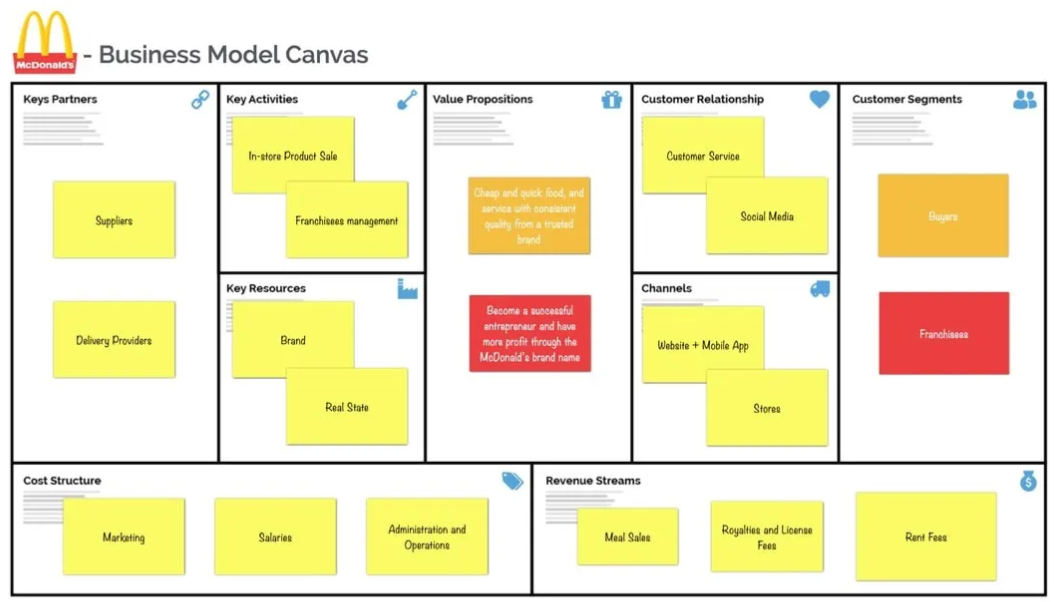
Source: Business Model Analyst
Let’s break down McDonald’s business model:
- Value Proposition: McDonald’s offers food of consistent quality, served quickly and consistently across the globe.
- Customer Segments: Their main targets are families, young people, the elderly, and business folks.
- Key Partners: Franchise holders are crucial. Today, over 95% of McDonald’s restaurants are franchised. Along with suppliers, these form the three-legged stool of McDonald’s business: suppliers, franchisees, and McDonald’s itself.
- Key Activities: McDonald’s focuses on marketing and selling food and beverages.
- Key Resources: The company’s employees and prime restaurant locations.
- Customer Relationships are increasingly managed through consistent customer service and digital channels.
- Distribution Channels: McDonald’s distributes its products through its restaurants.
- Cost Structure: Major costs include employee salaries, facility construction, raw material procurement, and marketing.
- Revenue Streams: McDonald’s generates revenue from both company-owned restaurants and franchise fees.
From Assembly Line to Drive-Thru
Have you ever considered why McDonald’s operates so efficiently? It all began with a challenge the McDonald brothers encountered. Orders in traditional restaurants were time-consuming and often inaccurate. They observed an interesting pattern. Despite offering an extensive menu, the majority of customers ordered only burgers, fries, and soda.
In response, they made a bold decision. They significantly reduced their menu to just a few key items. This approach was akin to applying lean manufacturing principles to the fast-food industry - a concept Toyota had made famous in car production.
It was a restaurant stripped down to the minimum in service and menu, the prototype for legions of fast-food units that later would spread across the land. Hamburgers, fries, and beverages were prepared on an assembly line basis, and, to the amazement of everyone, Mac and Dick included, the thing worked! Of course, the simplicity of the procedure allowed the McDonalds to concentrate on quality in every step, and that was the trick.
The brothers fully committed to efficiency. They replaced plates and cutlery with paper bags and disposable accessories, focusing on reducing costs and saving time.
This lean approach yielded several significant benefits:
- Improved food quality
- Faster service
- More opportunities for staff innovation
- Overall waste reduction
The McDonald brothers didn’t stop at menu simplification. They used a methodical trial-and-error approach to perfect their system. They determined the precise temperature and duration for frying potatoes, regardless of the restaurant’s location. They even measured sauce portions down to the ounce.
Ray Kroc provides a vivid example of this meticulous approach:
We arrived at the optimum stack, and that determined the height of our meat suppliers’ packages. The purpose of all these refinements, and we never lost sight of it, was to make our griddle man’s job easier to do quickly and well. All the other considerations of cost cutting, inventory control, and so forth were important to be sure, but they were secondary to the critical detail of what happened there at that smoking griddle. This was the vital passage in our assembly line, and the product had to flow through it smoothly or the whole plant would falter.
Ray Kroc recognized the brilliance of this system. He noted that the brothers’ approach gave them a substantial advantage over competitors. While other establishments took 30 minutes to serve a burger, McDonald’s was doing it in mere seconds.
It’s remarkable to consider how the McDonald brothers adapted a concept from automotive manufacturing to revolutionize the food service industry. They demonstrated that lean operations - maximizing efficiency while minimizing waste - could be successfully applied across various business sectors.
This innovative approach to fast food service not only transformed the industry but also changed the way people eat and live. The next time you order a meal at McDonald’s, remember that you’re experiencing more than just fast food - you’re witnessing the result of a manufacturing revolution, adapted for the restaurant industry.
Is It a Good Investment?
So, what’s the bottom line on McDonald’s as an investment? Let’s break it down.
We’re talking about a company that’s pulling in over $7 billion in free cash flow every year. With EBIT margins hitting 50%, McDonald’s is operating at a level of efficiency that would make most businesses green with envy.
Now, if you’ve been paying attention to Warren Buffett and Charlie Munger, you know they’re always on about finding “great businesses.” Well, McDonald’s checks a lot of those boxes.
Let’s talk returns for a second. Since going public, McDonald’s stock has been serving up returns like it serves burgers - fast and plentiful. We’re looking at a compound annual growth rate of over 15% on the stock price alone. And that’s not counting the dividends, which have been yielding 2-3% annually over the past decade. Not too shabby, right?
But here’s the thing - and this is important - finding a great business is only half the battle when it comes to investing. The other half is buying that great business at a fair price, as Buffett and Munger would tell you.
Is McDonald’s trading at a fair price right now? Well, that’s a whole other can of worms - or should I say, bag of fries? It would take another deep dive to figure that out. And honestly, that’s a question for another day and another analysis.
The point is, McDonald’s has proven itself to be a powerhouse of a business. But remember, in investing, it’s not just about finding a great company - it’s about finding a great company at the right price.
Grinding It Out
Ray Kroc’s story is the stuff of entrepreneurial legend. His journey from a struggling salesman to the founder of a global fast-food empire teaches us valuable lessons about determination, vision, and the power of never giving up. But it’s important to remember that his success came with trade-offs. Let’s explore the key lessons from Kroc’s life, both inspiring and cautionary.
Taking Charge
Kroc firmly believed in personal responsibility:
I have always believed that each man makes his own happiness and is responsible for his own problems.
This mindset was a cornerstone of his success. When we take charge of our lives, we stop blaming others and start looking for solutions.
But taking charge isn’t just about solving problems. It’s also about continuous growth. As Kroc said:
As long as you’re green you’re growing, as soon as you’re ripe you start to rot.
This plant metaphor reminds us to keep learning and developing, no matter our age or success level.
Dreams to Action
Kroc wasn’t just a dreamer; he was a doer:
They called me Danny Dreamer a lot, even later when I was in high school and would come home all excited about some scheme I’d thought up. I never considered my dreams wasted energy; they were invariably linked to some form of action. When I dreamed about having a lemonade stand, for example, it wasn’t long before I set up a lemonade stand.
He didn’t just imagine working; he took jobs whenever he could, turning his dreams into reality through action.
Importantly, Kroc found joy in his work:
Work is the meat in the hamburger of life. There is an old saying that all work and no play makes Jack a dull boy. I never believed it because, for me, work was play. I got as much pleasure out of it as I did from playing baseball.
This attitude made it easier for him to put in the effort needed to succeed.
Building Resilience
Kroc viewed early struggles as preparation for future challenges:
Perhaps without that adversity I might not have been able to persevere later on when my financial burdens were redoubled. I learned then how to keep problems from crushing me. I refused to worry about more than one thing at a time, and I would not let useless fretting about a problem, no matter how important, keep me from sleeping.
Instead of seeing tough times as setbacks, he viewed them as preparation. It’s like he was in boot camp, training for the bigger challenges ahead. Those early struggles? They were building his resilience, getting him ready for when the stakes would be even higher.
Kroc developed a practical approach to handling the stress of it all. He had a simple rule: focus on one problem at a time. No multitasking when it came to worrying. And perhaps most importantly, he refused to let his concerns keep him up at night. He knew that losing sleep over problems wouldn’t solve them; it would only make him less equipped to handle them the next day.
Long Road to Overnight Success
Kroc’s success with McDonald’s at age 52 is often seen as an overnight sensation, but he saw it differently:
My years of experience in selling paper cups and Multimixers paid off here, because I knew exactly what hands held the strings I wanted to pull to get the job done. People have marveled at the fact that I didn’t start McDonald’s until I was fifty-two years old, and then I became a success overnight. But I was just like a lot of show business personalities who work away quietly at their craft for years, and then, suddenly, they get the right break and make it big. I was an overnight success all right, but thirty years is a long, long night.
Ray Kroc’s story is often told as a tale of late-blooming success. People marvel at how he started McDonald’s at 52 and seemed to become a success overnight. But Kroc knew better. He saw his journey differently, and there’s a lot we can learn from his perspective.
Imagine Kroc, with decades of experience selling paper cups and Multimixers under his belt. To many, these might seem like unremarkable jobs. But Kroc saw them as preparation. Each sale, each interaction, was teaching him something valuable. He was learning who held the strings in the business world, and how to pull them to get things done.
Kroc compares himself to show business personalities who work quietly at their craft for years before getting their big break. It’s a powerful analogy. Think of all the “overnight sensations” in music or movies who actually spent years honing their skills before hitting it big.
“I was an overnight success all right, but thirty years is a long, long night.” This line is packed with wisdom. It acknowledges the common perception of his sudden success while also revealing the truth of his long journey.
Here’s what we can take from this:
- Success often has a long runway. Usually, the result of years of preparation and hard work, what looks like sudden achievement to others.
- Every experience is valuable. Kroc’s years in seemingly unrelated fields gave him skills and knowledge that proved crucial when he started McDonald’s.
- Persistence pays off. Kroc kept working and learning for decades before he found his big opportunity.
- It’s never too late to start something big. When Kroc started his McDonald’s venture at 52, he proved that age is just a number when it comes to entrepreneurship.
- Recognize the value in your journey. Kroc saw how his earlier career prepared him for his ultimate success instead of dismissing it as irrelevant.
The Price of Ambition
While Kroc’s business success is inspiring, his personal life reveals the costs of single-minded ambition:
She absolutely refused to help. I’m sure she felt justified, but I felt betrayed. I just couldn’t believe she’d let me down like that. She wouldn’t even agree to work part-time or for a limited period, until I got the business going. That was when I began to understand the meaning of the word estrangement. It is a terrible feeling, and once it appears, it grows like dry rot.
This serves as a cautionary tale. Success in business doesn’t always translate to success in personal relationships. It prompts us to consider what we’re willing to sacrifice for our dreams and whether those sacrifices are truly worth it.
Who is This Book For?
“Grinding It Out” is more than just another business book or autobiography. It’s a multifaceted narrative that offers something for a wide range of readers.
This book is a goldmine for the aspiring entrepreneur. Packed with practical business lessons, it tells Ray Kroc’s journey from a struggling salesman to the founder of a global empire. Whether you’re interested in sales techniques, the intricacies of building a business from scratch, or the challenges of scaling up, Kroc’s experiences offer insights. His approach to managing supply chains and creating a value chain is particularly enlightening for those looking to build sustainable business models.
But you don’t have to be a business owner or aspiring entrepreneur to find value in this book. Kroc’s story of grit, resilience, and perseverance is truly inspiring for anyone facing challenges in their career or personal life. It’s a reminder that success often comes after years of hard work and that it’s never too late to pursue your dreams.
The book will fascinate history buffs and those interested in American culture as well. Kroc’s story is intertwined with the rise of fast food in America, offering a unique perspective on this significant cultural shift.
Kroc’s experiences provide real-world case studies in decision-making, problem-solving, and people management for students of leadership and management. His successes and failures offer valuable lessons in what to do - and what not to do - when leading a growing organization.
The book offers an engaging narrative, even if you’re simply a curious reader. Kroc’s straightforward writing style and candid reflections make for an entertaining read, regardless of your background or interests.
In essence, “Grinding It Out” is a testament to the power of perseverance and a reminder that with enough determination, it’s possible to overcome seemingly insurmountable odds and achieve extraordinary things.