 Mandelbrot
 The Accountant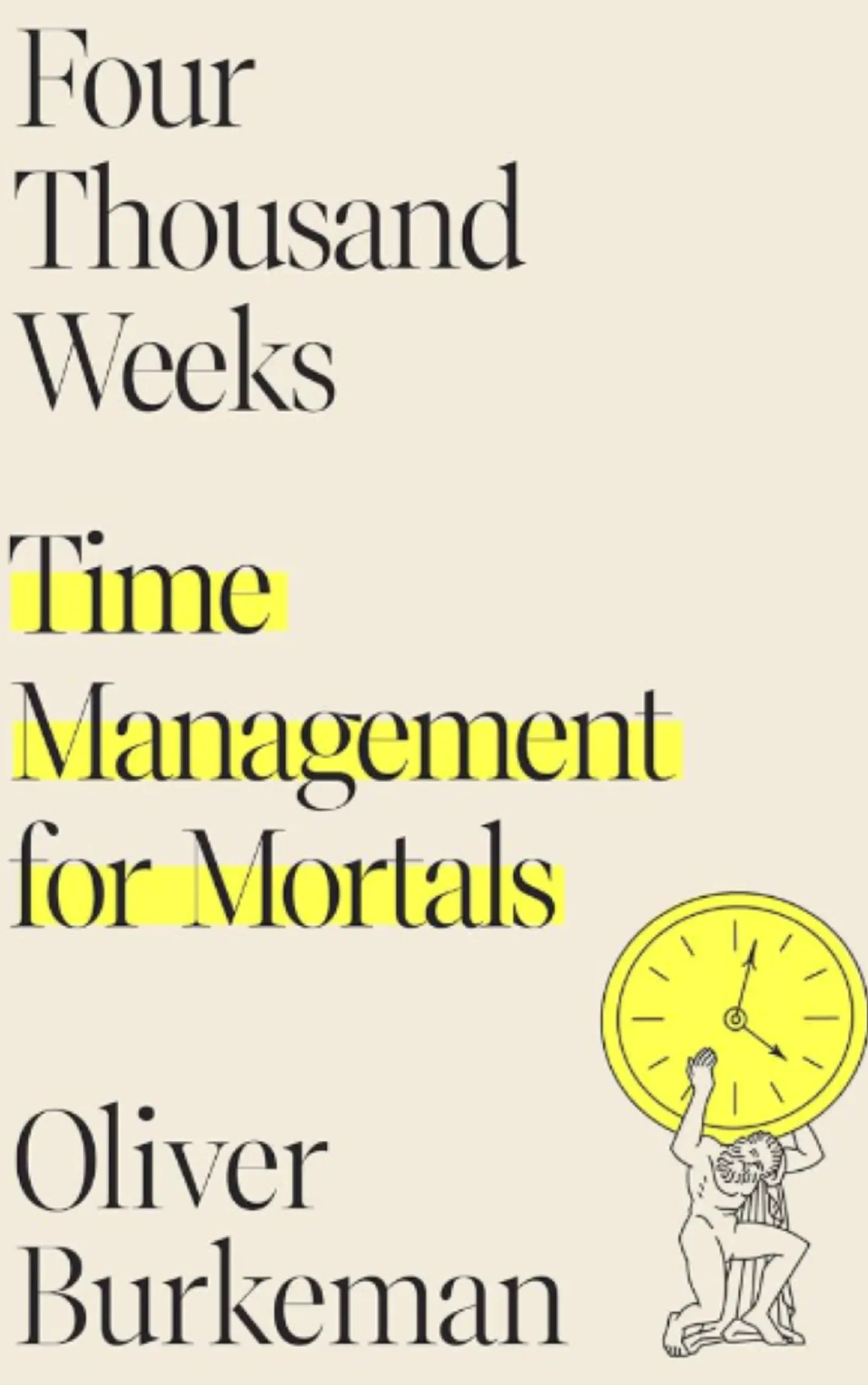
Eighty years comes to roughly four thousand weeks. That is the arithmetic behind the title, and it lands harder than the productivity advice that usually fills the books shelved next to this one. Four thousand is not a large number. You can hold it in your head without strain. You can fit it into a single cell. Most of the working files I build to track things of far less consequence run longer than the span of a human life.
Burkeman does not offer the number as motivation. He offers it as a demolition. The premise of nearly every system I have ever adopted, the calendars and the capacity models, is that with enough discipline you will eventually get on top of everything. Four thousand weeks is the proof that you will not.
Think of this book as an extended argument for the empowering potential of giving up hope, and embracing your limits.
Giving up hope reads like surrender until you sit with it. The hope being surrendered is a specific and toxic one: the belief that the backlog is temporary, that some future configuration of effort will clear the decks and leave you free. That state never arrives. The decks are never clear. Accepting this is not defeat. It is the first honest input into how you spend the time you actually have, instead of the time you keep promising yourself once the queue is empty.
What Did I Get Out of It
Finitude Is the Feature
The book’s pivot is to stop treating limitation as a defect in the system and start treating it as the system.
If you actually could get everything done, you’d never have to choose among mutually exclusive possibilities. Only by facing our finitude that we can step into a truly authentic relationship with life.
Choice is the whole game, and choice exists only because time runs out. A world where everything fits is a world where nothing carries weight, because nothing was foregone to make room for it. I spend a fair amount of my working life inside reconciliations, and the thing nobody tells you early is that the work has no terminal state. Close one period and the next one opens. The ledger does not resolve into stillness. It rolls forward.
No anxious pressure to “get everything done” because a farmer’s work is infinite: there will always be another milking and another harvest, forever, so there’s no sense in racing toward some hypothetical moment of completion.
The farmer in Burkeman’s example is not lazy. He has stopped pretending the work is the kind that ends. The modern fantasy is the clean queue, the moment you are finally caught up and can begin to live. Essentialism circles the same conclusion from a different angle. The constraint is permanent, so the only variable you control is what you let through it.
The Hurdle Every Task Should Clear
The most operational idea in the book is that finitude forces a hurdle rate on your attention, and abundance removes it.
The more firmly you believe it ought to be possible to find time for everything, the less pressure you’ll feel to ask whether any given activity is the best use for a portion of your time.
This reframed the to-do list for me as a capital allocation problem rather than a storage problem. If you assume infinite time, nothing has to compete for it, and a request with no competition gets approved by default. Every yes is funded by a no you never made explicit. The discipline is not in working faster. It is in forcing each item to clear a bar before it earns a place. The Power of Selective Focus makes the same argument from the other side.
If you never stop to ask yourself if the sacrifice is worth it, your days will automatically begin to fill not just with more things, but with more trivial or tedious things, because they’ve never had to clear the hurdle of being judged more important than something else.
Scope creep, described at the level of a single life. The tasks that colonize a calendar are rarely the consequential ones. They are the small favors and frictionless requests that arrive already approved, because nobody weighed them against an alternative. Burkeman’s answer is mechanical: keep an open list of everything and a closed list capped at ten, and let nothing onto the closed list until something leaves. He goes further and proposes a hard ceiling of three things in progress at once. His phrase for the result is “neglect the right things.” The point is not neglect. It is choosing your omissions on purpose instead of letting them happen to you. Time, Tasks, and Tendencies covers the way work quietly expands to fill whatever container you give it.
The Carry Cost of Keeping Options Open
Burkeman attacks the modern reflex to keep every door open, and he is right to.
Resist the seductive temptation to “keep your options open”, in favor of deliberately making big, daunting, irreversible commitments. They prove more fulfilling in the end.
Optionality is sold as pure upside, and in a portfolio it sometimes is. In a life it carries. The cost of holding every door open is that you never walk through any of them, and a decade spent standing in the hallway is itself a decision, just an unspoken one. The Unexpected Upside treats optionality as something to accumulate. Burkeman is the counterweight, the reminder that an option held forever expires unexercised. Wild Problems lands in the same territory on commitment.
There’s no possibility of a romantic relationship being truly fulfilling unless you’re willing to settle for that specific relationship, with all its imperfections - which means spurning the seductive lure of an infinite number of superior imaginary alternatives.
The imagined alternative always wins, because it is exempt from reality. A real partner, a real city, each carries defects you can list. The fantasy version carries none, because you never have to live inside it. Burkeman notes that the future feels more appealing than the present precisely because you can load it with hopes that contradict one another. Cash on the sidelines feels like prudence and freedom both, but it is a position with a view, and the view is more often wrong than the people holding it admit.
Attention Is the Whole of It
The line that reorganized my thinking is the claim that attention is not a resource you spend on life. It is the substance life is made of.
The crucial point isn’t that it’s wrong to choose to spend your time relaxing. It’s that the distracted person isn’t really choosing at all. Their attention has been commandeered by forces that don’t have their highest interests at heart.
What you attend to is what you get to have lived. The attention economy is not stealing your minutes so much as editing the contents of your one and only experience. Stillness Is the Key sits close to this, and Factfulness shows the downstream cost: a picture of the world skewed toward whatever is most alarming rather than most accurate.
Once the attention economy has rendered you sufficiently distracted, or annoyed, or on edge, it becomes easy to assume that this is just what life these days inevitably feels like.
The damage is not the wasted hour. It is the recalibration of your baseline, the way a feed of outrage convinces you that outrage is the weather. I notice the professional version in how threat perception drifts. Spend enough time braced for the dramatic failure and you start allocating vigilance to the loud risk while the quiet one accumulates unwatched. A distorted sense of where the danger lives is more expensive than any single alarm.
Stay on the Bus
Patience gets framed in the book as an active discipline rather than a passive one, and the best illustration is a parable about a bus station.
“It’s simple,” Minkkinen says. “Stay on the bus. Stay on the fucking bus.”
Every bus leaving Helsinki’s main station shares the same early route, so three years of work can turn out to look derivative, a copy of whoever rode the line before you. The instinct is to jump off, return to the station, and start again on a fresh route. Do that repeatedly and you produce a career of beginnings. The distinctive work appears only past the point where the routes diverge, and you reach it only by staying aboard through the stretch that looks like everyone else’s. So Good They Can’t Ignore You makes the same case for craft over the hunt for a perfect starting line.
The most productive and successful made writing a smaller part of their daily routine than the others. They cultivated the patience to tolerate the fact that they probably wouldn’t be producing very much on any individual day, with the result that they produced much more over the long term.
The heavy producers did less on any given day and more across the years. Patience here is not idleness. It is the willingness to tolerate thin daily output for the sake of compounding, to stop demanding a verdict from each session. Bird by Bird describes the same posture from inside the writing life. Burkeman’s word for the person who has internalized it is the radical incrementalist, and the label is more useful than it first sounds.
The Relief of Cosmic Insignificance
The closing turn is the one I expected to resist and did not.
Overvaluing your existence gives rise to an unrealistic definition of what it would mean to use your finite time well. It sets the bar much too high.
If your life has to matter on a cosmic scale to count as well spent, every ordinary day registers as a shortfall. Lower the bar to its honest height and the things already filling your weeks stop reading as filler. Burkeman calls the opposite condition paralyzing grandiosity, the sense that you owe the universe something consequential before your time is up. The relief is in being let off a hook you hung yourself on.
How to live: quietly do the next and most necessary thing. If you do with conviction the next and most necessary thing, you are always doing something meaningful and intended by fate.
After four thousand weeks of arithmetic and finitude, the instruction is small. Do the next necessary thing, and the meaning takes care of itself. Focus on the next step arrives at the same plainness. There is a passage about a man stuck in traffic after a friend’s sudden death, no longer cursing the delay but asking what his friend would have given to be caught in it. The reframe has nothing to do with traffic and everything to do with treating the unremarkable hour as the thing itself rather than the obstacle between you and the thing.
Who Is This For
There is one sentence in the book I read more than once, because it described me with no decent place to hide.
I derive so much of my sense of self-worth from work.
A book that tells you the list will never end is also telling you that the scoreboard you have been keeping is rigged against you. If your worth is settled by output, and output has no terminal state, then you have signed up for a contest that cannot be won, only paused. That is the discomfort the book is built to produce, and it is worth sitting in.
This is for the knowledge worker who has optimized themselves into a quieter kind of misery, who runs life off systems and has started to suspect the systems are the problem rather than the cure. It is for the parent who has felt the strange dilation of time around a newborn, dragged out of clock time into what Burkeman calls deep time. It is for the investor who confuses an open position for prudence and calls indecision patience.
It is not for anyone who wants a method. There is no app at the end of this, no five-step morning routine, no tighter loop. The book dismantles the premise those tools rest on, and a reader hoping to reclaim their schedule will close it more unsettled than when they opened it. That unsettling is the deliverable.
What it changed in me is narrow and real. I stopped treating the unfinished list as evidence of a personal failing and started treating it as a property of the work. The backlog is not a verdict. It is the shape of a finite person standing in front of an infinite supply of things worth doing, choosing a few and letting the rest go. Four thousand weeks is not enough for everything. It was never going to be. The honest move is to decide what the few are while the cells are still being counted.