 Mandelbrot
 The Accountant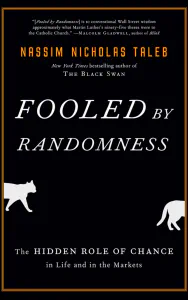
“My portfolio is up 70% this year,” shared a close friend in our WhatsApp investment group. “That’s almost triple the S&P 500’s returns.” The group celebrated his success, and naturally, everyone wanted to know his secret. When I asked him about the role of luck versus skill in his impressive returns, he thoughtfully considered the question. While acknowledging that luck plays a part, he emphasized how he’d positioned himself for success through months of research, financial analysis, and careful timing.
This conversation perfectly illustrates what Nassim Taleb calls being “fooled by randomness.” We humans are pattern-seeking creatures, desperate to find order in chaos. When success comes our way, we rush to create stories that explain it, attributing outcomes to our skills and decisions rather than acknowledging the role of chance. But here’s the crucial question Taleb would ask: can these results be consistently repeated? In a market driven by countless unpredictable variables – from geopolitical events to market sentiment – a single year of outstanding returns might tell us less about skill than we’d like to believe. After all, in a room of thousand traders, pure chance dictates that some will have stellar years through no particular insight of their own.
What’s particularly fascinating is how our relationship with randomness shifts depending on our circumstances. While some people refuse to see luck in their triumphs, attributing every success to skill and strategy, others see nothing but luck in their achievements, dismissing years of hard work and preparation. I belong to the second category. For years, I struggled with impostor syndrome, convinced that my career successes were just fortunate accidents. Each promotion or achievement came with a nagging voice: “You just got lucky. You don’t really belong here.”
Reading “Fooled by Randomness” helped me understand this contradiction. Taleb shows how randomness is neither good nor bad – it’s simply a fundamental force shaping our lives. The same force that some refuse to see in their successes was the very thing I was letting diminish my achievements. Understanding this changed everything: if chance plays such a significant role in life, why should we feel guilty when it works in our favor?
This paradox – our selective blindness to randomness – lies at the heart of “Fooled by Randomness.” It’s a book that fundamentally changed how I view success, failure, and the role of chance in our lives. Through Taleb’s lens, I began to see how randomness permeates everything from financial markets to career trajectories, and how understanding this can make us both more humble and more confident at the same time.
What Did I Get Out of It?
Reading “Fooled by Randomness” is like putting on a pair of glasses that suddenly brings the world into sharper focus. Things that once seemed clear-cut – success, failure, skill, luck – become more nuanced and complex. The book doesn’t just explain how randomness fools us; it fundamentally changes how we see the world around us.
Here are five crucial insights that transformed my understanding of luck, skill, and success:
Not All Success Stories Are Created Equal
The difference between a dentist and a trader tells us everything we need to know about skill versus luck. On the surface, both might be considered successful professionals, but the nature of their success couldn’t be more different. As Taleb explains:
“Of course skills count, but they do count less in highly random environments than they do in dentistry.”
A dentist’s success is built on thousands of repetitive actions. Each filling, each root canal, adds to a predictable pattern of outcomes. Their success is what Taleb calls “ergodic” – it reveals itself through repetition and time. The relationship between effort, skill, and outcome is clear and direct. A dentist who performs well consistently isn’t lucky; they’re skilled.
But what about success in more random environments? Take trading, for instance. One successful year tells us surprisingly little about skill. As Taleb notes:
“At a given time in the market, the most successful traders are likely to be those that are best fit to the latest cycle. This does not happen too often with dentists or pianists—because these professions are more immune to randomness.”
The key question isn’t whether someone is successful – it’s whether their success is repeatable. Taleb emphasizes:
“Repetitiveness is key for the revelation of skills because of what I called ergodicity – the detection of long-term properties, particularly when these exist.”
This becomes even more apparent as we move up organizational hierarchies. Taleb points out:
“Now take a peek inside the chief executive suite. Clearly, the decisions there are not repeatable. CEOs take a small number of large decisions, more like the person walking into the casino with a single million-dollar bet. External factors, such as the environment, play a considerably larger role than with the cook.”
Does this mean skill doesn’t matter in domains ruled by randomness? Not at all. As Taleb clarifies:
“Let me make it clear here: Of course chance favors the prepared! Hard work, showing up on time, wearing a clean (preferably white) shirt, using deodorant, and some such conventional things contribute to success—they are certainly necessary but may be insufficient as they do not cause success.”
This insight fundamentally changes how we should evaluate success stories, including our own. Instead of asking “How successful is this person?” we should ask:
- In what kind of domain did they succeed?
- How repeatable are their decisions and their outcomes?
- What role did environmental conditions play in their success?
- How much of their process can actually be replicated?
Some fields, like dentistry, engineering, or playing the piano, reward skill and preparation in predictable ways. Others, like financial markets, entrepreneurship, or corporate leadership, have a much larger random component. As Taleb provocatively suggests:
“CEOs are not entrepreneurs. As a matter of fact, they are often empty suits… More appropriately, what they have is skill in getting promoted within a company rather than pure skills in making optimal decisions—we call that ‘corporate political skill.’”
Understanding this distinction isn’t just academic – it’s practical wisdom that can save us from dangerous misconceptions. When we read success stories or seek to learn from others’ achievements, we need to first understand the nature of the domain in which that success occurred. Are we looking at a dentist’s predictable progression or a trader’s lucky streak? The answer should fundamentally change how we interpret and learn from their experience.
Alternative Histories and Path Dependence: The Roads Not Taken and The Traps We Build
Life is full of branching paths, but we can only experience one version of events. To help us understand what this means, Taleb presents a stark thought experiment:
“Imagine an eccentric (and bored) tycoon offering you $10 million to play Russian roulette, i.e., to put a revolver containing one bullet in the six available chambers to your head and pull the trigger. Each realization would count as one history, for a total of six possible histories of equal probabilities. Five out of these six histories would lead to enrichment; one would lead to a statistic.”
In real life, the odds are even more deceptive:
“Reality is far more vicious than Russian roulette. First, it delivers the fatal bullet rather infrequently, like a revolver that would have hundreds, even thousands, of chambers instead of six. After a few dozen tries, one forgets about the existence of a bullet, under a numbing false sense of security.”
This makes alternative histories - the paths not taken - nearly impossible to see. While we might understand that a Russian roulette winner was lucky, we struggle to see the role of luck in everyday success. As Taleb emphasizes:
“One cannot judge a performance in any given field (war, politics, medicine, investments) by the results, but by the costs of the alternative (i.e., if history played out in a different way). Such substitute courses of events are called alternative histories.”
The wise person, Taleb suggests, must try to see these invisible paths:
“While the remaining five histories are not observable, the wise and thoughtful person could easily make a guess as to their attributes. It requires some thoughtfulness and personal courage.”
But there’s an even deeper trap: once we choose a path, we often become imprisoned by it. This is what Taleb calls path dependence. Consider his example:
“Say you own a painting you bought for $20,000, and owing to rosy conditions in the art market, it is now worth $40,000. If you owned no painting, would you still acquire it at the current price? If you would not, then you are said to be married to your position.”
This marriage to our positions happens because we can’t see the other paths anymore. We get trapped by our past decisions, our beliefs, and our successes. As Taleb notes:
“Many people get married to their ideas all the way to the grave. Beliefs are said to be path dependent if the sequence of ideas is such that the first one dominates.”
The combination of invisible alternative histories and path dependence creates a dangerous trap. Success makes us forget both the paths not taken and blinds us to future possibilities:
“Lucky fools do not bear the slightest suspicion that they may be lucky fools—by definition, they do not know that they belong to such a category. They will act as if they deserved the money.”
The solution? We must develop two abilities: seeing the paths not taken and staying free from the tyranny of our past choices. Taleb admires George Soros for mastering this second skill:
“What characterizes real speculators like Soros from the rest is that their activities are devoid of path dependence. They are totally free from their past actions. Every day is a clean slate.”
This dual awareness changes how we should make decisions:
- What other paths could events have taken?
- Are we holding positions just because we’ve held them in the past?
- Can we truly evaluate our current situation without being biased by our history?
- Are we learning from our mistakes, or just justifying our past choices?
The goal is to maintain both the wisdom to see all possible paths and the freedom to choose new ones. As Taleb reminds us:
“My lesson from Soros is to start every meeting at my boutique by convincing everyone that we are a bunch of idiots who know nothing and are mistake-prone, but happen to be endowed with the rare privilege of knowing it.”
The Narrative Fallacy: Our Need to Create Stories
Humans are storytelling machines. We can’t help but create narratives to explain everything around us, especially success and failure. But as Taleb warns, this tendency to create stories is one of the main ways we get fooled by randomness:
“Past events will always look less random than they were (it is called the hindsight bias).”
Think about any success story you’ve read. The path to success always seems clear and logical in retrospect. Each decision appears to lead inevitably to the next. As Taleb observes:
“I would listen to someone’s discussion of his own past realizing that much of what he was saying was just backfit explanations concocted ex post by his deluded mind.”
This narrative fallacy shows up everywhere. We see it in business books, financial news, and even our own explanations of our successes and failures. Taleb points out:
“Bookstores are full of biographies of successful men and women presenting their specific explanation on how they made it big in life (we have an expression, ’the right time and the right place,’ to weaken whatever conclusion can be inferred from them).”
The problem goes deeper than just creating stories - we actually change how we interpret events based on what we know happened later. Taleb explains:
“When you look at the past, the past will always be deterministic, since only one single observation took place. Our mind will interpret most events not with the preceding ones in mind, but the following ones.”
This creates a dangerous cycle. Success stories appear more deterministic than they really were, which makes us more confident in our ability to predict and control future outcomes. As Taleb notes:
“A more vicious effect of such hindsight bias is that those who are very good at predicting the past will think of themselves as good at predicting the future, and feel confident about their ability to do so.”
The media makes this worse by constantly trying to explain random market movements:
“A move of 1.03 with the Dow at 11,000 constitutes less than a 0.01% move. Such a move does not warrant an explanation. There is nothing there that an honest person can try to explain; there are no reasons to adduce.”
Yet we can’t seem to resist the urge to explain everything:
“Just as one day some primitive tribesman scratched his nose, saw rain falling, and developed an elaborate method of scratching his nose to bring on the much-needed rain, we link economic prosperity to some rate cut by the Federal Reserve Board, or the success of a company with the appointment of the new president ‘at the helm.’”
The solution isn’t to stop telling stories entirely - that’s probably impossible. Instead, Taleb suggests we need to:
- Recognize our tendency to create narratives
- Be skeptical of after-the-fact explanations
- Remember that clear patterns in the past don’t guarantee similar patterns in the future
- Stay humble about our ability to understand and predict events
As Taleb reminds us:
“Unless the source of the statement has extremely high qualifications, the statement will be more revealing of the author than the information intended by him.”
This insight fundamentally changes how we should read success stories, news reports, and even our own explanations of events. The cleaner and neater the story seems, the more we should question it.
Our Selective Blindness to Randomness: The Success-Failure Paradox
We are remarkably inconsistent in how we view randomness. As Taleb points out with characteristic directness:
“You attribute your successes to skills, but your failures to randomness.”
This selective blindness creates a peculiar paradox. Some of us, like the trader from our WhatsApp group, refuse to see luck’s role in our triumphs. Others, caught in impostor syndrome, see nothing but luck in their achievements. Taleb helps us understand why this happens through several insights.
First, our emotional machinery often overrides our rational understanding:
“We are faulty and there is no need to bother trying to correct our flaws. We are so defective and so mismatched to our environment that we can just work around these flaws. I am convinced of that after spending almost all my adult and professional years in a fierce fight between my brain (not Fooled by Randomness) and my emotions (completely Fooled by Randomness).”
This emotional override affects how we process both success and failure:
“I have experienced leaps of joy over results that I knew were mere noise, and bouts of unhappiness over results that did not carry the slightest degree of statistical significance.”
Our relationship with randomness becomes even more complicated when we consider status and comparison:
“Psychologists have shown that most people prefer to make $70,000 when others around them are making $60,000 than to make $80,000 when others around them are making $90,000. Economics, schmeconomics, it is all pecking order.”
This relative positioning makes us particularly vulnerable to misinterpreting randomness. When others succeed, we look for explanations that diminish their achievement. When we succeed, we search for explanations that highlight our skill. As Taleb notes:
“Intellectual contempt does not control personal envy. That house across the street kept getting bigger, with addition after addition—and Nero’s discomfort kept apace. While Nero had succeeded beyond his wildest dreams, both personally and intellectually, he was starting to consider himself as having missed a chance somewhere.”
The solution isn’t to try to eliminate these emotional responses - that’s probably impossible. Instead, Taleb suggests a more practical approach:
“Since my heart does not seem to agree with my brain, I need to take serious action to avoid making irrational trading decisions, namely, by denying myself access to my performance report unless it hits a predetermined threshold.”
This insight applies beyond trading. We need to:
- Acknowledge our emotional responses to success and failure
- Create systems that protect us from our biases
- Remember that both success and failure often contain elements of skill and luck
- Stay humble in success and resilient in failure
As Taleb reminds us:
“Most of us know pretty much how we should behave. It is the execution that is the problem, not the absence of knowledge.”
The key is to find a balanced view of randomness - one that neither dismisses our efforts nor ignores luck’s role. This balance allows us to be both humble and confident, prepared yet aware of what lies beyond our control.
Dignity: Our Last Defense Against Randomness
After understanding how randomness fools us, how do we live with this knowledge? Taleb’s answer is surprisingly stoic: maintain your dignity. As he puts it:
“No matter how sophisticated our choices, how good we are at dominating the odds, randomness will have the last word. We are left only with dignity as a solution—dignity defined as the execution of a protocol of behavior that does not depend on the immediate circumstance.”
This isn’t just philosophical advice - it’s intensely practical. Taleb is specific about what dignity looks like in the face of randomness:
“Start stressing personal elegance at your next misfortune. Dress at your best on your execution day (shave carefully); try to leave a good impression on the death squad by standing erect and proud. Try not to play victim when diagnosed with cancer (hide it from others and only share the information with the doctor).”
The power of this approach lies in focusing on what we can control. As Taleb emphasizes:
“The only article Lady Fortuna has no control over is your behavior.”
This dignity becomes particularly important in fields dominated by randomness. Consider Taleb’s observation about option traders:
“Very few option traders can maintain what I call a ’long volatility’ position, namely a position that will most likely lose a small quantity of money at expiration, but is expected to make money in the long run because of occasional spurts.”
Why do they struggle? Because maintaining dignity - staying calm and following your strategy - is hardest precisely when it’s most needed. As Taleb notes:
“It is not how likely an event is to happen that matters, it is how much is made when it happens that should be the consideration. How frequent the profit is irrelevant; it is the magnitude of the outcome that counts.”
This approach to randomness requires a particular kind of courage. Not the courage to take risks, but the courage to face uncertainty with grace:
“It certainly takes bravery to remain skeptical; it takes inordinate courage to introspect, to confront oneself, to accept one’s limitations.”
Dignity also means avoiding common emotional traps:
“Try not to blame others for your fate, even if they deserve blame. Never exhibit any self-pity, even if your significant other bolts with the handsome ski instructor or the younger aspiring model.”
The ultimate goal isn’t to control randomness - that’s impossible. Instead, it’s to maintain our composure and principles regardless of what randomness throws our way. This means:
- Accepting what we cannot control
- Focusing on our behavior rather than outcomes
- Maintaining our standards especially in difficult times
- Avoiding the temptation to blame or complain
As Taleb concludes:
“Delivering advice assumes that our cognitive apparatus rather than our emotional machinery exerts some meaningful control over our actions.”
The truth is, we can’t control randomness, but we can control how we face it. In the end, our dignity might be the only thing that’s truly ours.
Who Is This For?
“Fooled by Randomness” is not an easy read (I know I am repeating myself here, as I said the same for Antifragile and Black Swan). Taleb’s writing style is like his thinking - unfiltered, raw, and often meandering. He interrupts his main arguments with literary references, historical anecdotes, and personal rants. His tangents can be challenging to follow, especially when he dives into obscure philosophical concepts or references classical literature that I am not familiar with.
But this seeming chaos has its own value. Taleb writes with intellectual honesty, unbothered by political correctness or the need to appease big names in finance or academia. His digressions, while sometimes frustrating, often contain hidden gems - stories and insights that spark new ways of thinking about entirely different topics.
You’ll get the most out of this book if you’re the kind of person who enjoys being challenged intellectually and doesn’t mind working through complex ideas to find deeper insights. If you’re an investor or trader, this book will fundamentally change how you think about risk and randomness. If you’re a professional struggling with either impostor syndrome or overconfidence, you’ll find frameworks to better understand your relationship with success and failure.
However, if you’re looking for a straightforward self-help book with simple, actionable steps, you might want to look elsewhere. Taleb doesn’t offer easy answers or step-by-step guides. His ideas require contemplation and often challenge our basic assumptions about success and failure. If you prefer your ideas presented in a linear, structured way, you might find Taleb’s style frustrating.
Think of reading Taleb like having a meandering conversation with a brilliant but somewhat eccentric professor. The path might be winding, but the destination is worth the journey. While the prose can be challenging and the tangents numerous, the core insights about randomness, success, and human nature are worth the effort required to extract them.