 Mandelbrot
 The Accountant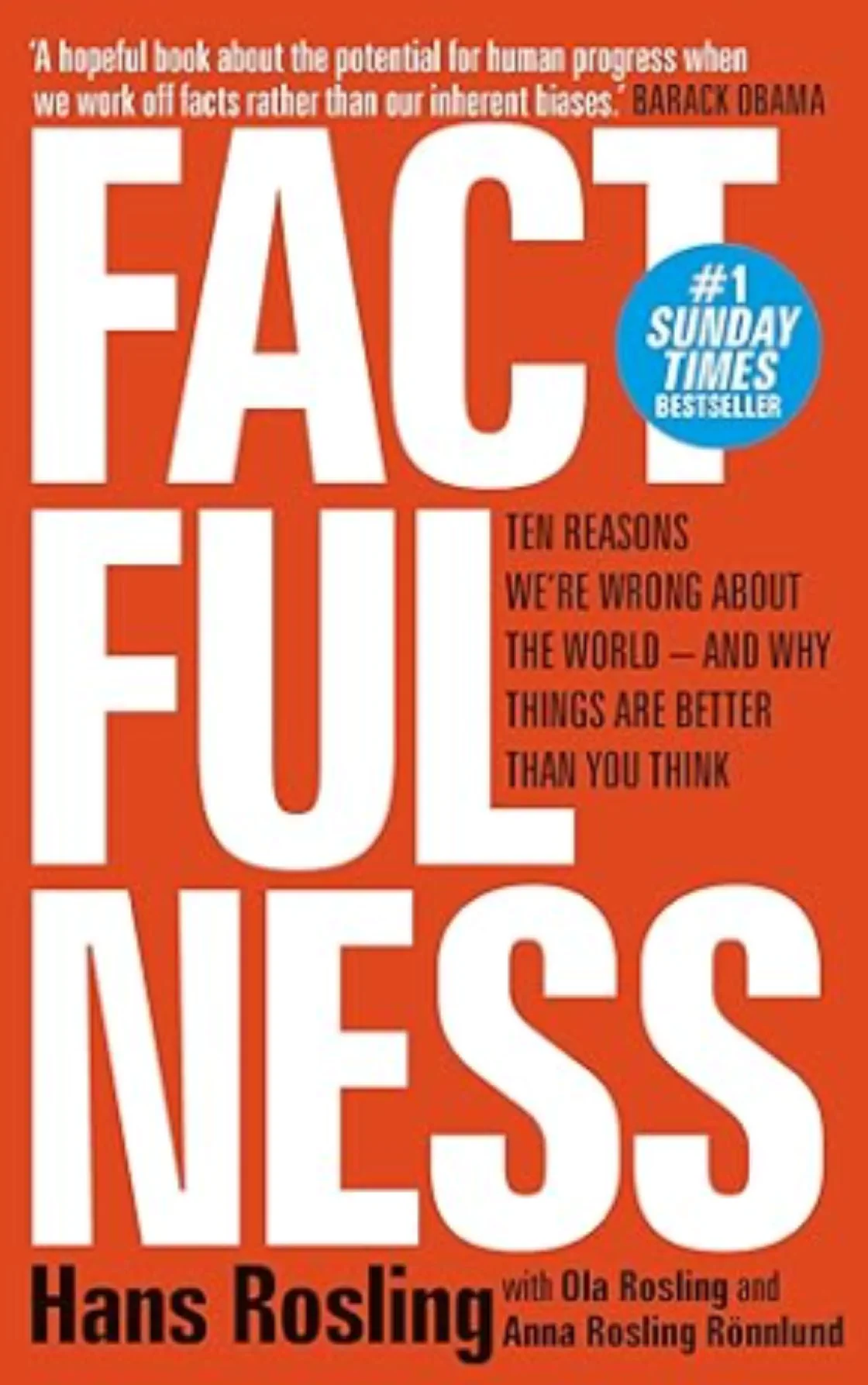
That was the whole story. No explanation, no moral drawn out at the end. Just the request and the answer.
It stayed with me longer than stories that tried harder. I think because the ring does not fix anything. The king’s victories are still victories. His losses are still losses. What changes is the distance from which he sees them. In joy, he reads the inscription and remembers that joy ends. In grief, he reads it again and remembers that grief does too. The ring pulls him out of the moment just far enough to see it as one point on a longer line.
I thought about that ring while reading Hans Rosling’s Factfulness. The book is not about equanimity. Rosling is too interested in the data for that. But he keeps asking the same question the ring asks: How much of what you believe depends on where you are standing when you look?
Hans Rosling wrote it as he was dying, and the book carries the weight of that. There is no posturing in it. Just a doctor and statistician trying to leave behind a way of seeing the world that he thought mattered more than the specific conclusions he had reached.
What I found inside wasn’t a book about global development or economic statistics. It was a book about how my own attention manufactures distortion, and how that distortion shows up in places I had never thought to look. Including the places where I am paid to see clearly.
What Did I Get Out of It
Frightening Is Not the Same as Dangerous
Rosling makes a distinction I had been collapsing for years:
“frightening” and “dangerous” are two different things. Something frightening poses a perceived risk. Something dangerous poses a real risk.
I had been treating these as synonyms. When something landed in my inbox marked URGENT, I assumed it was also material. When a news headline made me anxious, I assumed the underlying probability of harm had moved. The two have almost nothing to do with each other. A thing can be frightening and trivial. The dangerous ones are usually silent for years before anyone gets around to calling them frightening.
The fear instinct is a terrible guide for understanding the world. It makes us give our attention to the unlikely dangers that we are most afraid of, and neglect what is actually most risky.
The control issues that have hurt the businesses I’ve seen were not the ones flagged in red on the heat map. They were the ones nobody bothered to flag because nobody was scared of them. Slow leakage. The opposite of dramatic. The same instinct Rosling describes in news consumption shows up in risk registers, where the frightening items get attention and the dangerous ones get tolerated. The phrase that has stayed with me from his framing is perceived risk. Most of what I budget time and worry against is perception. The actual exposure sits somewhere else, usually in a process I stopped looking at because it had been quiet for too long.
The Gap That Was Never There
Human beings have a strong dramatic instinct toward binary thinking, a basic urge to divide things into two distinct groups, with nothing but an empty gap in between. Good versus bad. Heroes versus villains. My country versus the rest. Dividing the world into two distinct sides is simple and intuitive, and also dramatic because it implies conflict.
The binary frame is everywhere once you look for it. Compliant or non-compliant. Material or immaterial. The categories are useful as shorthand and dishonest as descriptions. Most of what I deal with at work sits in the middle band, where the answer depends on what you’re comparing it to and how you’re measuring. The gap between the buckets exists in the spreadsheet, not in the underlying reality.
There is no gap between the West and the rest, between developed and developing, between rich and poor. We should all stop using the simple pairs of categories that suggest there is.
The same instinct runs through how we talk about companies, sectors, even people. Binary framing makes it easier to take a side, and taking a side feels like clarity. Rosling’s quiet insistence is that the clarity is manufactured, and the cost of the manufacture is that you stop being able to see what is actually there. He has data on his side. Most of the world’s population now sits in the middle of the income distribution, not at either end. The picture I had carried around in my head was decades out of date.
The Lonely Number
The section that hit closest to my professional reflexes:
To avoid misjudging something’s importance, avoid lonely numbers. Never, ever leave a number all by itself. Never believe that one number on its own can be meaningful. If you are offered one number, always ask for at least one more. Something to compare it with.
Half of what I do in any given week is push back against lonely numbers. A variance presented without the prior period. A loss figure without the exposure base. A control exception count without the population it was drawn from. The number feels meaningful because it has decimals and a currency sign attached to it, but it is decoration without context. Rosling is making the same point a good auditor learns to make in their first year, except he is making it about the news, about charity, about politics. The discipline that I had treated as professional turns out to be general. He is asking the public to read a balance sheet the way I would expect a junior to read a P&L.
Items on a list: just a few of them are more important than all the others put together.
The eighty-twenty observation is old, but Rosling pairs it with the lonely-number instinct in a way that landed for me. Most lists are not flat. The thing you should be working on is rarely the thing in the middle of the list. Selective attention only works if you have the honesty to weight the items rather than tick through them. The temptation in any review process is to give every line equal scrutiny because that feels rigorous. It isn’t rigor. It’s evasion of the harder question, which is which two or three items will determine the outcome and where the rest belong on a much shorter list.
When Urgency Becomes the Argument
Urgency instinct: The call to action makes you think less critically, decide more quickly, and act now. Relax. It’s almost never true. It’s almost never that urgent, and it’s almost never an either/or. The constant alarms make us numb to real urgency.
The deadline manufactures the case, and the case is then justified by the deadline. By the time anyone questions the substance, the deadline has passed and the question feels academic. The danger is not just that urgency makes you decide quickly. It is that constant urgency makes you numb to the moments that are actually urgent, which is the harder failure mode to recover from. The boy who cried wolf is also the boy who cannot tell when there is a wolf.
Every activist exaggerates the problem to which they have dedicated themselves. It hurts our ability to develop a true, fact-based understanding.
Anyone who has built a career around a topic has an incentive to inflate its importance. This is true of compliance, of controls, or any specialist function. Borrowed conviction cuts in this direction too. The person warning you most loudly is often the person whose career depends on you being warned. Rosling makes the point without cynicism, which is the part I struggle with. He is asking us to discount the warnings without dismissing the warners. The skill is in how you weight, not in whether you listen.
The System, Not the Individual
Look beyond a guilty individual and to the system.
Every issue I have investigated has had a name attached to it. Someone clicked the wrong button. Someone approved the wrong invoice. The named individual is always the easiest explanation, and almost always the wrong one. Behind the name there is a system that made the failure likely, a process that did not catch it, an incentive that rewarded the shortcut. Punishing the individual closes the case without fixing anything. It also guarantees the next person in the seat will repeat the failure for the same reasons.
Preference for single causes and single solutions: Being always in favor of or always against any particular idea makes you blind to information that doesn’t fit your perspective. Instead, constantly test your favorite ideas for weaknesses.
Rosling’s instinct here lines up with what systems thinking has been saying for decades. Single causes are comforting and almost always insufficient. Most of what goes wrong in organizations has at least three contributors, and the fix that works tends to address all three at once rather than the most visible one.
Who Is This For
This book is not really for the person who already reads global development statistics for a living. They will know most of the numbers. It is for everyone else, which is most of us.
If you find yourself reacting to headlines and want to know why your reaction so often outruns the underlying facts, this is the book. If you have noticed that your worldview hardened around the time you finished school and has not been updated since, this is the book. If you work somewhere that confuses urgency with importance, or a single number with a real picture of anything, this is the book.
I had previously mistaken a low-grade, constant cynicism for realism. The book did not argue against the cynicism; it just presented the baseline data. The world is measurably better than a generation ago, and still worse than it should be. Holding both realities at once requires cognitive effort. Picking one is easier, but it distorts the baseline.
The book sits next to A Short History of Financial Euphoria on my shelf for a reason. Galbraith wrote about how markets forget. Rosling writes about how individuals forget. The underlying mechanism is the same: we carry narratives that satisfy our dramatic instincts and mistake them for facts. The correction is entirely unglamorous. Look at the numbers. Demand the denominator. Notice when the urgency in the room is doing the work of an actual argument. The ring’s inscription does not predict the outcome. It just alters the distance from which you observe the circumstances.