 Mandelbrot
 The Accountant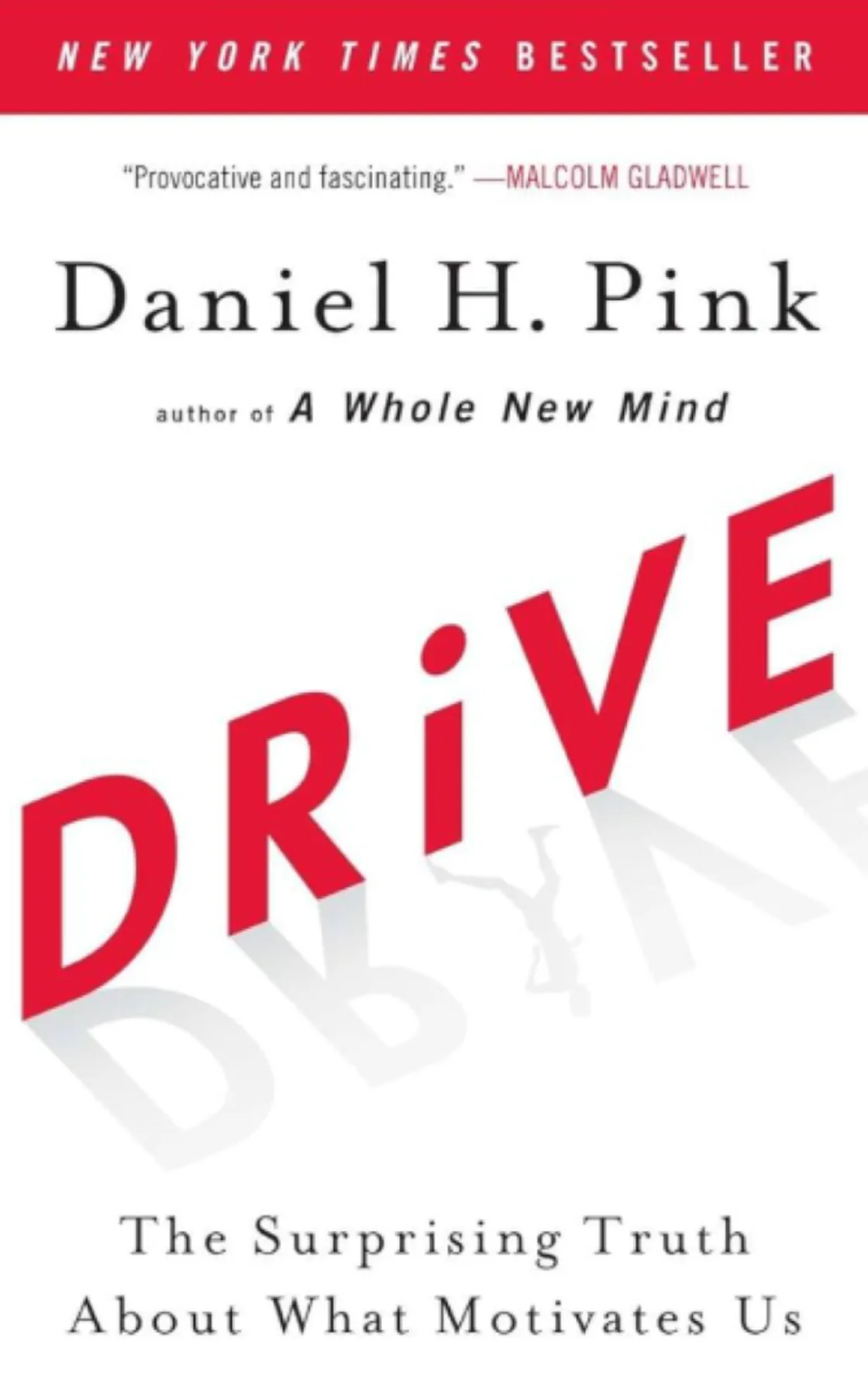
There are wealthy gentlemen in England who drive four-horse passenger-coaches twenty or thirty miles on a daily line, in the summer, because the privilege costs them considerable money; but if they were offered wages for the service, that would turn it into work and then they would resign.
Same road. Same horses. Same hours on the box. The only variable is whether the man holding the reins chose to be there or was obliged to be there.
A key motivational principle: “Work consists of whatever a body is OBLIGED to do. Play consists of whatever a body is not obliged to do.”
Daniel Pink builds Drive on the argument that the reward-and-punish operating system, which he also refers to as Motivation 2.0, was engineered for routine work and keeps getting applied to work that isn’t routine. His hypothesis is a synthesis of research carried out by Edward Deci and Richard Ryan, to Teresa Amabile, to Mihaly Csikszentmihalyi, to Carol Dweck. Pink’s synthesis thins out into a toolkit of tips.
For too long, there’s been a mismatch between what science knows and what business does.
The gap he describes is not one of ignorance. Every manager who has seen a sales target distort a quarter already knows something is wrong with the structure. The gap is that the working is cheap, legible, and defensible in a meeting. Intrinsic motivation is none of those things. You cannot put it in a policy document, and you cannot audit it.
What Did I Get Out of It
The Contingency Is the Poison
It isn’t about reward versus no reward. Money matters. The difference is contingency.
Only contingent rewards - if you do this, then you’ll get that - had the negative effect. Why? “If-then” rewards require people to forfeit some of their autonomy.
The forfeit happens at the moment the target is published, not at the moment it is paid. Once a number is announced in January, the year reorganizes itself around that number. Work that doesn’t move it is deprioritized, and work that moves it becomes urgent regardless of whether it creates anything. The employee has not been bribed. He has been told, precisely and in writing, which subset of his judgement the organization intends to buy.
Rewards, by their very nature, narrow our focus. That’s helpful when there’s a clear path to a solution. They help us stare ahead and race faster.
Narrowing is a feature when the path is known. Pink separates algorithmic tasks, where you follow established instructions to a single conclusion, from heuristic tasks, where no algorithm exists and you have to experiment your way to something new. Piece rates work on the first. They corrode the second. Most of the work that gets rewarded with a bonus today sits in the second category and gets measured as though it were the first, which is how you end up chasing the metric and missing the mark.
What a Reward Tells You About the Task
The most useful line in the book is eleven words long and mostly gets skipped.
By offering a reward, a principal signals to the agent that the task is undesirable.
The incentive carries information, and the information travels faster than the money. Attach a prize to the completion of mandatory compliance training and every person in the building learns that the training is a chore somebody had to bribe them through. Nobody says this out loud. Everybody updates on it. The principal-agent relationship is being described to the agent in a language he understands better than the policy memo.
Imagine an organization, for example, that believes in affirmative action; one that wants to make the world a better place by creating a more diverse workforce. By reducing ethics to a checklist, suddenly affirmative action is just a bunch of requirements that the organization must meet to show that it isn’t discriminating. Now the organization isn’t focused on affirmatively pursuing diversity but rather on making sure that all the boxes are checked off to show that what it did is OK (and so it won’t get sued). Before, its workers had an intrinsic motivation to do the right thing, but now they have an extrinsic motivation to make sure that the company doesn’t get sued or fined.
That passage is uncomfortable in a way Pink probably didn’t intend, because a checklist is not a mistake. It is how assurance works. You cannot testify to a control that produces no evidence, and a documented, repeatable, box-ticked procedure is the only kind of control that survives contact with a regulator. The trap is what happens to everything the checklist does not cover. The moment a control becomes the definition of doing the right thing rather than a proxy for it, the surrounding judgement stops being exercised, because judgement earns nothing and creates exposure. A reviewer who spots something odd outside the scope of his test has been given every reason to leave it alone. The control framework didn’t remove his instinct. It restructured the incentive around it until the instinct became a liability.
Get Compensation Right, Then Get It Out of Sight
Pink is not arguing that money is irrelevant, and the book is repeatedly misread on this point.
Get compensation right - and then get it out of sight. Effective organizations compensate people in amounts and in ways that allow individuals to mostly forget about compensation and instead focus on the work itself.
Below the baseline, none of the rest applies. If pay is inadequate or visibly unfair, attention goes to the unfairness and stays there. Pink splits fairness into internal, meaning what your colleagues make, and external, meaning what someone doing your job at a comparable firm makes. Both have to hold. One of the quieter failures I’ve watched is an organization that solves for external fairness in a recruitment market, brings someone in above the band, and then spends two years paying for the internal breach in ways that never appear in any compensation report.
Paying great people a little more than the market demands, Akerlof and Yellen found, could attract better talent, reduce turnover, and boost productivity and morale.
The efficiency wage argument runs into an accounting problem rather than an economic one. Wages sit in one line and get scrutinized there. The cost of turnover disperses itself across recruitment fees, training time, the error rate of people in their first six months, the institutional memory that walks out of the building unrecorded. No statement attributes that cost back to the wage decision that produced it, so the saving looks real and the cost never quite lands on anyone. Sol Price built an entire retail model on the opposite assumption and the P&L took decades to vindicate him.
Autonomy Is Not Independence
The Godin passage in the book undercuts the caricature of autonomy that most readers arrive with.
“As an entrepreneur, I’m blessed with 100% autonomy over task, time, technique and team. Here’s the thing: If I maintain that autonomy, I fail. I fail to ship. I fail to excel. I fail to focus. I inevitably end up either with no product or a product the market rejects. The art of the art is picking your limits. That’s the autonomy I most cherish. The freedom to pick my boundaries.” - SETH GODIN
Total freedom is not the goal and does not produce anything. Constraint is the goal. The variable is who selected it. Godin’s whole case for indispensability runs on the same principle, and Pink’s four dimensions of autonomy, task, time, technique and team, are a way of asking which of your boundaries you chose and which were handed to you.
Autonomy, as they see it, is different from independence. It’s not the rugged, go-it-alone, rely-on-nobody individualism of the American cowboy. It means acting with choice - which means we can be both autonomous and happily interdependent with others.
Where Pink goes quiet is the collision between autonomy and obligation. A results-only work environment is a plausible design for a sales team. It is not a design for an approval matrix. Segregation of duties is not a preference you can vote yourself out of, and no amount of intrinsic motivation substitutes for a second pair of eyes on a payment run. The honest answer is narrower than the book’s: autonomy over technique, sequencing and team is available almost everywhere, and autonomy over the obligation itself almost never is. Chouinard’s version at Patagonia works because the surfing is scheduled around the work, not instead of it.
Mastery Is an Asymptote
Three words:
Mastery is an asymptote.
You approach and never arrive, which is the reason the pursuit sustains itself and the reason it defeats anyone who needs to arrive. Dweck’s distinction underlies this. If you hold intelligence as a fixed quantity, every assignment becomes a measurement of how much you have, and the rational response is to accept only work you already clear comfortably. Pink calls the entity theory a system requiring a diet of easy successes. We’ve all seen careers built on that diet. They look flawless for about eight years and then stall, because the person has spent a decade confirming a level rather than raising one. It is an easy trap to fall into.
Those who did the best typically spent the most time and effort on the mundane activities.
The finding is unglamorous and matches everything I’ve seen about who actually gets good at technical work. The people who develop real command of a set of accounts are the ones who did the reconciliations themselves for years, not the ones who moved to review as fast as the org chart allowed. Waitzkin makes the same argument from chess and push hands: depth comes from staying with the small components long past the point where they are interesting. Effort is not the price of mastery. Effort is the evidence that something mattered enough to pay for.
Purpose, and the Sentence You Leave Behind
Pink’s third nutrient is the weakest chapter and the strongest idea.
A healthy society - and healthy business organizations - begins with purpose and considers profit a way to move toward that end or a happy by-product of its attainment.
Stated flatly, it reads like a mission statement written by a committee. There is a strong message in the scaffolding though: profit as catalyst rather than objective changes the ordering of decisions under pressure, and the ordering under pressure is the only test that means anything. Yunus’s social businesses and the low-profit limited liability structures Pink catalogues are attempts to hardcode the ordering into the entity itself rather than trusting it to management character. Mackey spent a career arguing the same case from inside a public company and spent most of it defending the ordering to shareholders.
A great man is one sentence.
Clare Boothe Luce’s challenge to Kennedy, and the one prompt in the book that is worth doing properly. Most people, asked what their sentence is, produce a paragraph, and the paragraph is the answer. Pink pairs it with a smaller practice: give yourself your own performance review, monthly, with learning goals stated first and a written answer to where you fell short. I already keep something close to that. Reading his version made me notice how much of mine is a record of outcomes and how little of it is a record of whether I got better, which is a different question entirely.
Who Is This For
Anyone who sets targets for other people. Not executives in the abstract sense, but the person who writes the actual KPI wording, decides the bonus gate, or signs the appraisal form. That person controls more behavior than the strategy deck does, and Drive will make him suspicious of the instrument in his hand.
Not for anyone who wants the underlying research. Pink is a popularizer and doesn’t pretend otherwise. Go to Deci and Ryan for self-determination theory, to Csikszentmihalyi for flow, to Dweck for mindset. The final third of the book, the toolkit of exercises and reading lists, can be skimmed without loss.
Parents will find more here than the title suggests, though Pink barely addresses it. The if-then structure is the default parenting grammar. Finish this, get that. What the research says about its effect on a child’s appetite for the underlying activity is not comfortable reading.
What it changed in my own thinking is narrower than the book’s ambition. I have designed frameworks on the premise that if I can measure something I can govern it, and that premise is not wrong so much as incomplete. Every measurement I introduce tells the person being measured which part of their judgement I have decided to purchase, and they will read that signal correctly even when I have not thought about what I was sending. The part I have not solved is the obvious one. Intrinsic motivation leaves no audit trail. It produces no evidence, cannot be tested for operating effectiveness, and would not survive a single review by anyone outside the room. I am reasonably sure it’s the thing holding most functions together. I just can’t sign off on it.