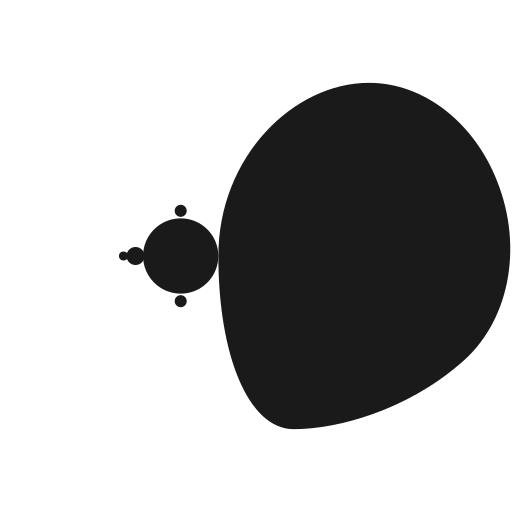
 Mandelbrot
 The Accountant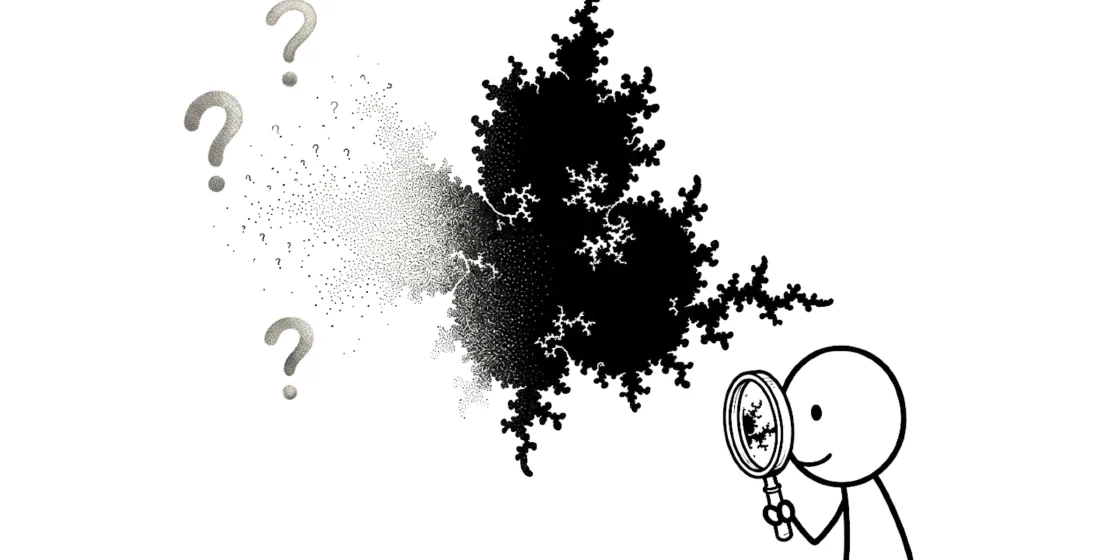
The British scientist Lewis Fry Richardson found this while chasing a different question. He wanted to know whether the length of a shared border predicted how often two nations went to war, so he collected the reported lengths. The numbers refused to agree. A single variable explained the gap: the ruler.
Measure a coastline with a long ruler and you cut straight across the bays. Switch to a shorter one and you follow each bay, then notice smaller inlets folded inside them. Go smaller again and you’re tracing the edge of individual rocks, then the grains of sand between the rocks. The measured length never settles. It grows the closer you look, and it never stops growing.
The mathematician Benoit Mandelbrot took that refusal to settle and built a geometry around it. A fractal is a shape that holds its structure at every level of magnification. Zoom in and the pattern comes back, smaller, carrying its own smaller copy of itself, without a floor.
Infinite Rabbit Holes
Pick something dull. The dullest subject you can name. Grout. The regulations governing the font on a tax return. Start reading and within an hour you are standing inside a discipline nobody warned you about. It has a history. Factions have spent careers fighting over one detail you didn’t know was contested. Every rabbit hole opens onto more rabbit holes, and each of them has its own rabbit drama.
Nothing is simple up close. Things only look simple from a distance, the way a coastline looks like a smooth line on a wall map. Zoom in on any topic and the smoothness dissolves into structure, and the structure dissolves into finer structure. The dullness was a function of resolution, not content.
I find that a strange comfort. There’s no such thing as an exhausted subject, only one I stopped zooming into.
The Same Nugget in a Different Field
Chris Begg describes what he went hunting for once formal schooling stopped delivering:
I believe that the world is very fractal, right? When you find a nugget of a principle, it could be applied across all different disciplines and realms.
That’s a second face of the same geometry. The first face is depth, the infinite descent I described a moment ago. Its twin is self-similarity: the pattern you find at one scale, in one field, turns up again at another scale, in a field that looks unrelated. A rule about how systems fail under load reads the same whether the system is a bridge or a balance sheet.
Begg also wrote that too much of his early education was “spent finding the fastest way to the finish line,” and that the answers he found “lacked a true understanding of the principles, the process and the illustrations of the practical experience that led to them.” The fast route to the finish line is the long ruler. You get an answer that closes the gap on the page and skips every bay.
Duality is the whole game and the whole trap. Charlie Munger’s latticework of mental models is a bet on self-similarity, on the idea that a principle mined from biology will pay off in a capital-allocation decision. But the same fractal that lets a principle travel also punishes you when you force a match that isn’t there (something I am trying to do in this essay perhaps). The pattern rhymes across domains until it doesn’t, and telling the real rhyme from the convenient one is not a skill I’ve finished learning.
Static Shapes, Living Knowledge
Here’s where the metaphor cracks. The Mandelbrot set sits still. Knowledge does not.
Some regions of the fractal barely move across centuries. Classical Latin grammar is close to frozen. Other regions rewrite themselves in a season, the way a genre of music mutates faster than anyone can document it. A static shape can’t hold both.
Nassim Taleb, in Antifragile, points at the fix without naming it:
things that grow in a natural way, whether cities or individual houses, have a fractal quality to them. Like everything alive, all organisms, like lungs, or trees, grow in some form of self-guided but tame randomness.
The tell is “tame randomness.” A fractal that grows keeps its rule and still surprises you at the edges. So the correction is to stop picturing a printed Mandelbrot set and start picturing something organic, a fractal that morphs while you’re looking at it, sprouting new detail in the fast regions while the old regions hold.
The crack shows up when you value a company. A firm’s competitive position isn’t a static shape you diagnose once. It grows, tamely and randomly, in Taleb’s sense. The moat you mapped in detail three years ago has been branching the whole time, and some of the branches are rot.
The Map Has Fuzzy Regions
If the full fractal is everything true about a subject, then what I hold is a map of it, and the map has uneven resolution. Some regions are sharp, rendered in detail I’ve earned through work. Others are a smear I’ve never focused. Most of the map is smear.
Circle of competence is just a claim about which regions of my map are in focus. The honest version isn’t a list of industries I understand. It’s a confession about resolution.
Company analysis makes the point for me. You read the annual report and feel you understand the business. Then you zoom into segment reporting, and one line resolves into a whole operating unit with its own economics. Zoom into that and you hit a revenue-recognition policy that changes the shape of everything above it. A related-party footnote opens a chamber you didn’t know was there. Diligence never bottoms out, because the fractal has no bottom.
My controls work runs on the same discovery. Map a process and you keep uncovering sub-processes underneath the boxes. The org chart is a low-resolution render of what the organisation does, and the failures that matter always live in the detail the chart smoothed over.
The capital allocator’s problem is that the fractal is infinite and the capital is not. You cannot zoom forever. At some point you commit, knowing large stretches of the map are still fuzzy. The skill was never reaching the bottom. There is no bottom. The skill is judging which patch of fuzz would ruin you if it sharpened into something ugly, and spending your remaining attention there.
Questions I am pondering
The part I can’t resolve is how to read my own resolution from the inside. A region I understand and a region I only think I understand look identical on the map until something tests them. Confident wrong beliefs are rendered in the same crisp lines as knowledge. I can’t tell, standing over my own map, which sharp-looking areas are sharp and which are a convincing blur I’ve mistaken for detail.
And the two problems interact in a way I haven’t untangled. The fractal is infinitely deep, and it’s also moving. So the fuzzy patch I’ve decided to leave alone might be sitting still, safely ignorable, or it might be one of the fast regions, branching into something new while I look away. I don’t yet know how to tell a dormant blur from an active one before it starts to matter.
So I’m allocating attention across a living surface, choosing which blurs to leave alone, working from judgment I can’t fully audit from the inside. Somewhere there ought to be a rule for when to stop zooming. I keep looking for it. Nothing I’ve found holds, and I’m no longer sure the fractal allows one.