 Mandelbrot
 The Accountant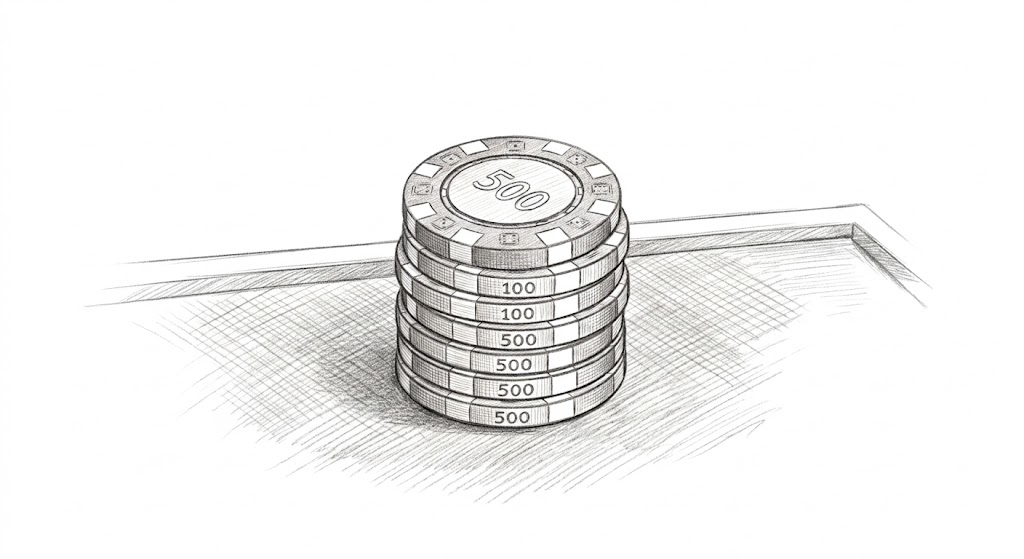
That scene sits at the root of the whole idea. Sharon Bertsch McGrayne, in her history of it, The Theory That Would Not Die, reduces the machinery to something you could teach a child:
Conceptually, Bayes’ system was simple. We modify our opinions with objective information: Initial Beliefs (our guess where the cue ball landed) + Recent Objective Data (whether the most recent ball landed to the left or right of our original guess) = A New and Improved Belief.
Two hundred and sixty years after a Presbyterian minister worked it out, we are still fighting about it. The theorem was ignored for a generation, revived to break Enigma, pressed into the hunt for lost submarines, and denounced by working statisticians who thought it was cheating. The theorem survived because it describes something the rest of statistics prefers to hide: a starting opinion. Everyone brings one. The honest thing is to write it down and then let the world push it around.
The mechanism carries a name. Bayes’ theorem, or in daily use, Bayesian updating. Begin with what you already believe. Move it when evidence lands, and keep moving it. The arithmetic can turn ugly, but the premise is almost insultingly plain, and for years I mistook the plainness for shallowness.
The Size of the Bet
McGrayne states the leap in the language of the casino:
knowledge is indeed highly subjective, but we can quantify it with a bet. The amount we wager shows how much we believe in something.
A thesis or a story about a company tells you why capital should be deployed. The position size tells you what you actually believe. It is easy to get caught up in the narrative; the macro trend, the product, or the promise of compounding growth. But if you still cap the allocation at half a percent, the narrative was theatre. The bet is the confession. Everything stacked above it is commentary I wrote to feel rigorous.
Once you accept that, the prior stops being an abstraction and acquires a price. When I decide to invest in a stock, the first number I owe myself is not the target return, it is how much of the book I would actually put behind the view today, before I have talked myself into anything. That figure is my starting guess about where the ball landed. The figure is usually smaller than my narrative implies, and the gap between the two is where most of my mistakes live.
Signals That Arrive Damaged
McGrayne is careful about what the incoming evidence looks like before we get to touch it:
our sensory and motor systems often produce signals that are incomplete, ambiguous, variable, or corrupted by random fluctuations.
A company reports an unexpected inventory build in the third quarter. Read on its own, the line item says almost nothing. Is management prepping for a massive product launch, taking advantage of cheap raw materials, or is the core business stalling while the factories keep running? A single data point cannot tell you, and the temptation is to force it to.
Bayes gives the discipline a shape. One inventory spike is noise. Three consecutive quarters of it, paired with a stretch in days sales outstanding, is a structural cash flow drain nobody wants to announce. The billiard player does not throw out his estimate because one ball landed left; he nudges. The analyst who dumps the stock over a single working capital blip has misread the strength of the signal, and the one who ignores a year of deteriorating cash conversion has stopped updating at all. Neither is doing the arithmetic. Both are protecting a prior they refuse to price.
Whom You Elect to Spend Your Time With
Ethan Hawke, in Rules for a Knight, puts a moral frame on the same mechanics:
THE quality of your life will, to a large extent, be decided by with whom you elect to spend your time.
The popular version of Bayes gets taught through people. A friend repeats something you told him in confidence. How much would you wager he does it again? Walk into the mental casino, find the roulette wheel, and put your chips down. If you would bet the house on a repeat, you have your answer without a single round of asking why he did it. And the why is a trap. It pulls you into scenarios you invent and then frighten yourself with, and it changes nothing about the odds of recurrence.
Capital works the same way, because you also elect whom to spend your money alongside. A management team is a group of people you are choosing to stand next to for years. Every disclosure reprices the bet. The related-party loan buried in a footnote. The buyback timed a shade too close to option vesting. Each is a “left” or a “right.” The discipline the theorem imposes is that it never lets you close the file. You are not allowed a final verdict on a person or a company. What you get is a running bet that every new action is entitled to move.
The same discipline keeps me from freezing a manager as a villain after one bad quarter. Maybe the write-down was honest. The guidance cut might have been courage rather than weakness. Each reading is a bet I am allowed to revise, not a sentence I hand down and lock away.
What I Haven’t Figured Out
The billiard player was told the truth. Each “left” and “right” arrived clean, from an assistant with no stake in his guess. Real evidence does not behave. A company’s disclosures are shaped by people who know I am sitting with my back to the table trying to locate the ball, and who would very much like to choose the word I hear next. The signal is not merely noisy. Someone authored it. Bayesian updating assumes the data is indifferent to your belief, and almost nothing I actually work with is indifferent to my belief.
There is a second thing I cannot resolve. The theorem needs a prior, and it stays silent on where the good one comes from. A bad starting guess can survive a surprising amount of updating, because I read each ambiguous new fact through the very belief I am supposed to be testing. Confirmation bias wearing Bayesian dress looks almost identical to disciplined updating from the inside.
And I have no rule for the right speed. Update too fast and I chase every ball that rolls left. Too slow, and I become the analyst who has watched a year of cash drain and still trusts the narrative. Somewhere between those failures is a learning rate that fits the situation, and I keep setting it by feel. McGrayne’s minister gave us the equation. He did not tell us how much to trust the man rolling the balls.