 Mandelbrot
 The Accountant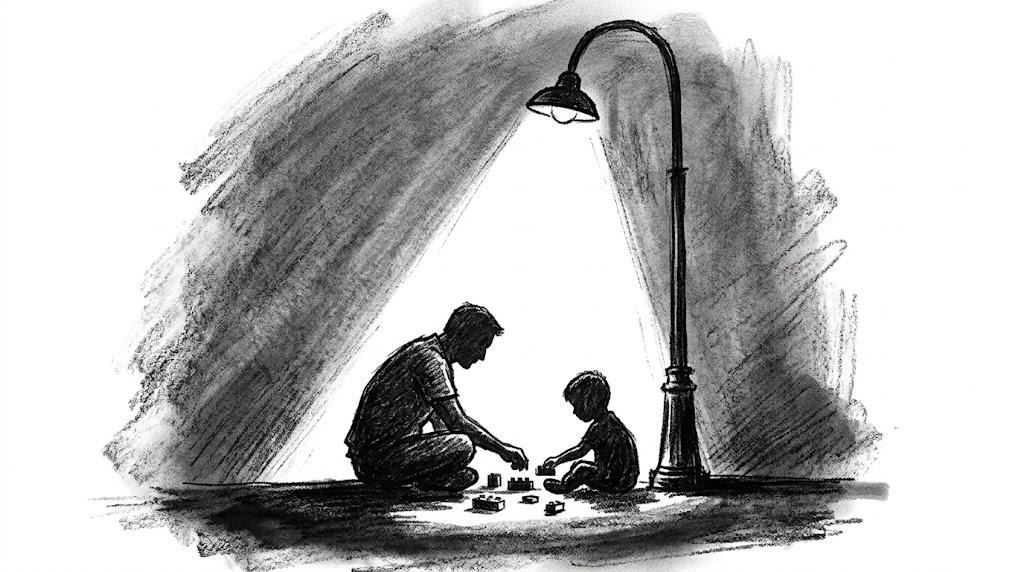
“What did you lose?” the man asks.
“My keys.”
The man drops down to help him look. After ten minutes of scouring the illuminated circle, he asks, “Are you sure you dropped them here?”
“No,” the neighbor says, pointing toward a dark alley. “I dropped them over there.”
“Then why are we looking here?”
“Because the light is better.”
We laugh at the absurdity of the joke. But we manage our lives the exact same way.
Hamza is nine. He still rides his bike with training wheels. It is well past time to take them off, but I keep putting it off. The thought of teaching him to balance is daunting. It requires navigating his fear of falling, the inevitable scraped knees, and the tears that I will have to endure. There is no manual for it. It is pure friction.
So, instead of taking a wrench to the training wheels, I pull a new box of Lego out of the closet. We sit on the floor, carefully following the instructions, snapping plastic bricks together. It feels productive. We are spending time together. But the truth is, I am choosing the Lego because it is easy.
I guess its natural that we gravitate toward problems we understand and avoid problems that expose our inadequacies.
In the 1950s, the British historian Cyril Parkinson gave this behavior a name. He called it the Law of Triviality. He observed that the time we spend on an issue is inversely correlated to its actual consequence.
Parkinson illustrated this with a story about a corporate committee. Their agenda had three items: a £10 million nuclear power plant, a £350 staff bike shed, and a £21 coffee budget.
The nuclear plant passes without debate. The engineering is catastrophic if wrong, but the math is too complex to critique on the fly. No one wants to ask a naive question and expose their ignorance. The incentive in the room is quiet compliance.
Then comes the bike shed. Here, the risk of speaking up drops to zero. Everyone knows what a shed looks like. Everyone has an opinion on aluminum versus wood. The members demonstrate their value to the group by arguing over roofing materials.
Finally, the coffee budget. Everyone is an expert on coffee. They know its cost and its value. The committee spends more time on the £21 budget than on the £10 million reactor.
We call this bikeshedding.
It happens because we misunderstand how our brains allocate energy. We assume we allocate our focus based on importance. In reality, we allocate it based on cognitive friction.
When a problem is outside our comfort zone—when it lies in the pitch-black alleyway—it requires heavy lifting. It exposes what we don’t know or what we fear. But when a topic is universally understood, the barrier to entry vanishes.
Building a Lego set has numbered bags and a step-by-step booklet. Debating a coffee budget requires only a basic understanding of money. Completing a simple task feels like doing work. It feels like progress.
We subconsciously substitute a hard problem we can’t easily solve for an easy problem we can. The danger of bikeshedding is that it masks itself as diligence. It feels highly productive to optimize the trivial.
Fixing this requires recognizing that time and emotional energy are finite forms of capital. You cannot trust your intuition to tell you where to spend them. Your intuition just wants to feel competent while avoiding hard work.
We gravitate to the trivial because it feels safe. We can measure the cost of coffee. We can follow the instructions in a box. The light is simply better there. The real challenges; the complex risks, the difficult conversations, the scraped knees, remain hidden in the dark. If we are not careful, we spend our lives managing the pennies and snapping together plastic bricks, satisfied with our effort, while the hard things are left undone.