 Mandelbrot
 The Accountant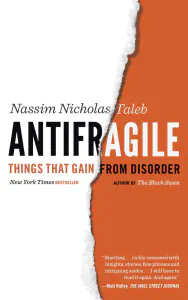
Imagine facing a monster with multiple heads. You swing your sword, slice off one head, and feel accomplished. But then, two new heads grow back in its place. That’s the Hydra from Greek mythology. It doesn’t just survive attacks - it gets stronger from them.
Nassim Taleb would call the Hydra “antifragile.” In his book “Antifragile: Things That Gain from Disorder,” Taleb introduces this concept. It’s a new way to think about how things react to chaos, stress, and uncertainty.
To understand antifragility, let’s consider two other mythical examples. First, there’s Damocles, who sat on the king’s throne with a sword dangling over his head by a single hair. That’s fragile. One bit of bad luck, and it’s over.
Then there’s the phoenix, a magical bird that burns up and rises from its own ashes. That’s resilient. It can take a hit and return to its original state.
But antifragile? That’s the Hydra. It doesn’t just bounce back - it improves with every challenge.
This idea isn’t just mythology. It’s all around us. Evolution is antifragile - species adapt and improve in response to environmental pressures. Our immune system strengthens with moderate exposure to germs.
The concept applies to people too. It reminds me of G. Michael Hopf’s words:
Hard times create strong men. Strong men create good times. Good times create weak men. And, weak men create hard times.
- G. Michael Hopf
I’ve lived this cycle. Growing up, I had a sheltered life. My parents provided comfort and security. Problems seemed distant. Life was good - perhaps too good.
Then, in my late teens, everything shifted. My dad made financial mistakes, and our family faced hard times. The security I’d known vanished almost overnight. It felt devastating.
Looking back, I see how those challenges shaped me. They pushed me to develop skills I never knew I needed. I learned resilience and how to handle pressure. Without those hard times, I might have struggled with even minor setbacks in the real world.
That’s antifragility. It’s not just about surviving stress. It’s about using challenges to grow and improve. This principle appears in many areas, from personal development to economic systems and technological innovation.
In exploring Taleb’s antifragile world, we’ll uncover lessons about disorder and uncertainty. We’ll see how these ideas apply to our lives and the systems we’re part of.
What Did I Get Out of It?
Taleb’s ideas are like a software upgrade for your brain. They push you to think at a higher level. But let’s be honest - his writing isn’t easy to digest.
It took me two months to finish Antifragile. Usually, I can knock out a 300-page book in couple of weeks. This one’s over 400 pages, and the writing is tough to follow. Maybe I’m just part of the majority that Taleb seems to think is stupid. Who knows?
Here’s the thing about Taleb’s writing: it’s hard to review. I find his style to be all over the place - disorganized, in-your-face, and breaking all the rules. It keeps you on your toes, but it can also drive you nuts. It’s like listening to classical music. A little bit is interesting, but a whole album? That’s a challenge.
Taleb’s ideas seem simple at first glance. But try to explain them precisely, and you’ll find yourself scratching your head, well at least that was the case with me.
Despite the difficult read, I’ve pulled out some valuable lessons. Let’s break them down:
Embrace Uncertainty and Randomness Antifragility
We’re often taught that the key to success is careful planning and avoiding risks. But what if the opposite were true? What if the path to real growth and resilience lies in embracing uncertainty?
Nassim Taleb challenges our conventional wisdom with his concept of antifragility. He argues that some things actually benefit from shocks and thrive on volatility. As he puts it:
…randomness, uncertainty, chaos: you want to use them, not hide from them. You want to be the fire and wish for the wind.
This isn’t just about being resilient or robust. It’s about getting stronger because of unpredictability. Taleb explains:
Antifragility is beyond resilience or robustness. The resilient resists shocks and stays the same; the antifragile gets better.
Think about your own life. How often have unexpected events led to growth? Maybe a job loss pushed you to start that business you’ve always dreamed of. Or perhaps a chance encounter opened up a whole new career path.
These aren’t just lucky breaks. They’re examples of antifragility in action. By exposing ourselves to randomness, we create opportunities for exponential growth.
But embracing uncertainty isn’t easy. It goes against our instinct for comfort and predictability. It requires a mindset shift. As Taleb notes:
The antifragile loves randomness and uncertainty, which also means—crucially—a love of errors, a certain class of errors. Antifragility has a singular property of allowing us to deal with the unknown, to do things without understanding them—and do them well.
This doesn’t mean being reckless. It’s about creating systems in your life that can benefit from volatility. In your career, it might mean taking on projects outside your comfort zone. In your fitness routine, it could involve varying your workouts to challenge your body in new ways.
The key is to start small. Introduce controlled doses of randomness into your life. Be open to new experiences. Allow yourself to make mistakes and learn from them.
Remember, in a world of constant change, the ability to thrive on uncertainty isn’t just an advantage - it’s a necessity.
Via Negativa
We often think progress comes from adding things - more knowledge, more possessions, more activities. But what if the path to improvement lies in taking things away?
This is the essence of via negativa, a powerful concept Taleb explores in “Antifragile.” It’s about addition by subtraction, knowing what to remove rather than what to add.
Taleb illustrates this idea with a story:
A king, angry at his son, swore that he would crush him with a large stone. After he calmed down, he realized he was in trouble, as a king who breaks his oath is unfit to rule. His sage advisor came up with a solution. Have the stone cut into very small pebbles, and have the mischievous son pelted with them.
This parable shows how breaking down a big problem into smaller, manageable parts can be more effective than tackling it head-on.
In our lives, via negativa can be a powerful tool. Instead of always seeking to add new habits or skills, we might focus on eliminating harmful ones. Taleb suggests:
The first step toward antifragility consists in first decreasing downside, rather than increasing upside; that is, by lowering exposure to negative Black Swans and letting natural antifragility work by itself.
This approach can be applied to various aspects of life. In health, it might mean focusing on removing processed foods from your diet rather than adding the latest superfood. In productivity, it could involve eliminating distractions instead of trying to cram more tasks into your day.
Taleb goes further, arguing that this principle extends to knowledge itself:
…the greatest—and most robust—contribution to knowledge consists in removing what we think is wrong—subtractive epistemology.
This means that often, knowing what’s false is more valuable than claiming to know what’s true. It’s a humble approach to knowledge, one that acknowledges our limitations and protects us from overconfidence.
The beauty of via negativa is its simplicity. As Taleb puts it:
Subtractive knowledge is a form of barbell. Critically, it is convex. What is wrong is quite robust, what you don’t know is fragile and speculative, but you do not take it seriously so you make sure it does not harm you in case it turns out to be false.
By focusing on what to remove or avoid, we can often achieve more with less effort. It’s a strategy that aligns with nature’s own methods, stripping away the unnecessary to reveal the essential.
Our environment constantly pushes us to add more, the via negativa approach offers a refreshing alternative. Sometimes, the best way forward is to take a step back and ask not what we can add, but what we can take away.
Skin in the Game
Imagine a world where airline pilots weren’t required to fly in their own planes. Would you feel safe? This scenario might sound absurd, but it’s not far from how many parts of our society operate today. Taleb calls our attention to this problem with his concept of “skin in the game.”
At its core, skin in the game is about alignment. It’s the idea that people should have a personal stake in the outcomes of their decisions and actions. Taleb puts it bluntly:
The chief ethical rule is the following: Thou shalt not have antifragility at the expense of the fragility of others.
This principle isn’t just about fairness. It’s about creating systems that work better for everyone. When decision-makers bear the consequences of their choices, they’re more likely to make careful, thoughtful decisions.
Taleb offers a historical example:
Hammurabi’s code—now about 3,800 years old—identifies the need to reestablish a symmetry of fragility, spelled out as follows: If a builder builds a house and the house collapses and causes the death of the owner of the house—the builder shall be put to death.
While this ancient law might seem extreme, it illustrates a crucial point: when people have skin in the game, they’re motivated to do their best work.
In our modern world, we often see the opposite. Corporate executives make risky decisions, knowing they’ll reap the rewards if things go well, but won’t suffer much if things go badly. Politicians implement policies without having to live with the consequences. Taleb argues this lack of skin in the game is a recipe for disaster.
He suggests a simple heuristic:
Never get on a plane if the pilot is not on board.
This rule can be applied broadly. Before taking advice, ask yourself: Does this person have to live with the consequences of their recommendation? Are they risking anything themselves?
Skin in the game isn’t just about avoiding bad outcomes. It’s also about fostering trust and credibility. Taleb notes:
You can define a free person precisely as someone whose fate is not centrally or directly dependent on peer assessment.
When we have skin in the game, we’re free to act on our true beliefs, not just say what others want to hear.
Implementing this principle in our own lives might mean:
- Only giving advice in areas where we have personal experience
- Aligning our work with our values, so we genuinely care about the outcomes
- Being willing to accept the consequences of our decisions, good or bad
By embracing skin in the game, we not only make better decisions for ourselves, but we contribute to a more robust and trustworthy society. It’s a powerful reminder that true responsibility comes not from words, but from having a personal stake in the outcome.
Beware of Iatrogenics and Naive Interventionism
Sometimes, the cure is worse than the disease. This idea is at the heart of what Taleb calls “iatrogenics” - harm caused by the healer. It’s not just about medicine. It applies to any situation where well-intentioned intervention can backfire.
Taleb explains:
The name for such net loss, the (usually hidden or delayed) damage from treatment in excess of the benefits, is iatrogenics, literally, “caused by the healer,” iatros being a healer in Greek.
Think about it. How often do we rush to “fix” things without fully understanding the consequences? We see a problem and immediately want to solve it. But in complex systems, our solutions can create new, unforeseen problems.
This tendency to intervene is what Taleb calls “naive interventionism.” He argues that it’s particularly dangerous when combined with what he terms the “expert problem”:
There is a certain mathematical property to this bottom-up volatility, and to the volatility of natural systems. It generates the kind of randomness I call Mediocristan—plenty of variations that might be scary, but tend to cancel out in the aggregate.
In other words, small, local interventions tend to balance out over time. But when experts make large-scale interventions, the consequences can be severe and far-reaching.
Taleb offers a provocative example from economics:
…attempts to eliminate the business cycle lead to the mother of all fragilities. Just as a little bit of fire here and there gets rid of the flammable material in a forest, a little bit of harm here and there in an economy weeds out the vulnerable firms early enough to allow them to “fail early” (so they can start again) and minimize the long-term damage to the system.
This doesn’t mean we should never intervene. But it does suggest we should be more cautious, especially when dealing with complex systems that have evolved over time.
So how can we apply this in our lives? Taleb suggests a simple rule:
…we need to avoid being blind to the natural antifragility of systems, their ability to take care of themselves, and fight our tendency to harm and fragilize them by not giving them a chance to do so.
This might mean:
- In personal health, not rushing to medicate every minor ailment
- In business, allowing small failures rather than propping up every struggling project
- In parenting, resisting the urge to solve every problem for our children
The key is to recognize when our interventions might do more harm than good. As Taleb puts it:
The true hero in the Black Swan world is someone who prevents a calamity and, naturally, because the calamity did not take place, does not get recognition—or a bonus—for it.
By being aware of iatrogenics and naive interventionism, we can avoid unnecessary harm and allow natural systems - whether in our bodies, our businesses, or our society - to function as they should.
The Barbell Strategy for Risk Management
Imagine you’re at a gym. You see two types of people: those lifting very light weights and those lifting extremely heavy ones. Nobody’s in the middle. This is the essence of Taleb’s barbell strategy.
In “Antifragile,” Taleb introduces this concept as a way to manage risk in an uncertain world. He explains:
The barbell strategy is a way to achieve antifragility with a combination of two extremes, one safe and one speculative, deemed more robust than a “monomodal” strategy.
The idea is simple: instead of putting all your eggs in one basket, or spreading them evenly, you concentrate on the extremes. Most of your resources go into extremely safe options, while a small portion is allocated to high-risk, high-reward opportunities.
Taleb gives us a vivid example:
For a writer, this would mean getting a stable sinecure and writing without the pressures of the market during spare time.
This approach isn’t just for finance or careers. It’s a versatile strategy that can be applied to many areas of life. For instance:
In investing, you might put 90% of your money in ultra-safe treasury bonds, and the remaining 10% in highly speculative ventures. You’re protected from losing everything, but you’re also positioned to benefit from unexpected windfalls.
In your career, you could have a stable day job while pursuing a risky but potentially rewarding side hustle. As Taleb puts it:
Don’t put all your eggs in one basket, but also don’t put them in many baskets. Put them in the extremes instead.
Even in relationships, the barbell strategy might mean having a core group of close, reliable friends, while also being open to new, potentially exciting connections.
The beauty of this approach is that it protects you from the worst outcomes while still allowing you to benefit from positive Black Swans - those rare, unpredictable events that can have a massive impact.
Taleb emphasizes:
The barbell strategy is an application of the bimodal strategy: plenty of safety (in the form of cash or cash equivalents) on one side, and plenty of risk on the other side without corruption by the middle.
This strategy isn’t about eliminating risk. It’s about managing it intelligently. You’re not trying to predict the future - you’re setting yourself up to handle whatever comes your way.
By adopting the barbell strategy, you create a system that’s robust enough to withstand shocks, yet flexible enough to take advantage of opportunities. It’s a practical way to navigate an unpredictable world, balancing safety and potential in a way that can lead to long-term antifragility.
Remember, as Taleb says:
Barbell strategies, in general, allow us to be aggressive and paranoid at the same time.
In a world full of uncertainty, that’s a powerful combination.
Respect for Time-Tested Systems and Heuristics
Antifragility implies—contrary to initial instinct—that the old is superior to the new, and much more than you think. Taleb argues that time is the ultimate test of robustness. He states:
No matter how something looks to your intellectual machinery, or how well or poorly it narrates, time will know more about its fragilities and break it when necessary.
This idea challenges our modern obsession with innovation and “disruption.” Taleb suggests that systems and ideas that have survived for a long time likely have hidden strengths that we may not fully understand. He explains:
What survives must be good at serving some (mostly hidden) purpose that time can see but our eyes and logical faculties can’t capture.
Consider languages. Despite countless attempts to create “perfect” artificial languages, none have supplanted natural languages that evolved over millennia. There’s wisdom in their quirks and irregularities that we can’t fully articulate.
Taleb introduces the concept of the Lindy Effect to explain this phenomenon:
For the perishable, every additional day in its life translates into a shorter additional life expectancy. For the nonperishable, every additional day may imply a longer life expectancy.
This means that the longer something nonperishable has been around, the longer it’s likely to continue existing. Books that have been read for centuries are likely to be read for centuries more.
Taleb applies this thinking to his own reading habits:
Books that are one year old are usually not worth reading (a very low probability of having the qualities for “surviving”), no matter the hype and how “earth-shattering” they may seem to be.
This respect for time-tested systems extends to heuristics—rules of thumb that have evolved over time. Taleb argues that these often embody wisdom that we can’t fully explain but shouldn’t ignore. He notes:
To understand the future, you do not need inelegant jargon, obsession with “killer apps,” these sort of things. You just need the following: some respect for the past, some curiosity about the historical record, a hunger for the wisdom of the elders, and a grasp of the notion of “heuristics,” these often unwritten rules of thumb that are so determining of survival.
This doesn’t mean we should never innovate. But it does suggest we should be cautious about discarding old ways of doing things without understanding why they’ve persisted.
In your own life, this might mean:
- Being skeptical of the latest fad diets and instead looking at what eating patterns have sustained cultures for generations
- Considering time-tested investment strategies rather than chasing the newest financial products
- Valuing the advice of experienced mentors over the latest management theories
Taleb reminds us that the burden of proof should be on the new, not the old:
Time is functionally similar to volatility: the more time, the more events, the more disorder. Consider that if you can suffer limited harm and are antifragile to small errors, time brings the kind of errors or reverse errors that end up benefiting you.
By respecting time-tested systems and heuristics, we tap into a deep well of wisdom that can help us navigate an uncertain world. It’s a humble approach that acknowledges the limits of our understanding and the value of accumulated experience.
Optionality and Convexity are Valuable
In “Antifragile,” Taleb introduces us to the power of optionality - the ability to take advantage of positive outcomes without being significantly harmed by negative ones. It’s closely linked to the concept of convexity, where potential gains outweigh potential losses.
Taleb illustrates this idea with the story of Thales, an ancient Greek philosopher:
Thales put a down payment on the seasonal use of every olive press in the vicinity of Miletus and Chios, which he got at low rent. The harvest turned out to be extremely bountiful and there was demand for olive presses, so he released the owners of olive presses on his own terms, building a substantial fortune in the process. Then he went back to philosophizing.
This story demonstrates the power of options. Thales risked a small amount for the potential of a large gain. If the harvest was poor, he’d lose only his deposit. But if it was good, his profit was unlimited.
Taleb emphasizes:
The more uncertainty, the more valuable the option.
This principle extends beyond financial investments. In life, optionality gives us the freedom to explore and adapt without being locked into a single path. It’s about creating opportunities without being bound by them.
Taleb argues that optionality is so powerful that it can even substitute for knowledge:
If you “have optionality,” you don’t have much need for what is commonly called intelligence, knowledge, insight, skills, and these complicated things that take place in our brain cells. For you don’t have to be right that often. All you need is the wisdom to not do unintelligent things to hurt yourself (some acts of omission) and recognize favorable outcomes when they occur.
This doesn’t mean we should avoid learning or planning. Rather, it suggests that creating systems that give us options is often more valuable than trying to predict the future.
In practice, cultivating optionality might mean:
- In your career, developing a diverse skill set rather than specializing too narrowly
- In investing, using strategies that allow you to benefit from market upswings while limiting your downside
- In personal projects, starting small and being ready to scale up if things go well
Convexity, closely related to optionality, is about asymmetry - where potential gains are larger than potential losses. Taleb notes:
Antifragility equals more to gain than to lose equals more upside than downside equals asymmetry (favorable) equals likes volatility.
This principle can guide our decision-making. We should seek situations where we have more to gain than to lose, and where increased variability or uncertainty can work in our favor.
Remember, as Taleb says:
“Life is long gamma.” (To repeat, in the jargon, “long” means “benefits from” and “short” “hurt by,” and “gamma” is a name for the nonlinearity of options, so “long gamma” means “benefits from volatility and variability.”
By understanding and applying the principles of optionality and convexity, we can position ourselves to thrive in an unpredictable world. We don’t need to predict the future - we just need to be ready to seize opportunities when they arise.
Beware of Size and Scaling Effects
Think about the difference between a pebble and a boulder. You can easily toss a pebble, but a boulder? That’s a whole different story. This simple idea is at the heart of what Taleb calls “size and scaling effects.”
Taleb argues that as things get bigger - whether it’s companies, governments, or projects - they become disproportionately more fragile. He illustrates this with a vivid example:
A squeeze occurs when people have no choice but to do something, and do it right away, regardless of the costs.
These squeezes become more severe as size increases. Taleb explains:
Squeezes are exacerbated by size. When one is large, one becomes vulnerable to some errors, particularly horrendous squeezes. The squeezes become nonlinearly costlier as size increases.
This isn’t just about physical size. It applies to organizations, projects, and even personal commitments. As things scale up, the potential for catastrophic failure often grows faster than the potential benefits.
Taleb challenges the common business school notion of “economies of scale”:
In spite of what is studied in business schools concerning “economies of scale,” size hurts you at times of stress; it is not a good idea to be large during difficult times.
He argues that the apparent benefits of size often hide significant risks:
…squeezes are much, much more expensive (relative to size) for large corporations. The gains from size are visible but the risks are hidden, and some concealed risks seem to bring frailties into the companies.
This principle applies to projects too. Taleb notes:
…an increase in the size of projects maps to poor outcomes and higher and higher costs of delays as a proportion of the total budget. But there is a nuance: it is the size per segment of the project that matters, not the entire project—some projects can be divided into pieces, not others.
So what can we learn from this? How can we apply it in our lives?
- In business, consider the benefits of staying small and agile rather than always pushing for growth.
- For personal projects, break big goals into smaller, manageable chunks.
- In investing, be wary of companies that have grown too large and complex.
- In personal life, consider the hidden costs of taking on too many commitments.
Taleb sums it up with a memorable phrase:
Always keep in mind the difference between a stone and its weight in pebbles.
By being aware of size and scaling effects, we can build more robust systems in our lives and work. We can avoid the pitfalls of excessive growth and instead focus on creating structures that are resilient and adaptable.
Remember, sometimes staying small isn’t just easier - it’s smarter.
The Importance of Redundancy and Overcompensation
Nature doesn’t believe in perfect efficiency. It builds in extra capacity, backup systems, and tends to overreact to stressors. Taleb argues that this apparent wastefulness is actually a key to antifragility.
He introduces this concept with a biological example:
Layers of redundancy are the central risk management property of natural systems. We humans have two kidneys (this may even include accountants), extra spare parts, and extra capacity in many, many things (say, lungs, neural system, arterial apparatus), while human design tends to be spare and inversely redundant, so to speak.
This redundancy might seem inefficient, but it’s what allows systems to survive and even thrive in the face of unexpected challenges. Taleb explains:
Redundancy is ambiguous because it seems like a waste if nothing unusual happens. Except that something unusual happens—usually.
The same principle applies to overcompensation. When faced with a stressor, living systems often respond by becoming stronger than necessary to merely cope with that specific stress. Taleb notes:
Your body is more imaginative about the future than you are. Consider how people train in weightlifting: the body overshoots in response to exposures and overprepares (up to the point of biological limit, of course). This is how bodies get stronger.
This idea extends beyond biology. In finance, keeping extra cash reserves might seem wasteful during good times, but it provides crucial flexibility during crises. In your career, developing skills beyond your current job requirements creates options for the future.
Taleb draws a direct link between redundancy and antifragility:
…very same logic applies to overcompensation: it is just a form of redundancy. An additional head for Hydra is no different from an extra—that is, seemingly redundant—kidney for humans, and no different from the additional capacity to withstand an extra stressor.
So how can we apply this in our lives? Here are a few ideas:
- In personal finance, maintain an emergency fund larger than you think you need.
- In your career, continuously learn skills beyond your current job requirements.
- In relationships, cultivate a broader social network than seems immediately necessary.
- In health, don’t just exercise to meet current needs, but to build extra capacity.
Taleb summarizes the power of this approach:
If you ingest, say, fifteen milligrams of a poisonous substance, your body may prepare for twenty or more, and as a side effect will get stronger overall.
By embracing redundancy and overcompensation, we’re not just protecting ourselves against known risks. We’re building systems that can handle unexpected challenges and even grow stronger from them. It’s a key strategy for creating antifragility in an unpredictable world.
Ethics of Antifragility
At the heart of Taleb’s concept of antifragility lies an important ethical consideration: we shouldn’t gain strength at the expense of others’ fragility. This principle forms the foundation of what we might call the ethics of antifragility.
Taleb states this clearly:
The chief ethical rule is the following: Thou shalt not have antifragility at the expense of the fragility of others.
This idea challenges us to think deeply about how our actions and systems affect others. It’s not enough for us to become antifragile individually; we need to consider the broader impact of our strategies.
Taleb illustrates this concept with examples from the business world:
The fragility of every startup is necessary for the economy to be antifragile, and that’s what makes, among other things, entrepreneurship work: the fragility of individual entrepreneurs and their necessarily high failure rate.
While this process leads to overall economic growth and innovation, it’s crucial to ensure that those who take risks are the ones who stand to benefit, not just large corporations or banks that can offload their risks onto others.
He extends this idea to the financial sector:
Hammurabi’s code—now about 3,800 years old—identifies the need to reestablish a symmetry of fragility, spelled out as follows: If a builder builds a house and the house collapses and causes the death of the owner of the house—the builder shall be put to death.
We talked about this earlier that while this ancient law might seem extreme, it underscores the importance of aligning incentives and consequences. It merely states that those who make decisions should bear the risks of those decisions.
Taleb argues that many of our current systems violate this principle:
We are fragilizing social and economic systems by denying them stressors and randomness, putting them in the Procrustean bed of cushy and comfortable—but ultimately harmful—modernity.
To apply the ethics of antifragility in our lives, we might:
- At work, ensure that we’re not profiting from risks we’re offloading onto others.
- In policy-making, design systems where decision-makers have “skin in the game.”
- In personal relationships, avoid gaining at the expense of others’ vulnerability.
Taleb summarizes the ethical stance we should take:
For the antifragile, good news tends to be absent from past data, and for the fragile it is the bad news that doesn’t show easily.
This reminds us to look beyond surface-level success and consider the hidden fragilities we might be creating.
By embracing the ethics of antifragility, we’re not just working towards our own resilience, but contributing to a more robust and fair society. It’s a call to think beyond our immediate gains and consider the long-term, systemic impacts of our actions.
The Nonlinearity of Life and Systems
Life isn’t a straight line. It’s full of curves, sudden jumps, and unexpected turns. This is what Taleb means when he talks about nonlinearity. It’s a crucial concept for understanding how things really work, whether we’re talking about economics, health, or personal success.
Taleb explains the basic idea:
“nonlinearity” means that the response is not a straight line.
This simple definition has profound implications. In a nonlinear world, small changes can have huge effects, and big efforts sometimes yield little result. It’s why a tiny crack can bring down a bridge, or why a single tweet can sometimes change the course of a company.
Taleb uses a vivid example to illustrate this:
A donkey equally famished and thirsty caught at an equal distance between food and water would unavoidably die of hunger or thirst. But he can be saved thanks to a random nudge one way or the other.
This “random nudge” is key. In nonlinear systems, tiny variations can lead to vastly different outcomes.
The concept applies to risk as well. Taleb notes:
Fragility implies more to lose than to gain, equals more downside than upside, equals (unfavorable) asymmetry
This asymmetry is a hallmark of nonlinear systems. It’s why financial crashes can happen so suddenly and devastatingly, while bull markets tend to build more slowly.
Understanding nonlinearity can change how we approach problems. Instead of always looking for big solutions, we might focus on small interventions that can trigger larger changes. As Taleb puts it:
…tools (and culture) of policy makers are based on the overly linear, ignoring these hidden effects. They call it “approximation.” When you hear of a “second-order” effect, it means convexity is causing the failure of approximation to represent the real story.
In our personal lives, recognizing nonlinearity might mean:
- Being open to serendipity, knowing that small chance encounters can lead to big opportunities.
- Understanding that in areas like health or skill development, progress often comes in sudden bursts rather than steady increments.
- Being cautious about extrapolating from past experiences, as the future might behave very differently.
Taleb sums up the importance of this perspective:
The payoff, what happens to you (the benefits or harm from it), is always the most important thing, not the event itself.
By embracing the nonlinearity of life and systems, we can become more adaptable and resilient. We learn to expect the unexpected and to look for opportunities in volatility. It’s a key part of developing an antifragile mindset, one that doesn’t just survive in a complex world, but thrives in it.
The Fallacy of Prediction and Forecasting
We’re obsessed with predicting the future. From weather forecasts to stock market projections, we crave certainty in an uncertain world. But Taleb argues that this obsession is not just misguided - it’s potentially dangerous.
Taleb points out a fundamental flaw in our approach to prediction:
An interesting apparent paradox is that, according to these principles, longer-term predictions are more reliable than short-term ones, given that one can be quite certain that what is Black Swan–prone will be eventually swallowed by history since time augments the probability of such an event.
This counterintuitive idea challenges our usual thinking. We tend to believe that short-term predictions are easier and more accurate. But in complex systems, the opposite is often true.
Taleb is particularly critical of experts who claim to predict with precision:
Forecasting can be downright injurious to risk-takers—no different from giving people snake oil medicine in place of cancer treatment, or bleeding…
He argues that the real danger isn’t in failing to predict specific events, but in not understanding the nature of the systems we’re dealing with:
…after the occurrence of an event, we need to switch the blame from the inability to see an event coming (say a tsunami, an Arabo-Semitic spring or similar riots, an earthquake, a war, or a financial crisis) to the failure to understand (anti)fragility, namely, “why did we build something so fragile to these types of events?”
Instead of trying to predict the unpredictable, Taleb suggests we should focus on building systems that can withstand or even benefit from unexpected shocks:
What makes life simple is that the robust and antifragile don’t have to have as accurate a comprehension of the world as the fragile—and they do not need forecasting.
This approach has practical implications for how we live our lives:
- In investing, it might mean creating a portfolio that can withstand various economic scenarios rather than trying to time the market.
- At work, it could involve building flexibility into your plans rather than rigidly following forecasts.
- In personal life, it might mean developing a diverse set of skills rather than betting everything on a single career path.
Taleb sums up the futility of excessive prediction with a stark reminder:
There is, in the Black Swan zone, a limit to knowledge that can never be reached, no matter how sophisticated statistical and risk management science ever gets.
By accepting the limitations of prediction and focusing instead on building antifragile systems, we can navigate uncertainty more effectively. We stop trying to see the future and start preparing for whatever it might bring.
Remember, in a world where Black Swans are always possible, the ability to adapt is far more valuable than the ability to predict.
The Power of Asymmetry
Asymmetry is at the heart of Taleb’s concept of antifragility. It’s about situations where potential gains outweigh potential losses, or vice versa. Understanding and exploiting these asymmetries can be a powerful tool in navigating an uncertain world.
Taleb explains the basic idea:
…we can almost always detect antifragility (and fragility) using a simple test of asymmetry: anything that has more upside than downside from random events (or certain shocks) is antifragile; the reverse is fragile.
This concept is crucial in risk management. Taleb argues that we should seek out situations with positive asymmetry - where we have more to gain than to lose. He illustrates this with the story of Thales:
Thales put a down payment on the seasonal use of every olive press in the vicinity of Miletus and Chios, which he got at low rent… The harvest turned out to be extremely bountiful and there was demand for olive presses, so he released the owners of olive presses on his own terms, building a substantial fortune in the process.
Thales risked a small amount for the potential of a large gain. This is the essence of positive asymmetry.
Taleb emphasizes that asymmetry is particularly valuable in uncertain environments:
The more uncertainty, the more valuable the option.
This principle extends beyond finance. In our personal lives, we can seek out asymmetric opportunities where the potential upside far outweighs the downside. For example:
- In learning, reading widely exposes you to many ideas at little cost, with the potential for significant insights.
- In networking, reaching out to new people has minimal downside but could lead to valuable connections.
- In career development, taking on challenging projects might be stressful but can lead to disproportionate growth.
Taleb also warns about negative asymmetries, where the potential losses outweigh potential gains:
Fragility implies more to lose than to gain, equals more downside than upside, equals (unfavorable) asymmetry.
We should be wary of these situations, especially when they’re not immediately obvious. For instance, taking on excessive debt creates a negative asymmetry - the potential downside (bankruptcy) far outweighs the upside.
The power of asymmetry lies in its ability to tilt odds in our favor over time. As Taleb puts it:
Antifragility equals more to gain than to lose equals more upside than downside equals asymmetry (favorable) equals likes volatility.
By consistently seeking out positive asymmetries and avoiding negative ones, we can position ourselves to benefit from uncertainty rather than being harmed by it. It’s a strategy that doesn’t require us to predict the future, only to recognize and leverage favorable odds when we see them.
Remember, in a world full of uncertainty, understanding and harnessing asymmetry can be your secret weapon for long-term success and resilience.
The Importance of Practical Knowledge
In “Antifragile,” Taleb makes a strong case for the value of practical, hands-on knowledge over theoretical understanding. He argues that we often overestimate the importance of academic knowledge and undervalue the wisdom that comes from experience and practice.
Taleb illustrates this point with a story he calls the “green lumber fallacy”:
A trader, Joe Siegel, was asked to explain the secret of his success. His reply was that he had an “edge” in the green lumber market. The person asking him the question later discovered that Joe thought that green lumber meant wood painted green, not freshly cut wood. Yet Joe had been highly successful trading it.
This anecdote highlights a crucial point: you don’t always need to understand the theory behind something to be good at it. Sometimes, practical experience trumps theoretical knowledge.
Taleb expands on this idea:
The green lumber fallacy is the situation in which one mistakes a source of necessary knowledge—the greenness of lumber—for another, less visible from the outside, less tractable, less narratable.
He argues that our society often values the wrong kind of knowledge:
We are managed by small (or large) accidental changes, more accidental than we admit. We talk big but hardly have any imagination, except for a few visionaries who seem to recognize the optionality of things.
This preference for practical knowledge extends to how we should approach learning and problem-solving. Taleb suggests:
Random Tinkering (antifragile) → Heuristics (technology) → Practice and Apprenticeship → Random Tinkering (antifragile) → Heuristics (technology) → Practice and Apprenticeship …
This cycle emphasizes the importance of hands-on experience and trial-and-error in developing real understanding.
In contrast, he criticizes the overreliance on pure theory:
Practice → Academic Theories → Academic Theories → Academic Theories → Academic Theories … (with of course some exceptions, some accidental leaks, though these are indeed rare and overhyped and grossly generalized).
Taleb’s argument has practical implications for how we approach learning and skill development:
- Value apprenticeship and mentorship over purely academic learning.
- Don’t be afraid to experiment and make mistakes - they’re often the best teachers.
- Be skeptical of purely theoretical knowledge that hasn’t been tested in the real world.
- Recognize that some of the most valuable knowledge can’t be easily articulated or taught in a classroom.
He sums up this perspective with a powerful statement:
We are largely better at doing than we are at thinking, thanks to antifragility.
By embracing practical knowledge and recognizing its value, we can develop a more robust and adaptable approach to learning and problem-solving. It’s about recognizing that true understanding often comes from doing, not just thinking or studying.
The Role of Stress and Recovery in Building Strength
Taleb’s concept of antifragility isn’t just about surviving stress - it’s about getting stronger from it. This idea applies to everything from our bodies to our minds, and even to systems and organizations. But there’s a catch: the stress needs to be followed by adequate recovery.
Taleb illustrates this with a biological example:
Humans tend to do better with acute than with chronic stressors, particularly when the former are followed by ample time for recovery, which allows the stressors to do their jobs as messengers.
This principle is at the heart of how our bodies build strength. When we lift weights, we’re actually causing small amounts of damage to our muscles. It’s during the recovery period that our bodies rebuild, becoming stronger than before.
But Taleb warns against constant stress without recovery:
…how harmful a low-level stressor without recovery can be, consider the so-called Chinese water torture: a drop continuously hitting the same spot on your head, never letting you recover.
This balance between stress and recovery is crucial. Too little stress, and we don’t grow. Too much, without adequate recovery, and we break down. Taleb explains:
For the nonorganic, noncomplex, say, an object on the table, equilibrium (as traditionally defined) happens in a state of inertia. So for something organic, equilibrium (in that sense) only happens with death.
In other words, living systems need some level of stress to stay alive and grow. But they also need periods of rest and recovery.
This principle extends beyond physical fitness. In our careers, taking on challenging projects can help us grow, but we also need time to reflect and integrate what we’ve learned. In relationships, working through conflicts can strengthen bonds, but we also need periods of harmony and enjoyment.
Taleb even applies this idea to economic systems:
…attempts to eliminate the business cycle lead to the mother of all fragilities. Just as a little bit of fire here and there gets rid of the flammable material in a forest, a little bit of harm here and there in an economy weeds out the vulnerable firms early enough to allow them to “fail early” (so they can start again) and minimize the long-term damage to the system.
So how can we apply this principle in our lives?
- In fitness, vary your workouts and ensure adequate rest between intense sessions.
- In learning, alternate between periods of intense study and relaxation to allow for better retention.
- In work, take on challenging projects but also schedule regular breaks and vacations.
- In personal growth, seek out new experiences that push you out of your comfort zone, but also allow time for reflection and integration.
Remember, as Taleb says:
Finally, an environment with variability (hence randomness) does not expose us to chronic stress injury, unlike human-designed systems.
By embracing the right balance of stress and recovery, we can build strength and resilience in all areas of our lives. It’s not about avoiding stress entirely, but about using it wisely to grow and become more antifragile.
Who is This Book For?
“Antifragile” isn’t an easy read. It’s like mental weightlifting - challenging, sometimes uncomfortable, but ultimately strengthening. I’ve been a fan of Taleb for years, despite (or perhaps because of) his reputation for arrogance. His writing has a way of upgrading your mind, and like any significant upgrade, it can be a bit disorienting at first.
I remember my first attempt at Taleb’s work back in 2011. I picked up “The Black Swan,” determined to absorb its wisdom. Despite finishing the book, I walked away with little more than a vague understanding of its core concepts. The pandemic prompted another attempt, but again, I found myself struggling to grasp the full depth of Taleb’s ideas.
It was only when a colleague suggested starting with “Antifragile” that things began to click. Don’t get me wrong - parts of it were still challenging. But as I worked through it, I could literally feel my perspective shifting. It was as if Taleb was rewiring my brain, offering a new lens through which to view the world.
So, who is this book for? It’s for the intellectually curious, those willing to grapple with complex ideas and challenge their existing worldview. It’s for anyone who’s ever looked at the unpredictability of life and wondered if there might be a better way to navigate it.
But be warned: this isn’t a book that offers easy answers or quick fixes. It’s a book that demands engagement, that asks you to think deeply about everything from your workout routine to your investment strategy to your approach to work and life.
“Antifragile” is for those who are willing to embrace uncertainty, who understand that true growth often comes from discomfort. It’s for people who aren’t satisfied with surface-level understanding but want to delve into the deeper mechanics of how systems - be they biological, economic, or social - really work.
If you’re looking for a book that will challenge you, that will make you question your assumptions and reconsider your strategies for dealing with an unpredictable world, then “Antifragile” is for you. It’s not always an easy journey, but for those willing to put in the mental effort, the rewards are substantial.
In the end, “Antifragile” is more than just a book - it’s a new way of thinking. And while it may not be for everyone, for those who connect with its ideas, it has the potential to be truly transformative. So if you’re ready for a mental workout, if you’re prepared to have your perspective challenged and expanded, then dive in. Your mind will thank you for it.