 Mandelbrot
 The Accountant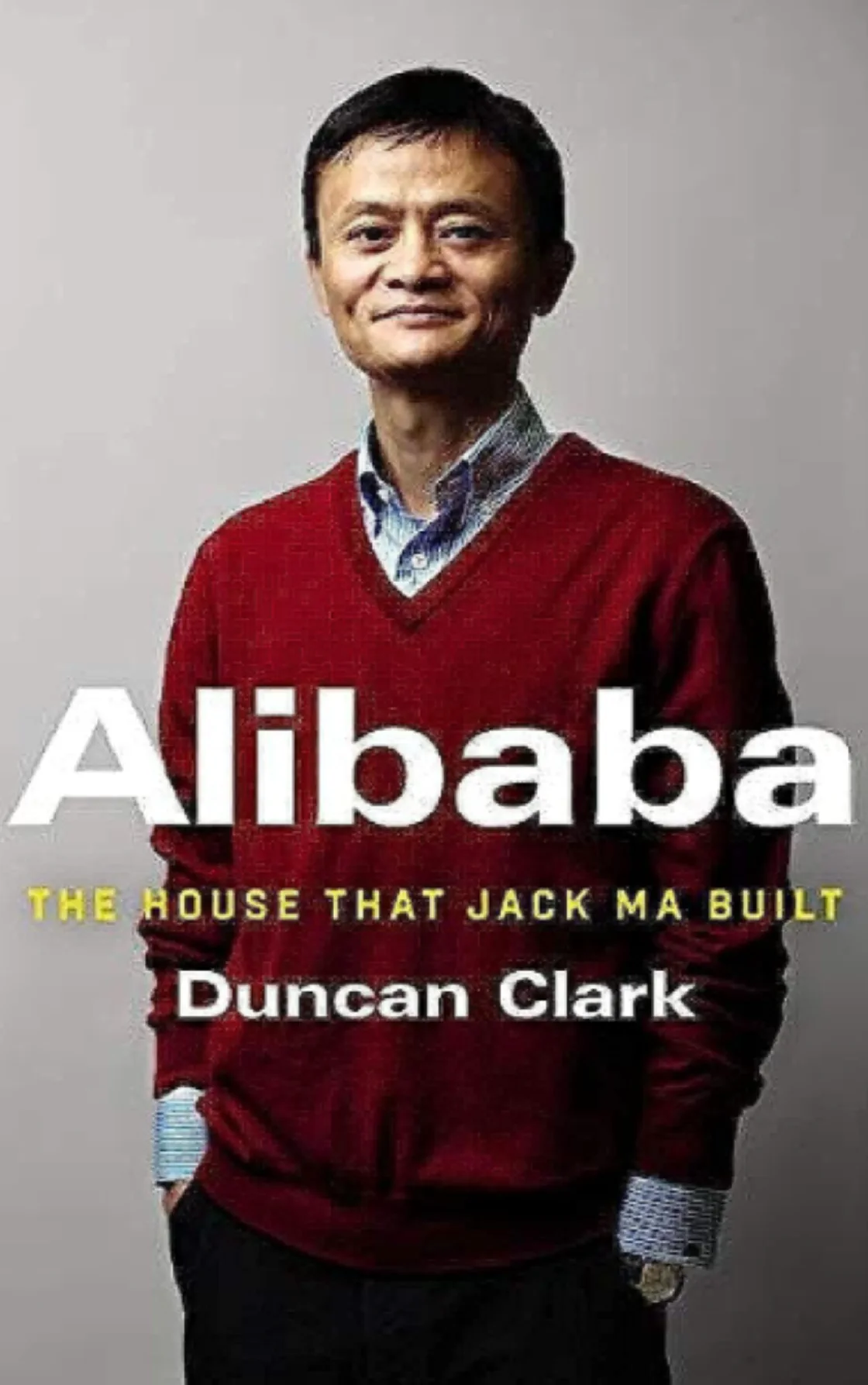
I first met Jack in the summer of 1999, a few months after he founded Alibaba in a small apartment in Hangzhou, some hundred miles southwest of Shanghai. On my first visit, I could count the number of cofounders by the toothbrushes jammed into mugs on a shelf in the bathroom. In addition to Jack, there included his wife, Cathy, and sixteen others. Jack and Cathy had wagered everything they owned on the company, including their home.
Eighteen toothbrushes tell you more about the early capital structure than a term sheet would. The founders slept where they worked. The largest shareholder had pledged the roof over his family. There was no outside money to burn and no line between the company’s risk and the household’s. Whatever Alibaba became later, it started from total exposure with almost no cushion.
Clark knew Jack from the apartment years, and the book reads like it. The affection shows. So does the access. The founder myth has been told many times, and I don’t think it is the reason to read this book. The nuts and bolts underneath it are: a marketplace that holds none of the goods it sells, and a company that by its own leader’s account survived because it lacked the things most startups believe they need.
Jack was born into a country where private business had nearly been erased. Clark notes that ninety percent of industrial production sat in state hands at the time. Everyone knows the arc of a man from that starting point building one of the largest private companies in the world. I found the habits and choices that kept the company alive through the years when its peers died more useful. Most of those choices look like weaknesses. They turned out to be the reason Alibaba was still standing when the market arrived.
What Did I Get Out of It
One Hundred Percent Made in China
Jack’s opening to the world came through a hotel lobby. China’s “open door” policy arrived in late 1978, when he was fourteen, and the tourists followed almost at once.
In 1978, only 728 foreign tourists visited Hangzhou. But the following year more than forty thousand came to the city. Jack relished any opportunity to practice his English. He started waking up before dawn and riding his bicycle for forty minutes to the Hangzhou Hotel to greet foreign tourists. As he recalled, “Every morning from five o’clock I would read English in front of the hotel. A lot of foreign visitors came from the USA, from Europe. I’d give them a free tour of West Lake, and they taught me English. For nine years! And I practiced my English every morning, no matter if it snowed or rained.”
Visitors went from a few hundred to tens of thousands in a single year, a rise of more than fifty times. Jack did not cause the flow. He put himself where the flow passed, at the door of the hotel foreigners used, and he stayed there for nine years. The policy change was open to every teenager in Hangzhou. The bicycle ride at five in the morning was not. I wrote about this distinction in Beyond Luck: How Positioning Shapes Our Lives and Careers: luck tends to land on whoever stands in the right spot often enough, and Jack stood in the right spot thousands of times before anything paid. The English he learned at that hotel door later set him apart from almost every other founder in China. He could pitch foreign investors without a translator. The return on a free tour of West Lake compounded for decades.
The second turn came in 1985, when a family he had met through those tours invited him to Australia.
It was the first time Jack had left China. He stayed for a month and returned a changed man. “Everything I’d learned in China was that China was the richest country in the world,” Jack later said. “When I arrived in Australia, I realized it was totally different. I started to think you have to use your own mind to judge, to think.”
What Jack lost in Australia was a baseline. He had measured his country against the only data he had been given, and the measure was wrong. A month of contrary evidence broke it. We see the same failure in organizations that benchmark only against themselves. A finance team that compares this year’s close to last year’s close will see improvement every time, because the reference point moved with them. They never learn that peers close in half the time. More analysis of the internal numbers rarely fixes that. One honest look at an outside reference does, the accounting equivalent of a month in Newcastle. Jack’s line about using your own mind to judge sounds like a slogan, but the mechanism behind it is specific. He could not judge until he had something to compare against.
A Marketplace That Owns Nothing
Clark draws the line against Amazon early. Taobao and Tmall carry no inventory. They serve as platforms for other merchants to sell their wares. The revenue model built on top of that choice is cleaner than I expected.
Attracted by the site’s huge user base, these “micro merchants” choose to set up their stalls on Taobao in part because it costs them nothing to do so. Alibaba charges them no fees. But Taobao makes money—a lot of it—from selling advertising space, helping promote those merchants who want to stand out from the crowd.
Taobao gives away the stall and sells the visibility. Free listing pulls in millions of small sellers. Millions of small sellers create a crowd so dense that nobody can be found in it without paying. The free tier manufactures demand for the paid one. Alibaba doesn’t need to price the stall because the crowd prices the advertising.
Read through a balance sheet, the absence of inventory changes almost everything below the revenue line. No stock to count, no obsolescence reserve to argue over at year end, no shrinkage, no warehouse leases tied to forecast volumes that never arrive. The working capital profile of a marketplace looks nothing like a retailer’s. Revenue looks different too. A retailer that owns its goods books the full sale price. A marketplace acting as an agent books only its cut. Put Alibaba and Amazon side by side on reported revenue and you compare two different things, which is why the Chinese platforms talked so much about gross merchandise volume. The headline number and the economic number pull apart, a gap I tried to work through in From Accounting to Economics. Anyone reading The Everything Store next to this book will find two companies that both sell to consumers online and share almost nothing in their cost structure.
Tmall adds a second tier.
Unlike Taobao, which is free for buyers and sellers, merchants pay commissions to Alibaba on the products they sell on Tmall, ranging from 3 to 6 percent depending on the category.
A take rate in the low single digits on someone else’s sale, with no goods on the books, is a thin slice of an enormous flow. The risk does not vanish with the inventory. The risk moves. A company that holds none of the goods also inspects none of them, so the control points shift from the loading dock to merchant onboarding and the payment flow. A retailer worries about stock it cannot sell. A marketplace worries about sellers it should never have admitted. Joe Tsai’s line, quoted in the book, that “the ecosystem has its own will to grow,” describes the upside of that structure. The same will to grow makes the ecosystem hard to police.
Surviving Without a Plan
Jack likes to say that his company’s success was an accident: “Alibaba might as well be known as ‘one thousand and one mistakes.’” In its early years, he gave three explanations as to why the company survived: “We didn’t have any money, we didn’t have any technology, and we didn’t have a plan.”
The line is good comedy and weak evidence. Plenty of Chinese internet start-ups in the late 1990s also had no money and no plan. They are not in books. A founder explaining survival after the fact is working from a sample of one, and the sample was selected because it survived. I spent a review on that trap in Fooled by Randomness, and the essay on Bob Dylan and survivorship bias circled the same ground from another side. As a causal explanation, Jack’s three reasons fall apart.
As a description of constraints, they hold up better. A company with no money cannot make a large, irreversible bet. A company with no plan has no sunk commitment to defend when the evidence turns. The thousand and one mistakes were affordable because each one was small. Poverty is not a strategy. But poverty capped the size of every error, and small errors do not compound into ruin.
Jack drew his model for planless action from fiction.
Jack found inspiration in Jin Yong’s legendary warrior Feng Qingyang. Feng was a teacher. His martial arts moves were never performed to any set plan.
Inside a company, the written plan often becomes the thing being managed. A budget built in October turns into a variance report by March, and the meeting is spent explaining the gap rather than asking whether the original assumptions still deserve respect. Feng fights the opposite way. He responds to what is in front of him. The danger is obvious: without a plan, nobody can tell drift from adaptation. Jack’s answer to that danger sits in the next idea, and the two need to be read together.
Nine Rabbits and the Day After Tomorrow
“If there are nine rabbits on the ground, if you want to catch one, just focus on one. Change your tactics if you need to, but don’t change the rabbit. . . . Get one first, put it in your pocket, and then catch the others.”
Here is the missing half of the planless warrior. Tactics flex. The target holds. Most organisations I have seen run it the other way around. Methods get locked into policy documents and process maps while the objective shifts every time a new leader arrives or a competitor announces something. The result looks busy and catches nothing. Jack’s rule separates the two layers: fix the rabbit, let the method move. I wrote about the discipline of picking one thing in The Power of Selective Focus, and the rabbit image states it more cleanly than I did. “Put it in your pocket” carries weight too. A half-caught rabbit counts for nothing. Finish one before chasing the next.
Then comes the line Clark says every Alibaba employee knows:
“Today is brutal, tomorrow is more brutal, but the day after tomorrow is beautiful. However, the majority of people will die tomorrow night.”
People quote the first half as encouragement. The second half carries the content. Jack isn’t promising that things improve. He is describing attrition: the payoff exists, and most participants will not be alive to collect it.
That framing changes what a founder should optimise for. If the beautiful day only rewards survivors, then the job tomorrow is to stay solvent, not to look impressive. Low cash burn and a founder whose own house was on the line point in the same direction. The “weaknesses” from the previous section start to look like the conditions for getting through tomorrow night. Investing works the same way. A strategy with a positive expected return is worthless to someone wiped out before the average shows up, a point I keep returning to in The Geometry of Ruin. When I look at a young company now, the runway matters more to me than the pitch.
The Chief Education Officer
Although he left the profession two decades ago, Jack has never really stopped being an educator. He used to joke that in his case CEO stood for “Chief Education Officer.”
Jack taught English before he founded anything, and Clark makes a reasonable case that he never changed jobs. He runs Alibaba the way a teacher runs a classroom, through slogans and repetition. The company codifies its values under the name of the Six Vein Spirit Sword, borrowed from Jin Yong, which describes not a weapon but the building of internal strength. “Customers first, employees second, shareholders third” gets drilled until every employee can recite it. Asked which person had most inspired him, Jack named Forrest Gump without hesitation. A teacher picks examples a room can hold on to, and Forrest Gump is the story of a simple man who keeps going.
The teacher’s instinct shows most clearly in how he hired.
When building up his team Jack preferred hiring people a notch or two below the top performers in their schools. The college elite, Jack explained, would easily get frustrated when they encountered the difficulties of the real world.
The logic is sharper than it first sounds. Top students have been rewarded for performing in structured environments with clear rules and fair grading. A startup in a Hangzhou apartment offers neither. Someone used to winning may read early chaos as proof they are in the wrong place, and leave. Someone a notch down has already learned to work without a guaranteed result. A teacher also knows that expectations shape performance. The Pygmalion effect works on employees as much as on students, and a team that knows the founder believes in it will stretch further than its credentials predict.
I am less comfortable with the other side of the policy. A founder who hires below the strongest available candidates rarely gets contradicted. Jack’s self-deprecation (“I might have a smart face but I’ve got very stupid brains”) disarms outsiders, but inside the company a teacher surrounded by students can stop being tested. Clark doesn’t push hard on that question. I wanted him to.
Opponents, Not Enemies
“If you can’t tolerate your opponents, you will be definitely beaten by your opponent. . . . If you treat your opponents as enemies, you have already lost at the beginning of the game. If you hang your opponent as a target, and practice throwing darts at him every day, you are only able to fight this one enemy, not others. Competition is the greatest joy. When you compete with others, and find that it brings you more and more agony, there must be something wrong with your competition strategy.”
The dartboard is the image to keep. Hatred narrows the field of view. A company fixated on one rival builds its roadmap as a response to that rival and misses the competitor arriving from the side. Clark contrasts Alibaba’s culture with Tencent’s, whose veterans focused on time to market, launching products they could perfect later, an approach known as “running with short steps.” A firm consumed by beating that style would end up copying it. The dartboard line reads like Jack’s warning against exactly that.
The second test in the quote is personal and harder to apply. If competing brings more agony over time, the strategy is wrong. Agony is information. I have watched investors hold a grudge against a stock that hurt them and buy more to prove a point, and I have done a version of the same thing. The position stops being an investment and becomes a dartboard. Sun Tzu’s preference for winning without fighting, which runs through Soldier of Fortune, sits close to Jack’s view. The strongest competitive position is the one where you don’t need the other side to lose.
“Masters of negotiation always listen, don’t talk. Those who talk a lot only have second-rate negotiation skills. A true master listens, and as soon as he moves his sword, you pretty much collapse.”
The best information in any inquiry arrives after the questioner stops talking. Anyone who has run a process walkthrough knows the moment. You ask how a reconciliation works, the controller explains the documented version, and then a pause opens. Leave the pause alone and the real version follows: the manual adjustment, the spreadsheet that lives on one person’s laptop. Fill the silence with your next question and you never hear it. Jack applied the principle to deal-making, but the mechanism travels across rooms. The person who talks most hands over the most information, and the person who listens decides when to move.
Who Is This For
Perhaps the most famous lesson of Jack the teacher is known by heart by every Alibaba employee: “Customers first, employees second, and shareholders third.” Jack describes this as Alibaba’s philosophy.
I respect a company that tells shareholders where they stand. Plenty of companies claim shareholders come first and then behave otherwise. Alibaba put its order in writing, and its investors bought knowing it. A ranking like that costs nothing in good years, when every group wins together. The ranking matters in the bad year, when someone has to absorb the loss, and anyone holding the stock should read the order with that year in mind.
Clark published the book in 2016. Four years later, the Ant Group IPO was halted days before listing and Jack largely disappeared from public life. Read now, the early chapters about a country where the state held ninety percent of industry stop feeling like background. A government opened the door in 1978, and a government can narrow it. Readers who found Apple in China useful will recognise the same dependency from the other direction: a private company whose fortunes rest on terms set by a state it cannot control.
Investors trying to understand platform economics will find the chapters on Taobao and Tmall repay the time on their own. Managers will find the material on hiring, and on fixed targets with flexible tactics, travels well beyond China. Anyone looking for a technical history of how Alibaba built its systems will be disappointed; Jack himself would be the first to say he can’t explain them. Readers who want a critical account of governance should look elsewhere too. Clark knew Jack from the toothbrush years, and the book is written by a friend.
We tend to discount leaders who cannot explain the technology their company runs on. Jack told an audience at Stanford in 2013 that he still didn’t understand coding, and he built one of the largest technology companies in the world anyway. He understood the small merchant, and he knew which rabbit to chase. We still want management to know how their business works. But I am no longer convinced that knowing how the code works is the part that matters.