 Mandelbrot
 The Accountant
He learned not to take them. Elephants hear well. One shot at a guinea hen carried through the trees, and the elephants were gone for the rest of the day. The small kill cost more than a cartridge. It cost the hunt.
Forty-six years later, writing about the stock market, Phelps made that lesson the spine of his book:
When looking for the biggest game, be not tempted to shoot at anything small. Elephants’ ears are very keen. Never after firing a single shot at a guinea hen, a colobus monkey, or an antelope did I see an elephant that day.
In a portfolio, the guinea hen is the quick gain. It is the trim after a good quarter, the sale that feels like discipline because it puts a realized number on the statement. None of these shots is wrong on its own terms. Each one is a meal. But each one also tells the elephants where you are.
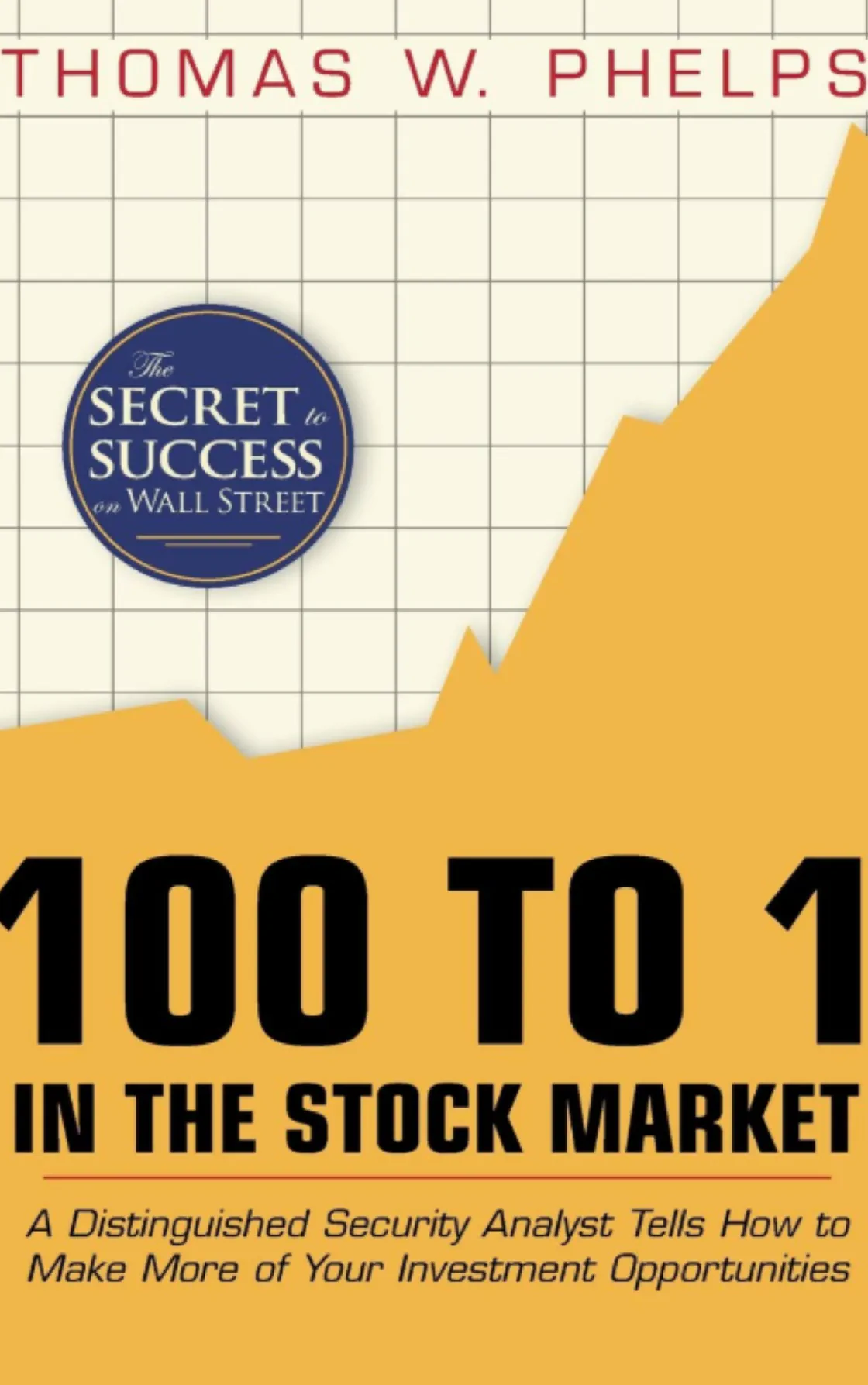
100 to 1 in the Stock Market came out in 1972. Its subject is in the title: stocks that returned a hundred times what an investor paid for them. Phelps spent most of the book asking what it would have taken to own one and keep owning it. His answer is unglamorous. The fortune did not come from trading well. It came from buying right and then doing very little for a very long time.
The idea sounds obvious until you count how much of the investment industry, and how much of my own instinct, is organized around firing at guinea hens.
What Did I Get Out of It
Every Sale Is a Confession
Phelps opens with a parable about five poor Arabs granted one wish each. The first asks for a donkey. The fourth asks to be king. The fifth asks to be Allah and wakes up naked on the sand, covered in sores. His moral is that people who ask little get little and people who ask too much get nothing. Then he adds that greed being what it is, most of us still ask for one donkey.
He treats the fifth Arab as a warning and the first as the common case. The first Arab never gets near the ruin that ended the fifth. His failure is quieter. He took what he was offered and stopped. Phelps sees the same failure in investors, and he puts it bluntly:
For the individual or institution really out to make a fortune in the stock market it can be argued that every sale is a confession of error. I write this fully realizing that to err is human. I do not mean to criticize anyone for making a few errors of the kind I have been making for forty-five years. But a problem well-defined is half solved.
This goes against how gains get recorded. A sale at a profit produces a realized gain. The gain lands in the accounts, gets taxed, and shows up in every summary of the year. Nothing in the record captures the compounding that stopped on the day of the sale. Opportunity cost has no ledger entry. The accounts are accurate and they still tell the wrong story, because they measure what happened and say nothing about what was given up.
Phelps is careful not to turn the idea into stubbornness. He says that refusing to admit a mistake is worse than making one, and that the faster an error is corrected the less it costs. His point is narrower. Even a correct sale is the cleanup after a bad purchase. And even a profitable sale deserves suspicion:
In a bull market correcting mistakes often means taking profits. But when we do so let us not kid ourselves we are making money. The truth is we are acknowledging missing vastly bigger opportunities, and incurring a capital gains tax liability to boot.
A position left alone compounds on money that would otherwise go to the tax authority, and the deferred liability works like an interest-free loan for as long as the holding stays open. Selling repays the loan and restarts the clock on a smaller base. Peter Lynch made the same argument in One Up on Wall Street with his image of pulling the flowers and watering the weeds. Phelps got there first and with a sharper word. He did not call the habit a mistake of technique. He called it a confession.
Shooting Where the Rabbit Was
The phrase recurs through the book, and Phelps admits he repeats it on purpose:
Time after time, year after year, men who would think you were crazy if you fired your gun at the spot from which a rabbit jumped a moment before, buy stocks that have advanced and sell stocks that have declined.
The hunter would never make that mistake in a field. The investor makes it every day, because a chart looks like information about the future and is only a record of where the rabbit used to be. Phelps has a second image for the same reflex. A fish bites an inedible spinner because the last moving thing it ate was good. The investor buys a rising stock because the last rising stock was good. Neither creature is reasoning about the object in front of it. Both are reasoning about motion. I wrote about the same pull in On Borrowed Conviction: momentum feels like evidence because other people’s buying feels like other people’s research.
The reverse case is harder to see, and Phelps uses the supermarket to show it:
The ability to foresee the future is rare, the ability to rationalize the present all too common. Hence when a stock we bought after careful investigation declines in price we often find it less attractive than before. That same housewife who buys three roasts of beef for her freezer because they are offered at a special low price will sell her Consolidated Doorknobs stock because it is trading at half what she paid for it.
The beef has not changed. The stock may not have changed either. Only the price has, and the buyer reads the price in opposite directions depending on the aisle. In the butcher’s case the lower price is a discount. In the brokerage account the lower price becomes a verdict on the original analysis. Kahneman’s work in Thinking, Fast and Slow explains the mechanism, but Phelps names the habit that matters more in practice. We rarely abandon a stock because we have new facts. We abandon it because a falling price makes the old facts feel embarrassing, and then we build a reason to match the feeling.
Earnings Are Not Earning Power
The passage is the one any accountant should recognize:
Earnings are simply reported profits no matter how obtained. As we have already seen, earnings may rise because of a sudden, non-recurring surge in demand, because of a price advance, because of a change in accounting practices, because of improvement in business generally which permits utilization of what previously was excess productive capacity. None of those reasons reflects earning power any more than the movement of a cork downstream attests its motive power.
The cork is the right image. A reported number can rise because the business got stronger, or because the current got faster. A change in a depreciation policy, a reserve released, a capacity utilization tailwind: each one moves earnings, and none tells you whether the business can swim. Close any set of accounts and the same question comes up. How much of the improvement belongs to the business, and how much belongs to the river? The gap between accounting and economics is where most of the analysis has to happen.
Phelps defines earning power as competitive strength: above-average returns on invested capital, above-average margins, above-average growth. He also separates return on invested capital from return on equity. When return on equity runs above return on invested capital, the company is earning more on its borrowed money than the borrowing costs. That gap can be real skill, or it can be leverage making an ordinary business look better than it is. The distinction carries straight into his warning about comparing valuation multiples across companies:
the fallacy of using price-earnings ratios for comparative purposes is the implied assumption that the earnings are as comparable as the prices. We know that the prices are comparable, so long as the quotations are expressed in the same currencies. But the earnings of different companies vary so much in quality and hence in value that we might as well be comparing cows and horses on the basis of how fast they can run.
Every screen that sorts stocks by price-earnings ratio assumes the denominator means the same thing in every row. It does not. One company’s earnings come from a durable franchise with low capital needs. Another’s come from a cyclical peak and a generous accounting choice. The prices sit in the same currency. The earnings sit in different species. A low multiple on low-quality earnings can be more expensive than a high multiple on earnings that will still be there in ten years.
Half the Move Is Psychology
Phelps breaks a stock’s return into two parts with arithmetic simple enough to forget:
the rise in the relative price of any stock must be derived from a rise in its relative earnings plus or minus any change in its relative multiplier or price-earnings ratio. That is simple arithmetic.
The Davis family built a fortune on the same equation, which they called the double play: buy growing earnings at a low multiple and collect when both the earnings and the multiple rise together. The Davis Dynasty describes the result. Phelps describes the part most investors skip. They model the earnings carefully and treat the multiple as fixed, as though the market’s willingness to pay for each unit of profit were a property of the stock and not a mood of the crowd. He corrects that directly:
Price-earnings ratios and relative price-earnings ratios measure investor expectations. Ofttimes more than half of the rise in the price of stock is due to a change in investor psychology.
If more than half of a stock’s rise can come from a change in how people feel about it, the multiple deserves at least as much attention as the earnings. Phelps goes further than I expected. He argues that buying in anticipation of a rising multiple is no less sound than buying in anticipation of rising earnings. He also insists there is no correct multiple, and that anyone buying at a very high one is paying cash now for something hoped for in the distant future.
He adds a practical observation about trends. The longer a trend runs, the more people will bet their savings that it continues. Old trends tend to outlast new ones, whether or not they deserve to, because more investors assume they will. The same crowd that sustains a trend also eventually kills the opportunity inside it. Phelps notes that nothing kills a money-making opportunity faster than its widespread popularity, and that this applies to growth stocks as surely as to Florida real estate. Humphrey Neill built a whole discipline out of that sentence in The Art of Contrary Thinking. Phelps compresses it further: by the time the need or the opportunity is clear, the profit potential is in the price.
Ask Who Is Talking
Phelps spent decades as a financial journalist before managing money, and he is suspicious of the trade he came from:
One of the most persistent illusions of the business of investing is that information is all you need to make money. Organizations that sell information foster that illusion. It is good for their business.
He adds that even complete and accurate information can mislead if it arrives late, and that a lemon flattened by a steamroller has more juice than news the market has already priced. The problem has grown since 1972. The volume of data available to an ordinary investor would have been unimaginable to Phelps, and the edge it provides has shrunk in proportion. More inputs do not produce better judgment. Beyond Intelligence covers what happens when the feed outruns the filter.
His alternative is to look past the information to its source:
Never forget that people whose self-interest is diametrically opposed to your own are trying to persuade you to act every day. Who is talking often means more than what is said. Try to identify people whose interests correspond with yours.
Every control framework rests on the same principle. The person who prepares a number should not be the person who approves it, and nobody should be trusted to report on their own performance without a second set of eyes. The reason is not that people lie. It is that incentives shape what they notice, what they emphasize, and what they leave out. A broker paid on commission is not wrong when he suggests a trade. He is talking from a position where every trade is good for him. Taleb’s Skin in the Game builds an entire ethic on that asymmetry.
Phelps pairs the incentive check with a check on reasoning. He tells the reader to ignore opinions and ask for the assumptions underneath them, because you can win any argument if you are permitted to make the assumptions. The best forecasting work I have read, including Superforecasting, lands in the same place. Nobody knows the future, so everyone is entitled to guess. An informed guess still beats a wild one, and you only learn which kind you are hearing by asking what it assumes.
Self-Deception Is Done to a Nice Guy
Phelps admits he spent years arguing that good timing plus good selection beats either one alone. By the time he wrote the book he had changed his mind:
But bear market smoke gets into one’s eyes and blinds him to buying opportunities if he is too intent on market timing. And the more successful one is at market timing, the greater the temptation to rely on it and thus miss the much greater opportunities in buying right and holding on.
The second sentence carries the weight. Success at timing does not just fail to compound. It trains the investor to rely on a skill that pays in small amounts, and that reliance crowds out the patience that pays in large ones. Phelps observes elsewhere that bull market highs form when higher prices look most convincing, and bear market lows form when lower prices look overwhelming to reasonable, well-informed people. Timing asks you to act against a consensus at the exact moment it feels most correct. Selection asks you to choose a business. Most people find the second far less emotional than the first.
The passage I return to most is about consistency:
But you must know yourself well enough to be sure you will not switch policies in mid-stream. Much profitless second-guessing, much shooting where the rabbit was, masquerades as adopting a new policy to meet changed conditions. Most deception is bad but self-deception is worse because it is done to such a nice guy.
Organizations change policy the same way. A control does not get abandoned in a meeting. It gets an exception, then a second one, and eventually someone writes a memo explaining that conditions have changed and the old rule no longer fits. Sometimes the memo is right. Often the memo is a rationalization dressed as adaptation, written after the decision was already made. Phelps’s test is uncomfortable because it points inward. Before calling a change of approach a response to new conditions, ask whether the conditions changed or only your nerve. He adds a line that sits underneath every investment that took too long to work: being right too soon is just as painful as being wrong. The investor who cannot tolerate that pain will find a policy reason to sell.
Who Is This For
The book is short, and parts of it have aged. The chapters on inflation and interest rates belong to the early 1970s, though Phelps’s claim that interest rates mirror inflation, and his story of Arnold Toynbee saying he knew of no currency that had gained value over the long term, still hold up. The tables of hundredfold stocks are a historical record more than a shopping list. Anyone looking for a method to find the next one will be disappointed. Phelps admits as much with a fable:
“I’ve given you the master plan,” the ant said. “It’s up to you to work out the details.” The master plan is to buy right and hold on. Some of us, left to work out the details for ourselves, may end up sleeping in the cold with the grasshopper.
That honesty is the book’s main value. Phelps does not pretend that buying right is easy, and he says he cannot decide which is harder, buying right or knowing enough to hold on. He gives the reader the destination and a set of hunting rules, and leaves the work where it belongs.
Traders will get little from it. So will readers who want a screen or a formula. Long-term investors who already own a few good businesses will get the most, especially those who find themselves trimming winners and calling the trims prudence. Anyone who works with financial statements will recognize the chapter on earnings quality, and anyone who has watched a rule erode one exception at a time will recognize the line about self-deception.
The book changed one thing in how I read my own record. I had treated a realized gain as a point scored. Phelps made me see it as a closed door, with the tax bill as the price of closing it. Some of those doors needed closing. Each sale was still a guinea hen, and I can only guess how many elephants heard the shot.