 Mandelbrot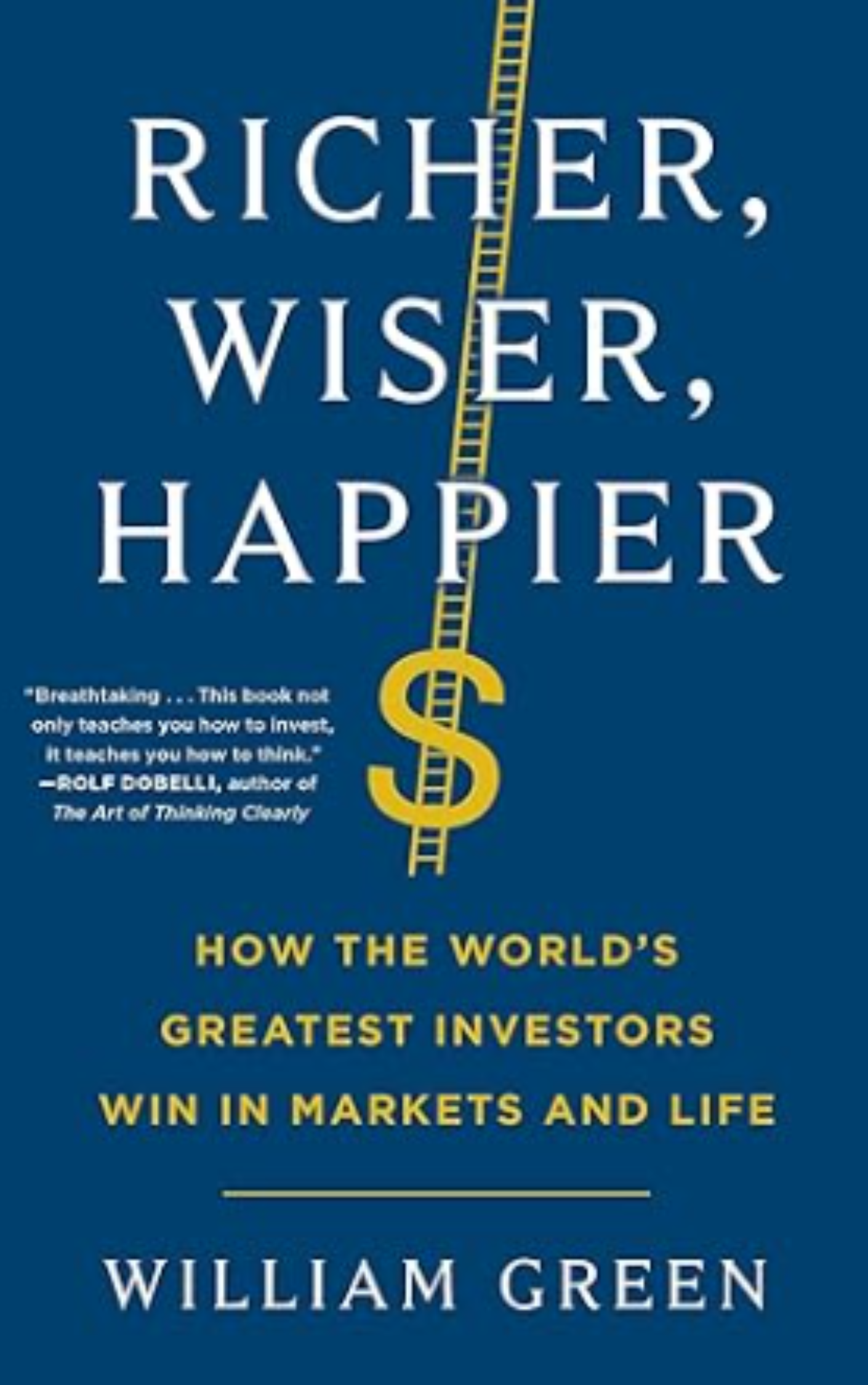
But Niko does not recommend filler. He had already pointed me toward half a dozen books that quietly rearranged how I think, so I bought this one expecting to disagree with him for the first time. Instead, I spent two weekends reading it cover to cover, and since then have been hooked onto William Green’s podcast.
The book is not a manual. There is no how to on getting richer or happier, but it will make you wiser. Green spent years interviewing the people who actually compounded capital over forty and fifty year stretches, and what he produces reads less like a strategy guide and more like a sequence of long, slow conversations with people who have already won and no longer feel any need to perform. The pattern that emerges is almost disappointing in its plainness. No proprietary formula. No private data feed. Just an unusual amount of self-knowledge, paired with a few principles applied for an absurd length of time. Underneath that, a deep allergy to whatever the crowd happens to be excited about.
One of Green’s subjects gives the warning sign cleanly:
If people can’t tell you how they do it, and you can’t understand what they do, that’s probably not the best spot to be in.
I underlined that line and sat with it. I have parked capital in places where I could not have, in writing, explained the underlying engine. The discomfort of that admission is part of why this book lingered.
What Did I Get Out of It
Subtraction as a Strategy
The dominant idea I took from Green’s interviews is that great investors are not adding more inputs to their decision process. They are removing inputs. Nick Sleep and Qais Zakaria spent their first years at Nomad working out what to ignore, and treated that exercise as more important than what to study. Sleep cites a William James line that I have since written into the front of my notebook:
The art of being wise is the art of knowing what to overlook.
I read that and immediately recognised the inverse pattern in my own work. Most of the bad analytical days I have had, the ones where I ended up confused or anchored to the wrong thing, started with the assumption that more inputs would produce a better answer. More data. More dashboards. More reconciliations. The reality is closer to what Sleep describes when he talks about the shelf life of information:
Sleep notes that information, like food, has a “sell-by” date. But some of it is especially perishable, while some has a long shelf life.
Once you start asking what survives the twelve-week test, half of what fills a research note disappears. The earnings beat, the analyst rating change, the macro headline that everyone was relitigating on Monday morning, none of it is durable. What survives are the inputs that describe how a business actually compounds over a decade: where customers come from, what the unit economics look like at scale, how management allocates capital when nobody is watching. The shift from collecting information to filtering it is the same shift that separates a control framework that works from one that drowns under its own evidence files. I keep relearning this in different forms, most recently through Essentialism.
The Scale-Economies-Shared Engine
The single richest chapter for me was the one on Sleep and Zakaria’s discovery of Costco. They spend years cycling through the standard value-investor playbook and eventually arrive at a business model that, once you see it, is hard to unsee. Sleep summarises the loop in one line:
Increased revenues begets scale savings begets lower costs begets lower prices begets increased revenues.
Reading that, I immediately understood why so many “moats” I had reviewed in financial diligence work were not moats at all. They were temporary cost positions held together by pricing power that the company refused to share with customers. The business looked profitable in any given quarter, but the structure was not self-reinforcing. The moment a competitor showed up willing to give margin back to the customer, the apparent moat collapsed. Costco, Amazon, GEICO, Walmart in its first decades all ran the same engine in different industries. The architecture is identical even though the products are not. I have written about this pattern from the founder angle in my notes on Sol Price and from the management angle in The Outsiders, but Green’s framing is the cleanest version I have come across.
The harder part, and the part Green presses on, is the temperament needed to operate the model from the inside. Bezos wrote it into the 2005 shareholder letter:
Relentlessly returning efficiency improvements and scale economies to customers in the form of lower prices creates a virtuous cycle that leads over the long term to a much larger dollar amount of free cash flow, and thereby to a much more valuable Amazon.com.
The bias against this kind of behaviour is enormous. Every quarterly cycle pulls management toward extracting margin now and rationalising it later. The Costco model only works if the people running it have an internal compass that refuses the short-term trade for years on end, often through periods of intense public criticism. Sleep’s observation that the founders of these businesses tend to be slightly fanatical, almost religious about deferred gratification, lines up with my own experience. The ones that compounded had founders who had to be talked into smaller dividends, not bigger ones.
Quality as the Operating Principle
I did not expect a book on investors to spend so much time on Robert Pirsig, but Green keeps returning to the idea that Sleep’s entire posture toward his work was shaped by Zen and the Art of Motorcycle Maintenance. Zakaria summarises the practical consequence in a way I keep thinking about:
The very rapid rejection of things made life very straightforward. It was all about quality. Money was secondary. It was much more about doing a good job, a quality job, doing the right thing.
What struck me here is not the moral content, which can sound saccharine when stripped of context, but the operational efficiency of using quality as the filter. If the only criterion is the quality of the decision, the quality of the relationship, the quality of the analysis, then most of the noise that consumes other investors simply does not arrive at your desk. You stop entertaining marginal ideas because they fail the threshold long before they reach a debate. Sleep and Zakaria turned away wealthy investors who they thought would erode the fund’s culture. They refused trades that would have been profitable but did not meet the standard. The decision cost of running their fund collapsed because the filter did the heavy lifting. I have written about a version of this in the architecture of quality before, but Green’s book sharpened it. Quality is not a virtue in this context; it is a labour-saving device.
Inversion and the Avoidance Reflex
Green dedicates a long passage to Charlie Munger, which I expected, and a quieter one to Jean-Marie Eveillard and Matthew McLennan, which I did not. Both chapters circle the same idea: most outperformance is the residue of avoided mistakes. Munger gives the cleanest formulation:
It’s counterintuitive that you go at the problem backward. If you try and be smart, it’s difficult. If you just go around and identify all of the disasters and say, “What caused that?” and try to avoid it, it turns out to be a very simple way to find opportunities and avoid troubles.
The operating logic behind every good control framework I have ever seen sits in those few sentences. You do not start by listing the things that should happen. You start by listing the failure modes and working backwards. Inversion is not a clever technique; it is the only honest way to design for the real world. I have written about this directly in Inversion, and the same pattern shows up across Poor Charlie’s Almanack.
What Eveillard adds, and what I had not seen put so plainly, is that the same logic dictates portfolio composition over decades:
To the extent that we’ve been successful over the decades, it’s due mostly to what we did not own. We owned no Japanese stocks in the late eighties. We owned no tech in the late nineties. And we didn’t own any financial stocks to speak of between 2000 and 2008.
The performance sits in the negative space. It is a deeply uncomfortable lesson because it cannot be sold as a strategy in a quarterly update. You cannot point to the chart of the bubble you avoided. Your investors only ever see the bubble you participated in, the trade that worked, the call you got right. The discipline of refusal does not appear on any performance attribution report. And yet, sitting back across the long arc of someone like Eveillard’s career, the refusals are the entire story.
The Patience That Almost No One Has
Mohnish Pabrai’s contribution to the book is mostly behavioural. He has spent years studying the mechanics of Buffett’s restraint, and the line he draws back is uncompromising:
The number one skill in investing is patience — extreme patience.
I have come to believe that patience is not really a skill, in the sense of something you can train through reps. It is closer to a structural condition. Either your life is set up so that you can wait, or it is not. Pabrai theorises that Buffett plays bridge online specifically to distract himself from his portfolio, which I found funny and then immediately useful. If even Buffett needs a deliberate behavioural circuit-breaker to keep his hands off the keyboard, then the rest of us are not going to white-knuckle our way to patience through willpower alone. We have to build the structure that makes patience the default. Howard Marks gives the version I keep coming back to:
Our performance doesn’t come from what we buy or sell. It comes from what we hold. So the main activity is holding, not buying and selling. I’ve always wondered if it wouldn’t enhance an organization to say, “We only trade on Thursdays.”
The Thursdays line lodged itself in my head. Most of the worst trades I have made were the consequence of being in front of a screen on a day when I should not have been. The gap between what my plan says and what I actually do narrows dramatically when the opportunity to act is removed by design. I have been experimenting with versions of this since reading the book, and it has had a larger effect on my behaviour than any framework I have tried to impose through discipline alone. The same idea sits inside The Most Important Thing, but Green’s framing has more teeth.
The Capacity to Suffer
The chapter on Thomas Russo introduces an idea that has changed how I look at companies under stress. Russo describes himself in one of the lines I now think about most:
I call myself a farmer. Wall Street is flooded with hunters, people who try to go out and find the big game. They fell it and bring it back, and there’s a huge feast and everything is fabulous, and then they look for the next big game. I plant seeds and then I spend all of my time cultivating them.
The farmer metaphor is doing a lot of work here. Russo is describing a temperament that consents to long stretches of apparent inactivity, where the visible output is zero but the structural compounding underneath is large. The corollary is what he calls a company’s capacity to suffer. The businesses he wants to own are the ones that can endure quarters or years of suppressed reported earnings because management is investing in something that will only show up in the financials a decade out. That is anathema to the way most public companies are scored. Wall Street rewards the absence of suffering, which means companies optimise themselves into a fragile shape that cannot bear any real adverse condition. I have seen this dynamic from the inside in companies whose reported numbers were beautiful and whose actual operating structure was held together by hope and short-dated assumptions, in the spirit of what I wrote about in Capital Returns and Balance Sheets Through Time.
Who Is This For
If you are looking for a book that will tell you which stock to buy or which model to build, you will be frustrated by Green. He does not provide one. The book contains no checklist that survives extraction from its surrounding context. The interviews are slow, the asides on philosophy are long, and the practical content has to be reconstructed by the reader from a series of personal portraits.
If you are early in your investing life and trying to compress the experience of the last fifty years of compounders into a single volume, this is the book I would put in your hands. It does what no textbook can do, which is show you what the inside of a serious investor’s head actually looks like over the long arc of a career. The texture is closer to Poor Charlie’s Almanack than to anything more technical.
If you work in any role where judgement matters more than execution, the book has more to offer than its title suggests. The principles that show up in every chapter, patience, subtraction, inversion, quality as a filter, are applicable to control design, audit planning, capital allocation reviews, and most other contexts where the cost of acting on noise is high.
The part I had not expected, and the part I am still digesting, is how much the book reframed my view of my own behaviour rather than my analytical method. I went in looking for tools. I came out with a longer list of things I was already doing that I no longer wanted to do, and a quieter sense that the gap between the people in this book and the rest of us is not really about intelligence or access. It is about a willingness to live for years in the structural conditions that make compounding possible, even when those conditions are uncomfortable and unfashionable. That is harder to copy than any spreadsheet.