 Mandelbrot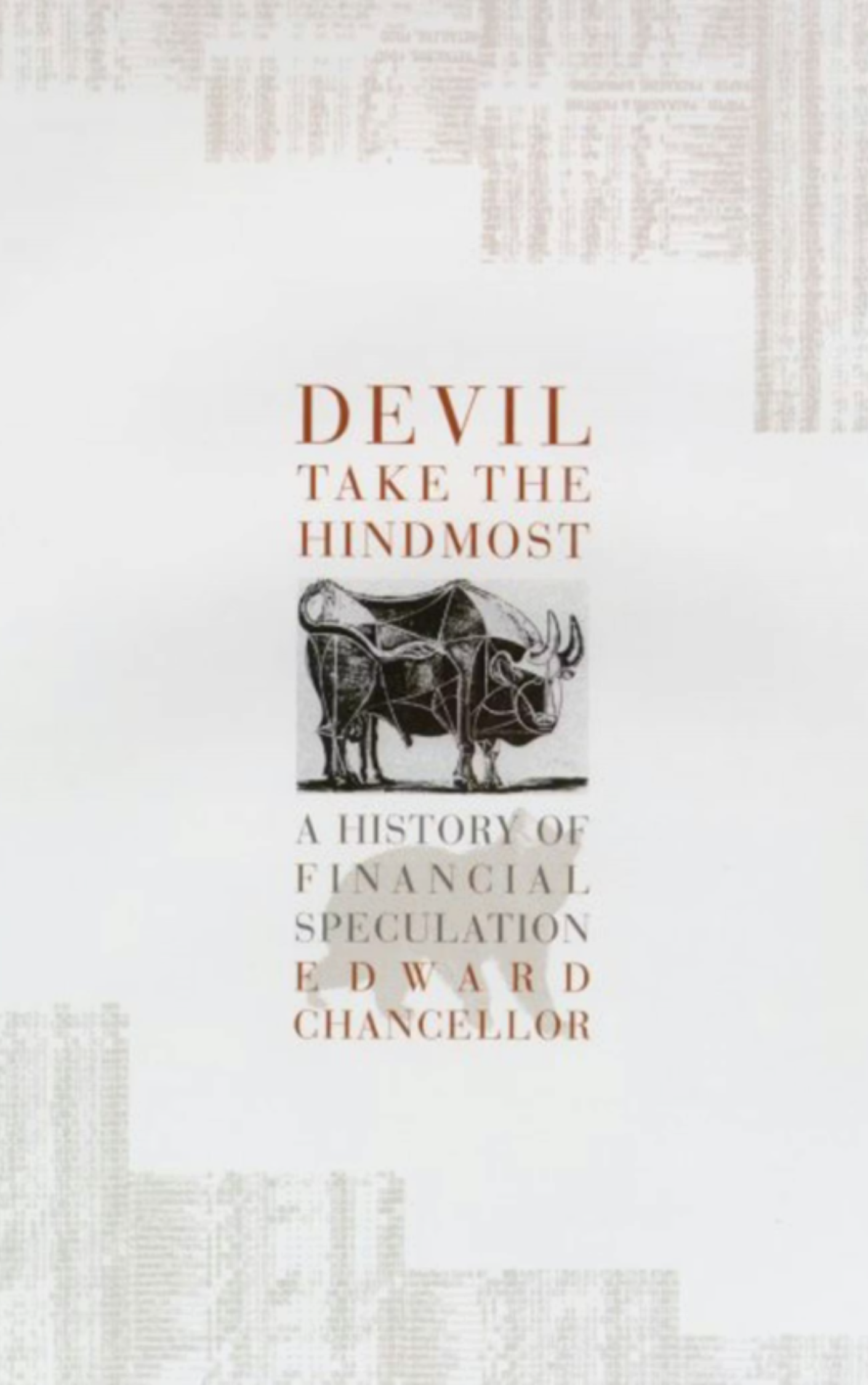
Chancellor describes Dutch speculators in 1636 entering into futures contracts for bulbs that did not yet exist, paid for with credit notes that could not be honoured, on the assumption that someone further down the chain would settle the difference. I had done a version of this. The instruments were glossier. The screen was prettier. The behaviour was identical.
That recognition was not the dramatic kind. It was duller and more uncomfortable. I had told myself I was investing in a new kind of network, a new kind of money, a new kind of system that the textbooks had not yet caught up to. The book quietly suggested that I had done what people with my exact set of incentives had been doing for four centuries. The people I had lost money to, or alongside, had also been there before, in different clothes, under different governments, holding different paper that meant nothing.
I read the book over several weeks. I have re-read sections of it more often than any other finance book on my shelf. What follows are the parts I keep returning to.
What Did I Get Out of It
The Line Between Investment and Speculation Is Drawn With a Pencil
Chancellor opens with definitions, and the definitions matter because most of us assume we already know which side of the line we are on.
Speculation is conventionally defined as an attempt to profit from changes in market price. Thus, forgoing current income for a prospective capital gain is deemed speculative
I sat with that for a while. By that definition, almost everything I have done in markets carries a speculative element. The pure income investor, the person buying a bond, holding it for yield, and ignoring the price screen, is rarer than I had assumed. The moment you allow capital appreciation to enter the thesis, you are on a spectrum.
the difference between a speculator and an investor can be defined by the presence or absence of the intention to ’trade
The intention to trade. That phrase has stayed with me. When I look back at my own history, the worst losses have not come from positions I bought intending to hold. They came from positions I bought telling myself I would hold while quietly tracking the price. The intention was contaminated from the start. The label was a costume.
This connects to something I keep circling in my own thinking about borrowed conviction. The label we give a position, whether “long-term hold” or “core allocation,” does not change what we will actually do when the price moves against us. The label is comfort. The intention is the real thing, and the intention is usually visible only in retrospect.
Credit Is the Siamese Twin
Chancellor’s central thesis, repeated across centuries, is that speculation does not happen on its own. It travels with a partner.
Credit was the Siamese twin of speculation; they were born at the same time and exhibited the same nature; inextricably linked, they could never be totally separated
Every mania in the book runs on borrowed money or borrowed promises. Tulip futures were settled with credit notes that did not represent actual cash. The South Sea Company issued loans against its own stock so investors could buy more of the same stock, a structure I tried to dissect in an earlier piece. Railway speculators signed up for shares they had no intention of paying for and sold the scrip at a premium. The 1920s investment trusts were leveraged on top of leverage. Junk bonds replaced equity with debt as a matter of doctrine. Japanese banks were allowed to count share holdings as capital, so credit creation itself became reflexive on stock prices.
The mechanism keeps reappearing because the underlying need is the same. To outbid the marginal buyer ahead of you, you have to commit more capital than you have. Credit fills the gap. The instrument changes. The function does not.
…investors leverage their gains using either financial derivatives or stock loans, credit becomes overextended, swindling and fraud proliferate, and the economy enters a period of financial distress which is the prelude to the onset of a crisis.
I now use this as a checklist when I look at any market environment. Where is the leverage hiding? Whose balance sheet is the inflated asset sitting on? When the marginal buyer stops, what unwinds first? These are the questions I ask before I ask whether the underlying story is true. The story does not collapse the market. The funding does. Reading Capital Returns afterward reinforced the same lesson from the supply side.
The Crowd Filters What It Does Not Want to See
The most uncomfortable section of the book, for me, was Chancellor’s treatment of crowd psychology and cognitive dissonance.
The intellectual inferiority of the crowd is a sign that people are filtering and manipulating new information to make it accord with their existing beliefs. Psychologists call this behaviour “cognitive dissonance.” Dissonant information, which contradicts the collective fantasy, is uncomfortable and people seek to avoid it.
I have done this. I can name the moments. There is a particular feeling of skimming an article that contradicts your position where your eyes move across the words but nothing lands. Some part of the brain has decided the information is not safe to absorb. You finish the article and feel reassured for reasons you cannot articulate. Kahneman’s framework gave me a name for the mechanism. Chancellor showed me the price tag attached to it.
According to Festinger, a group will maintain a state of cognitive dissonance until the pain exceeds the rewards. In stock market terms this might be seen as the moment when the fear of loss outweighs the greed for gain.
That last line is operational rather than philosophical. The crowd does not change its mind because new evidence has arrived. The crowd changes its mind because the pain has finally exceeded the reward. Waiting for “evidence” to shift the consensus is the wrong frame. The shift is emotional, and it is preceded by a series of small accommodations to bad news that the holder pretends are not bad. By the time the dissonance breaks, the price has already done most of the work of breaking it.
Manipulation Has a Shockingly Stable Playbook
What surprised me most across the centuries was how little the mechanics of manipulation had changed. Chancellor describes Gilded Age pool operators running the “partridge trick” and the “scoop game.” Read the description and you will recognise every pump-and-dump in the modern crypto market.
A pool operator would start by simulating weakness in a particular stock in order to shake out those holders on small margins and entice others to sell the stock short (this was known as the “partridge trick”). The pool even lent from its own stockholding to facilitate short sales. Disreputable brokers provided “wash sales,” which set misleading prices.
Wash sales and manufactured panics to clean out the weak hands before the real run. I read this section after my crypto losses and felt something close to relief, because the sense of having been outwitted by something genuinely new was replaced by the duller recognition that I had been outwitted by something extremely old.
All we have to do," claimed the fictional promoter in a contemporary novel “is to puff up shares to a premium, humbug the public into buying them, and then let the whole concern go to ruin
Three centuries before Telegram groups and X threads, the script was already written. The promoter inflates the price, distributes to retail, and walks away. The technology around the script has improved enormously. The script itself has not.
When the Rules Bend at the Worst Moment
What I did not expect from this book was how often I would mark passages about accounting. Chancellor is not writing about ledger entries. He keeps describing moments where the books bend to support the story instead of describing it.
George Hudson, the Railway King, joined the board of the Midland in 1842 and announced, “I will have no statistics on my railway.” He paid dividends out of capital. He let the share prices of his takeover targets rise on insider buying without protest from his shareholders. The dividends kept arriving, so the questions did not get asked.
Important changes were made to thrift accounting rules. They were permitted to sell off bad loans without taking an immediate charge against profits (this was called euphemistically “loss deferral”). On the other hand, anticipated earnings on real estate investments could be reported. Property development loans of up to 100 percent of appraised value were permitted. In short, virtually every rule in the book of prudent banking was either flouted or struck off
The S&L crisis sits in the same family as Hudson’s dividend trick and the Japanese banks counting share holdings as capital. The problem is never that the rules did not exist. The problem is that the rules were softened, exempted, deferred, or reinterpreted at the exact moment when their original purpose became most relevant. Buffett’s warning about alchemy, that a base business cannot be transformed into a golden one through tricks of accounting or capital structure, sits over this entire history like a quiet refrain.
I have spent years watching controls erode one approved exception at a time. Reading Chancellor was like watching the same erosion at the level of a national economy, decade after decade. Same incentive, same justifications, same eventual collapse. The pattern I described in The Library That Burned Twice is not a metaphor I invented. Chancellor catalogues it.
The Same Mania, Different Costumes
The book closes by linking the bubble economy of 1980s Japan to the American Gilded Age and to the financial architecture of 1720. Chancellor’s recurring point is that the surface details mislead.
It is often said that speculation never changes because human nature remains the same. “Avarice, or desire of gain, is a universal passion which operates at all times, in all places, and upon all persons,” wrote David Hume in the eighteenth century. To this we might add that the fear of loss, emulation of one’s neighbour, the credulity of the crowd, and the psychology of gambling are equally universal.
Munger said something similar, that envy more than greed is what drives bubbles. I believe this from experience. I did not buy crypto because I wanted to be rich in the abstract. I bought because people I knew were generating wealth I was not, and the gap between their position and mine was painful enough to overcome whatever caution I started with.
where wealth is the ultimate determinant of status, there lingers a constant fear of being left behind materially. We may say that the guiding principle of American society is not to grow richer in absolute terms, but to avoid becoming poorer in relative terms.
The fear of being left behind is the engine. The proverb in the title, devil take the hindmost, names it directly. Markets do not select for prudence in the short run. They select for participation. The prudent investor underperforms during the boom, looks foolish, capitulates near the top, and gets the worst of both worlds. Knowing this in advance does not make me immune. It only makes me slightly less surprised when I notice myself doing it.
Who Is This For
Chancellor does not summarise. He layers. The first chapters are dense with seventeenth-century context that pays off only in the second half, when you start seeing the same architecture repeated in modern dress. If you want a clean framework, read Galbraith’s short book instead. Galbraith gives you the diagnosis in a hundred pages. Chancellor gives you the case studies that make the diagnosis impossible to dismiss.
If you have lost money in a speculative environment and are still trying to understand why, not at the level of “the market turned” but at the level of the specific incentives that walked you into the position, this book is one of the most useful things I have read. It will not console you. It replaces the feeling of being uniquely foolish with the duller feeling of being unoriginally foolish, which turns out to be more useful.
If you build or audit financial systems, the book is worth reading for the manipulation playbook alone. The patterns Chancellor catalogues, manufactured scarcity and wash trading and dividends paid out of capital, are not historical artefacts. They are the same patterns we still write controls against, in slightly different clothing. The accounting carve-outs that enabled the S&L crisis would feel familiar to anyone who has sat through a quarter-end exception meeting.
If you are looking for prediction, the book will frustrate you. Chancellor does not tell you when the next mania will arrive or how to time the next exit. He is making a different argument. The mania is not a discrete event you can dodge with the right indicator. It is a recurring expression of unchanged human wiring under changed market conditions. The skill is not in predicting the next cycle. It is in recognising which one you are already inside.
What this book changed in my own thinking is small but durable. I no longer ask whether the current environment is a bubble. I ask which historical bubble it most resembles, and how that one ended. I no longer ask whether I am being prudent. I ask which version of myself is sitting at the keyboard, the one who studied the patterns or the one who is afraid of being the hindmost. The answer is not always the one I want.